prohibited by Gaddafi (and by the current governments)
Night Clubs:
prohibited by Gaddafi (and by the current governments)
Background
Libya is located in North Africa, with 1,770km of coastline
along the Mediterranean White Sea.
It is bordered by Egypt from the east, Algeria and Tunisia from the west, and
Chad, Niger and Sudan from the south.
The name of the country "Libya" was changed by the GNC on the 8th of January
2013 to دولة ليبيا ('The State of Libya').
The current situation of
the country (as of 2016) is "stateless".
The chaos and instability that resulted from the UN-authorised bombing campaign
of 2011 had flung the country back to the stone age.
Libya in prehistoric times was inhabited by the Berbers ('Imazighen') –
the indigenous people of North Africa including most of Ancient Egypt. Many
of the Ancient Egyptian gods and goddesses were Berber in
origin (see our History page
for more information about the Berber-Egyptian period).
According to Herodotus,
the ancient Libyans were the first to know civilisation, and no one knew of
Poseidon and Athena before them. Among the things invented by the ancient Libyans
are the wheel, the chariot, and the banking system (the Berber fortified
granaries of today).
The advancements made by the ancient Libyans in
the fields of art, science, mythology and in many other aspects of human
culture require decades of work to catalogue.
In later times the Libyans comprised two major groups: the agricultural population
of the coastal regions, and the shepherds or the nomads, of which Numidae is
the Latin form.
The Numidae of the Second Punic War were essentially the Berber
tribes of the Masaesyli and the Massyli, the subjects of the Berber kings Syphax
and Masinissa respectively.
The Numidian kingdom of Masinissa eventually included
all of Tripolitania. In the 7th century Libya was invaded by the Arabs, who,
with the later help of European colonial intruders, ended up dividing North
Africa into Arab countries such as Egypt, Libya, Tunisia, Algeria and Morocco.
The term "Arab" was introduced into Libya's official name for the first time
in history by Gaddafi when he renamed the Kingdom of Libya "The
Libyan Arab Republic" in 1969.
Berber Rebu in hieroglyphics
The Origin of The Name Libya
The Etymology of The Name Libya
There are several theories attempting
to explain the origin of the name, but it is almost certain that it comes from
the ancient Berber tribe known to the ancient Egyptians as Rebu or Ribu;
from which the Greeks derived
"Libya", and which the Arabs of today's Egypt know as Lubia,
whence Lubians, in line with their relatives and neighbours the Nubians.
The name "Libia", as found in the archaeological site of Qaser
Libia, in Cyrenaica, is widely thought to have been derived from the ancient
village of Olbia. Some sources also derive the
names "Libya" and "Lubda" (Leptis
Magna) from Lewwa, one of the Berber ancestors given
by Ibn Khaldun. However, the Greek form Leptis itself was derived from the
Berber and Punic Libqi, which
Bates linked to the Berber Ribu.
According to the Berber
Leo Africanus (1600, p.13), it was called "Libya" by the Greeks,
"Because it was in old time conquered by Libs the king of Mauritania.
In the holie scriptures it is called Chamesis, by the Arabians and Ethiopians
Alkebulam, and by the Indians Besecath.”
In the Bible the Libyans appeared as the Lubim, the Lehabim of the
Old Testament (after the Hebrews decided to add the letter 'h' to several
names, like Abram becoming Abraham, and Sara ending up as Sarah), the son
of Mizraim, which
Oric Bates was the first to identify
with the modern variant Ta-Mazight – an appellation
widely applied to the proud Berbers of North Africa.
The proposed etymology of 'Libya' being moisture has no support
other than the "Libyan
wind" which brought rain to Greek mainland; and as it is obvious
that Greek Libu is the same as Egyptian Ribu (following the universal
linguistic rule of L = R) one does not need to propose a Greek etymology for
a name that is not Greek.
The proper etymology must be sought in the mother language
of the given word - the ancient Libyan language:
Tamazight (else known as 'Berber'). Egyptian and Berber languages
are both members of the Hamitic branch of the Hamito-Samitic linguistic family,
and many of the ancient Egyptian and Berber mythical gods and goddesses are
still represented on the rock art of the great Mother Sahara, in what is known
as the largest collection of prehistoric
art in the world – well over one hundred thousand rock art sites.
Ancient Libyans, as pictured by the ancient
Egyptians.
The Mythology of The Name Libya
Libya was also the name of the Goddess known to the Greeks
as the Goddess Libya, and also of the whole continent before the Romans
named it Africa after the Berber Goddess Afri. Her name also appeared as
Libica in Michelangelo's
Sistine Chapel. In mythology, the "Goddess
Libya" had three sons by the Libyan Sea-God Poseidon: Belus, Agenor
and Lelex. King Belus ruled at Chemmis or Chamesis of
Leo Africanus, Agenor migrated to Cana'an (the Middle East), and
Lelex became king of Megara. The wife of Belus Anchinoe, daughter
of the Nile-god Nilus, bore him three sons: Aegyptus, Danaus and Cepheus,
and one daughter: Lamia, the Libyan Snake-goddess. The myth relates an
interesting "deception tale" in
which Danaus was sent to rule Libya where he had fifty daughters, and Aegyptus,
who had fifty sons, ruled over Egypt.
Libyan stamp showing the Goddess Libya.
The Politics of The Name of Libya
The following map shows how the country looked like during the colonial
periods. A look at the map of Egypt (bordered red) shows traces of the ancient
Libya, as in the "Libyan Desert", the site of the Libyan
Desert Glass, and the "Libyan Plateau". Not much was left
of Libya then; just an Italian-occupied
regency called TRIPOLI. Note how Cyrenaica
was made part of British-Egypt before the Italian takeover.
Map of Libya &
North Africa in 1914, showing The Country Tripoli (in green).
From: Harmsworth's Atlas of The World And Pictorial Gazetteer
With An Atlas of
The Great War,
Edited by J. A. Hammerton, The Amalgamated Press, LTD., London, pp. 284-285.
In 1912 the Ottoman Turks surrendered control of Tripoli to Italy in accordance
with the Treaty of Lausanne. In 1918 the Tripolitanian Republic was created to
become the first ever republic in North Africa & the Middle East; only to
be destroyed by the Italians a few years later. Following the Benyadem
Peace Accord the constitution
(known as The Primary Law) was created for the republic on May 1919, and an
8-member government was appointed for the Republic. Unfortunately the Tripolitanian Republic never gained the full support in the 1919 Paris Peace Conference
and subsequently disappeared from the pages of history.
1920s Italian Tripoli, from:
"Imperial Military Geography", by D. H. Cole, London,
1928, p. 78.
This map shows how Tripoli was enlarged by the colonial powers in 1919 to
arrive at the current map of Libya: the area between the dotted lines
and the actual borders (on the
left) was given to Italy by France in accordance with the secret
treaty of London;
while the area between the dotted [red] lines and the actual borders
(on the right) was given to Italy by Britain; with some sources saying the British
attempt to add Cyrenaica (Barqa) to their Egyptian colony was blocked by
the Italians who quickly formulated "Libya" to include Cyrenaica.
Also, note how the borders with Sudan
were before 1935, when Italy received the
"Aouzou Strip" as a result of the Mussolini-Laval
agreement. The Libyans fiercely resisted the Italian
takeover (from the Turks) and continued to fight the Italians until
1931, when the fascists hanged the leader of the resistance Omar Almukhtar,
in humiliation before his conquered people. Unfortunately foreign powers
continue to interfere in other sovereign states with unfortunate consequences
being effected in the name of "independence", "democracy"
and now "mistakes".
(Image from the
Chronicle of the 20th Century, Longman, 1988, p.159).
As part
of a larger map of Africa under the year 1911.
The Longman's Chronicle stated
that in the last 40 years (prior to 1911) "Africa
became the cockpit for colonial rivalries; in one generation the map of a continent
has been redrawn with new boundaries, new names and new masters". Libya
at the time was disputed between Italy and Turkey.
The actual name "LIBYA" as a state (or a country)
came into effect for the first time around 1934 when the provinces of Tripolitania
and Cyrenaica were united during the Italian occupation; initially Fezzan
was not included. In 1943 Italian Tripoli came under the control of the Allied
forces: the British took Tripolitania and Cyrenaica (the British Military Administration
of Libya), while France took Fezzan (the Military Territory of Fezzan-Ghadames);
and hence Britain suggested dividing the country into the previous
three regions (Cyrenaica, Tripolitania and Fezzan) with no success.
In 1949 the
United Nations decided to create an independent country which they called Libya.
This was the first government in history installed by the UN. Ironically in
2015 the UN also imposed the Presidency Council on the Libyan people four years
after it authorised the bombing of Libya back to square one.
Shortly after the UN takeover of Libya King Idris was installed and Libya
was granted (fake) independence when all the three provinces
were united into one country (namely Libya) on the 24th of December 1951, and
thereafter Libya became known as "The United
Kingdom of Libya".
Shortly after the installation of Colonel Gaddafi in 1969, Libya was renamed "The
Libyan Arab Republic", before it became
known as the "Great Socialist People’s
Libyan Arab Jamahiriya", where the last word became synonymous
with "Libya".
Many Libyans felt the introduction of the term "Arab" by
the government into the name of Libya did not fully represent
the population of Libya – a country that was originally inhabited
by the Berbers ('Imazighen')
and still is inhabited by the Berbers in various parts of the country including
most of Nafousa Mountain, Zuwarah, Ghadames, Jalo, Awjlah, and most of the
Sahara – the home of the Berber Tuareg confederacies.
The Current Official Name of Libya
However, the name "Libya" was
back as the official name of the country after the UN removed Gaddafi from
power in 2011 (via its 7-month bombing campaign that ended in Gaddafi's grotesque
murder) and "subsequently" installed
the Qaida-infiltrated National Transitional Council (NTC); only to be changed
once more on the 8th of January 2013 by the GNC to
دولة ليبيا (meaning "the State of Libya"). This
name however is not final and will remain in use until the final name is
decided by the forthcoming constitution. No one knows why the word "state" was
added to the official name – maybe to distinguish it from the "Goddess
Libya"!
Libyan passport showing the official name of Libya: "The
State of Libya".
The passport also shows the national emblem to be the star and the crescent.
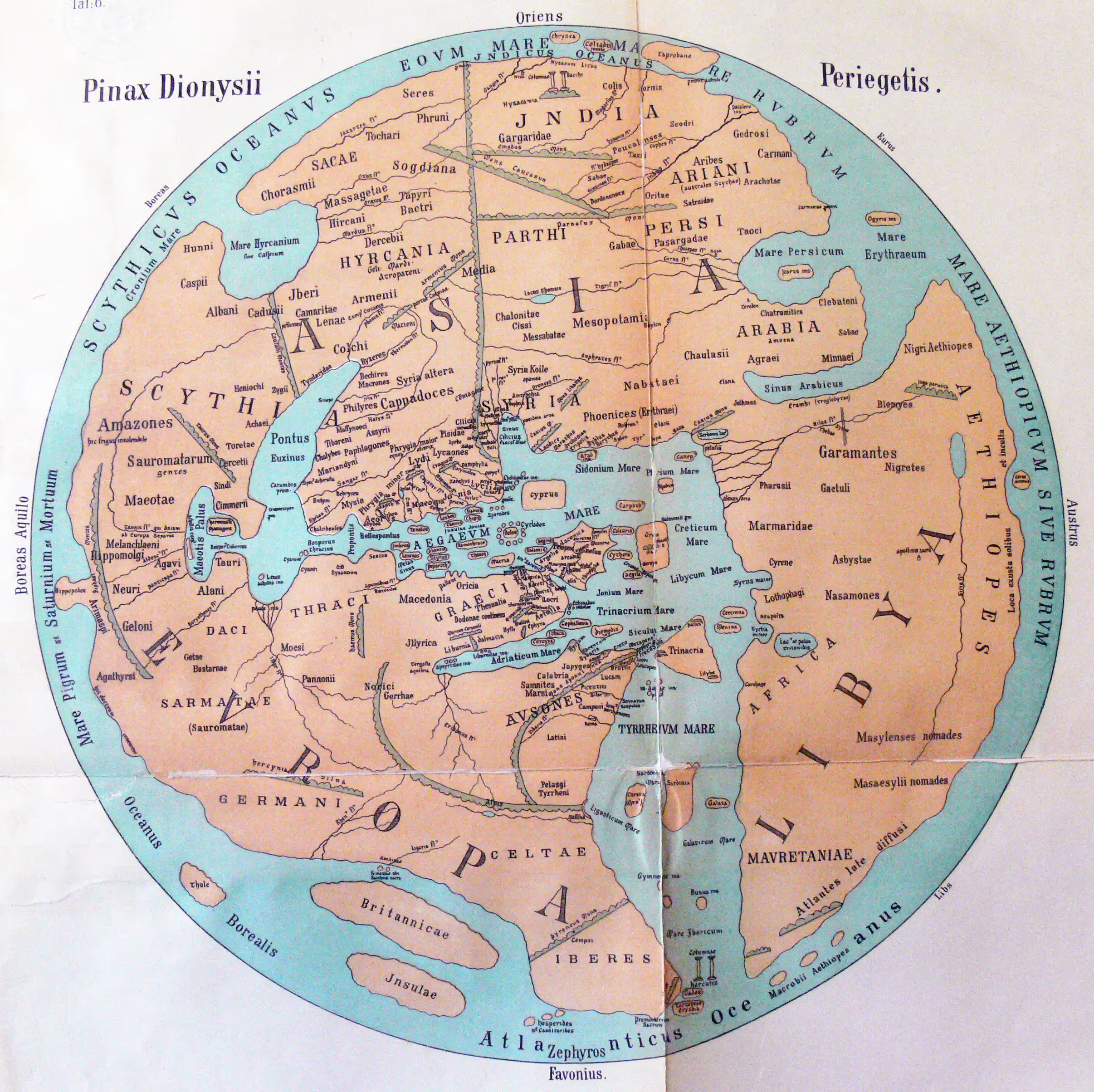
Part of the map of Ancient Libya, showing the locations of the native Berber
tribes of Ancient Egypt.
The above ancient map, which is over 2000 years
older than the colonial map, shows there was no Egypt, just a huge expanse of
land known to classical geographers and historians as Libya, extending
from the Nile to the Atlantic Ocean, to the extent that the name Libya also came
to designate the whole continent of Africa. Most classical geographers define Egypt as the stretch of land along the Nile: the border between Asia and Libya ('Africa'). When the Romans arrived
through the western gates (Tripolitania and Tunisia), they adopted the
name Aprica or
Africa, originally from the Berber name of the troglodyte Berbers
who inhabited the region, as in Yefren today, and thereafter
Libya became known as Africa. This means that the names
"Libya" and "Africa"
are both Berber in origin.
Africa is called "Libya", inhabited by various Berber tribes, and southern Africa is marked as Aethiopes (Ethiopia). Note that the Berber Garamantes were located immediately west of the Nile, which connects the ancient Temehu tribes with the speakers of Temahuq, the Berber Tuareg of the later Garamantes of Fezzan, central Libya. Also note the two Pillars of Hercules between Berber Atalents and Europa's Iberia.
Brief History of Libya
Generally speaking there are two kinds of history: the popular
history written by the invaders, and the suppressed history preserved by the
natives. For example, most Arab historians in writing Libya's history fail
to mention the Berbers. Instead they use the phrase "ancient Libyans" or,
like Gaddafi had said, "the original Arabs". Therefore according
to Mr. Bazama: "we write history on the basis
of Libya being part of the Arab world” (History of Libya, p. 95). Even
after the so-called February Uprising the situation has not changed – the same
history is being propagated, replacing one tyranny with another. Likewise,
most western sources fell into the habit of starting Libyan history with
the recent
Roman invasions, with the occasional exception of mentioning the Phoenicians.
North Africa was originally inhabited by an indigenous group
of
Berber tribes whose linguistic unity proves that an ethnic sub-stratum of "autochthons" single
race existed in North Africa from the Mediterranean to the Sudan and from the
Atlantic to the Red Sea. This ethnicity possibly goes back at least 100,000 years,
to the Cave of Haua Fteah' in
eastern Libya – the largest cave in the Mediterranean basin, providing continuous
archaeological record from 100,000 years to the present. Recent research suggests
the cave was inhabited 200,000 years ago [33].
According to C.B.M
McBurney (Libya in History, p. 7), 90,000 years ago Eastern Libya was occupied
by an exceptionally inventive and the most advanced group of Paleolithic hunters
so far known to have existed at the time. Then around 40,000 years ago Libya
was occupied by the large-brained Cro-Magnon – the direct ancestors
of the Berbers and the Iberians.
Cultural evidence from southern Libya, particularly
from Fezzan, the later home of the classical Berber Garamantes Kingdom,
goes back to more than 30,000 years. The Berbers (including the Garaments)
spoke a Hamitic language which together with ancient Egyptian,
Chadic, Ethiopian, Semitic and Omotic make up the Afro-Asiatic family of languages.
This language family is at least 20,000 years old, with some linguists pushing
this date farther back in time (pending future research).
Around 12,000 years ago heavy rainfalls
slowly turned the Sahara to lush-green land once more, and consequently a number
of civilisations flourished in the area, leaving behind rich representations
of what life once was, as preserved by the breathtaking treasures of the Sahara's
prehistoric drawings and engravings. For more please see our history page.
The Phoenician Arrival
The Phoenicians arrived
in North Africa in the 1st millennium BC and established trade relations with
their relatives the Berbers. Carthage was founded around 814BC to become
one of the most prosperous cities of the entire Mediterranean, until it was
destroyed first by the Romans then by the Arabs.
The Greek Invasions
The Greek invasions began in the seventh century BC in Cyrenaica,
where they established 5 colonies known
as the Pentapolis: the five cities of Cyrene, Apollonia, Ptolemais, Taucheira
and Berenice (Benghazi). Evidence indicates that some of these settlements
had indeed existed before the Greek invasion. Apparently
the city of Cyrene was invaded upon the oracular advise of Apollo
at Delphi by the Greeks of Thera (modern Santorini), and thus (like others)
their intrusion was portrayed as a divine mission, rather than a military
conquest.
The Roman Invasions
The Romans invaded North-West Africa near
the end of the 3rd century BC. They landed along the coasts of western Libya
and Tunisia, the Berber troglodyte area from which the Romans renamed the continent "Libya" Aprica ('Africa'),
after the name of the local Berber tribes, as in
today's Yefren (in Nafousa Mountain). After the Punic Wars Carthage
was finally reduced to rubble and razed to the ground in 146 BC. Shortly after
the battle of Zama the Berber kingdoms began
to suffer the impact of the Roman invasions, and by 46 BC, Julius Caesar deposed
the final Numidian king, Juba I, and thereafter Tripolitania was incorporated
into the province of Africa Proconsularis, to begin the export of
goods, animals and slaves to Rome. By the end of the first century AD Rome
had completed the pacification of Sirtica and Cyrenaica was handed over to
them by the Greeks. Under the influence of the Libyan-Berber-Roman emperor
Septimius Severus Libya enjoyed a massive development as witnessed by the spectacular
architectural development of Leptis
Magna, Tripoli and Sabratha.
The Vandals Invasions
The Germanic Vandals invaded North Africa in 429 AD under the command of
Genseric. In 432 they seized Hippo Regius and made it their first capital
in North Africa.
The Berbers, having been already exhausted by centuries
of wars against the earlier invaders, have defeated the Vandals on a number
of occasions including two major defeats between 496 and 530. After the succession
of Hilderic (523–530) the army was left to Hoamer, who was defeated by the
Berbers; leading to an internal revolt among the royal Vandals that ended up
with Hilderic, Hoamer and their relatives being imprisoned; before the end
of the Vandals Kingdom at the hands of the Byzantine Belisarius in 534.
The Arab Invasions
Then Arab invasions of North Africa began around 642 AD. Contrary
to popular belief the Berbers' resistance to the Arab invasions was long and
fierce. Like the Arab war generals themselves had said (in their wars against
the Berber priestess-queen Kahina): whenever a Berber tribe is slaughtered,
another emerged from the mirage like the jinn of the desert. Then the Caliph
sent Uqba Bin Nafi, who moved towards Fezzan in 663 and took Germa, the capital
of the Garamantian Kingdom in the south of Libya, before moving on the
province of Africa (Western
Libya including today's Tunisia) in 670 AD, where he established another military
base at Al Qayrawan. From this base he began to plan his attack on Byzantine
Carthage (or what had remained of Carthage), which he finally took in 693 AD.
Shortly after their arrival in Morocco the Muslims, under the command of the
Berber general Tarek Ben Zeyyad, crossed the sea and moved on to Spain. In
short, after nearly three centuries of wars (on and off) with the
Arabs the Berbers succeeded in maintaining some form of independence from the
sultans of the Middle East; leading to the Berber dynasties to remain very
powerful down to the 16th century; after which they began to decline. Combined
with the invasions of the Turkish pashas, and subsequently the disastrous European
invasions, the official Arabisation of the various Berber confederacies began
to take visible shape. All today's borders separating the Berbers' homeland
into various Arab countries were drawn and imposed by the European invaders
at the beginning of the 20th century.
The Turkish Invasions
The Ottoman pashas invaded Libya in 1516, before they occupied
Algeria in 1555 and Tunisia in 1574. In 1551 the Arab-Muslims took Tripoli
again. Corruption soon followed, piracy thrived, and the trade in human slaves
began to peak. It was not until 1714 that Tripolitania began to establish
complete independence from the pompous Ottoman pashas. in 1811 Tripoli took
Fezzan and gained control over the Tripoli-Bornu route. Unfortunately the Ottomans
re-established control over Tripoli in 1832 and continued to dominate
Libya until their confrontation with European colonialists at the turn
of the 20th century.
Modern European Invasions
In September 1911 Italy accused Turkey of
arming tribesmen in Libya and soon afterwards declared war against the Ottoman
pashas and captured Tripoli in October the 3rd, before it occupied Cyrenaica's
Tobruk and Benghazi. After the hopeless Lausanne Agreement of the 18th of October
1912, without consultation with the Libyan people, of course, Turkey signed
a deal with Italy, "granting" independence
to Libya; only for the Italians to return with vengeance to capture Tripolitania,
take Misrata, ransack Benghazi, and humiliatingly hang the symbol of resistance
Omar al-Mukhtar on the 16th of September 1931 – 9 years after Emir Idris Sanusi
fled to Egypt. Prison camps were set up for those who refused to give up the
fight, where the Barayka Camp alone imprisoned 80,000 Libyan freedom-fighters,
30,000 of whom died within two years of capture.
During the wars that followed the 1911 Italian takeover, Libya was the stage
on which a number of crucial battles were orchestrated for the control of the
Suez Canal, as it was also the home of the longest ever siege in Allied military
history, the bloodiest and most brutal African confrontation in "colonial
history",
and "the longest resistance to European colonialism" in
history.
During the "Libya
Wars" more than 100,000 Libyans disappeared in Mussolini's fascist dungeons,
while the Berenice of the Eusperides (Benghazi) was bombed more than
1000 times.
In 2011 the UN-authorised bombing campaign had destroyed Libya's entire
infrastructure, demolished the Libyan army, police and security;
opened Libya's borders for human traffickers, drugs and fake goods; and
ultimately turned Libya into a jihadist
wonderland", infested
with militias and radical groups; while at the same time spreading Libya's
massive arsenal across the whole region – all in the name of morality, protection
of civilians, and, of course, "unintentional mistakes".
Background
Regions & Cities
There are three regions in Libya: Tripolitania (the west), Cyrenaica (the
east), and Fezzan (the south). These regions were created by the colonial powers
when they divided the region among themselves; and as of today they are still
a source of insecurity to Libya. Tripolitania's capital is Tripoli; Cyrenaica's
main city is Benghazi; and Fezzan's capital is Sabha. For a full list of Libyan
cities and sites please see the Cities
tab in the
above green menu.
Borders
Libya is located in North Africa. The Arabs call North Africa "the
Maghreb", meaning 'the west'; while
the Berbers call it "Tamazgha", meaning 'the land of the Berbers'.
The state of Libya is bordered by the Mediterranean Sea from the north; Egypt
from the east; Sudan, Chad and Niger from the south; and Tunisia and Algeria
from the west. The
land boundaries span 4,348 km,
while Libya's coastline is 1,770 km long. For more information please
see the Geography tab in the
above menu.
Governments
As of 2016 there are two governments in Libya: the elected House of Representatives
(HoR) in Cyrenaica, and the UN-imposed Presidency Council (PC) in Tripolitania.
The HoR has its own government in Albayda, whose prime minister is Mr. Abdullah
Althni; while the PC's prime minister is Mr. Fayez al-Sarraj (whose GNA government
is still unapproved). The South of Libya is abandoned to warlords
and foreign radical groups. For more information about Libyan governments please
see the Government tab
in the above green menu.
Political Parties
Shortly after the installation of the NTC hundreds of political parties were
created in Libya. Due to the absence of any legal framework from the NTC many
Libyans expressed their doubts over the legality of such parties. According
to the High National Election Commission's website, 374 political
entities were created in 2011 and 2012. Most Libyans
blame these parties for the ensued failure. For more information about political
parties and the 2012 elections please see our political
parties page.
Gaddafi
Muammar Abuminyar
al-Qaddafi was installed on the 1st of September 1969 in a coup d'etat he claimed was a "White
Revolution". He ruled Libya as a
dictator until the 20th of October
2011 when he was killed during the UN-authorised bombing campaign.
His vision of democracy is described in his "Green
Book". Among the first things Gaddafi did was to Arabise Libya and declare
the native Berbers the enemy of the revolution. Making all Libyans Arabs and
Muslims, he then attacked and banned all political parties in Libya. Soon after his "revolutionary
committees" spread fear across the country the people began
to tremble with fear upon hearing Gaddafi's name.
For more information about Gaddafi please see our page Gaddafi.
February Uprising
The February Uprising was started peacefully by women and children in Benghazi;
before men took up arms against the state and began burning
government buildings. The armed rebels were soon helped by a Western bombing
campaign authorised by the UN; destroying Libya's entire infrastructure (including security and border control) and
heavily infesting Libya with foreign radicals and immigrants from across the
destabilised region. As it stands today Libya is still in complete chaos, drowned in crime and corruption, and
the UN's promised protection of civilians had never materialised. For
more information about the mysterious February "Unrest" and the arming of
civilians (including teenagers and radicals) please see our 17
February page.
Education
Education in Libya is free. Primary Education , which is compulsory
in Libya, consists of 9 years, followed by 3 years of Upper Secondary
education - also called Intermediate Education. The intermediate
education consists of two sectors: "Humanities & Arts" sector, and "Technical & Science" sector.
After primary education students have the option to go for vocational or
technical education to prepare them for employment. Those who complete
the intermediate education progress to university. There are 3 stages for university
education: Bachelor’s Degree, Master’s Degree, and Doctorate (PhD). For more
information please see the Education tab in the
above green menu.
Health
Health
service is free in Libya. After benefiting from a good start in 1980s the system
was hit by the UN sanctions in 1990s that practically crippled the health system
in Libya. The UN bombing of Libya in 2011 further destroyed what was left,
and this was worsened by the installed militias and foreign radical groups
that plighted Libya since the bombing was declared success. Reported
diseases include (but not limited to) infectious hepatitis, typhoid,
rabies, meningitis, and venereal diseases. AIDS and tuberculosis were
recently reported. Malaria was eradicated. For more information please see
the health tab
in the above green menu.
Health Ministry (وزارة الصحة): http://www.health.gov.ly
People
The main ethnic groups of Libya are the Berbers, Arabs and Tebu. The native
inhabitants of Libya are the Berbers (or "imazighen" 'the
nobel ones'). The Arabs invaded North Africa in the seventh century and
since they become the dominant group in Libya. The Berbers and Tebu are persecuted
by all the previous regimes of Libya, and the current constitutional declaration
still refuses to recognise them officially. For more on Libya tribes please
our Libyan
People page.
Museums
There are at least 15 museums in Libya, the most important of which are the
Red Castle museum in Tripoli, Cyrene Sculpture museum in Cyrene, and Ghadames
Museum in the oasis of Ghadames. Albarouni Museum in Jado contains Berber artifacts.
Libya's museums house a number of artifacts from the Berber period (before
the Greek and Roman invasions). However, most of the exhibits date to the Roman
period. For more on Libyan museums please see our Libyan Museums page.
Religion
Ancient Libya is the home of Mediterranean mythology and the beginning of
the Church. The Berber Simon of Cyrene helped Jesus Christ carry the cross,
and Berber Tertullian, Cyprian and Augustine are widely known as the "Fathers
of the Church". Berber St. Mark – the author of the
first Christian Bible (the
"Gospel of Mark") – founded the
Church of Alexandria where he began spreading the new religion. Islam arrived
in Libya around 642 AD. The Berber leaders accepted Islam but they
fiercely resisted the Arab conquest of their homeland, especially by
the Berber king Kusila and the Berber Queen Kahina . In the 10th century the
Berber Zirid dynasty broke away from the Shiite Fatimids, after which the Fatimids
brought the tribes of Bani Hilal and Banu Salim from Arabia to begin the Arabisation
of North Africa. For more information please see the Religion tab
in the above green menu.
Migrants
Mixing between legal refugees
and illegal migrants goes against established
conventions. Solving the problem does not require
any military solution; but to the contrary it is the military interference
with those countries that created the problem in the first place. The UN bombing
campaign of Libya in 2011 (without an exit strategy) is to blame for the current
immigration disaster that is plighting Libya more than Europe; and yet the
international community seems to
blame the Libyan authorities for the imposed catastrophe. Prime minister
Mr. Elkeib had warned in 2012 that they inherited the country in a state
of "disrepair".
For world leaders to turn round a few years later and say Libya was their "biggest
mistake" is simply
not good enough. They need to apologise, compensate the affected, and then
fix their mistake. For more information please see the Migrants tab.
Food
The main ingredients of Libyan
food are olive oil, palm dates, grains and milk, all of which are very ancient
foods and thus their use must go back to neolithic times.
Grains are used for making bread, cakes, soups, bazin,
and other dough-based dishes; dates are dried and stored for the
rest of the year, or eaten as they are, or made into syrup ('rreb') which can
be eaten with dough (soft bazin). Pasta, rice and couscous are regularly cooked
for most of the year, eaten with tomato-based sauce. The sauce usually includes
meat or chicken and onions, potatoes, bumpkins, carrots, courgettes, garlic
and check peas. For more information please see our Libyan
Food page.
Economy
The Libyan economy collapsed after the UN-authorised bombing campaign of 2011 without an exit strategy allowed radical groups and local militias to take over the country. Libyan economy never recovered since. Various militias and governments (including the UN-imposed PC and its unapproved GNA) have reduced Libya's output of crude oil down to a third of its pre-2011 output (1.6 million barrels per day). In addition to this the crisis of organised trafficking in humans and drugs as
well as lack of cash have enabled corruption to establish in the country, practically
bringing Libya to its knees. For more information on Libyan economy please
the Economy tab.
The Libyan Sibyl; The Ancestors of Christ (1510-12); Vault of the Sistine Chapel; by Michelangelo.
Source: Wikipedia
Commons.
The Great Berber Goddess Libya has so many names including Sibyl, Isis and Libica ('Libya'). She gracefully lifts Her "massive" book as about to rise. The book represents the scale of Berber civilisation created by Berber women in prehistoric times. This matriarchal Tamazight civilisation had inspired Libya's neighbours (like Ancient Egypt and Greece) to incorporate the obscure mysteries of Berber lore into their mythologies long before they ended up as corrupt "political cartoons" in classical mythology.
Experts say Michelangelo used "foreshortening techniques" in the Sibyl's arms to create the impression that the arms move farther away from us as She reaches forward. One of the cherubs mirrors Her position as a stark reminder that he is one part of a dual reflection of the Sibyl's nature.
The powerful, muscular body of the Great Goddess reflects both: the power the Goddess had (and still has, and will always have), and the power Berber women had in prehistoric times before the onslaught of patriarchy sent them to misery and slavery where they remained so to this day.
Berber women were the goddesses of the Goddess (regulating religion); the priestesses of the temple (venerating Mother); the oracles (foretelling the future); the queens (governing the egalitarian confederacies); and the Amazon warriors (defending the nation likewise Kahina). Men then suckled like babies in the cradle of civilisation: LIBYA.
The prophesy of Libyan Sibyl was simple: "coming of the day when that which is hidden shall be revealed."
There are three regions or provinces in Libya: Tripolitania, Cyrenaica and
Fezzan. The provinces go back to the Ottoman (Turkish) rule, and continued
to be recognised when the Italians invaded Libya in 1911. In 1931 Italy united
the three regions under the name of "The Libyan Colony". In 1937
the colony became known as "Libya". However, after the Anglo-French
invasions of Libya in 1943 the country was divided back into three regions,
which became the three *governorates, or muhafazat (in local Arabic)
after the installation of King Idris.
Some
sources say Libya will be divided into three countries (or states) in the
future as a direct result of the chaos inflicted by the UN in 2011. Five years on, there are three
governments already in conflict with one another, the last of which was imposed
by the UN on the 17th of December 2015. Most Libyans hope Libya would remain
united.
Provinces (Regions)
Tripolitania
The capital of the western region Tripolitania is Tripoli, the Pride of
the Mediterranean. One of the main tourist attractions of this region is the archaeological
sites of Berber-Roman Leptis Magna and Sabratha. The main site to see in Tripoli
is The Red Castle Museum, also known as the National Museum. Tripolitania's
Nafusa Mountain is predominantly inhabited by the native Berbers.
Cyrenaica
The capital of eastern region Cyrenaica is
Benghazi (with Bayda being the political capital). The main tourist sites of
the region are Cyrene,
Tolmeita, Qasr Libya, Slontha and Apollonia. Also of interest is the pre-Greek
Berber site of Slontha, and WWII sites of Tobruk and
Bardiya or Burdi. The region's inhabitants had complained in the past about
the vast distance they have to travel to the capital Tripoli in order to do
basic paper work, and hence many activists had called for semi-autonomy
Fezzan
The capital of the southern region Fezzan is Sabha. The main attractions
of this region is the vast amount of prehistoric cave art still neglected across
the Sahara's valleys, and, of course, Germa - the capital of the
ancient Berber Kingdom of the Garaments. Also of interest is the fantastic
range of Ubari's kaleidoscopic lakes and palm-fringed oases that attracted
large number of tourists before the destruction of Libya.
Districts (Administrative Divisions of Libya)
The three muhafazat (municipalities) of Libya originally
comprised of twenty five districts (or baladiyat ). These were
later replaced by thirty two sha'biyat (plus three
administrative regions), before they were finally reduced to twenty two districts
in 1987, known as sha'biyat or shabiyat (شعبيات),
which can be translated as '*populates'.
The current administrative municipalities are as follows (numbers
are shown in the above map):
(1): Flag of the Tripolitanian
Republic (1918 - 1923). Source:
Wikipedia.
(2): Flag of Cyrenaica (1949 -
1951).
The name Sanusi (or Senusi) refers to a political-religious
order, said to have been founded in 1837 by the grandfather of King Idris, the
Grand Sanusi. The black flag with the white
star and the crescent was adopted by Idris after he proclaimed the
eastern region of Libya as "The Emirate of Cyrenaica" on
the 1st of March 1949, and appointed himself the Emir of Cyrenaica. Even though
the UK did acknowledge the Emirate, the UN failed to recognise the new country.
Two years later (in 1951) he was installed the King of Libya.
(3): The Flag of "The Libyan Kingdom"
(1951 - 1969).
On the 24th of December 1951 the country was declared an independent state,
under the name of The Libyan Kingdom, also known as The United Kingdom of Libya
- uniting Cyrenaica, Tripolitania and Fezzan. After the Emir of Cyrenaica was
installed the King of Libya, Cyrenaica's flag was modified by the addition
of red and green, supposedly to represent Tripolitania and Fezzan.
(4): Flag of the "Libyan
Arab Republic"
(1969 - 1972).
(5): Flag of the "Federation
of Arab Republics".
The federation is a short-lived union between Libya, Syria and Egypt.
(1972 - 1977). Source:
wikipedia
(6): Flag of "The Great
Socialist People's Libyan Arab Jamahiriya"
(1977-2011).
(7): The current official flag of "Libya"
(2011).
It is not clear how exactly the flag came to be adopted, nor why a flag of
a "corrupt" monarchy should be used to represent
what meant to be a "revolutionary" Libya. But like before, the decision
was made somewhere, without consulting the Libyan people.
There were a number
of Libyan opposition groups that used the monarchy flag in exile during their
campaign to depose the ousted despot, and it is possible that one of these groups
had re-introduced the flag early on during the uprising. In a matter of weeks
it was effectively used all over the country by peaceful protesters, armed rebels,
web masters, the NTC, and the international media; followed
by a range of flag-decorated products quickly appearing in the market, ranging
from hand-held flags, scarves, hats, cups, badges and key-rings among other novelty
items.
The flag is now once more the official flag of Libya since the 23rd of
October 2011 (The Liberation Day) – the day Libya was prematurely
declared liberated by the NTC from the 42-year rule of Gaddafi. The flag was
defined by the NTC in its interim Constitutional
Declaration (Article 3). The flag was
defined by the NTC in its interim Constitutional
Declaration's Article 3, in which the white star was referred to as
'planet': كوكب .
Note:
(0): The unofficial, cultural
flag of the Berbers (2011).
This flag was used by the Berbers during the uprising
as an expression of freedom and revolt against oppression. It was carried,
together with the independence flag, during the February wars by the
Berber natives in Zuwarah, Nafousa Mountain, and the oases of the Sahara,
as well as by their Libyan Arab brothers from Misrata and Benghazi. The flag
does not represent any political inclinations and has nothing to do with dividing
the country, as some Libyans were quick to respond. It is a mere gesture of one's
identity and culture, previously oppressed by all the regimes of Libya. Nearly
all the Berbers are almost united in Libya staying united, and have no separate
tendencies.
The National Anthem
(1)
Arabic
The name of the national anthem is "Libya, Libya, Libya". It is also known also known as "Ya Beladi" ('Oh, My Country').
It was established in 1951.
The original anthem was written by al-Bashir al-Oreibi, and
composed by Mohammed Abdul Wahab (1907-1991).
After the staged coup of 1969,
the anthem was replaced with an Egyptian "marching song",
popularised during the Suez Canal War (1956).
Monarchy & New Libya National Anthem (source: YouTube).
(2)
Berber
After the February Uprising, the Berbers adopted
the same monarchy anthem, with the introduction of Tamazight,
instead of Arabic. The anthem is not recognised officially and does not represent
the official anthem in any way; but the Berbers saw no harm in singing the national
anthem in their language. Likewise the Tamazight flag, it is a mere cultural
expression of the new freedom, after the long persecution they endured in the
past.
The Independence Anthem in Tamazight,
in Martyrs Square (previously Green Square).
Libya has one of the highest GDP's per person in Africa, despite the rise
of youth unemployment, which currently stands at around 40%. The main source
of income is petroleum and natural gas. The manufacturing power of Libya accounts
for nearly 21% of GDP, primarily from agricultural products, iron, and petrochemicals.
Libya has a social security system and provides free housing, free health
service, and free education for all Libyans. The Libyan government also subsides
a number of commodities and helps with import tax (such as for cars and machinery).
Recent economic reforms have brought major changes to the Libyan economic
system, including inviting international investors and foreign bankers to invest
in Libya's free trade zones; privatising government owned companies; and opening
the country to tourism.
However, after the UN-authorised bombing campaign of 2011 the Libyan economy was turned upside down, as the inflicted chaos allowed radical groups and local militias to take over the country including its oil wells and terminals. Hundreds of the newly-formed militias (many of which created, armed and trained by western governments and their Arab dictatorial allies, such as Qatar and Saudi Arabia) took the law into their
hands and began punching holes in walls, blasting free Libyans (including children) with
missiles, assassinating Libyan officials, detonating bombs, torturing loyalists,
burning trees, robbing banks, cutting power cables,
and shutting down oil terminals, thereby bringing the country to its knees. Therefore blaming Libyans and Libyan factions for the inflicted tragedy may suit some political agendas and foreign needs but it does not represent the whole truth.
Many Libyans and Libyan institutions tried to bring the oil disaster to the attention of the world (including the UN) right from the start, but somehow the international community abandoned Libya to terror groups and foreign radicals, before they went on to bragg about the imposed democratic success that barred the Berbers from taking part in party election (in 2012).
The alarm bells were ringing right from the end of
2012, to no avail. For example, on the 22nd of December 2012, protesters broke
into Zueitina Oil Port and commanded the manager to shut down operations and
demanded from the transitional leaders (the installed, helpless NTC) to provide
them with
"jobs" [43].
This took place just five months after the so-called democratic success of
the 7th of July 2012 which brought Islamist-dominated GNC to power while leaving
Libya in complete mess.
Zawiya Refinery Plant, in western Libya, was shut down at least 4 times in
three months. On the 20th of March 2013 armed
rebels (or moderate militants, or unarmed civilians [of the UN]) from the "Jadhran
Brigade" had attacked el-Ghani
oil field after they arrived with "around 150 to 180 pickups mounted
with weapons"
[44].
According to one speaker in the Libya TV report, Ibrahim
Jadhran had attempted to negotiate
with the Jazeera militia to hand over the protection of the field to the Petroleum
Facilities Guard before the clashes started, but the militia refused. On
the 2nd April 2013 a large explosion destroyed the gas pipeline extending
from field (103), 12 km west of Ajdabiya, to Zueitina. Later on, Ibrahim
Jadhran himself shut down a number of oil terminals as he took command of the
Petroleum Crescent including Brega.
Ironically, the Libyan government then (the GNC) said, long before the attacks on the oil fields and terminals, that it has established a special
force to protect oil installations, called the "Petroleum Facilities Guard",
or the "Oil Installations Guard", reportedly made of 15,000
guards; but later it emerged that certain militias, such as Jazeera, are in
fact part of this oil protection force - something the Libyans had always opposed,
and even called for the government repeatedly to dismantle all militias and
instead form one unified force.
Nonetheless, despite this alleged oil protection force there were 4 attacks
on oil and gas installations in one week alone, excluding the unconfirmed
Zueitina report, and excluding the protests at Jalu 59,
and excluding all the other attacks on oil installations forgotten from 2012 - more
than enough for any concerned government to be alarmed, rather than sit
back and condemn the attacks as "unacceptable" after they take place.
This is
like the Special Security Force set up by the GNC to protect the GNC only to
see the GNC being repeatedly attacked.
This could indicate that there is a conspiracy to bring the Libyan economy
to its knees right from the day the UN finished its bombing campaign. A few
years later, the acting-President of Libya, Mr. Agila Salah (the HoR's president),
revealed that the conspiracy of "starving
Libyans" was created by some Libyans inside Libya with foreign
supervision to starve the Libyans in order to impose a particular situation
on the Libyan people in which the destiny of Libya would be in the hands of
a minority supported by foreign forces. The acting-President of Libya was also
reported to have said that the same people who created the crisis are the ones
who are talking about
"solving" it in return for imposing themselves as governors of Libya
[45; click
here for a copy of the statement ].
Energy
&
Oil
The exploration of oil began in 1955, and by 1959 Libya's
first oil fields were discovered at Amal and Zelten. The oil industry in Libya
is run by the state-owned National Oil Corporation (NOC), with several smaller
subsidiaries and some foreign firms. Libya's high quality crude oil is low
in sulphur and produced at a very low cost, which makes it very valuable to
foreign investors. According to official energy statistics from the US government
( EIA ),
Libya holds the largest oil reserves in Africa, about 41.5 billion barrels
as of January 2007; and still remains highly unexplored, as current agreements
with oil companies only cover 25 percent of Libya.
Oil production between 2012 and 2016
In 2012 Libya's crude oil production was 1.6 million barrels per day (bpd) – the same as it was in 2010. After the inflicted chaos of 2011 and the ensued
clash of militias and foreign radicals the output began to drop steadily. By
2016 the oil production has dropped to 0.35 million
bpd; literally destroying Libya's
economy and taking the cost of living to almost impossible for the majority
of Libyans. For
the first time in modern history the Libyans were literally starved, deprived
of fuel and water, kept in the dark as a result of regular power cuts, and
work without wages for months on end.
About 90 percent of Libya's
oil is sold to Western Europe. Owing to the imposed international sanctions
(before 2011) Libya has more oil than its aging equipment can process. After
the recent lifting of the sanctions Libya has resumed the purchase of parts and equipment
to upgrade its refining and production capacities. Although most of Libya's
current power plants are oil-generated, several stations have been converted
to natural gas. Libya's gas reserves were estimated at about 70 trillion cubic
feet (tcf), and it is thought that there are substantial reserves both onshore
and offshore.
Update: oil production in 2018: 1.1 million barrels per day.
Projects to utilize natural gas include the 800-megawatt power
plant in Zwara (Zuwarah), a 600-megawatt Western Mountain Power Project, a
1,400-megawatt power plant to be located on the coast between Benghazi and
Tripoli, and the 1,200-megawatt Gulf Stream combined power and desalination
complex in Sirte. Libya currently possesses an electric power production capacity
of about 5 gigawatts, with plans to more than double the capacity by 2010.
There are rumours that Libya's state-owned General Electricity Company (GEC)
may allow private companies to invest in the Libya's power generation and distribution
sectors. The GEC's largest current project is to expand the country's network
of power substations, concentrated mainly in Benghazi, Sabha and Tripoli.
Crude oil prices: the world's oil reserves will run out very soon, and some countries
like Dubai, according to experts, has only 8 more years of oil production.
Hence, the leaders of the western powers have been urging other countries for
sometime now to invest in renewable energy and nuclear power as a long term
solution for the energy crisis. This means that once the earth's resources
are used up, focus will be shifted towards the sky and the rest of the solar
system for energy, like wind, light and planetary mining. The sun is the best
example there is about nuclear energy: extremely efficient, free, and clean.
Britain, the most advanced country in utilising wind power, has pledged to
free Britain from its dependence on oil and continues to invest in renewable
and nuclear energy. In a recent American-Libyan scientific cooperation (2008),
the two countries have agreed to study the earth, the sun and the other members
of the solar family as one system.
The most significant new discoveries, since the
discovery of el-Bouri field in 1976, have been in the Fezzan area, southern
Libya, and in the Murzuq basin, like el-Sharara field, which produces around
200,000 bbl/d. In October 1997 large reserves, estimated at around 700 million
barrels, were discovered at the NC-174 Block, 465 miles south of Tripoli, also
in Murzuq, but production did not start until February 2004, at around 10,000
bbl/d. In August 2003, production started at the Aljurf offshore oilfield
in Block 137, with an estimated output of around 40,000 bbl/d.
Oil Refineries
Ras Lanuf Export Refinery: located on the Gulf of Sirte, with a crude
oil refining capacity of 220,000 bbl/d
Az Zawiya refinery: located in northwestern Libya, with crude processing
capacity of 120,000 bbl/d
Tobruk Refinery: with crude capacity of 20,000 bbl/d
Brega Refinery: located in northeastern Libya, with crude capacity of
10,000 bbl/d
Sarir Refinery: a topping facility, with 10,000 bbl/d of capacity
Agriculture
Before the discovery of oil in 1950s agriculture supplied about 26% of GDP,
some of which was exported; by 1978 this figure was reduced to a mere 2%. Analysts
blame the oil industry which enticed many peasants to migrate to the wealthy
cities. However, the value of food imports was more than 37% greater than it
had been in 1950s. Currently, agriculture employs about 14% of Libya's workforce.
Several projects and initiatives were established after 1969. The largest project
to come out of the 1981-85 agricultural development was the Great Man-Made
River (GMMR) – a massive network of water pipelines planned to transport water
to urban and arid desert areas. Agricultural credit and substantial amounts
of funds were made available to the Libyan people by the National Agricultural
Bank, thereby encouraging nearly 20% of the labour force to remain in the agricultural
sector. Despite this massive development, agriculture accounted for about 3.5%
of GDP.
Currently, approximately 80% of Libya's food is imported. Libya's Food Buying
Agency NASCO buys about 400 thousand metric tons (400 TMT) of durum, 350 TMT
of bread wheat, and 400-800 TMT of flour and semolina per year. Most of Libya's
bread-wheat comes from the EU, while Canada and Syria are major suppliers of
durum. The main crops produced in Libya include wheat, barley, palm dates, olives,
figs, grapes, apples, oranges, watermelons, tomatoes, cucumber, almonds, apricots,
peaches, truffles, peanuts and soybeans.
Gaddafi's Seed Banks
One of the best projects built by Gaddafi is Libya's Seed Banks. The
project was started in early 1990's to provide vegetable and fruit seeds for
Libyan farmers at bargain prices. By 2010 Libya's seed banks, particularly
Tripoli's Zapatia Seed Bank, were competing with the best in the world in terms
of quality and prices. Unfortunately after the UN bombing campaign of Libya
in 2011 the banks somehow disappeared, and consequently a few years later Libyan
farmers found themselves importing seeds at an extortionate prices. As a result
the prices of vegetable and fruits shot up by 1000%, leaving the UN-protected
Libyans starving - literally. Imaging the idea of importing seeds that do not
produce seeds in the following season as opposed to cheap, proper seeds that
produce further seeds! Probably another good reason for Gaddafi to be removed.
Food
Today, approximately 80% of Libya's
food is imported. Libya's Food Buying Agency NASCO buys about 400 thousand
metric tons (400 TMT) of durum, 350 TMT of bread wheat, and 400-800 TMT of
flour and semolina per year. Most of Libya's bread-wheat comes from the EU,
while Canada and Syria are major suppliers of durum. The main crops produced
in Libya include wheat, barley, palm dates, olives, figs, grapes, apples,
oranges, watermelons, tomatoes, cucumber, almonds, apricots, peaches, truffles,
vegetables, peanuts and soybeans. Food in Libya includes a wide variety of
local and foreign dishes, like European, Indian and Chinese.
At the top of
the list of traditional dishes are couscous and bazin. Most restaurants and
cafes provide a menu very similar to the menus found elsewhere in North Africa
and Europe, like steak, scallop, burgers, roast chicken, rice, pasta, soups,
sandwiches, etc. Food during desert and camping tours will be prepared by
our specialist chefs who will accompany us on their own kitchen-vehicle.
They will be more than happy to prepare special meals for vegetarians and
vegans.
Couscous is originally a local North African dish, made of
wheat or barley semolina, rolled into tiny balls (the size of half rice grain)
and then steamed on top of a sauce made of tomato puree, mild spices, garlic,
olive oil, chick peas, vegetable and meat (or fish), depending on type.
The Bazin is also made of wheat or barley, boiled in water until forms
a hard doughy lump, which then is knead several times to achieve a certain
consistency and then placed in the middle of a large bowl, with the sauce around
it, and eaten with fingers: driving the fingers in the dough, breaking a small
bit, mixing it with the sauce several times until it becomes soft, and then
thrown into the mouth to be further chewed and swallowed. It is really the
hard way to eat.
Tea and coffee are served without milk, and Green tea is
normally served after a meal to aid digestion. All other types of drinks are
also available, with the exception of alcoholic drinks which
became illegal after the arrival of Gaddafi in 1969, as they still remain after
his grotesque murder by the installed militias.
Industry
Industries: petroleum, textiles, handicrafts, cement and food processing.
Major Exports: US$37 billion, mostly from crude oil and refined petroleum
products: Italy (38%), Germany (15%), Spain (9%), France (6%), Turkey (6%),
USA (5%).
Major Imports: US$14.47 billion, mostly of machinery, transport equipment,
food, manufactured goods: Italy (21.2%), Germany (10%), Tunisia (6%), UK
(5%), Turkey (5%), France (5%), South Korea (5%), China (4%) .
Tourism
For a short period it looked like Libya was about to develop a massive
tourist industry to rival that of Egypt and Tunisia; but unfortunately the
UN's bombing campaign of 2011 had ignited violence in the country which
ended any hopes of Libya having a prosperous tourism industry for the near
future. Let us hope world leaders place an international embargo on arms trade
and stop arming civilians, moderate militants, rebels and radicals from around
the impoverished world. Only peace and science can secure prosperous
success.
Geography
Geography
Libya is located in North Africa. Being the fourth largest country in Africa
(1.759.540 sq. km), its coastline stretches for about 1,770 kilometres of sand
beaches, clear water, and pure hot sunshine. Its land boundaries (with Egypt,
Sudan, Chad, Niger, Algeria and Tunisia) span 4,348 km, as follows:
Egypt 1,115 km
Algeria 982 km
Tunisia 459 km
Niger 354 km
Chad 1,055 km
Sudan 383 km
The geography of Libya is around 90% desert or semi-desert, with arable land
making up around 1%. The Libyan terrain is mostly barren, flat plains, plateaus
and depressions. The fertile green area stretches along the coasts of Tripolitania
and Cyrenaica, with a number of desert oasis across the Sahara. There are a
number of mountains in Libya, the most prominent of which are The Green Mountain
in Cyrenaica, the Berber Mountain (or Nafousah Mountain) in Tripolitania, the
Harouj Mountain in Fezzan, the Tibesti Mountain (by the Chadian border), and
a chain of other mountains in the Acacus region.
Strategically speaking Libya
is the African gate through which early human civilisations found their way
to Egypt, the Middle East, Asia and Europe. Its strategic location was equally
responsible for the successive waves of invasions throughout history, from
the arrival of the Phoenicians down to the European attacks on Tobruk and
Benghazi in the early twentieth century.
Climate
The highest temperature in the world was recorded in Libya
on the 13th of September 1922, in el-Azizia, was a staggering 136.4 degree
Fahrenheit (or 58°C: degrees Celsius). During the period between May and September
the coastal temperature can rise to 38°C (100F), while in the southern parts
of the country it can reach 50°C. Generally it is recommended to visit Libya
between late October and April, when the temperature is generally mellow. However,
be prepared as winter temperatures, especially at night, can drop to below
0C. Snow does fall sometimes in Libya, but only in the mountains, just as it
does in Morocco’s Jebel
Toubkal –
North Africa’s highest peak (4167 km).
When To Visit Libya
Coastal Libya: you can visit the coastal areas across the whole year.
Western Libya: the best time is between September and May.
Eastern Libya: ideal time to visit is between September and June.
Sahara desert region: October - March: temperature drops below zero at
night.
Best time to visit Libya: October to November: not hot nor cold; just warm & clear
sky.
Sun lovers: for beach holiday and serious tanning: May to August.
Definitely no for desert tours: May - August.
Demographic Data
The population density varies from region to region. For example,
along the coast and in the regions of Tripolitania and Cyrenaica the density
is about 50 persons per a square kilometre, while in Fezzan it drops to less
than one person - the reason, of course, being nothing other than the huge expanse
of barren sand we know as desert. The ethnic groups of Libya are mainly Arabs,
Berbers, Hausa and Tebu. There are also
immigrant communities, mostly from North African countries, like Egypt, Tunisia
and Morocco; the Middle East; Sub-Saharan Africa; and a very small number from
European and Asian countries.
Land Borders & Seaports of Libya
Land Borders
Ras Ejdayr (Tunisian-Libyan border), also spelt as: Ras Ajdir, Ras Jdayr.
Musaid [Emsaa'd] (Egyptian-Libyan border).
Debdab (Algerian-Libyan border), Ghadames.
Wazen (Tunisian-Libyan border), Nalut.
Ghat or Tenalkum (Algerian-Libyan border), Ghat.
Ethoom or Alqatroun (Niger & Chad-Libyan border).
Alkufra (Sudan-Libyan border).
Seaports
Zuwarah
Tripoli
Misrata
Khoms
Ras Lanuf
Briga Commercial
Darna
Benghazi
Tobruk
Education
O O
Education
selmed التعليم
Introduction
Education in Libya is free. Primary education (year 1 to year 9) is compulsory
in Libya. According to the old system (pre 1980s) primary school consists
of six years, followed by three years secondary school, followed by 3 more
years for upper secondary school (intermediate education); giving a total of
twelve years of education before going to university.
Students have the option
to leave school after the secondary education to go for vocational or technical
education, which prepares students for work. Some students find it hard to
progress beyond secondary school and thus opt for this option.
The new system combines the first six years and the three years of secondary
education in one system known as "Primary Education" (التعليم الأساسي);
starting from year 1 (age 6) and ending with year 9 (age 15). The
upper secondary education (the intermediat education التعليم الثانوي)
is the same as the old system.
Intermediate education consists
of three years; the first year is general, after which the students has the
option to either go for the "Humanities & Arts" sector (القسم
الأدبي), or
go for the "Technical & Science"
sector (القسم العلمي).
In the new system, however, the student has further options to specialise
in one of the following branches (شعبة): primary science,
engineering, bio sciences, economics, social sciences, or linguistics
(with four subdivisions: Arabic language, English language, French language,
and Hausa language) - there is no attempt yet to include Tamazight ('Berber
language').
After the intermediate education the student would then progress to University
level, where s/he can study from 5 to 7 years for her/his degree.
Literacy:
Among the the good things Gaddafi did was empowering Libyan women,
and improving the Libyan educational system. Female literacy leaped
from 35% to nearly 86%. He also introduced woman's consent for her husband
to take other wives, but this was reversed by the NTC right on
the so-called Liberation Day.
1980: approximately 55% (males: 70%; females:
35%)
2001: approximately 81% (males: 91%; females: 69%)
2004: approximately: 82% (males: 92%; females: 72%)
2015: approximately 91% (males: 96.7%; females: 85.6%)
The Old Educational System
Primary Education (التعليم الابتدائي): 6 years:
Year 1 (age: 6 years)
Year 2 (age: 7 years)
Year 3 (age: 8 years)
Year 4 (age: 9 years)
Year 5 (age: 10 years)
Year 6 (age: 11 years)
Secondary (Preparatory) Education (التعليم الإعدادي):
3 years: considered O
Level:
Year 1 (age: 12 years)
Year 2 (age: 13 years)
Year 3 (age: 14 years)
Upper Secondary Education: (التعليم الثانوي):
3 years: considered A
Level:
Year 1 (age: 15 years)
Year 2 (age: 16 years)
Year 3 (age: 17 years)
The New Educational System
Primary Education (التعليم الأساسي): 9 years:
Year 1 (age: 6 years)
Year 2 (age: 7 years)
Year 3 (age: 8 years)
Year 4 (age: 9 years)
Year 5 (age: 10 years)
Year 6 (age: 11 years)
Year 7 (age: 12 years)
Year 8 (age: 13 years)
Year 9 (age: 14 years)
Intermediate Education (التعليم الثانوي): 3 years: considered A
Level:
Year 1 (age: 15 years)
Year 2 (age: 16 years)
Year 3 (age: 17 years)
Primary Education (Primary & Secondary)
Number of students in year 2000: approximately
766,807 students
Number of teachers in year 2000: 97,334 teachers
Subjects:
The certification gained in the following subjects are considered to equal
O Level. If a student fails any of the subjects s/he can retake the exam at
the end of the summer holiday. If fails again the student needs to retake the
whole year doing all the subjects again (including all the passed subjects).
Islamic Discipline
Grammar, Spelling & Calligraphy
Reading & Literature
English Language
Mathematics
Arts
Sciences
Computing (Information Technology)
National Discipline
Geography
History (His-Story only - no Berbers)
Intermediate Education (Upper Secondary التعليم الثانوي)
Number of students in year 2000: approximately 717,000 students were enrolled
in secondary, technical, and vocational schools.
Subjects:
The certification gained in the following subjects are considered to equal
A Level. If a student
fails any of the subjects s/he can retake the exam at the end of the summer
holiday. If fails again the student needs to retake the whole year doing all
the subjects again (including all the passed subjects).
The subjects slightly vary according to specialisation (according to the
chosen branch [شعبة] of the Intermediate Education.
These branches are: primary science, engineering,
bio sciences, economics, social sciences, and linguistics
(with four subdivisions: Arabic language, English language, French language,
and Hausa language):
Islamic Discipline
Grammar & Writing
Literature, Expression & Eloquence
English Language
Mathematics
Physics (Mechanics)
Physics (Nuclear Physics, Electricity, Magnetism)
Computing (Information Technology)
Chemistry
Biology
Calculus
Finance Management
Banks & Currencies
Economics
Accountancy
Psychology
Population Science
Political Science
Philosophy
Geography
History
Linguistic Interpretation
Phonetics
Religious Studies
Dogma
Reading
Writing
Conversation
Technical & Vocational Education
After completing the 9-year primary education students have the option to
go for vocational or technical education. The aim of vocational education is
to prepare students for employment. The training courses include studies in
building, carpentry, agriculture, marine fishing, and
electrical, mechanical, and architectural studies.
2000: approximate number of students: 70,000
Number of higher technical and vocational institutes: 84
In academic year 1998/99 there were 398 basic vocational training enters
training more than 130,000 male and female students.
Information Technology College (كلية تقنية
الحاسوب): www.hict.edu.ly/
Academy of Graduate Studies (أكاديمية الدراسات العليا)
The Libyan University (الجامعة الليبية), else known as "The University
of Libya", was founded in 1955 during the reign of king Idris. The university
had to campuses: one in Tripoli and another in Benghazi (al Manar Palace).
In 1973, four years after the installation of Gaddafi, the university was
split into two universities:
University of Tripoli (in Tripoli)
University
of Benghazi (in Benghazi)
In 1975 the approximate number of students in these two universities
is 13,418. After the 7th of April 1976 the two universities were given new
names by the Gaddafi administration:
Alfateh University (in Tripoli)
Garyounis University (in Benghazi)
By 1980 the number of universities in Libya climbed to 9 universities; while
the number of students shot up to 200,000 students. The 7th of April is a black
day in Libyan history because it is the day Gaddafi's agents (including his
prime minister Abdulsalam Jalloud) entered the universities and began hanging
students in the open in their program to clean the campuses from the so-called
"enemies of the revolution".
The following is a list of the main
universities in Libya:
University of Tripoli (جامـــعة طرابلــس): uot.edu.ly/
University of Benghazi (جامعة بنغازي): uob.edu.ly/
University of Omar Mukhtar (جامعة عمر المختار): omu.edu.ly/
University of Sabha (جامعة سبها): sebhau.edu.ly/ar/
University of Elmergib (جامعة المرقب): elmergib.edu.ly/
Libyan International Medical University (لجامعة الليبية الدولية للعلوم
الطبية): limu.edu.ly/en/
University of Misrata (جامعة مصراتة): misuratau.edu.ly/
University of Zawiya (جامعة الزاوية)
University of Azzytuna (جامعة الزيتونة): azu.edu.ly/
There are three stages to university education:
Stage
One: Undergraduate: Bachelor’s
Degree: requires four or five years of full time study.
Stage Two: Postgraduate: The Higher Diploma
and the Master’s Degree: require two years
of study after gaining the Bachelor's Degree. Limited number of subjects (Arabic,
Islamic studies, humanities, social sciences).
Stage Three: The Doctorate (PhD): requires
two years of study and research after completing the Master's Degree. Limited
number of subjects (Arabic, Islamic studies, humanities). All other subjects
are taken abroad, mainly in European universities, particularly UK and
US universities.
Open Universities (الجامعــة المفتوحة)
There is one open university in Libya, located in the capital Tripoli. It
has about sixteen branches across the country. The open university was founded
by Decree 670 of 1987 by Gaddafi's GPC (اللجنة الشعبية العامــة). It began
service in the year 1989/1990.
Private education is outlined according to Decree 134 of 2012.
Ministry of Education
The Ministry of Education (General People’s Committee
for Higher Education) was formed in 2004. After the change of regime in 2011
the ministry's name was changed to: Ministry of Discipline & Education
(وزارة التربية والتعليم)
Educational Curriculum and Disciplinary Research Centre (مركز
المناهحج التعليمية و البحوث التربوية)
Benghazi's Gifted Centre
The National Committee for Education, Discipline and Science: http://natcom.org.ly/
Curriculum
Curriculum material in Libya is not fully scientific nor historically
honest. It is tailored to suit a particular culture, belief, and political
view. Whenever a new government is installed the curriculum usually changes
according to the type of government. For example, Gaddafi imposed the study
of his Green Book, which is a mixture of religious beliefs, socialism and
Mao Tse-tung's communism.
As another example, the
history books taught in Libya have
completely denied the existence of the Berber civilisation(s), and instead
glamorised ancient civilisations as being Arabic or that of "ancient
man",
even though the native Libyans were and still are matriarchal by nature. This
has not changed after the installation of the NTC in 2011, when the Berbers
took to the streets demonstrating about the new curriculum imposed by the new
leaders.
Archaeology
and anthropology are
also rewritten according to the same rules. The certification for the Upper
Secondary education include exams in English, French and Hausa languages, but
nothing for Tamazight yet despite being not only the local but also the native
language of Libya.
Hopefully Libyan
education, likewise the Libyan constitution and the health system, would catch
up with the rest of the world once freedom, justice, free speech, and free
learning sink in.
Immigrants
Immigrants
For unknown reason media outlets mix between legal refugees
and illegal immigrants (including economic migrants). The distinction has always
been clear except after the recent destabilisation program that seems to affect
certain countries more than others. The answer probably lies in the fact that
governments are obliged by refugee laws to grant political asylum
to political refugees, and therefore if the name is changed from "refugees" to "immigrants" then
the Geneva conventions would no longer apply. Hence the systematic use of the
title: immigrants. However, forcing affected countries to protect illegal
immigrants is another matter altogether simply because illegal activity is
usually punishable by law.
The problem of illegal migrants and legal refugees is often caused
by poverty, political oppression and wars. Logic tells us that to solve the
problem of refugees (and most immigrants for that matter)
is to stop destabilising poor nations. The second step is to address the issue
at the source and not at the destination or at any transit point. Helping poor
nations to stand on their feet, rather than bringing them to their knees, would
be effectively beneficial.
For example,
the UN-authorised bombing campaign of Libya in 2011 (without an exit strategy,
and with implied objectives to change regime without due consideration for
the ensuing chaos) is largely to blame for the current immigration disaster
that is plighting Libya more than Europe, and yet the international powers
and their established media for some reason seem to be quite happy to blame
the helpless Libyan authorities for the imposed catastrophe while ignoring
the crimes committed by the UN. A sick joke, to say the least; straight from
audacity dawn.
Disrepair
It must be noted that, like the GNC's prime minister Mr. Elkeib
had said in 2012, the Libyan government had inherited the country in a state
of "disrepair".
For world leaders to turn round a few years after the imposed disaster
and say the Libya bombing campaign was their "biggest mistake" is simply
not good enough. They need to do the right thing and fix their mistake, and
make sure such mistakes are not repeated elsewhere, like in Syria, Yemen, and
(seemingly) Iran and Saudi Arabia to follow soon. Still worse,
admitting abandoning Libya after its utter destruction was their second mistake
is seemingly no more than a futile attempt to divert attention away
from the grand job.
Part 1: Gaddafi's GPC's Contribution
After 1969's "staged" coup Libya witnessed
a massive influx of foreign workers, primarily invited
to take part in rebuilding Libya. Many of these workers
came from Tunisia (construction workers and labourers), Egypt (teachers and labourers),
Palestine (teachers), and Yugoslavia and Bulgaria (doctors
and nurses), among other countries.
After
Gaddafi split from his Arab dictators, he turned his attention to poor Africa
instead. Self-titled "the king of kings of Africa", Gaddafi
called for pan-African unity and a common currency. This change in Libya's
politics was responsible for the ensued second wave of immigrants,
estimated at one million workers, mainly from neighbouring
African countries like Sudan, Niger, Chad and Mali.
High
Libyan wages for unskilled workers, which reached nearly $300 a month,
were also attracting large numbers of immigrants from
sub-Saharan Africa and from Asia. It was reported that this wave of legal immigrants
eventually led to other waves of illegal immigrants,
and soon afterwards Libya became a transit route for organised
criminals who smuggle illegal immigrants into Libya and
then from Libya into Europe via Sicily and Italy.
One
of the main smuggling routes was the 800 miles desert route between Niger and
Libya, via the city of Agadez. Later on, during Gaddafi's
last verbal assaults on Europe, he was reported to have warned to turn "Europe
black".
Italy had agreed a $500 million worth of electronic monitoring devices to help
Libya crack down on illegal migrants turning up on Italian shores; but later
it emerged during the war that many
immigrants fled Libya via the same sea, some of whom were left to die in the
sea, as reported by the Guardian [47].
With the increase in Libyan unemployment (currently
stands at about 35%), and the spread of "social problems", which had
never existed before at this scale, many Libyans began to have second thoughts
about immigration; and thus through local committees, the government said,
they influenced the GPC to react and order a crackdown on the employment of
illegal workers in the year 2000.
Shortly afterwards, a wave of mass deportation
of illegal immigrants (who had no official visas) began to attract the attention
of human rights organisations. Tens of thousands of Nigerians, Ghanaians, Chadians,
Gambians and Sudanese were deported; with many more being held in mass detention
centres in an indescribable conditions. The total number of illegal workers before
the wave of deportation reached approximately 1.5 million workers; while the
number of legal workers was estimated at about 750,000 workers.
Part 2: NTC's And GNC's Contribution
As soon as Libya was prematurely declared liberated in late 2011, the NTC
was reported to have abolished entry visas for Tunisians, and was also said
to have negotiated deals to bring one million Egyptian workers into Libya!
On August 2012 Tunisian, Libyan and Egyptian foreign ministers were reported
to have agreed to deepen cooperation and consider whether to allow their citizens
to travel without the need for visas. In the same week Libyan transitional
rulers had agreed with Morocco to abolish Libyan visa requirement for Moroccan
'diplomats', 'workers' and 'private passport' holders (whatever that means).
With the constant change of governments and officials it becomes more difficult
to follow these policies, or even confirm if they were implemented or not.
Aljazeera's Imran Khan reported that more than 6,000 Syrians arrived in Libya
because they did not need a visa - by 2013 the Libyan media said the number
of Syrian refugees reached 100,000.
Criminal gangs and "mystery cells" came to light immediately after
liberation of Libya (2011), and began a systematic campaign of organised trafficking
in illegal immigrants across all Libya's borders. These groups appear
to be well armed, busy, and have no regard for the law. They assassinated border
security officials in Benghazi; attacked and killed border officials at Emsaad
(Libyan-Egyptian border); and kidnapped and killed government
officers in and around Kufra.
The NTC said it was tackling the issue and progress
was being made. But even after the NTC was replaced by the elected
GNC, the ministerial office remains
unable to control the disaster, despite declaring Fezzan a "military Zone",
and despite the stark warning given by PM Ali Zidan that the air force is out
to blast outlaws taking advantage of Libya's fragile tragedy.
Many Libyans objected to these activities including
official agreements struck by "transitional" rulers, and
organised criminal activities running in the background, stating that matters
of security, treating the wounded, and restoring basic services
should have priority; especially
so when so many Libyans still are out of work, and when the official and final
government is yet to be elected.
On the other hand, many Western countries
were urging others to take more [illegal] migrants despite the fact that unchecked
movement of large numbers of people allows various terror groups to
smuggle their sleeper cells as illegal migrants.
Part 3: The Italian Contribution
"The Libyan-Italian Friendship Day": on the 30th of August 2008
Italy had agreed to pay Libya US$5 billion as compensation
for its occupation of the country from 1911 to 1943, in a memorandum signed
by the Italian Prime Minister Silvio Berlusconi and (then) the Libyan leader
Col. Muammar al-Qaddafi.
Italy had also agreed to provide US$500 million
to build "electronic monitoring devices" to help
Libya crack down on illegal migrants turning up on Italian shores. There will
also be a colonial-era mine clearing project to make the area safer for both
locals and tourists.
The reality is that the immigration problem was made worse after the murder
of Gaddafi, and more unexploded ordinance were left by the European armies
that took part in bombing Libya in 2011 despite the repeated pleas by
the Libyan army to help with clearing the mess.
After the murder of Gaddafi
the Western governments (via the installed NTC) were keen to honour the previous
contracts struck with Gaddafi but only in relation to their needs. To monitor
the entire Libyan coast and install the electronic monitoring devices was not
one of them, if not to the contrary!
Part 4: French & EU Contribution
The full results of the (irresponsible and hijacked) UN bombing campaign began
to manifest right from day one: the so-called liberation day, and ever since
the Libyans have never stopped reporting the tragic crisis of illegal migrants
flooding Libya from after the destruction of the Libyan government.
But the world
then seemed blind to the seeds they sowed in 2011, and instead world leaders
were boasting about the imposed democratic success that barred the Berbers
from taking part in party elections – the democratic success they later called
a "mistake".
Many western sources and websites now openly say things like: Libyan governments
are not doing enough to tackle the migrant crisis that is affecting Europe.
The truth is that the Libyan government(s) were calling for help in dealing
with the imposed tragedy for the past five years but the world did not want
to know – except when it was too late, so that they could organise another
bombing campaign (which is under way right now (in 2016) in Sirte and along
the Libyan coast).
LANA repeatedly
reported the influx
of illegal migrants in millions (one million from Egypt alone) and all the
conferences held by the African Union and the European Union regarding this
crisis were "no
more than ink on paper", LANA said [40].
Not only that, but according to officials from the Libyan Parliament (the
HoR) the French actually let immigrants cross from Niger and Chad into Libya
without doing anything.
These activities did not make it to the European headlines, along the boats
leaving Libya to "turn Europe black", but some sources did
report the news. Here are the words used by the Middle East Eye:
"One of the last Niger checkpoints is Madama, 100km south of the
border, where the French military has established a base. Smugglers say
the French soldiers observe all passing traffic but never interfere. A
Libyan soldier from the south, Hassan Suki, who posed as a civilian to
monitor the migrant flow, said both the French and Niger governments were
exacerbating the migrant problem. “Many people in the EU don’t realise
what’s happening here, and that France and Niger are behind it,” he said" [42].
"Many people in the EU don’t realise what’s happening here, and that
France and Niger are behind it,” he said". A few years later, once
the damage has been done, the EU responded by kicking another military operation:
the European Union Naval Force Mediterranean (EUNAVFOR Med), else known as Operation
Sophia.
The goal of the "farce", they say, is to stop the influx of illegal
immigrants into Europe from Libya. How responsible they could
be!
One
would presume the right thing to do is to protect your borders, but for some
reason national security is always thousands of miles away from home – literally
in other people's homes – the homes that
do not have national security nor sovereignty anymore.
As noted by Wikipedia,
"The UK's House of Lords has noted in a report
that claims this kind of search-and-rescue operation acts as a ‘magnet
to migrants and eases the task of smugglers, who would only need their
vessels to reach the high seas’ had some validity. Also the Libyan coastguard
has warned that the EU's "Operation Sophia" boosts migrant
smuggling, explaining that "People, when they get rescued, call
their friends to tell them that there are EU vessels only 20 miles from
Libyan waters to save them"" [41].
Wikileaks has this illustration to highlight
the issue:
https://wikileaks.org/eu-military-refugees/
Having said that, creating the problem by destabilising sovereign states
and throwing them into chaos for the clutches of warlords and sponsored terror
groups is the main cause of this man-made disaster. Such irresponsible acts
by the UN and other western states must stop if we were to speak about
solving the illegal migrants operation.
Highlighting the issue merely to flood Europe with
migrant propaganda and thus trigger a clash of cultures in Europe in which
many poor people may one day perish is an agenda helpless people can only
watch unfold.
It is not only wars that are bad
for peace, but also sponsoring wars, and arming teenagers, civilians, released
prisoners, rebels, moderate militants and radicals, as well as manufacturing
all kinds of weapons and profiting from their use (away from home).
Of course, it all depends on the intentions.
2018 Update:
In 2018 the EU admitted that its Sophia Operation has led to more immigrants
being stranded in Libya. When they were bombing Libya to pieces in 2011 many
Libyans and experts from around the world warned the leaders of the [so called]
UN and its Western allies about their [foolish] destruction of Libya's infrastructure
without exit strategy but they were adamant that they were in the right side
of history, only to turn round a few years later to admit their Libyan "foray" was
indeed an "unintentional mistake" that resulted in Libya's
total infestation with terrorists, militia groups, immigrants, radical
groups, chaos, poverty, darkness, PTSD, wars, crime and other exotic disasters
imposed on Libya for the sake of reverberating morality.
The Grand Plan To Divide Libya And Settle "illegal
immigrants" in Libya
Why is Europe helping the Libyans to settle illegal immigrants
instead of stopping immigrants enter Libya?
The news reader (in the above video) asks a number of valid questions
currently asked by many Libyans across the stricken country. He says
the proposed aids to prepare Libyan municipalities to receive illegal immigrants
harbour (or hide) implied objectives including settling illegal immigrants
in Libya and dividing the already divided country. In
many sovereign countries from around the world entering a country illegally
is a crime usually punishable by deportation.
Other Libyans from around the
country are strongly objecting to European diplomats and other foreign dignitaries
holding meetings with local councils and municipalities in clear violation
of Libya's sovereignty, and instead they say any contacts should be approved
via the elected government of Libya and not via the one imposed by the UN.
These questions include:
Why not give this aid (the 50 million Euros) to the African countries from
which these illegal immigrants come?
Why not help Libya protect its borders to stop the influx of illegal immigrants
instead?
Why not protect the borders of the neighbouring countries to stop their
people from entering Libya illegally?
Why cannot they help Libya with all these issues so that the government
can concentrate on running the country?
Why cannot they help the starving Libyans themselves to return to the normal
life they destroyed in the name of alleged protection?
Of course many Libyan politicians had already stated that many European and
other Western countries are intentionally prolonging the agony in Libya so
that the country stays in total chaos so that they can implement all their
hidden agendas. In fact the whole bombing of Libya in 2011, most Libyans now
say, was based on these agendas and not on protecting the Libyan civilians
as the UN had claimed. The Libyans had been placed in greater danger than
ever before in Libya's entire history in
the name of protection from an imaginary massacre.
The irony is that the EU has been helping Libya with border security since
2012 and yet the disaster seems to get worse by the year!!!!!!! Or is it a
case of running the borders themselves so that immigrants can be waved in with
complements as many reports seems to confirm?
Many Libyan politicians including
Mahmoud Jibril (the former NTC Prime Minister) had openly stated that the illegal immigrant crisis
in Libya is an organised crime run by some unnamed groups (or countries).
NTC's Former Prime Minister, Mr. Mahmoud Jibril, talks about important and dangerous issues threatening Libya's future. From his revelations and from other reports one can deduce the following points:
The immigrants issue is not a random problem of refugees trying to get to Europe, but an organised criminal operation involves certain governments.
Libya, with its massive territories, rich resources, and its tiny population is thus an ideal target for UN's hidden agendas (Agenda 21 and Agenda 2030), as well as an easy target because Libya since the UN bombing campaign of 2011 is not an independent nor sovereign; it is still under the control of the UN and its embargos.
By stopping immigrants reaching Europe the immigrants actually end up stuck in Libya and thus forcing the Libyan government to provide safe camps for these illegal immigrants (and terrorists hiding as immigrants); and with a bit of media propaganda about migrants being tortured, sold & bought, and abused in Libya, the transitional Libyan government of Tripoli is lured to provide a safe heaven for such immigrants including hospitals and schools; to ultimately become Libyans.
Thus there are Libyan reports about the Grand Plan to divide Libya and settle "illegal
immigrants" in Libya [31]. Probably as a disclaimer, in 2018 the EU admitted that its Sophia Operation has led to more immigrants
being stranded in Libya.
The PC, the GNA and the UN have no right to impose international agreements on Libya during a transitional period. Libya needs a constitution to decide what should and should not be allowed, and then an elected government to implement the law according to the constitution. Therefore the UN and many of the Western countries are immorally taking advantage of the country they destroyed in the name of protection.
Dear Libyans, the key is to keep Libyans busy fighting each other until it is too late for Libyan children to realise what hit them, because by then it becomes nothing more than forgotten history.
Open your eyes, and say " No to arms; no to the UN", before it is too late.
Religion
Religion
Muslims:
Sunni Maliki: around 96% (all Arabs and majority of Tuareg Berbers)
Abadi: around 4% (Berbers, except Tuareg Berbers)
Christians: less than 3% (foreigners)
Jewish, Buddhist, Hindu: less than 0.3% (foreigners)
Mythology
Ancient Libya was the home of Mediterranean mythology, the earliest
religion known to womankind. The ancient religion of the native Berbers was
their mythology. Most of the
Egyptian and Greek gods and goddesses are Libyan in origin. For example, Amon,
Ament, Antaeus, Bast, Osiris, Isis, Shu and Nit, are
all Berber in origin. Egyptian Nit, Phoenician Tanit and Greek Athena were
all adopted from Berber Tannit, else known as the Libyan Triple Goddess Neith par
excellence.
Many of the ancient practices of the native inhabitants of
Libya were based on the veneration of the ancestors and the dead. According
to Westermarck a number of the Berbers' religious principles
are still practiced by Berber women under the disguise of Tomb Worship, where
women regularly visit the tombs and perform various rituals in association
with the ancestors and the dead; such as receiving sacred prophecies
through dreams obtained by sleeping in tombs of holy ancestors. Some prophecies
speak of reincarnations that will return to complete the work of the ancestors
Shortly after
the installation of Gaddafi many of the Berber tombs were bulldozed on the
orders from the dictator because he viewed them as Berber pagan symbols; in the same
way after the installation of the NTC in 2011 many of the installed
radical and moderate militia groups began demolishing sacred tombs across Libya.
This tomb worship,
according to Herodotus, goes back to the ancient Libyan Nasamon Berbers, and
it may even go back farther in time since sacred traditions are indeed carried
forward from previous generations. The ancient Libyan Nasamons took oath at
the graves of persons who were reputed for justice and transparency.
In addition
to tomb-worship, complete traditions from the Berbers' previous mythology remain
alive in various traditions and festivals. Saharan prehistoric art, Berber
jewellery, Berber
folklore and music have also preserved some fragmented elements of Berber
belief.
For a list of Berber gods and goddess please see Berber
Mythology.
Christianity
Ancient Libya was also the beginning of the Church. The Bible says Moses was born and grew up in North Africa; the Libyan Simon of Cyrene helped Jesus Christ carry the cross [Mark 15: 21-24]; and Berber Tertullian, Cyprian and Augustine are widely considered to be the "Fathers of the Church".
Among the first to leave Libya for Egypt and start a number
of Christian communities was the Berber St. Mark (1st century AD) – the author
of the first Christian Bible: the
"Gospel of Mark". Also St. Mark was the founder of the
Church of Alexandria in Egypt, where he began spreading the new religion
– the religion which Berber Arius Ammonius deplored
for being freely mixed with pagan philosophy.
Islam arrived in Libya with the Arab invasions of 642 AD. When the Berber
queen Kahina asked Hassan Ben Nua'man (the general of the Arab army) about
the reason for their invasion and Hassan replied they had a message from God,
the queen replied: "let
us have the message and go back to your homeland".
This illustrates
how the Berbers had welcomed Islam as a religion but strongly resisted the
Arab conquests of their sovereign homeland. Those Berbers who refused to accept
Islam, according to Oric Bates (The Eastern Libyans, p. 240), were instead given the right by Amr Ibn el-Asi
to sell their women and children to pay 3000 dinar tribute.
Soon afterwards, the Berbers came under the rule of the Umayyad Caliph
of Damascus, before succumbing to the Umayyads of Baghdad in 750. By 920 Libya
came under the rule of the Fatimid. When the Berber Zirid dynasty broke away
from the Shiite Fatimid, the latter brought the tribes
of Bani Hilal and Banu Salim from Arabia to strengthen their positions – the
two tribes that marked the beginning of the Arabisation of North Africa.
Currently about 96% of Libyans are Muslim Sunni of the Maliki school, with
the remaining Berbers (except the Tuareg Berbers) following the Abadi (or Ibadi)
sect of Islam. There are also small communities of Sufis and (foreign) Christians.
The Senussi Movement of Cyrenaica (with Jaghbub being its historical centre)
was crushed by the Italian invaders for its ties with King Idris Assenussi,
from which the movement took its name.
All Nafusi, Sukna and Awjilah Berbers are Abadite; the majority
of Tuareg Berbers are Sunni Maliki. The Abadi sect is regarded as "heresy"
by some Muslims and thus the Berbers are referred to as Khawarej or Kharijites
– a name derived from the verb "to leave", in reference to those
Muslims who rebelled against the troubled Caliphate.
The Abadi sect was persecuted especially by some dictators like Gaddafi. In
July 2017 the Libyan Supreme Fatwa Committee (of the General Authority
of Endowment And Islamic Affairs, of the Bayda government in Cyrenaica) was
widely criticised for declaring the Berber Abadites "deviant",
"Kharijites" and "astray" who adhere
to "infidel"
doctrines, such as "the Koran being created", and even stated
that Abadi preachers cannot lead Islamic
prayers in a mosque.
The president of the GNA, Mr. Sarraj, speaking in general terms had condemned
incitement to hatred and "fitna", but made
no specific mention (whatsoever), neither by name nor by organisation,
to the radical edict nor to the Supreme Fatwa Committee [1]. What made matters worse is that the Bayda government
has approved the
extreme edict made by its religious authority (the Supreme Fatwa Committee), and
even stated that the Supreme Fatwa Committee is "moderate" and
that the edict said nothing about the Abadites possessing infidel doctrines.
This is very, very strange because the fatwa clearly
mentions in Arabic the Abadite as:
الإباضية فرقة منحرفة ضالة، وهم
من الباطنية الخوارج، وعندهم عقائد كفرية، كعقيدتهم بأن القرآن مخلوق وعقيدتهم
في إنكار الرؤية، فلا يُصلّى خلفهم ولا كرامة
The audacity is that instead of repudiating such extreme hatred and incitement
to violence, the Bayda government said the fatwa made no mention
of the "Amazigh" by name, although everyone knows that in Libya
only the Berbers (the Amazigh) are Abadite (or Ibadis or Abadis). Outside
Libya the Abadi sect can also be found in Mzab (Algeria) and Djerba (Tunisia).
Outside North Africa there are some Abadis in the Horn of Africa and the
majority of Oman. In total the Abadis make up less than 1% of all Muslims
in the world.
The government of Libya provides free health care for all the people of Libya.
Health and disability benefits are regulated by Decree 111 of 1999. The World
Health Organisation said the establishment of the "Health
Information and Documentation Centre", which collects and reports on
national health data, was "a positive step towards the development
of national health information system" in Libya. Previously to 2011
health care (including private health care) in Libya was regulated by the GPCHE. Now
the care comes under the control of the Health Ministry (http://www.health.gov.ly).
Health Care Sectors
The health system in Libya consists of four sectors:
Government health care: provided through hospitals, clinics and health
centres.
Army health care: provided for all soldiers and officers of the Libyan
army.
Oil Companies health care: provided for all the employees of the oil companies
in Libya.
Private health Care: pay-for health service in large cities like Tripoli.
Health Care Training Centres
In addition to Libyans many of the medical staff (doctors and nurses)
come from former Yugoslavia, Poland and the Philippines. By 1995 the number
of doctors and dentists has increased by 700%. According to the statistics
released by the Ministry of Health in 2010 there are 11,323 doctors in Libya,
3,176 dentists, 1,101 pharmacists, 40,926 nurses and midwives, 16,640 health
professionals, and 34,371 health admin and medical assistants. Also there
are a number of health care schools and training centres in Libya including
the following:
9 medical schools
7 dental schools
6 pharmacy
schools
14 nursing schools
9 allied health sciences and technical institutions
Hospitals in Libya
One of the good projects to come out of the Gaddafi experiment is building
hospitals. In the early 1970s and 1980s the government built a number of hospitals
across the country and equipped them with the latest technologies. The
hospitals had a good start,
but soon afterwards fell in a state of disrepair. Lack of maintenance
and absence of proper management led to the failure of the Libyan health
system. This failure was initially triggered by the UN (or the so-called international
community) sanctions against Libya in 1990s, which practically destroyed the
Libyan economy including the health sector.
Such failure was
made worse after the UN authorisation to bomb Libya had ignited violence in
the country, where armed civilians and militant militias began punching holes
in hospital walls and vandalising medical facilities; forcing many of the foreign
doctors and nurses to flee the country. Even the diplomatic community that
once bragged about the democratic success they imposed on Libya fled through
the Tunisian border once the airport was blasted by the installed militias.
As of 2016
the health system in Libya is complete disaster, effected by the international
community in the name of protection of civilians. This remains a fact of history
even though many sources fail to admit, for some reason or another.
MSF (Sans Frontières/Doctors
Without Borders) is training health staff at Zuwarah hospital in
intensive and emergency care. Zuwarah hospital is the only hospital in the
district equipped to deal with emergencies. After the American bombing of a
site in Sabratha in February 2016 (without Libyan authorisation) the hospital
admitted 15 injured people. The MSF team said they are providing similar services
in Cyrenaica and supplying three hospitals in Benghazi with drugs.
On
September 2016 (on a request from the unapproved GNA) Italy said it will
build a military hospital near Misrata airport, guarded by 100 soldiers; leaving
the civilian population widely un-served and unprotected by the unleashed violence.
Number of hospitals, clinics and pharmacies in Libya
According to the 2010 Ministry of Health report there are 97 hospitals in
Libya, plus 1,424 primary health care centres. There are around 20,689 beds
in public hospitals, with extra 1,060 beds in welfare clinics, giving an
average of 37 beds per 10,000 population. Also
there are 1934 pharmacies, 415 clinics, 311 labs, 297 dentists (dental clinics),
and 297 private clinics in Libya. The number of beds in private clinics is
2088 beds.
Number of hospitals in Libya:
Specialized hospitals: 26
Central hospitals: 18
General hospitals 21
Suburban hospitals 32
Number of hospitals by area (Ministry of Health).
Number of hospitals by area:
Tripoli: 15
Benghazi: 15
Algebel Algharbi : 9
Misrata: 6
Almargheb: 6
Nalut: 5
Zuwarah: 4
Marj: 4
Algebel Alakhdar: 4
Ajdabiya: 3
Wadi Alshati: 3
Derna: 3
Buthnan: 3
Zawiya: 2
Sabha: 2
Sirte: 2
Kufra: 2
Aljufra: 2
Aljafara: 2
Murzuq: 2
Alwahat: 1
Wadi Alhayat: 1
Ghat: 1
Primary Health
Care Centres:
According to the 2010 Ministry of Health report there are 1424 health care
centres in Libya, categorised as follows:
Primary Health Care Unites: 837
Health Centres: 535
Combined Clinics: 37
Dentists: 15
Partnerships, Clinics, Private Clinics, Dentists And Pharmacies:
Pharmacies: 1934
Clinics: 415
Labs: 311
Dentists: 297
Private Clinics: 103
Life Expectancy
It was reported that life expectancy in Libya is reaching that of Europe.
The expectancy grew from 46 years in 1950s to 74.5 years in 2000s. Current
life expectancy stands at:
Women: 77 years
Men: 72 years
Fertility rate 2.7 (per woman)
Family size (number of members) by area.
Zuwarah has the smallest family in Libya (average 5.3 persons per family);
Sirte has the largest (7.6) (Ministry of Health).
Main Causes of Death
Cardio vascular diseases: 37%
Cancer: 13%
Traffic accidents: 11%
Diabetes: 5%
Age pyramid shows the number of Libyan per age group,
with those aged 85+ years at the top of the pyramid (Ministry of Health).
Key Health Statistics
Birth Rate: 18 births/1,000 population.
Death Rate: 3.60 deaths/1,000 population.
Infant mortality rate: 16.7 (per 1000 live births).
Under-5 mortality rate: 20 (per 1000 live births).
Maternal mortality ratio: 27 (per 100 000 live births).
HIV/AIDS: 300 cases (according to WHO, 2008).
Population growth rate 2.8%.
Average family size: 6 to 10 persons per family.
Population density 3.3 (persons per km2).
Urban population (%) 85%.
Rural population (%) 15%.
Daily Smokers: men: 47.6%; women: 0.1%.
Overweight 57%.
Blind: approximately 1.2% of Libyans are blind (due to cataract).
Raised blood pressure (≥ 140/≥ 90) not on medication: men: 68.4%; women: 48.5%.
PTSD: 123,200 Libyans suffer from severe PTSD, as a result of the UN bombing.
Severe Depression: predicted 220,000 Libyans, as a result of the violence ignited by UN bombing campaign of 2011.
Diseases
The Centre for Infectious Diseases Control is the Libyan institute that controls
disease in Libya including all vaccination programs. The Centre has 22 branches
(one for every district in Libya), with 51 vaccination centres across the
country. According to the World
Health Organisation report for 2008 the following cases
were reported:
Hepatitis B: 2451
Hepatitis C: 1264
Pulmonary tuberculosis: 772
AIDS: 303
Meningococcal meningitis: 22
Measles: 8
Malaria: 7
Tetanus: 2
Cholera: 0
Poliomyelitis: 0
Diphtheria: 0
Neonatal tetanus: 0
Tramadol Disaster
One common feature uniting a number of Arab Spring countries
is their infestation with tramadol, artan, weed, alcohol, guns, rocket
launchers, outdated foods, expired medicines, fake goods, and illegal immigrants, plus massive
administrative corruption and total collapse of security.
The tramadol disaster was initially reported from Libya, Tunisia
and Egypt, before Algeria informed its North African sisters that smuggling
of people, drugs and arms has reached "an alarming level".
For
example, nearly 440 million tramadol tablets were confiscated by the Egyptian
authorities in Egypt in 2012 alone [34]. The same Egyptian source says Egypt
has been flooded with advanced weapons on a massive scale.
One of the recent attacks to hit Libya was reported by LANA
[35] on the 25th of October 2013, when it said two million Tramadol tablets
were seized by Omar al-Mokhtar brigade south of the Jaghbub area (by the Egyptian
border) - just 4 days after one million tablets were seized from a site in
the capital Tripoli on the 21st of October 2013.
In one of the biggest seizures
to date, over ten million tramadol pills (10,000,000) were confiscated
in Misrata. The shipment apparently arrived
from India via Misrata's Free Trade Zone [38,39]. On the 25th of September
2014 Libyan authorities intercepted a shipment of tramadol at Benghazi seaport
containing a staggering 28 million tramadol tablets.
Destroying central authority while attacking the borders from
all sides leaves such (helpless) countries in total disarray - far away from
the presumed protection imposed by the UN on all Libyans by all necessary measures
including authorised violence. Such systematic attacks, hitting a
number of regional countries concurrently and allegedly without any coordination
are nothing but a recipe for organised disaster. A devastating war to destroy
the fabric of the society to smithereens.
Tramadol can be suicidal, experts say, especially when mixed
with alcohol. According to drugs.com, the most frequently reported events were
in the central nervous system, where seizures have been reported in patients
receiving tramadol within the recommended dosage range, with tramadol-related
deaths occurring in patients with previous histories of emotional disturbances
or suicidal tendencies. Similarly, Artan is a bizarre drug that induces morbid
hallucinations which when mixed with alcohol and RPG's produces weird results,
such as an uprising on a grand scale.
Tramadol is also a problem in some European countries. According to the Sunday
Times (08/09/2013), tramadol is being linked to more deaths than cocaine (175
deaths in 2012 alone). The report also says that Dr Cathy Stannard said prescriptions
of "strong
painkillers . . . had been given to patients too often and in doses that were
far too large" (p.
19); while the Labour MP Jim Dobbin said the government had been complacent
and "has refused to accept the scale of the problem".
According to drugs.com [36], tramadol was manufactured in the
Czech Republic by TEVA Czech Industries, s.r.o., Opava-Komarov; and that it
was manufactured for the American company TEVA PHARMACEUTICALS USA (Sellersville,
PA 18960, Rev. AA 2/2012).
Most of the tramadol reaching Libya was said to have arrived via
Egypt, possibly originally from a Middle Eastern state! For more information
about Libya's health system please see the Health Ministry's website: http://www.health.gov.ly
Government
Government
"The tribal Nymph, it seems, chose an annual lover
from her entourage of young men, a king to be sacrificed when the year
ended . . . His sprinkled blood served to fructify trees, crops, and
flocks, and his flesh was torn and eaten raw by the Queen's fellow-nymphs
. . .
His ritual death varied greatly in circumstance; he might be torn to
pieces by wild women, transfixed with a sting-ray spear, felled with
axe, pricked in the heel with a poisoned arrow, flung over a cliff, burned
to death on a pyre, drowned in a pool, or killed in a pre-arranged chariot
crash. But die he must." [31]
The political system of ancient Libya was based on egalitarian
principles. This period of Libyan history remains undocumented and further
research is required. Most modern governments, on the other hand, are based
on "military
dictatorship",
imposed by invasions and foreign interventions in the name of enlightenment,
independence, democracy, or most recently mistakes.
For
example, Gaddafi attempted
to mix his religious beliefs, socialism and Mao Tse-tung's communism to sketch
his "third world theory" in which government allegedly is in the
hands of people.
However, likewise most governments worldwide, all the
governments installed in Libya spoke of independence, revolution, democracy
and equality when they practiced persecution, dictatorship, oppression, injustice,
inequality, brutality and stagnation, while hijacking the ideals people died
and continue to die for.
Freedom is always
trimmed to suit a particular dogma or certain political or religious need.
The natives, wherever they are on this planet, are always pushed back to second-class
citizenship, while the conquerors boast about values they maintain via authorised
violence.
As it stands today, 2016, Libyan politics is complete chaos,
with two (or three) installed governments being led to fight each other amongst
a myriad of local and foreign radical militias, while leaving the impoverished
Libyans suffer the consequences of the few.
Ancient Libyan Government System: Egalitarianism
The ancient Berber government, likewise that of the whole
Berbers of North Africa, follows egalitarian principles that are
based on tribes cooperating with each other to achieve best survival for the
whole community.
One of the most fascinating
aspects of egalitarianism is that the system eliminates poverty and prevents
the emergence of the super rich and the super powerful in society, simply
because the egalitarian constitution (the 'customary laws' of the tribal society)
ensures sharing the harvest amongst all members of society
– not just the elite 1%.
Each tribe has a representative tribal leader at the
Tribal Council – today's divided con-gress. The egalitarian tribal council
of the elders is made of both female and male transparent members of the society
who lead by example. They effect peaceful solutions via 'diligent dialogue'
and 'logos' at the tribal council primarily to avoid conflict.
Due to the historical
onslaught of foreign invasions on indigenous territories from around the world,
the egalitarian system is now on the brink of extinction. For more on
egalitarianism please see our page: Libyan
People.
Libyan Berber Kingdoms & Confederacies
In the ancient Berber system a confederacy is defined as a group of related
or neighbouring tribes (most of which consist of
a number of clans). For example, the Azger confederacy is composed of
forty-one tribes (nine noble tribes, and 32 vassal tribes). As another example
we have the Ait Atta Confederacy, the largest Berber confederacy in south-eastern
Morocco. These confederacies, which cooperated with each other for greater
protection, were in fact the "kingdoms"
of the later times. According to the Berber Tuareg of the Sahara the king of
the confederacy is called Amenukal.
There were a number of Berber kingdoms in existence before the Roman
invasions, the most influential of which were the Berber kingdoms of the Egyptian
Delta, which flourished long before the invasions of Menes (who invaded the
Delta and forcibly united Lower and Upper Egypt around 3300 BC); the Mauri
Kingdom; the Gaetali Kingdom; the Libii Kingdom; the
Kingdom of Numidae (which included Tripolitania and parts of today's
Tunisia and Algeria); and of course the famous Garamantian Kingdom of Fezzan
in southern Libya.
Pliny
(viii. 40) has a curious story, says Bates, of a deposed king of the Garamantes
who regained his position with the help of an army of two hundred dogs. The
Libyan tribe Alitemnii chose as king the fleetest among them, and to aid him
the tribesmen then elected the most just. The great Libyan chief Meryey was
dispossessed (after his defeat by the Egyptians) and replaced by his brother.
The Libyan king of the Meshwash, king Shoshenq I (Shishenq I), ruled Egypt
during the 22nd Dynasty (945-924 BC) and
went on to ransack Jerusalem; his daughter was married to king Solomon.
The
Chief of the Meshwash usually had under his command subordinate chiefs. King
Namlot, a 'Great Chief of the Meshwash', was referred to as the "Great
Chief of Chiefs".
The great chief wears two ostrich-plumes (as those of the Temehu chiefs, see
our home page for illustration), while his followers wear one
each. It was these differences in rank, points out Oric Bates, that led to
the diversity of terms used by Greek and Roman writers in speaking of Libyan
chiefs: "kings"; "dynasts";
"rulers"; and "elders".
Ancient Libya also had what was known as "Prophet Kings". According
to Silius Italicus, the Libyan warrior-priest Nabis is described as an Ammonian
chief who feeling himself under the protection of Berber Amon rides fearlessly
through the thick of battle, reciting the name of his god: Amon (or Amen).
And according to a document of the XXIIIrd Dynasty, the son of the chief
of the Meshwesh is mentioned as the "prophet of Hathor";
the "prophet
of Sutekh"; and the "prophet and chief of Wayheset".
The Aures queen of the Berbers, the only Berber general who defeated the Arab
invaders, was also a priestess and a prophetess whose title Kahina was
derived from Afroasiatic Kahi ('prophet', 'who
sees the future').
After the Roman
invasions and the subsequent battle of Zama Julius Caesar deposed
the final Numidian king, Juba I, and thereafter Tripolitania was incorporated
into the province of Africa Proconsularis. By the time the Arabs
invaded Libya the Berber kingdoms were more-or-less destroyed, and
subsequently were
reduced to broken confederacies.
These confederacies survived down to
the 16th century; after which they began to decline as a direct result of the
Ottoman and later the European invasions. It was after this colonial era that
power was transferred to the Arabs by the colonial intruders who divided the
region into what is now known as "Arab countries".
Ever since the
Berbers were neglected and persecuted where they remain so to this day without
a government of their own. For modern attempts to form Berber kingdoms in
the 20th century please see the Rif
Berber Republic (Morocco, 1923), and the Tripolitanian
Republic (Libya, 1918).
Berber Tuareg Confederacies
Kel Azger Confederacy: the
Azgar confederacy is made up of:
Ihaggaren: the aristocratic or noble tribes: nine noble tribes in total,
six of which are composed of more than one clan
Imghad: the vassal or servile tribes: thirty-two ignoble tribes in total
The Azger government is a sort of feudal monarchy with deep-rooted
spirit of communism, as found amongst all Berber tribes. Each tribe elects
the "Amghar" ('The Elder', or 'Chief') from the members of its ruling family.
These Imgharen (The Elders) in turn elect an Amenukal ('King') from the members
of the royal family.
If the king was deposed or departed, the heir to the office is not the king's
son, but rather the son of the late king's eldest sister.
Government of King Idris (of the United Libyan Kingdom)
Gaddafi's Government
National Transitional Council (NTC)
General National Congress (GNC)
House of Representatives (HoR)
Presidency Council/Government of National Accord (PC/GNA)
The Installation of King Idris & Gaddafi
In 1949 the United Nations decided to create an independent country which
they called Libya. This was the first government in history installed by the
UN. Ironically in 2015 the UN also imposed the Presidency Council on the Libyan
people four years after it authorised the bombing of Libya in 2011.
Shortly after the UN takeover of Libya King Idris was installed and Libya
was granted (fake) independence in 1951 - the independence that allowed the
invaders to persecute the natives. It was not long before Gaddafi was installed
to wreak yet more havoc across the already dilapidated region, to intensify
the persecution of the natives to the point of denial, and to begin his grand
weaponising programs to arm the Libyans (the arms later used to depose him
and install the NTC by the bomb). Of course, the weapons were provided by the
West and the East, as they still provide Saudi Arabia (the largest buyer of
arms in the world in 2015) - probably in anticipation of part two of the so-called
Arab Spring. Political experts put it down to "double standards", to divert
attention from the master plan.
In the 1970s col. Gaddafi was implicated in a number of terrorists attacks
on western targets including the downing of an American airliner over Scotland
and the Berlin discotheque. It was later proved that Libya had nothing to do
with the Scotland incident that led to imposing sanctions against the Libyan
people in 1992, and ultimately to the destruction of the Libyan economy. Gaddafi
himself, of course, was never touched by the so-called sanctions, and, as the
UN well-knows, the sanctions affect the innocent people more than anyone else.
Nonetheless the seeds of corruption sown by the sanctions came to fruition
in the Arab Spring when chaos and weapons established proper corruption that
brought the country Libya to its knees. In 2016 Libya is listed among the top
ten most corrupted countries in the world - a staggering achievement effected
under the UN's protection of civilians scheme. Gaddafi was grotesquely murdered
in August 2011, and Libya was handed over to chaos, religious militants (moderates
and radicals) and even to terror groups and armed militias from around the
stricken region. All the UN and its western allies had to say after that was
that it was unintentional mistake; probably to divert attention from the "mistake-of-all-mistakes"
yet to come.
The Installation of NTC
It is no secret that the National Transitional Council (NTC) was installed
by the Bomb. The massive bombing campaign that lasted around seven months was
authorised by the UN, apparently to protect civilians but in reality had ignited
violence and allowed the arming of civilians including teenagers; and thus
placing the Libyan civilians in greater danger than ever before in Libya's
entire history. In a gesture of good will the installed NTC was quickly declared
helpless and powerless by the world's media, and thereafter foreign radicals,
sponsored militias and armed teenagers began to take the law into their hands;
still euphoric from the glamorisation of the media that gave them the spot
light.
The GNC Elections
The NTC was said to have been heavily infiltrated by islamists from the start,
and yet the UN and its allies went ahead with their destruction program without
an exit strategy to protect the civilians; and thus the elections that followed
on the 7th of July 2012 brought the islamist-led GNC (General
National Congress) to power.
For some reason the elections were bungled so quickly even before treating
the wounded and clearing the mess effected by the bombing; the same in Egypt,
but Sisi realised the conspiracy and turned the game round; and the same in
Tunisia; in all of which the Islamists were assisted to hijack the organised
unrest the foreigners call "Arab Spring".
And for some other reason the Berbers were barred from taking part in the
so-called GNC elections, which according to one analysts was because the NTC
feared that the Berbers would vote against the islamists (see our Political
Parties page for more on this massive and unreported violation of imposed
democracy).
The HoR Elections
The GNC was an interim body and therefore began to prepare for yet another
interim government, which was elected on the 25th of June 2014, namely the
House of Representatives (HoR).
But somehow the elected government was exiled to Tobruk; the GNC refused to
leave and instead organised a military coup via its militia group "The
Libya Dawn"; and thus throwing the country in further disarray.
The UN-Imposed PC
For some reason the UN decided to side with outlaw militias that orchestrated
the coup against legitimacy and hijacked power from the elected HoR. Dragging
the GNC members and independent members (from various political parties that
represent no one but themselves) to Morocco the UN eventually violated the
4th draft agreement and imposed the Presidency Council (PC) on the Libyan people;
thereby further deepening the divide. This led to many Libyans to believe that
the UN had a hidden agenda to divide Libya into various states. This government
was imposed under the pretext of "the Libyan Political Agreement" (LPA)
signed in Skhirat in Morocco on the 17th of December 2015 in total violation
of the earlier agreements. Most Libyans objected to the LPA agreement and considered
making a deal with the defunct GNC (whose terms in office has expired after
the election of the HoR) is a violation of democracy. As of today (2016) Libya
has two government fighting each other for legitimacy, while leaving the southern
Fezzan for warlords and terror groups to plunder for the time being. Many members
of the elected HoR in Cyrenaica say many members of the UN-imposed PC support
terror in Libya; while most of the PC's members do not recognise the HoR's
army's fight against terror in Derna and Benghazi. Therefore the claim that
the GNA is a Government of National Accord is no more than a sick joke because
such government has created more discord than any previous government in Libya's
history. For more on this UN-violations please see our GNA page for full report.
To be continued.
List of Libyan Prime Ministers
Mahmoud Almuntasir (29 March 1951 - 19 February 1954)
Mhemed Sakizli (19 February 1954 - 12 April 1954)
Mustafa Ben Halim (12 April 1954 - 26 May 1957)
Abdul Majid Kubar (26 May 1957 - 17 October 1960)
Mhemed Osman Said (17 October 1960 - 19 March 1963)
Mohieddin Fikini (19 March 1963 - 20 January 1964)
Mahmoud Almuntasir (20 January 1964 - 20 March 1965)
Hussein Maziq (20 March 1965 - 2 July 1967)
Abdul Qadir Albadri (2 July 1967 - 25 October 1967)
Abdul Hamid Albakkoush (25 October 1967 - 4 September 1968)
Wanis al-Qaddafi (4 September 1968 - 31 August 1969)
Mahmoud Sulayman al-Maghribi (8 September 1969 - 16 January 1970)
Muammar Gaddafi (16 January 1970 - 16 July
1972)
Abdessalam Jalloud (16 July 1972 - 2 March 1977)
Abdulati Alobeidi (2 March 1977 - 2 March 1979)
Jadallah Azzuz Attalhi (2 March 1979 - 16 February 1984)
Mhemed Azzaroug Rajab (16 February 1984 - 3 March 1986)
Jadallah Azzuz Attalhi (3 March 1986 - 1 March 1987)
Umar Mustafa Almuntasir (1 March 1987 - 7 October 1990)
Abuzed Omar Dorda (7 October 1990 - 29 January 1994)
Abdul Majid al-Qaud (29 January 1994 - 29 December 1997)
Mhemed Ahmad al-Mangoush (29 December 1997 - 1 March 2000)
Imbarek Shamekh (1 March 2000 - 14 June 2003)
Shukri Ghanem (14 June 2003 - 5 March 2006)
Alnaghdadi Mahmoudi (5 March 2006 - 23 August 2011)
Mahmoud Jibril (5 March 2011 - 31 October 2011)
Abdulrahim Elkeib (31 October 2011 - 14 November 2012)
Ali Zidan (14 November 2012 - 11 March 2014)
Abdullah Althni (11 March 2014 - to present [2016]), elected HoR's Prime
Minister)
Fayez Alsarraj (17 December 2015 - to present [2016], UN-imposed Prime
Minister)
https://www.youtube.com/watch?v=ORVCy7rs_SM
Internal (temehu.com) web pages about Libyan governments