According to many Libyan
politicians and analysts the UN has no interest in helping the Libyans, let
alone protecting the Libyan civilians "by all necessary measures".
To the contrary, most Libyans say, the UN's activity clearly revolves around
the destruction of Libya's unity after having destroyed Libya's
entire infrastructure before letting-it-be-infected with terror and chaos. Listen
to this discussion,
for example, and this one,
and many more if you care.
Many Libyans believe the UN is the main reason behind extending the Libyan tragedy, and as long as the UN continues to interfere in Libya's sovereignty the agony will not disappear; it will get worse, they say.
The UN claimed to be helping the Libyans for the past seven years and yet there is no solution on sight, except more mayhem, more disasters, more governments, more violence, more violations, more suffering, more pain, more darkness, and hundreds more of mind-boggling UN-inflicted tragedies that no one dares to mention.
From Libyan perspective, if there is an organisation that is evil in this world it
has to be the UN — meaning the hijacked UN, and not the UN the 'concept' the people aspire to worldwide. Why? Because of its sheer hypocrisy of talking about
peace whilst authorising violence against a helpless, weak nation like Libya.
And authorising violence for (the alleged) protection of civilians, or for whatever else the masters say, is debatable, but authorising violence
based on lies is, without a doubt, the crime of the century.
On the other hand, authorising
violence based on lies to destroy the country and then abandon it to the clutches
of world terrorists and criminals only to turn
round a few years later to say their Libya job was "unintentional mistake"
is, without a doubt, pure evil. It does not require a degree in political science.
This has convinced many Libyans (and many more from around the world) that the UN is not a peaceful union of the world's nations; it is an aggregation of
the ten most richest and powerful states in the world. All UN resolutions
are meaningless and can only be implemented when the big ten say so. Surely everyone agrees this is not a world union as we know the word.
That is the UN is a deceptive, smart system designed to manipulate the planet according to hidden agendas, where elite leaders can walk
in and come out with bombing-warrants to bomb sovereign nations based
on lies — the lies they later claim to have been no more than "unintentional
mistakes". The lies that ruined the lives of everyone in Libya.
The Chairman of the HoR's Dialogue Committee (of the elected Libyan parliament), Mr Nassia, has expressed his concerns regarding the UN's disregard for the recent progress achieved between the HoR and the HCS in relation to uniting the executive authority. Mr. Nassia asked if the UN's lack of response is due to the UN's desire to extend the division amongst the two governments in Libya, or else due to the UN's desire to prolong its mission in Libya.
Sixty seven HoR members (of the Libyan Parliament) have condemned UNSML's role in Libya as “a blatant interference
in the Libyan affairs”. They said it is becoming apparent that the
"international parties" are "tampering"
with the Libyan issue by obstructing efforts to resolve the problem.
HoR member Esa Alareibi condemns the recent actions of the UN mission
in Libya: condemns the bizarre behaviour of the UN.
Activist Azza Maghur Accuses UNSMIL
of Double Standards: the UN's rejection of the HoR's
appointment of
Mr. Shukri as the governor of the Central Bank of Libya, according
to the Libyan lawyer Azza Maghur, contravenes
the Libyan Political Agreement (LPA) as stated under Article
15. The lawyer also pointed out the following violations:
The UN has turned a blind eye to the election of the presidency of the HCS.
The UN has turned a blind eye to the issuance of resolutions by the Presidential Council
in violation of the LPA.
The UN has turned a blind eye to the non-replacement of a member of the Presidency Council
who resigned.
The UN has turned a blind eye to the conclusion of a bilateral agreement on illegal immigration
by the Presidency Council without jurisdiction.
The UN has turned a blind eye to the continuation in power of the PC and the GNA despite
the expiry of the LPA’s two-year limit.
The failure of the first phase of the 20SRM [conducted by the UN-imposed Ghassan Salame] without reaching consensus
between the HoR and the HCS. The HoR had accepted the initiative
proposed by Salame (in relation to amending the LPA) but the
HCS had rejected it, and yet Salame said nothing.
HoR Warns The UN With International Court: رئيس مجلس النواب يهدد الأمم المتحدة بمقاضاتها أمام محكمة العدل الدولية في حال إستمرار تعاملها مع الرئاسي وحكومته
the HoR's president (the acting president of Libya Mr. Agila Saleh) was reported to have threatened to take the UN to the International Court
(at the Hague) for the violations committed by the UN against Libya's sovereignty
and against the Libyan constitution.
The HoR's president had stated in a letter addressed to the Secretary-General
of the United Nations Ban Ki-moon on Tuesday (23/8/2016) that the conduct of
the UN is unacceptable [9]. You can read this letter here: part 1, part 2.
The UN Imposes Its Own President: one of the main violations eventually endorsed via the so-called LPA is the UN-imposed PC President Mr. Sarraj. The HoR nominated a list of 14 people for the PC presidency and thus the prime minister of the GNA on the 2nd of September 2015, but unfortunately the UN ignored the entire list and went ahead with imposing its own president.
The exclusion of Berbers from the LPA talks via deceit.
The UN's apparent approval of the the illegal formation of the High State Council in violation
of its imposed LPA. This was reported by Temehu.com in April 2016 under the GNA's HCS tab.
The UN's recognition of the formation of the GNA by its imposed PC without approval from the HoR.
Major-general Osama Juwaili's forces launched
a surprise attack on Ras Ajdir border and Abukemmash on the 5th of January
2018. Major-general Osama Juwaili , the GNA-appointed
commander of the Western Zone, claimed the attack came because of his initiative
to secure the road between Tripoli and Tunisia.
The cowardly attack of Osama's militia employed tanks, heavy artillery,
and rockets in their random shelling of residential areas in the Berber
village of Abukemmash — close to the Libyan-Tunisian border. The residents
were horrified and fled indoors for protection; many of whom left the village
altogether and retreated to Zuwarah City for protection. One person
was killed and many more were injured. Four fighters died from Osama's
forces.
Mayor of Zuwarah Municipality met the GNA President, Mr. Serraj, and demanded
justice for the crimes committed by Major-general Osama. He also requested
from the GNA's president to issue a statement to explain to the Libyan
people the situation for the people. President Sarraj condemned the random
attack on civilians and ordered a ceasefire. Also the mayor was reported
by Libyan media to have said that the GNA had failed to confirm or deny
their involvement in the attack. Thirty hours later and still no statement
from the GNA; no mention even of the attack on civilians neither in their
official website nor in their Fakebook page.
The mayor of Zuwarah's Municipality, Hafed Bensasi, told Libyaschannel
on the 7th of January that Zuwarah forces, commanded by Brigadier Hafed
Alghali, have an authorisation from the GNA's Presidential Guard to secure
the border point, and that Brigadier Alghali was due to take over
on Sunday, but Major-general Osama Juwaili attacked the border point on
Friday the 5th in an attempt to take over the border before Brigadier Alghali
assumes his duties [1].
The Amazigh Municipality warns the Berbers of the conspiracy to drag the
nation into civil war [2]. The Berbers must ignore all Arab and Western
attempts to further widen the scope of violence initially authorised and
imposed on Libya by the so-called UN.
Zuwarah Municipality Exposes Osama's Attempt To Hijack Control
of Ras Ajdir
Authorisation
Zuwarahh's Brigadier Hafed Alghali was appointed by the GNA's Presidential
Guard to command the Ras Ajdir Office via its Decree 233 (of 2017). Zuwarah
has been guarding the border point for the past 49 years. Before the installation
of Gaddafi in 1969 the border point of Ras Ajdir was located in Zuwarah
itself (the actual checkpoint to leave Libya was located in Zuwarah).
It was Gaddafi's government that moved the checkpoint to the actual land
border between Libya and Tunisia. The following is a copy of the authorisation
issued by the GNA's Presidential Guard:
Decree 233 (of 2017) appoints Zuwarah's Brigadier Hafed Alghali the Commander
of Ras Ajdir Office.
The Decree was signed by Major-general Najmi Remdan Alnakoua, President
of the Presidential Guard of the UN-imposed GNA.
Osama Juwaili's Internal Note
In response to the above, Major-general Osama
Juwaili, according to Libya's Channel [3], released the following document
in which he lists the issues he says "agreed on" (without saying
by whom).
Unlike Zuwarah's official authorisation from the GNA, Juwaili's document
is not signed by the President of the Presidential Guard, and thus cannot
be compared to an official "decree". In
fact it is signed by him (Osama Juwaili ) and written on a lined paper
by hand. Note also the title of the document: "Internal
Note", which means it is not a decree nor an official document.
Nonetheless, Major-general Juwaili (in this
note) states the need to reform the border point and that the border points
should be manned by official policemen.
Zuwarah's Delegation's Meeting With The GNA
أكثر 06-01-2018 (Akther: discussion program about
the Ras Ajdir attack)
GNA's Statement
On the 8th of January 2018 the website of the GNA's Prime Monister Office
published a statement regarding what it called "the events in the
western area" ( بشأن أحداث المنطقة الغربية ). The statement
was not stampped nor signed [5]. The following is a copy of the statement:
"Statement of the Presidency Council of The Government of National
Accord regarding the events in the western zone. The Presidency Council
of The Government of National Accord announces the cessation of all military
operations in Abukemmash and the surrounding area, and orders were given
to the concerned authorities to receive control of Ras Ajdir border.
The Presidency Council confirms that security preparations taken are
sufficient to provide security in the entire zone and return life to
normality; while emphasising the need to continue the government's efforts
to chase the criminals, the careless, and those who squander the people's
wealth by all available methods.
We take the opportunity to thank our people in Zuwarah for their nationalistic
stand and for their support to build the state of institutions and
law."
End of translation.
It is clear that the statement does not refer to any official
body or force but instead uses ambiguous names (like "orders were
given to the concerned authorities") which further inflames the
situation. It
is also clear that the above statement was designed to please both sides,
without condemning the shelling of civilians by Osama's forces — that
is by the forces authorised by the GNA to protect the Western Zone.
On the other hand thanking the people of Zuwarah for the murder committed
by the government forces is expected to do the trick!
Osama & Zuwarah Security Room Meeting
According to Zuwara Media Centre, a ceasefire was agreed in a
meeting between what they called "the so-called Osama Juwaili" and
Zuwarah's Security Room. The centre has also reported that Major-general
Osama will visit Zuwarah to offer his condolence and also visit Ras Ajdir
border in coordination with Zuwarah Military Council where a joint statement
will be read.
Osama Juwaili Apologised To Zuwarah Security Room For The Wrong Information
He Received.
Osama Juwaili (second from left, Commander of Western Zone);
Salem Aekaak (second from right, Manager of Ras Ajdir Office);
Hafed Alghali (first from right, Commander of Ras Ajdir Office).
In the afternoon of the 8th of January 2018 the two sides met again in
Ras Ajdir, where Osama Juwaili apologised for
his actions which he said were due to the wrong information he received. He also promised to compensate
the damage caused during the attack.
It is not known why Libyaherald.com said the Ras Ajdir border was taken
over by Osama Juwaili [9]. The author of the news (not known, merely: "By
Libya Herald reporters") did not provide any evidence or documents
to substantiate his (or her) claim. The image shown alongside the article
was taken from Zuwarah's Media Centre's Facebook page [ZMC] (even though
this was referenced as "social media"), without quoting other
statements reported by ZMC. The truth of the matter is that the border
point is still under the command of Zuwarah's officially appointed Hafed
Alghali and Salem Aekaak. The border point has been under the control of
Zuwarah long before even Gaddafi was installed in 1969.
Here is what Libya Herald wrote [9]:
"The commander of the Presidency Council’s (PC) western
military zone Usama Juwaili has officially taken charge of the Ras
Jedir border and its environs days after launching an offensive on
the area. Juwaili, a Zintani, visited Zuwara to meet with officials
and brief his general’s."
Libya Herald does not say what "officially" means. Libya Herald
did not say that Osama Juwaili visited Zuwarah to apologise for the crimes
committed by his forces against civilians (as documented above). Libya
Herald does not say who "his generals" are.
The PC statement, seemingly misinterpreted by many Libyan media outlets,
as given above in its entirety,says nothing about Osama Juwaili taking
control of the border. In fact the statement thanked the people of
Zuwarah for their nationalistic
stand to protect Libya —
a statement omitted from all Libya's Channel news and other media
outlets. The authorisation given above proves that the GNA's Presidential
Guard had appointed Zuwarah's officials to protect the Ras Ajdir border
because of their expertise and experience. All other claims are false.
We could speculate as to why such media propaganda and official ambiguity
but unfortunately this is not the place for such trivial matters.
Speech of Ras Ajdir Manager Statement
Zuwarah's Salem Aekaak confirms his control of Ras Ajdir
is official and all other rumours are false [7].
The statement of Salem Aekaak, Zuwarah's manager of Ras Ajdir Border,
confirms that the border point still under the command of Zuwarah's officials
who were appointed by the GNA's President of the Presidential Guard (since
2016). Osama Juwaili went to Zuwarah to apologise for the crimes his forces
committed against civilians in Abukemmash and Ras Ajdir. His visit to Ras
Ajdir is a media propaganda in which he talked about the need
for more funds [8] for Ras Ajdir Border.
The ministry of tourism held Libya's first conference for tourism on the
27th of September 2017. The motto of the conference is "Tourism . . . Reality
and Challenges".
The conference was held in Bab Albahar Hotel in the capital Tripoli. For
further information please see our Tourism
Conference page.
The CDA Regurgitates Its Final Draft
Constitution
29 July 2017
On the 29th of July 2017 the CDA had once more shocked the world by dramatically
voting its final draft constitution without reaching consensus with neither
all the CDA's members nor with the two ethnic groups of Libya: the Tebu
and the Berbers. Out of 60 CDA
members only 43 members voted for the proposed draft. The GNA's president
had welcomed the
flawed draft and said nothing about any of the reported violations. The
HoR so far is silent about the matter, even though many HoR members have
personally rejected the draft. The Tebu members of the CDA had also rejected
the draft. The Amazigh Supreme Council said it will take
the CDA to court over the proposed draft. For further information and to
download a copy of the draft constitution please see: https://www.temehu.com/constitutions.htm
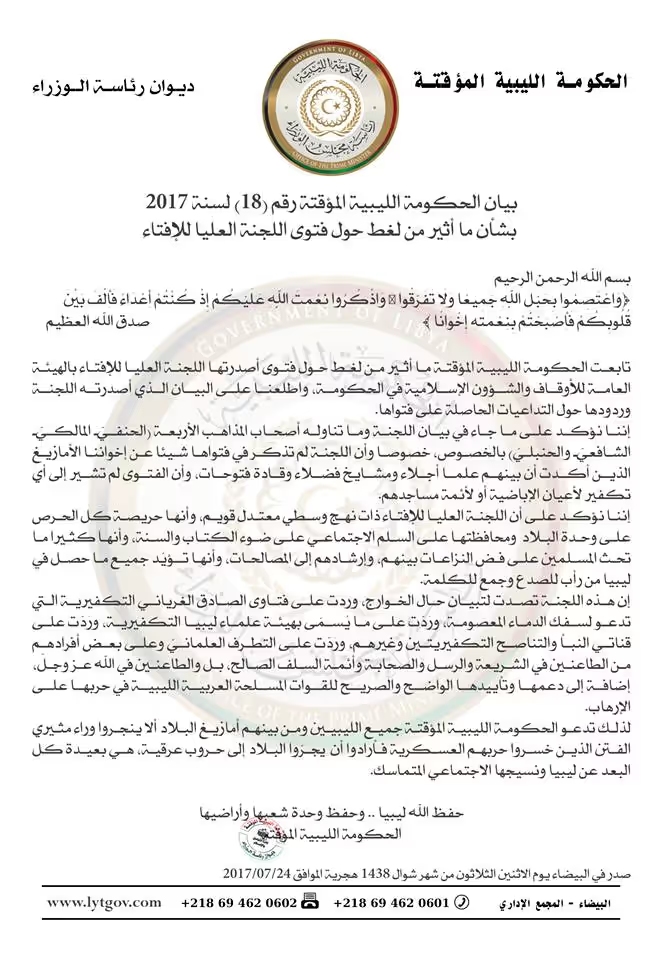
General Authority of Endowment Declares
Muslim Berbers Infidels
Original source of edict: https://www.aifta.net/archives/421
(the
website of
the [eastern] General Authority of Endowment And Islamic Affairs
الهيئة العامة للأوقاف والشؤون الإسلامية).
This above edict,
written in Arabic, was delivered in response to
a question posted by someone who asked about the suitability of dealing
with and praying behind an Abadi preacher in Nafousa Mountain, western Libya,
who preaches that the "Koran was created". The question
was signed by the initials: A' and Z [ع ز].
The Libyan Supreme Fatwa Committee (of the General Authority of
Endowment And Islamic Affairs)
was widely criticised for declaring most Libya's Berbers "deviant",
"Kharijites" and "astray", who adhere
to "infidel"
doctrines, such as "the Koran being created", and denying
the "vision" (الرؤية - the idea that
the believers will see the Creator on resurrection day),
and therefore Abadi preachers cannot, the edict continues, lead Islamic prayers
in a mosque.
The president of the GNA, Mr. Sarraj, speaking in general terms had condemned
incitement to hatred and "fitna", but made
no specific mention (whatsoever), neither by name nor by organisation,
to the radical edict nor to the Supreme Fatwa Committee [1].
Still worse, the Bayda government (the government
appointed by the HoR) has approved the
edict made by its religious authority (the Supreme Fatwa Committee), and
even stated that the Supreme Fatwa Committee is "moderate" [7] and
that the edict said nothing about the Abadites possessing infidel doctrines.
This is very, very strange because the above fatwa clearly
mentions in Arabic the Abadite as
الإباضية فرقة منحرفة ضالة، وهم من الباطنية الخوارج،
وعندهم عقائد كفرية، كعقيدتهم بأن القرآن مخلوق وعقيدتهم في إنكار الرؤية [
رؤية المؤمنين لربّهم في الآخرة]
and
even stated that praying behind them is "indignified" and "not
permitted" (فلا يُصلّى خلفهم ولا كرامة). Does this mean that the
Prime Minister cannot read Arabic? Or does it mean there is an evil
agenda to wind-up the Berbers to cause civil war in Libya? Whatever the reason
behind all of this nonsense the world needs to know that most Berbers abhor
violence and have no intention of swallowing the bait
swallowed by their neighbouring brothers across the region. Terror is
simply a matter for intelligence to weed out, in silence, without firing a
single bullet, if, of course, the intention is to eradicate the radicals!
The audacity is that instead of repudiating such extreme hatred and radical
edict, the Bayda government said the fatwa made no mention of
the "Amazigh" by
name, although everyone knows
that in Libya only the Berbers (the Amazigh) are Abadite (or Ibadis or Abadis).
This is like saying the inhabitants of Jeddah are infidels, and when the Saudis
complain, one can reply to them by saying: who said anything about the Saudis!
From a Berber perspective such statements and fatwas serve no purpose
other than "fitna" and
incitement to hatred; and to deny a link between Abadite and Imazighen
is like adding insult to injury; and hence Libyaherald wrote:
"The Beida-based government has sided with its Awqaf (religious endowments)
and Islamic Affairs Authority in the row over the latter’s fatwa damning
Ibadis as infidels. It has claimed that the committee is moderate . . . despite
the fact that a large proportion of Libya’s Amazigh community are Ibadis"
[2].
The National Commission for Human Rights in Libya had condemned the
fatwa:
"وكانت اللجنة الوطنية لحقوق الإنسان في ليبيا أعربت عن استنكارها
واستهجانها الشديدين فتوى اللجنة العليا للإفتاء التابعة لـ«الحكومة الموقتة».
وأعلنت في بيان، الاثنين، «رفضها وإدانتها الدعوات التكفيرية والتحريض والعنف
اللفظي والإرهاب الفكري والديني المتطرف الذي تمارسه هيئة أوقاف الحكومة
الموقتة، من خلال تكفير مكونات اجتماعية (في إشارة إلى الأمازيغ وهم معظم
أتباع المذهب الإباضي في ليبيا)." [5]
Here is the full response of the Amazigh Supreme Council [6]:
"The Amazigh Supreme Council, declares absolute rejection of
the fatwa issued by the High Committee of Fatwas, affiliated to the
so called Interim Government, located in eastern Libya. In that fatwa,
they stated that Ibadhi muslims are a deviant astray group, belonging
to Khawarij and possess infidel doctrines. Which is a direct incitement
for a genocide of the Amazigh people in Libya, a blatant violation
of international treaties and conventions, a call for unrest among
Libyans by threatening the social peace in the country, and the possibility
of propagation of this menacing speech to neighboring
countries; Algeria and Tunisia; Therefore, we call all Libyans to refrain
from being persuaded by such racist and menacing speech. During these
difficult times, we urge all the military councils of all the Local
Governance Units within the membership of the Amazigh Supreme Council,
to unify their work and efforts to guard security and stability. Furthermore,
we call the international community to commit to its duties of protecting
civilians. Tripoli, 10/07/2017 (27/06/2967ⵣ) "
Over two-hundred (200) Libyan intellectuals including writers and academics
and political activists and journalists have signed
a statement [8] totally rejecting
sectarian
religious discourse (الخطاب الديني التصنيفي) that divides Libyans (الذي يشق
صف الليبيين) and strives to disseminate hate speech amongst the sons and daughters
of one nation (ويجتهد في بث خطاب الكراهية بين أبناء الوطن الواحد) . They
have also questioned the role of the General Authority of
Endowment And Islamic Affairs and the nature of its political project
that targets individuals and institutions in a way that does not agree with
the principles on which the General Authority of
Endowment is based.
The University of Tobruk has revealed that it will create a faculty of
antiquities & tourism. The announcement came via its facebook
page on the 22nd of June 2016. The building of the current education college
will be used as the headquarters of the tourism college. After the planed
refurbishment the building will be ready for the educational year 2016/2017.
The dean of the new faculty, Mr. Belaid Emrabeth, was reported to have
said that the number of targeted students for admission to the college
will be around 100 students, and that places will be allocated according
to the acceptance criteria. For further details about this faculty, and
about Khums's faculty of antiquities & tourism, please see: https://www.temehu.com/atf.htm
Algeria Officialises Tamazight In The Constitution
7 February 2016
The Kabyle Flag
The Algerian Parliament has made Tamazight ('Berber language') official
in the Algerian constitution on Sunday the 7th of February 2016. The decision
was passed
by an overwhelming majority of 499 MPs, with only 2 MPs voting against,
and 16 abstained. Prime Minister Abdelmalek
Sellal said the constitutional revision that included promoting Tamazight
as an official language is "the crowning of the political reforms" originally
initiated by the president Abdelaziz Bouteflika.
A few months earlier, the Kabyle flag
was raised outside the UN on the 10th of October
2015 in a symbolic ceremony that was attended by Ferhat Mehenni, the president
of the Provisional Government of Kabylia, and one of the founders of MAK.
The flag was later taken down. It is not known why any Berber would want
to raise the Berber flag outside an organisation that authorised violence
against sovereign Libya only to destroy Libya's entire
infrastructure and infect the country with terror and chaos while leaving
the Libyan civilians in greater danger than ever before in Libya's entire
history.
On the previous day to the ceremony, Mr. Mehenni chaired a conference
about: “The
independence of Kabylia and the new global geopolitics”. The
message is quite simple: to let the whole world know that Kabylia will soon
be independent. There is no doubt that calling for "independence" at this crucial
stage is
"premature", if not a dangerous move that may lead to war. Everyone
can see that the hidden agenda for the whole region seems to be nothing more
than infecting countries with terror, chaos, and the clash of foreign-sponsored
militias.
Many Berber sources in Algeria had already noted the strange development
of "religious terrorism" in Kabylia being the work of the Algerian
service, or the work of mystery gladios to justify future intervention
if and when needed; once classified as "terrorists" and
"separatists"
the rest is history. The Moroccan minister of education had already been reported
to have called for tackling "Amazigh extremists" who use
Tamazight to
"fight Islam and Arabic language".
The Berbers need
to remember that politics is all about "deceit" and not fact, and
so once setup nicely for the job, like Libya, there is nothing anyone could
do but sit back and watch the odyssey unfold. Some foreign institutions
may appear to encourage people to stand up for their rights and even lead "teenagers"
to violence to achieve political freedom; but then why cannot they enforce
such human rights through the UN where indigenous human rights still remain
nothing more than "recommendations"?
Take a look at the Kurds, for example; they were lured to fight their neighbours
from all sides for the sake of "independence". As a second example,
take the orchestrated tragedy of Azawad, where the Berber Tuareg of Mali
were lured, lured, to push for the independence
of beloved homeland that was originally violated by colonial France in 1894
only for the French to return in 2013 with bombs to scatter the radicals
across the region; leaving the Tuareg Berbers stuck in limbo and surrounded
by nurtured terrorists. Why didn't the UN support the independence of Azawad
instead?
Is it right then for the Berber leaders to initiate a chain reaction that
may eventually drag the whole Berber nation into war? Or even better is it
right to lead your own people to a war you cannot, yet, win? "Self-determination" is
the first step forward to lay the foundation for a future "independence" that
would be based on mutual understanding and ripe political climate.
Tamazight
needs indigenous leadership free from any foreign advice or violence, and
away from regurgitated foreign politics exported to plight impoverished
nations with wars. Let us welcome the Algerian government's officialisation
of Tamazight, and use the constitution to protect our nation; to implement
a complete educational system based on scientific principles; to create an
economic power and Berber banks; to exert our will to run an independent
existence without independence; and then let time do what it does best: gradually
dissolve rock into dust.
Libyan Visa Update (15)
15 January 2014
Tourist Visa
The Ministry of Tourism has finally decided to start issuing tourist visas
to foreign nationals wishing to visit Libya. The decision was taken in a meeting
between the minister of tourism and Tripoli's immigration officials on the 26th
of December 2013 [68]. Officials at the ministry of tourism have confirmed the
news to us on early January 2014. The good news was also confirmed by the ministry's
media coordinator to Libya Herald [66].
In a separate development Solidarity Press has reported [67] an agreement
between the Libyan and Tunisian ministries of tourism to begin the activation
of tourism in Libya and Tunisia. The agreement came after the Libyan minister
visited Tunisia in December 2013 and agreed with her counterpart a number of
measures including cooperation in the fields of tourism marketing and training.
The representative of the Tunisian Office of Tourism in Tripoli, Mr. Ezeddin
Alqarami, was reported to have said that the agreement relates to the preparations
made for the year 2014, which will be a "promising year" for
both countries [67].
The new visa procedure is almost identical to the old one. Your chosen operator
or visa provider needs to receive a scanned copy of your passport's bio page
and also a list of the sites to be visited ('the route'). The visa approval
will be available within 48 hours of the application being presented to the tourism
ministry (if all goes well). During the old procedure the application is presented
to the immigration department for approval, but now the application must presented
to the tourism ministry. The ministry processes the application then transfers
the request to the immigration department. Finally the visa approval is collected
from the immigration department. Like before, the approval can be used to obtain
the actual visa stamp on arrival without the need to visit the embassy. The visa
stamp will be valid for four weeks from the date of issue; renewable on request
and pending approval. It is understood that there will be a simplification of
the entry procedure at all the entry points including the land borders. As we
have reported in our earlier updates, the compulsory tourist guide is no longer
required; and the passport Arabic translation was abolished in 2010 by the previous
government. The only obstacle remaining to tackle is safety, which is now worse
than ever before.
There seems to be a sudden change in the ministry's policy regarding tourist
visa. According to the earlier news released on the 19th of June 2013 the
Libyan tourism minister Ikram Imam "said she did not expect foreign
holiday makers to return for another two years" [2] – that is until
June 2015; as further confirmed on the 28th of October 2013, when she told LANA
[6] that due to the deterioration of security in Libya the tourism ministry does
not aspire to have foreign tourists this year [2013] nor in the following year
[2014]. Nothing has changed in relation to security and safety, and therefore
all visitors are warned that the assassination campaign that was targeting Libyans
in the past has now began to affect foreign visitors too (see below for details).
On the 8th of January 2014 the tourism ministry's staff went on strike, apparently
protesting against the ministry's "waste of state funds" –
in reference to the money spent by the ministry on attending international tourism
fairs, as we have reported in one of our earlier updates. There are however other
points of concern, such as the ministry's lack of approach to cooperative management;
meeting with Arab tourism officials from dictatorial states; poor website; and
the ministry's failure to implement a proper administrative structure across
all its regional offices.
The strike coincided with a protest by a group calling itself the "Women
Against Corruption", reportedly protesting against the alleged financial
and administrative corruption at the ministry of tourism [70], and demanding
the removal of the minister of tourism from her office. Such demands reflect
the current chaos inflicting Libyan politics where people can appear anywhere,
with or without weapons, demanding the removal of government officials and closing
down oil terminals and other essential installations required to run a country!
Among its recent projects the ministry said it has started work on a range
of tourist projects including those in Tellil (in Sabratha) and in the Green
Mountain (Cyrenaica) [6]. It has also activated the Emsaad Tourism Information
Centre on the 26th of June 2013, when the deputy assistant of the tourism ministry,
Mr. Khalid Khlifa Hsien, visited a number of areas east of Tobruk, reportedly
to gather information about the areas in preparation for establishing tourist
investment projects in the area [1]. He also met with the members of Emsaad Local
Council and other tourist companies and organisations to officially activate
Emsaad Tourism Office. It is hoped that the office will present its tourist investment
projects to attract visitors and tourists to the area. Of course, the real disaster
affecting Emsaad is the "lack of border security", without of which
there can never be tourism in Emsaad or anywhere else in Libya.
Libyan economy deputy minister, Dr Abdelkarem Mgeg, was refused British visa
to attend a business meeting in preparation for the so-called "Foreign Direct
Investment Libya Focus conference" [3]. Apparently since his Schengen
visa was issued from Poland Dr. Mgeg needed to enter Europe via Poland before
he could travel to other Schengen countries.
Fake Visas
We have mentioned in one of our earlier updates that suspending some types
of visas encourages criminals to exploit the vacuum created by taking monopoly
of fake visas, as well as abusing the allowed visas for purposes other than those
permitted. For example, the expensive business visas are widely provided by visa
offices for business men and women, journalists, transit travellers and tourists
alike.
It was recently reported that criminals have resorted to various methods
for smuggling blank visas between countries, including using clothes parcels.
The following three incidents – all from the month of October (2013) – were chosen
to illustrate the scale of the disaster the authorities still reluctant to recognise;
not to say anything of the officials who were reported to have been issuing genuine
identity numbers and official documents including birth certificates and passports
to non-Libyans (presumably once they have been smuggled into the country on either
fake visa or across the porous border [27]). On the 24th of October 2013 the
Egyptian authorities intercepted a 16-kg clothes parcel containing 4923 blank
Libya visas and 9600 duty stamps, apparently sent to Falcon Trading Company (شركة
صقر تريدنج) from "Dubai-China" [24]. Six days earlier, immigration
officials at Misrata airport deported 171 Egyptian nationals back to Egypt on
the same plane after arriving with fake Libyan visas [25]. The same source also
said that 450 fake visas were intercepted in the previous week alone. While
on the 18th of October 2013, Egyptian officials at Cairo airport have confiscated
695 blank Libyan visa forms "concealed inside a consignment of Chinese
tea"
[26]. And on the 1st of December 2013 officials at Misrata airport returned
360 passengers to Egypt after arriving with fake Libyan visas onboard two separate
planes [53].
10 June 2013: the Maltese foreign affairs ministry is investigating an alleged "racket" profiteering
from issuing expensive Maltese visas in Libya. According to Malta Today [31], "Reportedly,
the Maltese Consulate in the Libyan capital, Tripoli, is charging up to €3,000
for visa applications which cost €70 (120 Libyan Dinars)." Although
the source relates that the ministry was investigating the alleged crimes for "weeks",
such incidents were in fact reported since March 2012 (see our Visa Update 7).
Checkpoints
As reported earlier, attacks on checkpoints and the setting up of fake checkpoints
continue to take place in freed Libya. Travel at night is not recommended, and
camping in deserted places remains a risky adventure in today's Libya, especially
after the dead bodies of one British engineer and a New Zealand woman were found
by the beach in Sabratha in December 2013.
According to Solidarity Press, the government authorised Libya Shield Forces
to set up a number of checkpoints across the capital Tripoli in an attempt to
clamp down on the terror activities carried out by the mystery terrorists in
black vehicles (without number plates and with tinted glass) [9].
The announcement (if it amounts to anything in practice) came after the spat
of violence that plighted the capital Tripoli in recent months. For example,
exactly seven days before the announcement was made a fake checkpoint was set
up by an armed gang of "mystery men" in Aarea 27 West of Tripoli,
confiscating "modern cars"
from their owners while shouting abuse [10].
6 September 2013: a group of mystery men attacked a checkpoint in the town
of Sousa, Cyrenaica. No serious casualties were reported, but one guard and two
of the attackers were injured during the ensued exchange of fire [11]. By January
2014 the same checkpoint was attacked five times.
8 November 2013: a checkpoint with a small guards building near Benghazi
was flattened to the ground in a massive bomb blast. The same check point was
bombed earlier in the year.
14 November 2013: Mr. Ahmed Hamouda, a special forces officer from Benghazi,
was shot dead whilst performing his duties at a checkpoint in the Gardens Area
[47].
16 November 2013: three men in grey BMW fired at a check point in Benghazi
outside the "7 October Hospital". The point was manned by
the Mushat al-Bahria Brigade [49]. This is one of the very rare occasions in
which the culprits were later arrested – two men and one woman.
25 November 2013: LANA has reported that unknown assailants attacked a checkpoint
at the entrance to Derna's seaport with a suitcase-bomb. LANA said the bomb blast
was heard across the town of Derna, causing massive devastation but no human
casualties [50]. However, on the following day, Solidarity Press reported that
according to the port's manager, Mr. Ibrahim Alousta, the news circulated by
the media is far from true [51].
Libya's First Suicide Bomber Strikes in Bersis:
Libya declared a 3-day official mourning on the 22nd of December 2013 for
the 13 people killed in Libya's first suicide bomb in history. The suicide terrorist
struck at Bersis checkpoint [69], east of Benghazi; thereby officially putting
freed Libya on par with liberated Afghanistan and democratised Iraq!
Land Borders
Emsaad land border continues to be unpredictable, with the usual closures
and occasional trouble. Ras Ajdir and Wazen appear to enjoy a relative stability
in recent months, with the occasional incident that often results in closing
the border for a few days. If you do have an entry visa to Libya then you would
be allowed to enter and exit via these land borders. Remember, if you are allowed
in via Ras Ajdir, for example, then you should be able to exit at the other end
(Emsaad). After the recent development tourist visa on arrival is now possible
at Ras Ajdir and Emsaad border, as before, providing the visa approval was secured
in advance.
Security: according to the spokesman of the Libyan air force in the eastern
region only 50% or 60% of Libyan borders are covered by the air force, leaving
nearly half of Libya's borders totally unprotected. It seems certain that the
borders are controlled by mysterious forces operating under the cover of "criminal
gangs" ever since the Libya War began in 2011. Such forces continue
to distribute Libyan weapons across the region, as well as flood Libya with drugs,
tranquillisers, fake goods, outdated and poisoned foods, explosives (200 suit
cases loaded with explosives were found in one single lorry near Tobruk), and
of course illegal immigrants (nearly 2 million migrants have been reported by
LANA, so far).
According to an Algerian source quoted by LANA [39] the border between Libya
and Algeria is under the control of extreme Salafist militias, and that 14 armed
militias which do not belong to the central authority in Tripoli are in charge
of the border area. Despite the fact that the Algerian government has deployed
nearly 20,000 soldiers along its borders with Tunisia and Libya, reports
continue to emerge of Libyan weapons (including missiles and anti-tank rockets)
being found in Algeria [40; 41; 42]. It seems certain that Algeria too may soon
fall to what the Berbers led to believe is an "Arab spring".
Emsaad (Amsaad):
19 June 2013: Benghazi: the headquarters of the border guards in Benghazi's
Boudzira area was attacked by unknown assailants who threw hand-made explosive
devices at the building. No human casualties were reported. In a separate incident
on the same day, a patrol unit belonging to the border guards was also attacked
while on duty in the area of Rah'ba [36]. It was widely believed by many Libyans
that the organisation(s) responsible for the illegal border activities are behind
the attacks on the border points and border guards and offices.
01 July 2013: Salloum Border: the road to the border was blocked by protesters
(or by those who say they are protesters), for the usual reasons that are reported
before. A few days later, on the 5th of July 2013, the Emsaad border point
with Egypt was closed on orders from the Libyan government. According to a special
forces commander, the border point was closed after it was found manned by civilians
dressed in military uniform who do not belong to any official body [34].
20 July 2013: the Egyptian army fires bullets at unauthorised gangs practicing
illegal activities along the Libyan-Egyptian border, injuring a number of people
[31]. Reports from Libya continue to speak of complete chaos and total lack of
law at the Emsaad border point.
21 July 2013: Solidarity Press first reported the rumours regarding the border
point of Emsaad being destroyed with explosives by armed groups acting outside
the law [4]. This came two days after the Egyptian army was reported [5]
to have been involved in clashes with outlaws from the Egyptian side of the border.
It seems both governments are unable to deal with the determination of such mystery
cells operating outside any known law, with the Libyan government claiming weak
and helpless to protect such strategic border point – given the amount of weapons
and immigrants that are flowing in both directions via this particular border
point, in addition to the numerous other points strewn along the thousands and
thousands of miles of Libya's unsecured borders.
28 July 2013: the Egyptian authorities announced today that the border with
Libya will be closed after 72 hours. The decision came after the total collapse
of security at the border point between the two countries following the 30th
of June military coup in Egypt [22]. Smuggling of goods, drugs, weapons and illegal
immigrants became rife during the past few weeks. On the same day, the Libyan
prime minister Ali Zidan announced the deployment of police, army and customs
officers to Emsaad to secure the border point; as he also revealed the formation
of a "security room" to secure Emsaad border, and a similar
room for Ras Ajdir [21]. The Libyan border was in fact closed from the previous
day (the 27th of July 2013) on orders from the prime minister, apparently to
prevent the assassins responsible for the latest assassinations in Benghazi from
escaping to Egypt [23].
03 August 2013: according to the commander of the 1st Infantry Battalion,
Almahdi Alawwami, services at Emsaad have returned to normal, after the battalion
was appointed to secure the border point following the recent trouble [19]. On
the 3rd of July 2013, a group of outlaws attacked members of the battalion at
the border point, damaging a number of government vehicles. The attackers have
attempted to steal one of the vehicles, but they were defeated and fled the scene
[20].
19 September 2013: chaos and total absence of law were reported by a number
of people who traveled through the Egyptian-Libyan border. According to some
travellers there were no Libyan officials at the Libyan border of Emsaad, and
that after spending hours looking for any border official to check their documents
the procedure is often "strange" and unofficial. There was no news
of the "security room" setup by the prime minister in July. On the
other side of the border, at Salloum, some travellers complained that the border
point is manned by civilians from Salloum, some of whom charge up to two hundred
Libyan dinars just for the stamp [18].
19 October 2013: the ministry of interior issued a decree commissioning colonel
Abdulrazaq Mohammed Aldrouqi director of the National Security Directorate for
Emsaad land border. The head of Emsaad Local Council told LANA that Colonel Aldrouqi
had assumed his new duties with utmost seriousness and determination [13].
21 October 2013: the Egyptian authorities re-open Salloum border for Egyptian
and Libyan passengers only. The point was closed three days earlier after
nearly 50 Egyptian lorries were held for six days by protesters in Ejdabiyah.
The protesters were protesting against the imprisonment of their relatives in
Egypt. All the Egyptian hostages were released unharmed [12].
24 October 2013: according to Solidarity Press, the commander of the 1st
Infantry, Col. Mahdi Mabrouk, announced the withdraw of his unit from Emsaad
border. The army unit was in charge of the border point since July 2013. Solidarity's
source also said the withdrawal was due to the lack of "means"
and the lack of "support from the local people". Chaos at
the border was due to the fact that transit commerce was disorganised, Colonel
Mabrouk told Solidarity Press [52].
General Sisi, the head of the Egyptian coup that toppled elected Morsi, was
reported recently to have warned that Egypt's border with Libya is the greatest
strategic danger currently facing Egypt. However, many Egyptians feel it is Sisi
himself who is the greatest danger to Egypt after robbing them of victory and
thereby plunging Egypt in great turmoil.
Ras Ajdir:
01 July 2013: Ras Ajdir Border: long delays from the Tunisian side, with
no apparent reason. Libyan officials wave all travellers leaving Libya (mostly
Libyans) quickly, after carrying out the usual checking procedures, but once
they reach the Tunisian side the traffic comes to a stand still [35].
9 July 2013: the Tunisian consulate in Tripoli was attacked by some angry
Libyan assailants, in a protest against the Tunisian border authorities whom
they say seized their goods and cash [33].
28 September 2013: Ras Ajdir border was reopened today after an agreement
has been reached by both sides [17]. The border was initially closed on the 24th
of September after the Tunisian authorities fired in the air to disperse the
Tunisian crowed that gathered around the Tunisian border point in Bengerdan.
Reports [15] state that trouble erupted between Libyans and Tunisians after a
Tunisian national was attacked and stabbed by Libyans inside Libya, to which
the Tunisian authorities responded by firing in the air to disperse the crowed.
In response to this, the Libyan authorities closed the border point at Ras Ajdir.
However, according to a number of accounts from Zuwara Media Centre [16], a Tunisian
man, named Adel Tabet, was attacked and stabbed in Zelten (a small Arab village
between Zuwara and Ras Ajdir), before some Libyans intervened and took him to
the shared border between Libya and Tunisia. When the injured Tunisian arrived
in Bengerdan, many Tunisians were reported to have began attacking Libyans inside
Tunisia, with one group even attacking the Tunisian border point in Bengerdan,
which prompted the Tunisian authorities to fire in the air to disperse the crowed.
According to another account, Adel Tabet was in Zelten to sell 10,000 dinars
worth of pasta, which he brought with him from Bengerdan, and that after he completed
the deal he left Zelten, before he was stopped by assailants in a black Chevrolet
car (with a long antenna) between Zelten and Abukemmash, stabbed him and took
all his cash before fleeing the scene. It was other Libyans who took him to the
hospital before the news reached Bengerdan, when his relatives began attacking
Libyans.
Southern Borders
As covered in our earlier updates, on the 19th of December 2012 the temporary
prime minister, Ali Zidan, declared the southern region of Libya a "military
zone", and stated that the Libyan air force is out to blast outlaws taking
advantage of Libya's southern borders. Ten months later, the situation on the
ground is ten times worse, and to illustrate the weakness of his government the
Libyans say the PM staged his own kidnapping – albeit for a few hours. Of
course, it would not be fair to blame neither the Libyan government nor the Libyan
people (the protected civilians).
According to a recent report by Libya Herald, illegal immigrants are crossing
the border at Madama (near Tumu – the Libyan official border crossing station)
without being asked for any documents, and that according to the head of Murzuk's
military security, Colonel Barca, around "600 illegal immigrants cross
the border every day"
[14]. The more disturbing news is that the colonel said the authorities in Tripoli
never bothered to reply to their requests for materials including vehicles and
weapons. The same reluctance was reported from Emsaad and from Ras Ajdir.
The Libya Herald report goes on to speak of an al-Qaeda terrorist camp in
Isseyne, at the border between Ghat and Algeria, and that when Hassan Massafer
("a member of Katiba 206 in Obari") informed the authorities
in Tripoli, he was told by the authorities: "‘Don’t do anything. You
don’t see it. You don’t look at it!’" [14].
Such bizarre response, or allegation, is difficult to explain; but according
to the same report, Tuareg civil authorities accuse
"Tripoli of using the [terrorists] argument in order not to
process their request to give Libya[n] national ID numbers to 14,000
Tuareg families"
[14]. It is important to note here that the Berber Tuareg's ID issue goes back
to Gaddafi's era, when a number of Tuareg families were living in Libya without
Libyan IDs. One of the reasons was that the Libyan government made it a condition
for Tuareg families to live in newly-created settlements (or camps) in order
for them to be issued with Libyan identification cards so that the government
can build hospitals, schools and other essential amenities, which otherwise it
cannot provide if families choose to stay nomads (as they have always been).
In response, some Tuareg sources (at the time) said Gaddafi's move intended to
Arabise their society, as was the case in Algeria, where many Tuareg communities
were abandoned in the desert after refusing integration into the state's
camps. It seems the same issue continues to be a source of trouble for the native
Berbers of the Great Sahara (now divided into Libya, Algeria, Niger and Mali).
Terrorism in (New) Libya
The Western media today openly speaks of Libya being a dangerous place, plagued with
terrorists and outlaw militias that refused to lay down their weapons, without
saying who really was behind the training and coordination of such deadly militias
in the first place – when the world was united to destroy Libya's central authority
with an iron fist and without an exit strategy. The true implications of such
regime change were obscured by the media's propaganda regarding the success of
the violent intervention; the success of the bungled
elections (hurriedly organised while the Libyans were kept busy blasting
each other in the background); and the disasters of the unjust constitutional
declaration that sent Libya back to square one. To be fairer to the truth,
at least the Independent did make the effort to scratch the surface in its "Special
report: We all thought Libya had moved on – it has, but into lawlessness
and ruin", though without pinpointing the cause of it all.
During Gaddafi's dictatorial grip on power Libya was among the safest destinations
in the world. During the UN-authorised bombing campaign warnings were voiced
regarding radical flicker being amongst the rebels of Cyrenaica, but no
one really cared about the consequences Libya made to suffer. NTC's rebel prime
minister Mr. Mahmood Jibril warned during the bombing campaign that the weapons
sent to Libya by some dictatorial states were reaching radical groups in Cyrenaica,
but no one wanted to know. Terrorism is now well established in (Free) Libya,
especially after the UN's 5,900 bombing missions were
announced "complete with precision".
Two years ago, most Libyans were assured that Libya will never become like
democratised Iraq, where nearly 1.4 million Iraqis died after the hanging of
Saddam in the Big Feast, but today it is almost impossible to have a single day
without a terrorist act shocking the Libyans already disoriented by the devastating
war. It took Libya's chief of the Special Forces two years to say there was a "conspiracy"
to plunge Libya into civil war; with Libya itself becoming the safe haven for
radical groups and the centre for world terrorists, complete with Tesco -
the largest arms black supermarket in the world.
The biggest problem Libya faces today is the tragedy of Libyans being divided
into two opposing groups: the loyalists and the rebels – ignoring for the time
being the "climbers", "defectors", "federalists", "Berberists" and
the assisted "radicals". All Libyans are urged to lay down their (given)
arms and remember that only those who encourage civilians to use violence to
achieve peace would benefit from seeing people kill each other. Violence is not
the answer and will never be the answer, no matter what others say. The loyalists
need to know that punishing the Libyan civilians and in the process destroying
Libya itself is exactly what their true enemies would love to see.
The Black Chevrolet mentioned in a number of terrorist incidents
has become a common feature of Libyan terrorism. Such vehicle (often with tinted
glass and without number plates) was reportedly involved in countless incidents
all over Libya, from Ras Ajdir to Misrata and from Sirte to Derna. Are they loyalists
intent to foil the uprising, as the obscure government says? Are they gladios preparing
the climate for further foreign intervention, as propounded by some sources in
the West? Are they sponsored radicals intent to destabilise Libya, as some Libyan
officials say? One thing for sure, they are well-organised, persistent, very
active, totally invisible, very sophisticated, and never fail. No ordinary criminal
could host such a collection of "special"
qualities without ever being caught or fail, and hence many Berbers, from Azawad
to Zuwarah, often refer to such groups by the name of "mystery cells".
Many of the clashes, assassinations and border activity were associated with
such mystery groups, with the government always unable to identify nor arrest
any of the mystery terrorists. For example, the recent deadly clashes of the
15th of November 2013 in the capital Tripoli, which left nearly 40 dead and 400
injured, were reportedly started by mystery shooters [48]. Similar masked shooters,
as reported by Aljazeera, appeared in Egypt immediately after the military coup
against Morsi, shooting at Sisi's army to provoke a response against the otherwise
peaceful protesters.
A number of foreign men were arrested in Libya during the past few years,
but detailed information released by the government remains rare. On the
6th of June 2013, a 200-seat boat was found empty near the coast of Zuwarah.
According to Hafed Alqeffaz, the manager of marine affairs at the seaport of
Zuwarah, his team was instructed by the Libyan navy to pull the empty boat to
the port. He also said that the boat (named مار إيام) was found empty because
its occupants were previously arrested by Libyan forces and taken to the city
of Zawiya, leaving the boat behind [37]. Mr Alqeffaz revealed that the documents
found inside the boat show the occupants to be Syrian navy officers, and that
a number of flags belonging to different countries were found inside the boat.
He also speculated that the boat may had an illegal accomplice inside Libyan
territorial waters.
According to Reuters "four
American military personnel" [58] were arrested in Libya, apparently
not by government forces but reportedly by the militias operating in and around
Sabratha. Solidarity Press said the group consisted of "five foreigners"
who attempted to escape when they were ordered to stop at a checkpoint between
Sabratha and Lajilat in western Libya, and that according to eyewitnesses
the men had "light weapons" and one of the cars that attempted
to escape was chased to the area of Tawila after which it was found burnt [59].
LANA said the four military men were members of the American embassy's security
team [60], who, according to the New York Times, were in the area of Sabratha
because they "were believed to have been reviewing potential evacuation
routes for diplomats" [61]. The American ambassador Deborah Jones visited
Sabratha just a few weeks earlier where, according to Libya Herald, she discussed "potential
cooperation" with the local council [63].
On the 2nd of January 2014 the media reported two more Americans being arrested
inside Benghazi University's campus, before they were taken by the Libyan special
forces to the headquarters of the Libyan army in Benghazi. Initially Reuters
said their identities were not
"immediately clear" and that the American embassy "could
not be reached for comment" [58]. Other sources said the two were in
Libya to play basket ball, but Solidarity Press [65] said the two suspects, one
American and the other from Cameroon, were arrested filming near the campus and
that during questioning they insisted on being basket ball players despite the
fact that they do not belong to any sport club nor to any other organisation
in Libya.
On the 3rd of January 2014 the bodies of a British man and a New Zealand
woman were found by the beach near the Mellitah gas complex, near Sabratha. LANA
said the dead bodies showed signs of being shot with bullets [64]. A few days
later, the body of the British victim was identified to be that of Mr. Mark De
Salis, a power manager who was bringing electricity generators to Libya and who
was (in the past), according to Sky News, an RAF member. The female body was
identified to be that of Lynn Howie, who according to Libya Herald was in Libya
for a visit.
Attacks on Hotels & Hotel Bombs
For the first time in Libya's history big hotels have become a terrorist target.
This means that it is probably safer to stay in the smaller hotels than go for
the luxury resorts. All the hotels attacked so far are 5-star hotels:
Radisson Blu Hotel: 7 November 2013: heavy armed clashes
nearby the hotel have resulted in the hotel being hit a number of times. The
building was damaged, with "a lot of broken glass in the lobby",
a member of staff told Libya Herald. There were no casualties reported, but the
guests were relocated to the basement [43]. The clashes started between Waddan
bridge and the planetarium after the commander of "Misrata Nosoor
Battalion", Mr. Nuri Friwan, was murdered on the 5th of November. In
retaliation his forces and/or supporters in the capital attacked a number of
local brigades in Tajoura and Suq al-Juma [44], resulting in 29 injuries and
2 deaths [45]. The fighting was reported to have spread to a number of areas
including Algeria Square, Ben Ashur and Alshat street, involving heavy machine
guns, RPGs and snipers.
Waddan Hotel: 7 November 2013: initially Waddan was not
mentioned during the 7th of November clashes, but later it emerged that a number
of important building were hit including the Waddan Hotel, the Turkish and the
Italian embassies, the ministry of Foreign Affairs, and the ministry of
Planning. One diplomatic source, who was staying at the Waddan Hotel at the time,
had confirmed to Libya Herald that,
"An armed group entered the Waddan, [PM] Zeidan said, and terrorised
guests, including senior diplomatic staff. Possessions and money were apparently
taken at gunpoint"
[46].
Radisson Blu Hotel: 29 July 2013: a car-bomb was successfully
defused outside the 5-star hotel, apparently after "an unknown person" reported
the vehicle [28]. The car bomb was said to consist of "eleven explosive
devices" and "ten seven-litre containers of petrol”. Security
barriers were installed in the hotel to prevent unauthorised vehicles parking
near the hotel after a "bomb threat" was received on the 26th
of April 2013 [29]. The 29th of July car bomb was left near one of the newly
installed security barriers.
Corinthia Hotel: 23 July 2013: a mortar narrowly missed
the 5-star hotel and instead hit a block of flats nearby. The missile was launched
from a vehicle that was parked in a car park behind the Corinthia hotel. According
to Libya Herald, a loud explosion was heard by guests inside the hotel, while
workers on the 16th floor of one of the Dat Elemad towers "heard the
blast and reported that the building shook" [30].
Overall Advice
Although tourist and business visas are currently being issued to foreign
visitors wishing to visit or transit Libya, we strongly advise against all but
essential travel to Libya. Armed gangs and militias can appear anywhere and strike
without warning. Regardless of what the government and its foreign allies say,
terrorism is now well established in Libya, with bomb blasts gradually becoming
more familiar to the Libyan civilians, and the assassination campaign that was
previously targeting Libyans is now affecting foreign nationals, some of whom
were shot on the spot. Visitors are advised to avoid driving at night, venturing
into isolated areas alone, and camping in deserted locations. The Berber Tuareg
of the Sahara say it is safe for tourists to visit the desert, despite the continued
violence in and around Sabha and Kufra.
The overall advice is: stay away from Libya for the time being. As noted previously,
adventure travellers, taking risks by nature, may enjoy a mix of anxiety and
tranquility to nurture their desire to experience the real thing; so long as
they are insured and warned of the lurking danger. Armed gangs or militia outlaws
could appear anywhere and strike without warning.
Tourist and transit visas still are suspended by the Libyan transitional government;
and all our visa services remain suspended until the ban is lifted. Please note
that due to the volume of enquiries we may not be able to respond to all the
emails we receive.
(1)
Security & Safety: the security situation
is worsening, despite the government's claim to the contrary; and the bombing
campaign that was affecting mainly Benghazi has now reached the capital Tripoli.
The Libyan Prime Minister Ali Zidan, in his recent press conference (aired
by Libya.tv, via Alwataniya), said his police and security forces have defused
a number of car bombs and that the diplomatic community was informed.
Attack on Foreign Visitors: the Libyans'
worst fear is here – the attack on foreign visitors including women was officially
acknowledged to have taken place in Benghazi [21], when a British family was
violated by an armed group acting outside the law [22]. It is such outlaws that
are now roaming "liberated Libya", seemingly and practically unstoppable
by the law.
Checkpoints: generally speaking
checkpoints are manned by armed officers working for the government, but there
is also the possibility of being stopped by an armed gang or rebels at a fake
checkpoint. Undercover cameramen from Solidarity Press traveled from Tripoli
to Benghazi to investigate the conditions in which checkpoints operate. The team
have discovered that there are 18 checkpoints between Tripoli and Benghazi, as
follows: 5 points in Misrata, 2 in Sirte, and 1 point for each other town between
Benghazi and Tripoli. They have also discovered that there was no proper search
for identity documents in any of the checkpoints, except in Misrata where checkpoint
officers conduct vigorous checks on identities and vehicle documents, as well
as search the vehicles for concealed weapons [23]. The correspondents said the
security forces manning the checkpoints were from the Security Support Units & Military
Police (جهاز الإسناد الأمني وإدارة الشرطة العسكرية).
As reported in one of our previous updates, the Libyan prime minister Dr.
Ali Zidan has assured Libya Herald on the 31st of January 2013 that, “in
a few weeks security will be fine and companies will be back” [11]. A few
weeks later, the Prime Minister himself was called by the GNC for questioning
over the failure of his government to provide security for the GNC, let alone
for the whole of Libya. And a few months later, security worsened, when for the
first time in Libya's history Libyan children were "blown to pieces".
Without any official body to state the law, the Libyans cannot understand how
any decision can be implemented, let alone followed-up. The government however says they are aware of these outlaws, they know who they are, and that they are
gradually building the apparatus to deal with "outlaws". No doubt the
government is having difficulties finding a way out of the chaos, mainly due
to lack of exit strategy.
(2)
Libyan Tourism: the Tourism Committee at
the GNC continues to discuss the ministry's development plan for 2013. However,
it is not known what the ministry can achieve with a budget of one million dinars
(around £500,000) – the amount assigned to the Ministry of Tourism by the current
2013 Budget of 66.8 billion Libyan Dinars. Libya Herald says the amount given
to the tourism ministry is, "the lowest sum awarded to any ministry
this year" [24].
On Saturday the 9th of March 2013 the minister of tourism, Ikram Imam, held
a meeting in Benghazi with the managers of a number of tourism companies and
tourist offices from Cyrenaica, to discuss the current state of tourism in Libya.
The meeting was attended by deputy head of the local council of Benghazi Saad
Saaiti; deputy minister of tourism Abdasameea Mahboub; assistant deputy minister
of tourism Khaled Hussein; and director of the Tourism Office in Benghazi Ashref
Ghrour. Like the minister's earlier meetings with similar organisations and companies
in Tripolitania and Fezzan, the ministry reviewed the "action plan" of
the ministry to create "the necessary atmosphere"
for the development of sustainable tourism in Libya, such as "updating" the
institutional structure of the ministry "in preparation for the start" to
take the necessary steps to activate or stimulate domestic tourism and
raise the quality of tourism services in the region. And like most other ministers,
the tourism minister did refer to the "difficulties" the ministry had
endured under the rule of the previous transitional government, such as the non-activation
of the General Board for Tourism (as reported by Temehu.com long before the new
ministry was created) and also the government's withdrawal of the Board's direct
terms of reference (or وسحب مجموعة من اختصاصاتها المباشرة بقطاع السياحة), leading
to, the minister said, obstructing the work of the ministry in relation to the "supervision" and "follow-up" of
its projects.
A number of managers have expressed their "dissatisfaction"
with the ministry's performance, and accused the ministry of not providing the
necessary support and services required to enable Libyan tourism companies and
organisations to fulfil their role in "activating"
this vital sector of Libya's promising economy – just as the ministry itself
blamed the previous transitional government for not doing enough to re-activate
tourism in Libya. They have also demanded from the minister to provide "opportunities
for young Libyans" to effect and run Libyan tourism investment projects
abroad, in order to benefit from the opportunity to develop their abilities and
expertise in the field of tourism – just as foreign companies (including some
from dictatorial states) are eagerly urged to participate and even lead. Why
not, they asked, why not? At the end of the meeting, the minister expressed her "understanding" of
the complaints put forward, and confirmed that the ministry "will strive
to address"
all the "obstacles" and proposals [17]. Understandably the
minister goes away, meeting with other tourism officials from other towns, regions
and states, re-reviewing her "plan" for activating tourism that never
gets activated.
There is no doubt that tourism companies and organisations in Libya had suffered
from the day the war began. Without any due support or compensation from
the government to offset the loss sustained during and after the war, many Libyan
tourism companies were forced to close and lay their staff, due to their inability
to cover the incurred costs. Many Libyan tour operators gathered at the tourism
board and demanded news regarding the saga of the "Libya Visa"
and activation of tourism, without of which they cannot survive. In contrast,
the Libyan transitional Prime Minister, Dr. Ali Zidan, had confirmed on the 21st
of February 2013 that Libya will compensate the Turkish companies that were forced
to stop their activities during the war, and that these companies will be offered "incentives" to
encourage their return to Libya [10] – something most Libyan companies patiently
still are waiting for.
Tourism companies, civil society organisations and charities interested in
tourism from Fazzan (southern Libya) have expressed their deep disapproval of
the current policies of the Tourism Ministry, which they say do not benefit the
nation at this particular stage, and even condemned the current policies of the
ministry as a "waste of state funds". In a protest staged in Sebha,
on Thursday the 14th of February 2013, they demanded from the GNC's Tourism Committee
and from the Ministry of Tourism to stop wasting Libyans' money by participating
in international exhibitions that do not serve the interests of the public at
the present time, and instead called for the government to focus on the
"inner workings of the country" [7]. They have also spoken
of "financial transparency" and the establishment of a "Higher
Council for Tourism" to oversee the development of tourism infrastructure
in the southern region, which they said was previously neglected. Such calls
for transparency were voiced before by the Board of Tourism itself, as reported
in one of our earlier updates, but nothing was heard of the matter since.
Compensation For Future Loss: on the 20th of
May 2013 Reuters reported a bizarre case of a Kuwaiti company claiming 930 million
US Dollars from Libya as compensation for the canceling of its planned tourist
resort before the uprising broke out in Libya [25]. The irony is that most of
the damages claimed are to cover estimated "future losses" covering
the next 90 years. That is asking for cash for a project that was never built,
does not exist in the real world, and for a whole 90 years (worth of revenues)
from the future. Officials at Kharafi (the Kuwaiti Group in question) "were
not immediately available for comment", Reuters wrote [25]; while Libya
Herald reported that a Libyan senior government official had warned that "if
the award, with its key component for loss of future income, were allowed to
stand, it would be “a disaster”. Libya could be faced with claims running in
to hundreds of billions" [26]. The Chinese however are not only asking
for compensation incurred during the war, but also for the "increased
costs of construction" since the uprising began [27].
Apparently, Reuters said the news were also reported by al-Qabas
and al-Jarida newspapers, according to which the Kuwaiti company signed a deal
with deposed Gaddafi in 2006, and that the group had invested on "feasibility
studies", "design" and "management contracts
up until 2010, until Libya cancelled the deal" [25]. It is not categorically
clear if this means that the deal was cancelled by Gaddafi or Gaddafi's government
in 2010, but if it is so confirmed, then Libya would appear under no obligation
to take any further action, since the NTC categorically stated that it will honour
the contracts struck by foreign companies with Gaddafi, and not those cancelled
by Gaddafi before the uprising began.
(3)
Land Borders: the president of the Department
of Cooperation and Relations at the Immigration Department, Nasreddin Ghellab,
has revealed on Thursday the 7th of February 2013 the creation of an electronic
system to document the entry and exit of all foreigners. The system was said
to be linked to all land, sea and air entry points as well as to the Libyan embassies.
The new system will enable any patrol unit to confirm within seconds whether
the provided documentation is legitimate or not. Work is also under way to link
this system with the "residency system" to confirm the legality of
any foreign resident in Libya. The projects are the personal efforts of the engineers,
the technicians and the officers of the Immigration Department, he said [1].
However, a month later – on the 7th of March 2013 – senior EU and Interpol
officials were reported to have arrived at Tripoli airport on the 6th of March
2013 to launch the EU-funded border security system at Tripoli airport. The system
will allow Libyan border authorities to verify any given passport against the
Interpol Database, which holds records of 36 million missing passports worldwide
[16].
Interim Deputy Ministry of Labour, Abdel Razak Altamtam, has announced on
Thursday the 7th of February 2013 the suspension of all procedures relating to
import of foreign labour into Libya, except those relating to companies already
in contract with the state of Libya to develop and rebuild the infrastructure
of the dilapidated state. He added that these measures are temporary and that
there will be an urgent action in cooperation with the Ministry of Interior,
the Immigration Department, and other ministries to regulate the foreign labour
market in Libya [2].
Libyan border officials from Emsaad met with their Egyptian counterparts
on the 11th of February 2013 to discuss procedures relating to cross-border movement,
better security, and prepare the border for commercial traffic and tourism. The
meeting was attended by the Libyan committee appointed by the Minister of Interior
to re-organise and prepare the border; some members of the local council of Emsaad;
regional coordinator of information security; and representatives of some of
the agencies operating at the border. From the Egyptian side the meeting was
attended by the director of the Salloum border point; head of the Egyptian customs
and a number of security departments and operators from Salloum [5].
Local Egyptians have blocked the road leading to the Libyan border in a protest
against the new visa regulation, which requires from all Egyptian nationals to
obtain Libyan visa from the Libyan embassy in Cairo before heading for the border
[8]. According to Egypt Independent [9], local Egyptians say the decree was announced
on Tuesday (the 19th of February 2013), and that in response,
"demonstrating Egyptians are preventing Libyans from entering Egyptian
territory" and that around "820 vehicles are currently gathered
in and around the Salloum crossing awaiting entry to Libya". Prime
Minister Dr. Ali Zidan has announced that Libya and Egypt will establish consulates
in Salloum and Tobruk respectively. The announcement was made in Cairo during
the PM's visit to Egypt on the 8th of March 2013.
Of course, the story has another dimension. The local Egyptians living near
the border are related to the Libyan tribes living in Cyrenaica by the Libyan
border. During Gaddafi's reign, the Egyptians required visa to enter Libya except
those living by the border. But the current Libyan transitional government re-introduced
the visa without exception. This apparently has angered the local Egyptians,
even though the same procedure applies to all Libyans and to all other nationals,
and even though Local Egyptians were reportedly implicated in illegal cross-border
trade, and according to many eyewitnesses, it is Awald Ben Ali who are smuggling
weapons across the Libyan border.
According to LANA, the movement across the Emsaad border has returned to "normal"
on the 7th of March 2013, after the Egyptian drivers were issued with temporary
Libyan visa (lasting for 10 days), while at the same time maintaining the earlier
requirement of Libyan entry visa to be obtained from the Libyan embassy in Egypt
from all other Egyptians [15].
However, on the 30th of March 2013, after weeks of violence along the border
and at the Libyan embassy in Cairo, LANA has issued a warning to all Libyans
to avoid travelling to Egypt via the land border, and instead urged all traveller
to fly to Egypt [19]. The warning came after violence broke out again in the
Egyptian side, when protesters destroyed one of the custom offices [20]; leading
to a number of Libyan families being stuck at the border (inside Egypt), unable
to return to Libya after they were prevented from doing so by some Egyptian groups
that do not belong to the Egyptian authorities, unless they raised the green
flag and called Gaddafi's name, Solidarity Press said [21].
Wazin-Dehiba: the border crossing was temporarily closed on
the 10th of March 2013, after clashes
broke out between Libyans and Tunisian "traders", reportedly in relation
to smuggling and lucrative cross-border trade [18].
The Libyan Foreign Ministry was reported by Solidarity Press to have barred
visitors who cary Iranian visa in their passports from entering Libya [3]. New
Quryna initially reported the Lebanese newspaper Alakhbar to have said that the
Libyan authorities have informed the Lebanese foreign ministry of their decision,
and that the UN's envoy to Libya, Tarik Metri, said the Libyan authorities banned
specific employees (requested by the UN to work in Libya) due to their background.
But New Quryna [4] later said that the UN envoy denied he made the announcement
attributed to him by Alakhbar in relation to Libya barring Lebanese nationals
who had Iranian visas from entering Libya.
Both land borders with Egypt and Tunisia will be closed between the 14th and
the 18th of February 2013, in preparations for the 17th of February second anniversary.
International flights to Sabha and Abreq airports will be suspend temporarily,
but all traffic through Tripoli, Benghazi and Misrata airports will continue
as normal [1].
[1] lana-news.ly/ara/news/view/14097/
Libyan Visa Update (13)
27 January 2013
The spokesman of the Ministry of Interior, Mr. Magdi al-Arafi,
was reported to have announced that the land border with Egypt will be closed
for all foreigners, except Egyptian nationals. Foreign nationals who have entry
visa to Libya must now travel to Libya by air [1].
The Ministry of Interior was also reported to have decided on
the 22nd of January 2013 that all foreign visitors to Libya now require Libyan
entry visa, without exception, including Tunisian and Turkish nationals
who previously did not require visa. [2]. All work applications submitted
by Libyan companies will now have to be submitted to the Interior Ministry for
approval and identification, as well as to determine if such workers are in actual
terms "needed" in the country.
The official website of the Ministry of Interior (moi.gov.ly/)
does not seem to provide any news regarding this matter (as of the 27th of January
2013), and government officials are yet to confirm the reasons for the sudden
decision. It was reported however that the decision was intended to tighten security
measures against organised trafficking in "human beings" and illegal
cross-border "culture". New Quryna [3] has speculated the unconfirmed
rumours that some
"Syrians and Iranians" were implicated in spreading "Shia" in
Libya, after undisclosed number of Syrian and Iranian nationals were arrested
with fake passports.
Coming just a few weeks before the February anniversary, the sudden decision
may well come as a precaution to prepare for a peaceful celebration. Two days
later, violence broke out in Egypt to celebrate the 25th of January revolution,
which many Egyptians say has failed to deliver their expectations and even called
for a second revolution. With many Libyans feeling about the same, talking about
a second no-fly zone (and all that), the precaution is necessary; but leaving
the border open for Egyptian nationals may not necessarily prevent any of the
aforementioned speculations and other agendas many aggressively push towards
the stricken Sahara.
Benghazi: two days later, on the
24th of January 2013, Germany Netherlands and England urged all their diplomats
and nationals to leave Benghazi immediately – the "free
Benghazi" of the Western leaders who visited the eastern spark of the uprising
after the war came to an end; for which unfortunately only the Libyans now seemingly
suffer the blame.
Reuters has said that the German foreign minister Guido Westerwelle
told reporters that "The warning was made because of a series of bits
of information", which he declined to reveal because "security
is the most important thing" [4]. The stability of Libya and the security
of the Libyans themselves beg for such "information" to be
shared with the Libyan authority and, if transparency is what they claim, with
people overall.
Devastated Libyan Interior Ministry was flabbergasted when it
was reported by LANA to have not received any notification from the British Foreign
Office (FCO); and its humble request for an "explanation" from the
British Embassy was met with no answers [5]. The deputy interior minister for
security affairs was also astonished by the allies' decision when he suggested
the British could have withdrew their nationals discreetly without creating such "unjustifiable" provocation
[6].
According to Libya Herald, the British embassy
felt it was not "an over-reaction"
[5]; even though Air Malta was reported elsewhere to have cancelled its scheduled
flights to Benghazi in response to the "advice" given by the British
FCO. Regarding the sensitive bits of information, it was reported by
Libya Herald, five days later (on the 27th of January 2013), that the British
Ambassador Michael Aron has said that
"the Libyan government . . . [has] the same information that
we do”; and that “We understand that the majority in Libya and Benghazi
are against terrorism" [9]. This confirms that according to British
"understanding" there is an unspecified minority in Libya that is
not against terrorism!
On the 27th of January 2013, Reuters reported the threat is
targeting specific Westerners, when it wrote:
"Al Qaeda is plotting to kidnap German and British citizens in Libya,
the Spiegel weekly magazine quoted German intelligence sources [BND] as
saying" [12]. On the 28th of January 2013, the British Foreign Office
had announced that its embassy in Tripoli may face a terrorist attack [13 ].
Italy has already withdrew its diplomatic staff from Benghazi
last week, after its consul was reported to have been attacked but was unhurt.
Spain on the other hand had advised its nationals in Algeria to be "vigilant" when
venturing outdoors; with Australia urging its community not to fight in Syria
neither for nor against the "Lion"; and with Japan closing its embassy
in Mali.
Summary:
Tourist visa still is suspended.
Transit visa still is suspended.
Business visa on arrival is now (said to be) available only from the embassy.
Tripoli airport remains open to foreign nationals, with Benghazi airport
remaining an optional risk, with the Libyan government stating that security
measures are implemented in the city.
Land border with Egypt is closed for all foreigners except Egyptian nationals.
Unpredictable land border with Tunisia remained open only for Libyans and
Tunisians (once proper documentation is provided), until the 27th of January
2013, when LANA [8] reported that the border is now open for travellers in both
directions, once more.
Southern borders are closed after declaring the region a military zone, with
prime minister Zidan is out to blast outlaws exploiting Libya's fragile and unfolding
tragedy.
Security remains a (predictable) consequence, rather than an issue, ever
since the presumed liberation was declared prematurely while homes were
still being shelled.
Road accidents are on the increase.
Crime and corruption are sky rocketing, with shoulder rockets rather than
with tiny pistols, with some branches, according to Libya Herald and others,
rising by nearly 500%, such as theft and murder [7]; as well as financial corruption,
officially blamed for admitted "lack of bureaucracy".
Libyan leaders however are unable to secure the country, draft a constitution,
build a government, reinstate the army, form a police force, or establish
security. On the 31st of January 2013 the Libyan prime minister Dr. Ali Zidan
told Libya Herald that, “the phrase lack of security is wrong. If there was
no security we would not be here now. But I want to assure you that in a few
weeks security will be fine and companies will be back” [14].
On the 31st of January 2013 the international media was heard for the first
time to use the phrase, "the frontline is being moved from Afghanistan to
North Africa" – a frightening concept to come to terms with, after having
suffered for 42 years from imposed tyranny.
Tourist visa is still suspended. Some Libyan companies are "talking" about
the likelihood of the tourist visa being reinstated very soon, and although there
is no official confirmation of the rumours, the Libyan minister of tourism,
Ikram Imam, had revealed on the 5th of January 2013 that there will be an "adjustment" and
a "simplification"
of the visa and tourist procedures [1]. Let us all hope that the saga of
the "Libya Visa" is simplified and adjusted to stay that way for good
this time.
Upon her return to the capital, she further held a meeting with the departments
of the tourism ministry from across Libya, on Monday the 7th of January 2013,
to explore the means for them to commence implementing the "work plan",
or the "strategy", proposed by the Tourism Ministry to the GNC.
The strategy apparently includes creating a "distinctive" tourist
identity to put Libya on the map of international tourism, and to provide quality
service according to the values and traditions of Libya [2]. According to Solidarity
Press [3], there are 23 offices in Libya which are currently implementing the
programs of the tourism ministry.
(1.2): Business Visa
The expensive business visa is still available for those wishing to do business
in Libya. However, it was reported that the number of business visas processed
by the immigration authorities in Tripoli shortly after the suspension of tourist
and transit visas has shot up to 200 business visas per day. As a result the
authorities have introduced strict procedures to process the business visa on
arrival. By the end of 2012 it became apparent that the one-month business
visa on arrival has been suspended, and now it is available only via Libyan embassies.
(1.3): Fake Visas
History is abundant with examples of products and services banned by
the law only to proliferate underground, where corruption, greed and absence
of law empowers the emerging warlords. The member of Benghazi's Local Council,
Tareq Bouzriba, told Solidarity Press that the problem starts at the Libyan embassies,
especially those in Egypt, Tunisia and Chad. By refusing the visa application
the embassies force workers to pay 6,000 pounds for the visa elsewhere,
instead of the 50 Egyptian pounds they need to pay the embassy [6].
He also pointed out that the ease with which some Libyans secure legal permits
to establish certain projects, for which they receive 6,000 Dinars from the government
to cover the cost of importing 20 workers, had resulted in some Libyans setting
up fictitious companies to import the workers. Since the fictitious companies
do not provide any jobs for their workers after arrival in the country, the immigrants
end up jobless in Libya, likewise many Libyans who were previously sidelined
to live on "handouts" -- apparently not for being unemployed but for "lack
of work".
The illegal network appears to involve flying out blank visas from Libya
to be sold where others are ready to pay. In one of the recent incidents the
Egyptian authorities arrested a Libyan passenger at Cairo Airport after arriving
with 492 blank visas [7]. Another group, reported on the 26th of December 2012
to have been arrested by the Supreme Security Committee (SSC), appears to have
made a copy of the official "plate seal" and also copies of
the stamps used to approve Libyan visa approvals [8].
On the 24th of October 2012 three Libyans were arrested with 684 fake passports in
Bangladesh [9]. Three African women were arrested in Tripoli on the 3rd of January
2013 for possessing a fake Ministry of Health "stamp", used to issue
forged "health certificates", required by immigrants in order to enter
Libya [10]. And on the 8th of January 2013, LANA reported that an armed group
attacked the "Work & Training Bureau"
in Ejmeil and stole the official stamp of the bureau, after intimidating
staff [21].
Rivalry between Manpower Agencies and other unknown groups competing for the
inflicted chaos has also resulted in a number of reported scams, some of which
had attempted to implicate the Libyan consulate in the illegal trade; eventually
leading the Libyan government to stop issuing visas to Bangladeshi workers
from Tuesday the 4th of December 2012 [11]. To further tighten security, the
immigration department has announced it will create a new branch inside Tripoli
Airport itself.
Strict procedures were also applied to Egyptian applications, and according
to the Egyptian Ministry of Foreign Affairs (MFA) Egyptian nationals were
warned not to enter Libya without a visa or without a passport, due to "the
risk of road accidents, “which has resulted in the deaths of a number of Egyptians
recently” [12].
(1.4): Work Visa
The chaos of work visa and the illegal trade in migrants has resulted in a
number of incidents and border clashes with slave bandits trafficking in African
and Arab migrants from all sides of Libya. The most bizarre story we have come
across is the story of "Sudanese For Sale". On the 30th of
August 2012 al-Ahram revealed details of the "Hell-Journey" undertaken
by Sudanese get-rich "dreamers", and operated by armed-groups who sell
their lured victims in a market reminiscent of medieval "slave markets".
The disturbing report then continues by saying that the "slaves" were
displayed in the market for the buyers to select for the mere price of 150 Libyan
Dinars, and that the "bought-slaves" end up working all day without
getting paid [4].
Presumably many of the illegal immigrants would stay and work in Libya, while
others will ultimately continue their adventure to Europe across the Libyan sea,
with some drowning in the way, and with some being left to drown in the sea.
It was also reported that many of them have returned home according to their
own will; while according to the latest statistics from the Libyan committee
for the prevention of illegal immigrants the number of illegal immigrants deported
so far during the second half of 2012 is 13,100 immigrants, including 2813 from
Niger, 4583 Egyptians, 1007 Sudanese, and 4052 other Africans, while surprisingly
only 23 immigrants were deported to Tunisia [5].
2: Land Borders:
The land borders of Libya have been hit with "frequent closures"
and the occasional "trouble" ever since liberation day. Each "closure" seems
to have a different reason including transporting vehicles across both borders
without any documentation; transportation of humans without IDs or passports;
clashes over personal and social matters; and trafficking in alcohol, narcotics,
petrol and weapons as well as in outdated and poisoned food. In conclusion, it
is impossible to predict what will happen next, or when the borders will re-turn
to their pre-war state – or shall we say: pre-UN-protection state!
(2.1): Western Borders: Ras Ajdir
The Ras Ajdir border has been through quite a number of closures in the past
14 months, the last of which has ended on the 10th of December 2012, when the
border was reopened once more. The border was closed again on the 13th of December
2012, only to be partially re-opened on the 15th of December 2012.
After his meeting with the Tunisian Prime Minister, Hamadi Jebali, on Monday
the 7th of January 2013, the Libyan Prime Minister Dr. Ali Zidan had ordered
the border to be fully re-opened. The earlier partial closure was applicable
only to lorry and truck drivers. However, according to Radio Tataouine [20],
violence continues in Bengerdan – a Tunisian village close to the Libyan border,
for the third day running, and that the border is still closed as of the 8th
of January 2013 despite the aforementioned decision to re-open the border by
the Libyan PM.
Initially the road was closed from the Tunisian side to prevent Libyans passing
through, and there were reports of Libyans being attacked and "robbed" of
their belongings. The attacks followed strict border controls that were applied
by the Libyan authorities to cross-border trade. Apparently some lorry and truck
drivers wanted to operate freely without paying any attention to health regulations
concerning food importation, and without paying any custom duties.
On the 21st of November 2012, the forces of Libya Shield had arrested an armed
group stationed at a fake check point between Ras Ajdir and Zuwarah, near Zulthen
(not to be confused with Zliten); stopping foreign visitors and Libyans and confiscating
their passports and personal belongings. The Libya Shield was alerted when one
Libyan telephoned the forces to verify the legality of the check point [13].
(2.2): Eastern Borders: Musaid
The situation at the other end of the coastal highway is not much different.
On the 17th of December 2012 the Egyptian government closed its border with Libya
after a confrontation between locals and Egyptian police. Seven people were injured
in this latest incident. The reason, apparently, is the same as the reason causing
the trouble at Ras Ajdir border with Tunisia, namely the refusal to pay the custom
duties required from cross-border traders. The traders were reported to have
attacked the Egyptian police with stones, leading to the latter retaliating with
tear gas [14]. Attacks on Libyan drivers inside the Egyptian border were also
reported a number of times. The Libyan border point itself came under attack
several times including being shot-at by "arms"
criminals and "human" traffickers. Land travellers using the long road
from Tobruk to Ejdabiyah are warned to take extra care or to avoid the road altogether,
as Solidarity Press reported [15] that the Libyan authority had arrested two
members of a gang which was carrying out armed attacks along the Tobruk-Ejdabiyah
road.
(2.3): Southern Borders: Fezzan
The transitional government had declared south Libya a "military zone" and
temporarily closed its borders with Sudan, Niger, Chad and Algeria. (See below
for more on this.)
3: Safety:
Generally speaking Libya is far more safer for visitors than it is for Libyans,
and it would appear that the government has what it calls a "plan" for
2013 to state its authority and exert control over the country. As it stands,
Ghadames and Nafusa, as well as Sabratha, Tripoli and Leptis Magna should be
Okay to visit; but Cyrenaica and the Sahara are definitely not recommended.
(3.1): General Safety
Still without a constitution and without an elected president, an army or
an effective police force, the situation remains "fluid" and "unpredictable".
So far three transitional governments had exchanged seats and shook hands for
the responsibility they stepped forward to take, and yet Libya is to see the
promised prosperity or the illusive and all inclusive peace.
It has now been more than fourteen months since the presumed liberation of
Libya and yet there is no sign of law or order taking place; just the usual "leaders" and
the "people" blaming each other for their mistakes, and for the chaos,
violence and corruption flourishing before their eyes while suspended in a state
which the Libyans call الإنفلات الأمنى ('total-failure
& collapse of security').
According to Libya Herald, Danish Trade and Investment Minister, Pia Olsen
Dyhr, "has challenged traditional stereotypes of Libya as a hostile
environment for foreign businesses, saying that Tripoli is no more dangerous
than Tunis" [16]. She was also reported by the same source to have
thought that, "there is a different picture" in her country’s
media to the reality in Libya. Whereas according to Tripoli's Security Directorate,
foreign companies are unwilling to return to Libya to complete their programs
due to the spread of chaos [17].
Of course, Tripoli is no more dangerous than Tunis, but Libya is not just
"Tripoli"; and in fact that is the whole point the Libyans are trying
to make across Cyrenaica and the Sahara. No doubt, progress was (being) made,
but the slightly improved security in Tripoli, the seat of all 'decisions' and
power, has witnessed an increase in violence in Cyrenaica -- the region seemingly
being punished for attempting to share power with the capital; while Fezzan has
been declared a "military zone" by the leaders of "liberated" Tripoli
in December 2012, when at last the transitional prime minister gave the stark
warning to "blast" outlaws taking advantage of Libya's tragedy along
the southern borders [18].
To further bolster Libya's authority, on the 25th of December 2012, the Ministry
of Interior's spokesman, Mr Majdi Alerfi, had revealed his ministry's "plan" to
dismantle illegal militias and withdraw heavy weapons from the streets of Libya
[19]. Similar pledges have been heard before, and it is more likely they will
be heard again.
The GNC declared south Libya a "military zone" and temporarily closed
its borders with Sudan, Niger, Chad and Algeria. The move came two days after
the PM Ali Zidan arrived from his tour of Algeria, Chad, Niger and Sudan [1].
On the 19th of December 2012 the Libyan News Agency reported that Ali Zidan informed
the GNC of his preparations to send forces to the south and to appoint a "Military
Governor" for the military zone. He also advised locals to steer away from
the border areas that are not permissible by law [4], otherwise they will be
"blasted" by the Libyan Air Force [5]. The PM's stark warning was cheered
and applauded by a number of the GNC's present members.
By the 19th of December, the Libyan News Agency LANA [2] had reported that
Kufra's military commander, Colonel Miftah Alabdali, said Libyan Air Force was
already combing the area along the Chadian and the southern Egyptian borders.
It was also reported that at least one suspected camp was blasted on Tuesday
morning.
Border problems all over Libya were known from day one of Liberation, but
apparently both the NTC and el-Keib's governments were "powerless"
to effect a full solution to the issue. At last after 14 months of local complaints,
the Prime Minister Ali Zidan had promised the Berber Tuareg that securing the
borders and resolving the Daraj disaster would be among his government's priorities,
when he met with Tuareg representatives from all over Libya on the 27th of November
2012.
But on the 6th of December 2012 at least 20 Fezzani members of the GNC had
suspended their membership in a protest about the deteriorating security in Fezzan,
and even accused the Ministry of Defence and the GNC of not responding to their
proposed plan which calls for the resignation of the military commander of the
southern area, Abdurrahman Athawil, and the commander of the
"operations room", Wanis Bokhmadah [3].
Even security officials working for the transitional government accused the
ministries of defence and interior of negligence after they failed to provide
support for the fighting units in Sabha, during the clashes at Brak Ashathi in
September 2012. When the government security forces returned to Tripoli they
surrounded the Roxis Hotel and threatened to "blow up" the hotel unless
their demands to meet with the minister of Interior, Fawzi Abdulal, and the minister
of defence, Osama Ajwaili, were met. The returned security forces wanted to know
why their demands for support and aid were ignored [8].
The decision to declare the area a military zone has angered a number of Tuareg
leaders, and according to the head of the Amazigh World Congress, Fathi Benkhlifa,
Benghazi could be more deserving of such militarisation. There are far more
dangerous developments still taking place in Cyrenaica and along the Musaid border
with Egypt which are damaging to Libya's reputation and which could or otherwise
would derail the revolution.
Therefore the question to ask is why does not the Libyan Air Force exercise
its muscle along the eastern and western borders as well as inside Libya itself?
And why declare the whole region a military zone when the matter seemingly is
no more than border patrol?
The Libyans of the south on the other hand had never resorted to shutting
down oil fields or water or power supplies or public roads just to demand scholarship
for their revolutionaries, unpaid wages, or urgent medical treatment abroad for
their wounded, or even semi-autonomy at home just to provide food and shelter
for their own impoverished and war-torn people. And they had burnt no embassies
nor blew up any government offices or assassinated scores of Libyans as is the
norm in Cyrenaica. Instead they say they are still waiting patiently for the
government to do the right thing, and that their impoverished region was hijacked
by foreign elements to traffic in humans, arms, drugs and other 'contrabanda' agendas
under the eyes of the government ever since the presumed and premature liberation
of Libya.
On the following day, the 20th of December 2012, the president of the GNC,
Dr. Magarief, met with Tuareg leaders in Tripoli and, according to Solidarity
Press, he promised to resolve all their problems [7]. This sounds very promising,
but the source failed to say when the promise will be fulfilled or how the GNC's
president could have the "magic wand" to re-solve "all the Tuareg's
problems"!
Many Berber Tuareg, Tebu and Arab tribes in Fezzan still live in tattered
huts and palm-frond shelters in extreme poverty, beneath the scorching heat of
the Sahara's sun, and without any of the air-conditions and the other signs of
the luxury others enjoy along the shores of Tripoli and at the 5-star Rixos Hotel.
It is impossible to imagine these "mere hamlets"
live in rich Libya today, let alone in free Libya now; as much as it is possible
to perceive Libya itself does not exist beyond the boundaries of Tripoli – except
that Benghazi is seemingly being punished for trying to take a share of that
"policy".
On the 21st of December 2012 a relief convoy left Zuwarah for the south,
carrying food, medical supplies, clothing and blankets -- the good, old Libyan
spirit: the people are helping each other, while the leaders are blaming them
for their mistakes and even for the acts committed by others.
Unexpected development: on the 4th of July 2012 the Director General of the
Immigration Department in Tripoli has stopped approving visa applications submitted
by Libyan companies. There is no official statement regarding this matter. It
is not exactly known why this sudden suspension of visa -- coming a few weeks
after it was re-opened, and just three days before the elections.
This means that all our tourist and transit visa services
are suspended, once more.
Libyan Visa Update (10)
3 July 2012:
The main focus of this update is "safety". But before we go into
that, we start with a quick round up of the visa news.
Tourist visas are still being issued, but mainly for arrival at Tripoli Airport,
and do not allow arrival via any of the two land borders.
Transit visas are still being issued, but only for arrival at the Egyptian
border. On the 30th of June 2012 Emsaad border was temporarily closed by security
officials due to clashes with smugglers. An official from the security department
said they closed the border as a protest to attract the attention of the transitional
government, which he says is not doing enough to secure the border area. One
official was injured when he was shot at by arms smugglers and human traffickers.
Five days later, Libyaherald reported that Colonel Sulaiman Hasan Bortima, from
the borders control department in Benghazi, was assassinated on Wednesday the
4th of July.
The Tunisian border at Ras Ajdir is currently unavailable for tourist or
transit visa holders, but it is okay for exiting for those who entered Libya
via Egypt. If somehow you have secured your visa (with entry via Ras Ajdir),
you may not be able to bring your vehicle into Libya, due to the fact that the
Tunisian authorities currently (June 2012) do not allow any foreign vehicles
to cross towards Ras Ajdir. As an alternative route you can try entry via Dhiba
border point, but nothing is guaranteed, and you might not be able to return
to Tunisia once you cross over to the Libyan border point (only to find yourself
denied entry to Libya).
There are also some improvements in safety along the road to Nafusa Mountain
and Ghadames, but the recent events in and around Zintan and Mezda make travel
to Nafusa not recommended. There are also good news regarding desert sites in
Fezzan, like the lakes and Acacus, in that the national army was reported to
have taken over all the check points in the desert region including Sabha airport.
The Kufra area appears to be still locked in (imposed) war with local tribes
and government militias and therefore remains a no-go area.
Safety Update:
There are a number of worrying reports as well as some rumours that
leave one unable to form an accurate picture as to how safe it is for foreign
travellers to visit Libya. We believe it is important to provide enough information
about all aspects of life in Libya including its chaotic politics, regardless
of what government sources say; and we have been reporting most of the incidents,
clashes and terror activities that took place since the end of UN military
operations in Libya.
The first point to clarify is that many reporters and bloggers mix whatever
is happening in Libya in one "pot", without any attempt to separate
fact from fiction or politics from tourism. Some travellers did report the case
of the ICC's lawyer as an example for the danger foreign nationals currently
face in Libya, but it must be noted that her case was a "political"
case, allegedly involving espionage, and therefore is irrelevant to the issue
of travel. Ahmed al-Jehani, Libya's delegation at the ICC, told Michael
Vincent that she will be released by today (03/07/2012), but she will not be
welcomed back into the country. He also said he was a witness when she handed
over the documents to Saifalislam (abc.net.au/pm/content/2012/s3537317.htm).
The people of Libya are friendly, always helpful, and as we have reported
earlier there was hardly any incident in which a foreign traveller was harmed.
Before the war, Greenland and Libya were considered amongst the safest countries
in the world. And after the war, many visitors who visited Libya in the past
few months (May and June 2012) were very happy to report
they were greeted everywhere with a smile and handshake, and even some were given
free petrol wherever they went.
However, there are a number of disturbing cases of expatriates living in
Libya being attacked and had their vehicles stolen by armed men, and it is these
kinds of attacks that are worrying, as we shall see below. The new problem in
today's Libya is the emergence of armed "mystery cells" and
unknown
"terror groups" that began attacking both government and foreign targets
including diplomats and expatriates, without any of these groups having any public
support. For a list and more details on incidents of violence, please refer to
(february17.htm)
Danger Zones Along the Libyan coast
The road from Tunisia to Egypt can be divided into three sections:
Ras Ajdir – Misrata.
Sirte – Ejdabiyah.
Benghazi – Emsaad.
(1) –
The first section of the road is generally safe, and there are no problems
reported in terms of safety. The only resurfacing issue in this section is Ras
Ajdir itself. After the violent events of April 2012 in the Black
Crescent area, the government said it had taken control of the border area
and that it will implement a final solution to the crisis in the region, but
there is no sign of this taking place as of June 2012. Loyalists and smuggling
gangs from all surrounding areas (in both sides of the border) still are active,
with one convoy of three vehicles being blasted from the air by Tunisian fighter
jets on the 20th of June 2012. According to a recent announcement by the Tunisian
government the Libyan embassy was communicating with the Tunisian Ministry of
Interior regarding the activities of some Libyans living in and around Bengerdan,
Djerba and Zarzis. The Tunisian source also said that more than 500,000 Libyans
are now living in Tunisia, many of whom are loyal to the old regime. Depending
on the level of security to be implemented by the transitional
government of Libya, the loyalists may pose a threat in the months ahead.
(2) -
The second section, from Misrata to Benghazi, is also Okay, but if you will
encounter any trouble then it is more likely it would be somewhere along this
road. There were a number of clashes in and around Sirte in the past few months,
forcing a number of foreign workers to leave the area, when Sirte's Military
Council was reported to have had ordered a number of NGO groups involved in "demining"
operations to leave the area. According to the Interior Ministry,
only unregistered and illegal NGO's operating in Libya were ordered to leave,
to safeguard the interests of Libya, especially so when many of these workers
were x-military personnel.
However, according to our knowledge there were no reports of any travellers
or foreign visitors being harmed in any way -- (if you know of anything to negate
this statement, please let us know). The road itself is still in good condition
and frequented with check points. One of these check points was destroyed in
clashes between rival groups. None of our visitors had reported any issues along
this road, so far, and according to one feedback, the road blocks "were
manned by gentlemen, who were only too keen to ensure our wellbeing".
Many of our visitors completed this section of the road in one day, with one
British couple completing the journey from Cyrene to Misrata in 14 hours. Venturing
offroad along this section is risky, due to unexploded munition, buried landmines,
metal wreckage, pulverised tanks, and rocket shells strewn along the roadside.
(3) –
The third section of the coastal road, Benghazi – Emsaad, is generally safe
to cross, and there were no issues reported by travellers so far. The only area
to avoid is around Derna, where one issue last month prompted our guide to seek
local assistance to escort one of our groups to Benghazi, and therefore
historically speaking this was our first tour in which an armed convoy was used
to escort our visitors across Cyrenaica.
Made by Misrata's "Revolutionaries of The Central
Workshop".
Overall Advice
Libyans will not harm their guests and will do all they can to help. All our
visitors who came back to us with feedback were very pleased. But who is to say
that the newly formed "mystery cells"
will abide by the same "Libyan" tradition! Travel to Libya for the
time being must be classified under "adventure travel", the definition
of which involves taking risks.
End of update (10).
Armed Assailants Attempted to Takeover The Building of The Tourism Department
26 June 2012:
The Libyan Tourism Department held an emergency meeting on the 25th of June
2012, to discuss the current issues facing the department under the transitional
government. Earlier in the week the building of the department was raided by
a group of 40 people, 20 of whom were armed, in an attempt to take over the building.
The armed group presented a letter, allegedly signed by the deputy defence minister,
authorising them to use "force" to evacuate and take over the building.
The employees of the tourism department defended their headquarters and refused
to leave. When the minister arrived later, he informed the employees that he
had no knowledge of the authorisation. The assailants failed to intimidate the
staff and left shortly afterwards.
The meeting was held to clarify the incident and discuss a number of important
issues facing the tourism department in current Libya. To this day Libya still
does not have a tourism ministry, despite Libya's massive tourism heritage and
in spite of the potential of tourism becoming Libya's main source of income in
the future. The department made a number of legitimate demands including:
Implementing "transparency" requirements by all the managers and
heads of departments at the Tourism Department.
Freezing all the procedures of the managers and the heads of departments
at the Tourism Department.
Initiating an enquiry regarding the spending of "budgets" during
the "revolution".
Investigating the department's officials for "squandering the general
wealth".
Investigating all the previous contracts struck in the past.
Temehu Tourism Services.
Libyan Visa Update (9)
08 May 2012:
(1)
The majority of the enquiries we have received after our last update were
mainly concerned with the "compulsory guide", and so we thought it
would be a good idea to clarify some points regarding this issue.
Without a doubt the guide does provide assistance with route finding, language,
information about Libya and the Libyan way of life, handling disagreements that
might arise in dealing with "some" locals, and of course, the current
uncertainty effected by the war may also add another reason for the guide's services
being used for the time being.
But having said this, we do understand the restrictions associated with the
guide imposed by the previous government, and we sincerely hope the new transitional
rulers will abolish this requirement, or at least recommend it to the forthcoming
permanent government, to allow Libya's visitors the freedom they enjoy worldwide
and to encourage free tourism in Libya.
Due to the fact that many of our visitors specifically request from us to
include a guide in their itineraries, while others are clearly distressed by
having to waste so much money just to "violate their privacy", it seems
quite reasonable to abolish the compulsory status of the guide and instead have
it as an option travellers can choose.
Conclusion:
We have contacted the immigration authorities in Tripoli regarding this matter.
So far they have not issued any official decree regarding the previous
"compulsory" guide requirement, but we were given verbal confirmation
that this matter is now "discretionary".
As a result, we are not including this service until it has been officially decreed
by the concerned authorities in the capital, or unless specifically requested
by our visitors. However, please keep in mind that if new regulations are issued
by the tourism department before your arrival date, which we will publish here
if and when they become available, you will be notified accordingly of the recalculated
cost.
Fake Visas:
Another ring, consisting of one Libyan and one Egyptian, was arrested in Cairo
for possessing 15 passports stamped with Libyan "blank work visas",
visa forms, and a sum of cash. The fake visas were said to cost "several
thousand pounds" each.
Airports:
Ghadames Airport: was officially declared open on the 5th
of May 2012, and according to the spokesman of the transitional government, it
has been agreed that the previous two weekly flights between Tripoli and Ghadames
will resume full service. Tobruk & Alabrek Airports: both
were officially announced in late April 2012 to reopen in May. It was also reported
that Alburaq Air has doubled its flights between Alabrek and Tripoli to four
flights. This means that all the main airports in Libya are now back to normal. On
the 1st of May 2012 the first British Airways flight since the war had touched
down at Tripoli Airport.
The Ministry of Communications and Transport
Points Out The Importance of Tourism:
The strategy to create a solid alternative to oil and gas as primary sources
of income was established by Gaddafi's government in the 1990s, and it looks
set the new transitional government will continue the program, as stated by the
transitional minister Yousef Weheshy, who stressed that tourism issues are now
a priority, and called for all Libyans to assist tourism agencies with all they
can to market tourism.
End of Update (9).
Libyan Visa Update (8)
22 April 2012:
(1)
Visas:
Tourist Visa: good news:
the new "Tourism Department" in Tripoli has confirmed that "tourist
visas" are back. However, the reopened visa will be granted only for tourists
who intend to travel along the coast for the purpose of tourism. Southern
destinations are still closed and therefore Nafusa Mountain and Ghadames remain
unavailable for the time being. The procedure for tourist visa stays the same
as before (see our tourist visa
page for details). The overall situation is improving steadily, and as we
have reported in our last update there were hardly any reports of tourists or
foreign visitors being harmed by Libyans. Having said this, it seems possible
that clashes between rival militias and loyalists could erupt anytime and at
any place; and therefore all visitors are advised to check with their insurance
providers to make sure they are fully covered when it comes to visiting areas
considered as
"war zones".
Business visa is still being issued.
Transit visa is still being issued.
Work & Fake Visas: with the backlog of work visa applications
at the Libyan embassy in Cairo and with applicants camping outside the embassy
in the hope of securing a work visa to Libya, criminals in Cairo had attempted
to cash in by issuing fake visas. The Egyptian immigration had intercepted one
such visa at Cairo Airport on the 19th of April 2012. The detained man was reported
to have confessed to paying 1000 Egyptian pounds for his fake visa. Some
private companies too seem to cash in by charging Bangladeshi job-seekers up
to $4,500 per job application. Some job-seekers said they had paid the fees to
recruitment agencies, but officials at the Bangladeshi embassy in Tripoli were
reported to have confirmed only 1,500 job applications out of nearly 15,000 applications
the recruitment companies claimed to have processed for their clients. According
to one Libyan source, the number of illegal immigrants who entered Cyrenaica
without a visa in 2012 has now reached 1200 Arab, African and Asian immigrants.
Fake Libyan passports and birth certificates, used for smuggling illegal immigrants
into Libya, were also in sale in Egypt by a gang consisting of three Libyans
and five Egyptians. The cell was arrested by the Egyptian authorities on
Saturday the 21st of April 2012. Seven hundred passports, fifteen certificates
and 13,000 Egyptian pounds were found at the site.
(2)
Airports:
Sabha Airport: according to an announcement made on the 10th
of April 2012 by the Prime Minister's Office, the airport of Sabha has "reopened" for
business and that all services have returned to
"normal".
Tripoli Airport: finally, after nearly eight months, the
control over the airport was handed over to the transitional authority on Friday
the 20th of April 2012. The airport was under the control of militia fighters
from Zintan since August 2011; and now is under the control of the interior,
defence and transportation ministries.
Libyan Visa Update (7)
29 March 2012:
Visa: not much has changed since our last update,
but there are a few stories to report. The first story illustrates
the issue of those visitors arriving in Libya without a visa. Two British journalists,
Nicholas Davies and Gareth Montgomery-Johnson, were reported by AFP to have been
arrested by Misrata's Swehli Militia on February 2012 for entering Libya without
a visa. Apparently it was reported that they were working for Iran's English-language
Press TV and were detained for
"possible espionage" after being found filming at 2:00 am in a "sensitive
area" in Tripoli. They were later handed over to the NTC in the capital,
before they were released and flown home on the 19th of March 2012. The NTC had
earlier warned both Libyans and visitors to respect the law.
The second story concerns those Libyans who wish to transit
the UK on their way to another country. New British law, effective from the 3rd
of April 2012, requires Libyan, Syrian and Egyptian transit visitors to apply
for a Direct Airside Transit Visa (DATV)
(ukba.homeoffice.gov.uk/sitecontent/newsarticles/2012/march/70-Syrian-Egyptian-Libyan-change).
The British government says the restriction is necessary to protect
the security of its borders. Libyans were not happy with the decision. Many Libyans
who applied for American visa (including those who did so for medication purposes)
were later refused USA visa, apparently for "security reasons" too, and
the $400 dollars (or so) they paid in advance as fees were never refunded. On
the other hand, Maltese officials at the Maltese consulate in Tripoli were reported
to have had issued European visas for LD1100 -- nearly ten times the usual
price
(timesofmalta.com/articles/view/20111212/local/Bribery-claims-on-Tripoli-embassy.397973)
The third story is our favourite story: Libyan
visa on a piece of paper. According to Susan Bird (see link below),
she was invited to a dinner party hosted by Felix Marquardt -- apparently a businessman
who advises "governments on matters that require special handling in
getting the story right" -- which by itself is another kind of story.
The story goes that the host asked his guests to think about one object in their
lives that meant a great deal to them, and gave them ten minutes to come up with
the answer. Once time was up, the host took the initiative to provide his answer:
The Libyan Visa. The story does not say how or why Mr. Marquardt arrived at Tripoli
Airport without a Libyan visa, but it does state that the airport officials just
tore a piece of white paper, wrote his name in English and nationality in Arabic,
stamped it, and stapled it to a page in his passport.
"That was Felix's visa to enter Libya", Susan said.
The blue stamp on the right is the entry stamp (09/01/2012), and the red on
the left is the exit stamp (11/01/2012). Both carry the name: "National
Transitional Council, Libya" (at the top), and "Tripoli
International Airport's Immigration Department" below the date.
Compare this with the following official approval obtained by Temehu on the
10th of January 2012. The visa procedure itself is the same as before, and the "transitional
transit visa approval" looks almost identical to the old visa approval:
Libyan visa approval 2012.
Issued by the "Executive Office For Internal Affairs And Local Authority", Immigration
And Nationality Department Branch; 10/01/2012. The visa was issued to "Temehu
Tourism Services" for the purpose of "Transit". The table lists
the names of the visitors and the details of their passports' bio pages. Names
and details of visitors are confidential.
Overall advice:
We advise against all but essential travel to Libya. Our current advice
is primarily based on the fact that one is unable to predict future events, rather
than on tangible danger. No doubt the atmosphere is still "unsettled",
with some fighting going on right now in and around Sabha, but the balance is
gradually being tipped in favour of the law.
The reason for not allowing tourist visas, some officials say, is merely
the safety issue, and therefore this issue can only be officially settled once
the NTC declares Libyan civilians "protected" and Libya
"safe". They had declared Libya liberated way back in October 2011,
but they are yet to declare Libya "safe for all".
The world needs to know that Libyans have always respected foreign visitors,
regardless of government, and they still dearly cherish this ancient Libyan tradition.
For example, there are so many foreign nationals in Libya including politicians,
journalists, businessmen, oil workers and travellers, and yet there was not a
single incident of any of them being harmed in any way.
Conclusion:
All our services are currently suspended.
However:
Business visa is still being issued.
Transit visa is still being issued.
Tourist visa is still suspended.
Note:
Please check with your travel agent or insurance provider to make sure you
are fully covered when it comes to visiting areas considered as
"war zones".
Libyan Visa Update (6)
15 February 2012:
Visa: the "invitation letter" or "the
Name of Sponsor in Libya" and the approval of the immigration department
are still required for all types of visas. The immigration approval is also known
as "Visa reference number (from Libya)". Business
Visas are being issued via the usual procedure, but, as before, legally
and technically speaking they do not allow one to travel as tourist. We can also
confirm that Transit Visas were issued in 2012. The issue of "Tourist
Visa" however remains "fuzzy"
as ever, as Libyans still are waiting for the NTC to publish their promised
"visa policy", which way back in September they said
will come "in place soon".
Due to lack of "visa policy" Libyan embassies were left to use their "discretion" to
grant visas, as confirmed by Libya's ambassador to Malta Saadum Suayeh early
on. Some parts of the old law remained effective, others were suspended, while
government departments are seldom immune to the administrative "confusion" further
complicated by lack of clear instructions. Tunisians and Turks can enter Libya
without a visa, while more
than 6,000 Syrians arrived in Libya because they said they did not need a
visa. Also there are those who managed to enter Libya without neither a
tourist visa nor an invitation letter, mostly through land borders when they
were mainly guarded by armed groups. As a result the NTC has announced recently
that it is illegal for all foreigners to enter Libya without confirming their
visas.
Journalist Visa: the CPJ (the Committee to Protect
Journalists) says some journalists were told by the Foreign Ministry that a new
visa policy has been set, but embassies do not seem to be aware of it.
The CPJ wrote a letter to the interim Prime Minister Abdurrahim al-Keib regarding
the difficulties journalists had encountered when they attempted to obtain Libyan
visa. In an article titled "New Libyan rule halts delivery of journalist
visas". Read the full letter at: cpj.org/2011/12/new-libyan-rule-halts-delivery-of-journalist-visas.php .
Air Travel & Airports: there were some incidents
that took place in and around the airport early on, such as Tripoli's Souq al-Juma
group that surrounded the Tunisian passenger jet on the 26th of November, which
led to Tunisair suspending its flights to Tripoli. But generally speaking security
now has improved and the Libyan Air Force is operational. Many international
airliners have already resumed their flights to Tripoli, and many more said they
will resume flights by March 2012, while British Airways will not start their
services to Libya until May 2012.
Tourism: contrary to some recent claims, tourism
in Libya was effectively established in the last century -- 1990s. The industry
however had its limitations, like the "guide", lack of infrastructure
and a proper banking system, and the mandatory "tourism police" (required
only for groups of five or more travellers, and never for individuals as some
had reported). The previous ministry during the ousted government was called "The
General Board for Tourism and Traditional Industries". It was completely
useless and made no serious attempt to document the priceless heritage of Libya,
and even failed to protect this priceless heritage from "looting" and "vandalism"
(as reported elsewhere
in this site). Some of the previous government websites have continued to operate
under the loyalty of the NTC, but most of them have vanished including the website
of the Tourism Board.
On the 22nd of November 2011, the NTC had announced their second Transitional
Government, chaired by el-Keib. The cabinet contained 24 ministries, but not
one of "Tourism". Many sources across the Internet and the media
say Libya will re-establish tourism in New Libya, but without a "Tourism
Ministry" and without a
"tourism policy", one is left to wonder how tourism would function
and under which department. There is no doubt that this is a transitional period
and tourism can wait until safety and security were restored 100%. But the work
within the country must never stop, as there is so much to do to the destroyed
infrastructure that will take years and years to complete. Voluntary work however
has already began to clean the tourist sites in Libya and re-activate tourism
in the country.
On the 14th of November 2011, tour operators were invited to a meeting at
the General Board for Tourism, in the capital Tripoli, to discuss means of activating
and promoting
tourism in Libya. The organisers announced the formation of a new organisation:
"Tripoli Chamber of Commerce", as an independent
entity of the old "Tripoli Chamber of Commerce, Industry and Agriculture" (P.O.
Box 2321 Tripoli, Tel. 21-33755, Telex (0901) 20461). The meeting was "chaotic",
with many attendees unable to understand how they can memorise a 40-article document
read to them by one of the organisers. When some of them asked for a copy to
read, at leasure, they were told to visit the Chamber's Facebook page, but the
page had absolutely nothing to read. Emails and telephone numbers were taken
to keep the operators updated, but no calls were received since.
On the 19th of October 2011, the "Libyan Society for Tourism
Activation" (الجمعية الليبية للتنشيط السياحي lsta.org.ly)
was founded by a group of tour operators upon the decision (رقم 819.9.4)
of the "local
council" in Tripoli; but without any funding from the local council
or the central government. Their aim is to promote tourism in Libya, develop
local tourism skills via training, organise exhibitions and tourist festivals,
establish awareness of the natural beauty of Libya, campaign to keep Libya
clean, coordinate with the concerned authorities to preserve the local heritage
and establish new museums, and other activities relating to promoting and
developing tourism in Libya. The society however lacks the resources it requires
to achieve its intended goals and hence the need for support, donations,
and participation from all other operators as
well as from the ministry of tourism (if any).
Tunisian Border: there were a number of skirmishes
at the Libyan-Tunisian border after Libyans were repeatedly attacked inside
Tunisia by Libyans still loyal to the old regime and by Tunisians as well.
Reports from Zuwarah say the Libyans were attacked while the Tunisian police
and army stood watching. Both authorities eventually intervened and closed
down the border point for two weeks. On the 15th of December the border was
reopened after an agreement was reached between the Libyan army and the Tunisian
authorities. However, two weeks later Berbers from Zuwarah continued to be
attacked inside Tunisia, especially near Bengerdan area. The border has since
returned to normality, but one cannot rule out violence erupting again. On
the 2nd of February 2012 a small incident took place at Ras Ajdir, leading
to the border being closed temporarily once more.
Overall advice: we still advise against all
travel to Libya. All our services are suspended. The atmosphere
is still charged, militias occasionally fighting each other, danger from celebratory
fire, terrorist attacks from "loyalists"
and "sleeper cells" are possible and expected, and land mines and unexploded
munitions still are a problem.
Libyan Visa Update (5)
05 December 2011:
Visa: our visa services remain suspended.
Border: Ras Ajdir and Dehiba border checkpoints
with Tunisia are closed.
War: a recent shooting incident
at Ras Ajdir, between Libyan militiamen and border guards, forced the authorities
from both sides to close the border point. The checkpoint at Dehiba is also closed
after clashes with militiamen. Libya's ambassador in Tunis warned that there
are those individuals who want to create divisions between Libya and Tunisia.
A number of fights also broke out in a number of cities including Tripoli, Janzur,
and Bani Walid. Ashraf al-Marni Swayha, deputy head of Janzur's NTC military
council, was shot dead by Zintan fighters at a checkpoint in Janzur on Friday
the 2nd of December 2011; the locals responded by destroying the headquarters
of the Zintan forces in Janzur and burning their vehicles. On the 24th of November
2011, 16 people lost their lives during a battle in Souq al-Juma'a, Tripoli,
between locals and fighters from Bani Walid. Several people also lost their lives
in a gunfight in Bani Walid after a militia from Tripoli entered Bani
Walid in an attempt to arrest suspects. A heavy battle, lasting over three days,
broke out in Zawiya, with fighters using heavy weapons including missiles, rockets
and anti-aircraft artillery, resulting in a number of casualties, but the
NTC intervened and brought the situation under control.
Libyan Visa Update (4)
15 November 2011:
Visa: please note that for safety
reasons our visa services are currently suspended until further notice. Due to
fighting breaking out again along the costal areas including Tripoli and Zawiya
the overall situation remains fluid. Coastal areas were said to be safe before,
but now this seems to be far from true.
Libyan Visa Update (3)
30 October 2011:
Air Travel Ban Lifted: the NTC,
the sole legitimate representative of the aspiration of the Libyan people, has
requested from the UN to extend its operations in Libya until the end of the
year, but the UN Security Council has unanimously voted against their wish and
ended its military operation in Libya and cancelled its no-fly zone over Libya
on the 27th of October 2011 despite the widespread violence and clashes originally initiated by the UN authorisation of violence. The enforcement of the mandate will expire on the 30th of October, and therefore
all travel restriction will be lifted on the 31st of October 2011. Some international
flights are already operating from both Benghazi and Tripoli airports after the
introduction of "air corridors" on the 13th of October 2011
Visa: visitors still require an
invitation letter from Libya in order to obtain Libyan visa (as previous
update (2)).
Safety: Libya is now declared "Liberated",
just as the NTC had said it will do after the fall of Sirte. Fighting in Sirte
came to an end on the 20th of October 2011, and therefore we are expecting the
coastal highway between the Tunisian border and the Egyptian border to be declared
safe in the coming days. Some minor military operations are still going on. Threat
from terrorism therefore cannot be excluded yet, as the country still does not
have a police force in place and still is without an army. Once these two forces
are set up they still have the task of securing Libya. And even then individual
acts of violence are difficult to predict, as anywhere else, especially so in
today's volatile Libya where almost every single household is still armed, and
as various armed militias and battalions increasingly demand more active roles
in the new government of Libya.
Our Advice: we still strongly advise
against all but unnecessary travel to Libya.
Libyan Visa Update (2)
15 October 2011
A number of Libyan embassies have confirmed that the Libyan
visa process stays as before. The immigration department in Tripoli also confirmed
that the old visa provisions remain active and that they had no new amendments
as of October 2011. If you apply for a visa via the Libyan embassy they will
most often ask for an "invitation letter", also referred to as "authorisation" or "permission".
The British FCO has also confirmed this requirement on its most recent Libya
visa update (fco.gov.uk/en/travel-and-living-abroad/travel-advice-by-country/middle-east-north-africa/libya).
This must be obtained from inside Libya: from a Libyan friend or resident (if
you are applying for visit visa), from a company operating in Libya (if you are
applying for business visa), or from a tour operator (if you are applying for
tourist visa). Tour operators are authorised to process visas on arrival and
they will deal with the letter, the application for entry visa, and everything
else without the need to contact the embassy. All types of visas are issued in
Tripoli by the immigration department, but the Maltese recently said they would
like to see visas issued in Benghazi to facilitate travel between Malta and Benghazi.
We have no official confirmation from the Libyan transitional government regarding
this.
A number of United Nations sanctions are still active, including
the no-fly zone, and therefore a number of related services are not fully available.
To bypass the UN no-fly zone, the Libyan interim transport minister Anwar el-Feitori
and Lt. General Ralph J. Jodice signed a deal in Malta on the 13th of October
2011 which allows the establishment of "air corridors" to
be used by civil aviation, between Benghazi and Europe, and between Benghazi
and Misrata and Tripoli. They do not seem to link the capital with the rest
of the world. The NTC hopes Tripoli airport will open very soon, as it took command
of the airport from the fighters of Nafousa Mountain, who previously were in
control of the airport. This means that efforts are under way to normalise travel
procedures in Libya and that time is required to ensure safe implementation of
these procedures.
NTC chairman said Libya and Tunisia are now working together
to tighten security and establish proper control over the Libyan-Tinisian
land border. The agreement came after the reported proliferation of arms
smuggled from Libya, which has become a major concern to both countries and to
the whole region. Media reports speak of a busy black market in arms trade in
southern Tunisia, where a kalashinkov trades for 500 Tunisian Dinars. Travellers
wishing to travel to Libya now should be aware of the possibility of attacks
from armed groups still loyal to the old Libyan government, and need to know
that the Libyan-Tunisian border may become restricted at any time without
notice. The FCO says it had reports of violent incidents along the road to the
Egyptian border. Local reports from Zuwarah also confirm some recent incidents
in southern Tunisia, where Libyans travelling through Tunisia in their own cars
were attacked by loyalists stationed in Tunisia. The Tunisian army had intervened
on the following day and the border area has now been declared safe and under
control. The borders are now open and movement across is normal in both directions.
War is still going on in Libya,
with resistance popping up in new places unexpectedly. The most recent being
today's gun battle in Tripoli's Ben Gheshir (Gheshsheer). Yesterday's clashes
(of the 14th of october 2011) in Tripoli's Abu Salim area started after
around 50 armed men and women appeared and began rising the green flag
while chanting pro-Gaddafi slogans. Exchange of gunfire with armed men loyal
to the NTC ensued shortly afterwards, with journalists reporting smoke rising
in the air and heavy exchange of fire. Earlier in the week, the revolt by Gaddafi's
loyalists in Regdalin and Ejmail in western Libya, near Zuwarah, led to full
scale battle between pro-Gaddafi fighters from around the area of Regdalin and
fighters from Zuwarah's military council and the NTC's army who arrived later
to quash the rebellion. The battle lasted for several days, with GRAD rockets
landing in Zuwarah for a number of days, and heavy exchange of fire. There are
quite a number of towns that are still under Gaddafi's loyalists' control including
Sirte, Bani Walid, Zilah and Sabha and therefore security is a big issue, since
no one can anticipate when or where the loyalists might attack next. The new
minister of internal affairs, Mr. Ahmed al Dharrat, is setting up a new security
agency in Tripoli, with the aim of rooting-out Gaddafi's loyalists in the towns
under the control of the NTC, and currently there are a number of special forces
operations
"combing" several areas and towns including those the NTC does not
control.
As a result of the clashes in Tripoli in the past couple of
days we are reviewing our advice by strongly advising against all travel to Libya
for the time being. Business and diplomatic visits do not come under travel,
as these missions have their own security arrangements. [End of update (2).]
Libyan Visa Update
01 October 2011
There are a number of individual reports from visitors who say they had obtained
visas on arrival at the border(s), with some entering via Ras Ajdir while others
coming from Emsaad and reaching Benghazi. One report says that the border
visa is restricted and valid only for 15 days. There are also reports of visas
obtained from Libyan embassies, but most of these appear to have been issued
in relation to business and politics; while some embassies advised to get visa
on arrival, just as it was done before via tour operators. There are even reports
of visitors entering Libya with no visa at all. Even though many of these remain
unconfirmed reports, they do not represent the official view of the transitional
government. What is the Transitional National Council (TNC) has to say in relation
to the visa issue?
The new law according to the TNC's Constitutional Declaration
The TNC has announced on the 3rd of August 2011 a 37-point interim "Constitutional
Declaration" to provide a framework for the transition to an elected
government, and to call for a constitutional assembly within eight months. This
Constitutional Declaration updates the current (or the old) law, and also cancels
a number of old laws that are related to constitutional matters. Article
(35) of this Declaration specifically states
that the law regarding all provisions decreed in the current legislations stay
the same and remain effective as before, until they are amended or repealed.
Here is what it says in Arabic:
TNC's Article (35), Constitutional Declaration.
Translation:
"All the current provisions decreed in the existing legislations
shall continue to be effective, in as much as they do not conflict with the provisions
of this "declaration", until the announcement of new provisions to
amend or repeal them."
What this means is that almost everything stays the same, as
before, with the change of the old names of Libya and its institutions to the
new names, until the TNC completes the transition period and supervises an elected
government. Only the elected government can alter existing laws permanently and
introduce new constitution. We have contacted officials from the immigration
department in Tripoli and they have confirmed that everything stays the same
as before. We will publish any further updates as and when we get them.
Therefore the old visa law should stay the same. In fact Turkey was one of the
first countries to take advantage of this when it reiterated that its citizens
were allowed into Gaddafi's Libya without an entry visa (independent.com.mt/news.asp?newsitemid=132344)
and therefore they do not need any visas to enter new Libya. These issues are
still being addressed, and the following update from the Libyan embassy in Malta
hints at a new visa update to be released by the TNC soon.
.
Libyan Embassy In Malta Issues Libyan Visas
Libyan ambassador in Malta, Mr. Saadum Suayeh, was reported to have said that
he had issued visas to some Maltese on the same day (timesofmalta.com/articles/view/20110928/local/libya-visa.386797),
and that the visas were issued at his discretion.
But he also emphasised that a visa policy should be in place soon. Business visa
has a different set of procedures from tourist visa in the old law, and probably
it is business visas that the ambassador was issuing from the embassy in Malta,
as he made a clear reference to the Maltese business and political delegations
who plan to visit Libya.
The TNC's Representative in London favours "visa on arrival"
A few days ago, on the 27th of September 2011, Guma al-Gamaty, speaking to
business leaders at the "Libya - The Future" conference
in London, had suggested that Britain and Libya drop entry restrictions for each
others' citizens, and that "Each country should issue visas on arrival
at the airport". He added that the British should not be worried about
Libyans coming over and staying in Britain because most will be wanting to return
home afterwards (bbc.co.uk/news/).
This again indicates that the old system of visa on arrival may well stay
in place in the new system.
Is it safe to travel in Libya?
However, the real issue regarding travel in Libya is not the visa, but the
war. Fierce fighting still is going on in a number of areas across the central
parts of Libya, from coastal Sirte and all the way down to Sabha. There are also
a number of reports of old-government loyalists attacking southern areas, as
in the recent attack on Ghadames, and it is impossible to predict where next
they will hit. These minor attacks are not widely reported by the media, since
understandably the authorities seek a quick transition to normality, but the
war is far from over.
Security is not yet established across the coast from border to border, especially
around the Sirte area, and also in the southern areas. Even Libyans cannot enter
Misrata without an "invitation" from someone who is a resident of
Misrata – that is Libyans require an "invitation letter" to visit
Misrata as well as an "escort". We recommend all unnecessary travel
to Libya to be postponed for another month or two, until the TNC announces an
end of fighting And declares certain areas safe for foreign visitors. Nafousa
Mountain, Ghadames and the Sahara are definitely no-go areas for the time being.
But short visits to Tripolitania or Cyrenaica would be ideal for the time being.
Crossing tours (from border to border) should wait until Sirte (Sirte) is fully
secured. The road from Ras Ajdir to Emsaad is safe and secure except around 200
km between Misrata and Sirte, where fighting is still going on and therefore
the area may be restricted at any given time in the next week or two. All visitors
who intend to visit Libya now should assess these risks and decide if they can
wait or not.
The FCO (British Foreign & Commonwealth Office)
has updated its travel advice to Libya by advising against all but essential
travel to Zuwarah, Azzawiya, Tripoli, Alkhums, Zlitan and Misrata, and the coastal
towns from Ras Lanuf to the Egyptian Border, including Benghazi. They still advise
against all travel to all other areas in Libya.
(fco.gov.uk/en/travel-and-living-abroad/travel-advice-by-country/middle-east-north-africa/libya)
End of update.
The Guardian Confirms Vandalising Assaraya Alhamra Museum
11 September 2011:
In an article titled: "In Tripoli's museum of antiquity only
Gaddafi is lost in revolution", the guardian.co.uk confirms the
vandalising of the National Museum in Tripoli:
Read the full report at:
guardian.co.uk/culture/2011/sep/11/tripoli-museum-antiquity-shattered-gaddafi-image
Short link for the report:
gu.com/p/3xz76
Looting of Libya's Archaeological Artifacts & Assaraya Museum
Is it true?
Last week a number of Internet sites and blogs, including archaeologynewsnetwork.blogspot.com,
circulated the claims in that massive looting was under way in Libya, Leptis Magna
was bombed, and that prehistoric art sites were vandalised during the recent
events in Libya. The claims originally came from the Russian Nikolai Sologubovsky,
apparently a deputy head of a Russian committee of solidarity with the people
of Libya and Syria, who told Russian television, without providing any evidence,
that the National Museum in Tripoli has been looted and antiquities were being
shipped out by sea to Europe.
Vandalising prehistoric art in Libya is not new, as Temehu.com covered at:
temehu.com/vandalised-rockart.htm, and there is no reason to suppose it will
not happen again or it did not happen recently. Also we have no evidence regarding
the looting of Assaraya Alhamra Museum, but we are very much interested to hear
from those who have any evidence to share.
According to sciencemag.org (Claims of Mass Libyan Looting Rejected by Archaeologists): "The
antiquities in the major sites are unscathed," says Hafed Walda, an archaeologist
at King's College London . . . . "But a few sites in the interior sustained
minor damage and are in need of assessments."
Berber Language Will Be A Key Issue In New Libya!
27 August 2011:
CNN: the Editor Peter Fragiskatos, in an article published by CNN (in its
website, see link below), asks if New Libya will bring new freedom for the Berbers
in Libya. In an attempt to answer the question, he points out that, "language
rights will be a key issue going forward not only in a post-Gadhafi Libya, but
also in Morocco and Algeria, where much larger Berber communities live."
Read full article at: edition.cnn.com/2011/OPINION/08/26/fragiskatos.berber.language/
Current Update: All Our Libyan Visa Services Are Temporarily Suspended
03 March 2011
This is to inform our visitors that we are currently unable to provide any
visa services to Libya and therefore all our tours are currently suspended until
further notice.
Egyptian-Libyan Border Re-Opened
07 February 2011
The border between Egypt and Libya is now open for business as usual.
Travellers leaving Libya via Emsaad can now continue their journey overland to
Egypt as before. The situation in Egypt itself seems to be returning to normal
gradually.
Egyptian-Libyan Border Closed
31st of January 2011
The border between Egypt and Libya is closed. The first we learnt about this
is when our visitors who completed their transit tour in Libya were returned
immediately after reaching the Egyptian check point beyond Emsaad on the 31st
of January 2011. They were refused entry into Egypt and were ordered to return
to Libya immediately. It is not known for how long the border will be closed,
but it looks set to remain so until the situation in Cairo is defused.
Tunisian-Libyan Border: Update on Movement Across The Border
17th of January 2011
The border area between Libya and Tunisia still is open, and the border movement
seems okay as tourists do come in and out of the country as usual. However, the
Libyan side of the border is closed at night,
probably due to the fact that the border authorities need to prevent cross-border
movement of people illegally at night.
Please note that the Libyan side of the border is still open during the day
and therefore tourists wishing to enter Libya must do so either in the morning
or around midday.
We also hear that the Tunisian police have road blocks between some areas
in Tunisia to protect tourists from being attacked while traveling between cities
and towns. Otherwise the Tunisian side of the border with Libya is also still
open as usual. If you can make it to the Libyan border then your guide will be
there to meet you and welcome you into Libya.
Travel Restrictions Affecting The Western Mountain & The Red Hamada
January 2011
Following the recent local development in the Western Mountain near the Kabaw
area the tourism authority decided to close some of the sites for foreign visitors
to ensure their safety, and subsequently informed Libyan tour companies about
a number of restrictions affecting certain areas, including Kabaw, Yefren and
Nalut. Travellers passing by Nalut in the way to Ghadames cannot stop in Nalut, but
are allowed to drive through. Gharyan, Qasr Al-Haj and the neighbouring areas
are not affected. Also, in a separate incident, al-Hamada al-Hamra desert
is closed for tourists. Travellers who had the Hamada in their itineraries have
to drive to Sabha via Qaryat instead. It is not known why nor for how long the
ban will stay in force.
A request from the Tourism Police instructing Libyan tour operators
to follow the listed restrictions,
namely the border areas and the Murzuq-Acacus route.
Liberal Libya: "freedom, democracy & tourism: the future is Libyan"
28 June 2010
Source: The Australian [theaustralian.com.au/travel/news/gaddafi-son-says-future-in-free-votes/story-e6frg8ro-1225884933993].
Libya Visa For Americans: Second Update: Yes US Citizens Can Now Obtain Libya
Tourist Visa On Arrival
22 May 2010
We have announced on the 19th of May (see below) that we were attempting to
confirm the recent news regarding Libyan visa for Americans. We are now in a
position to confirm that the ban was lifted and that Americans are finally allowed
to visit Libya on a tourist visa. We can also confirm that we currently do accept
applications from American nationals to visit Libya on a tourist visa on arrival.
No need to visit any embassies any more.
Latest Update: Libya Appears To Lift Its Visa Ban On Americans: Can The Citizens
of USA Obtain Libyan Visa?
19 May 2010
We are currently attempting to confirm the news we heard today in that Libya
has finally lifted the visa ban on Americans, among recent changes which envisage
Libyan visa laws being relaxed to allow visitors from many countries to visit
Libya and to see for themselves, the government said, the new changes planned
ahead for "New Libya": the "Free Libya". If the news is confirmed
it would mean that the citizens of the United States of America will now be able
to obtain a Libyan tourist visa.
The news first leaked out on the 5th of May, after Saif al-Islam al-Qaddafi
was reported to have said, at the American University in Cairo, that “very,
very soon, it will be very easy for many people around the world to visit Libya.”
(oealibya.com/front-page/world-news/17572-2010-05-18-17-59-46).
However, we still do not have 100% confirmation regarding this latest update,
but today, the 19th of May 2010, may prove to be a historical day as we have
strong indications that the time has finally come for Americans to visit Libya
on a tourist visa.
“But soon, very, very soon, it will be very easy for many people around
the world to visit Libya.”
Libya Sees Thriving Tourism Industry
Ahead
Afriqiyah Airways 8U771 Crash Before Landing At Tripoli Airport
12 May 2010
We deeply offer our condolence to all grieving families affected by the Afriqiyah
Airways 8U771 crash at Tripoli Airport last wednesday (May the 12th 2010). Afriqiyah
Airways have set up a helpline for relatives, the details of which can be found
at their website:
afriqiyah.aero/index.php?option=com_content&view=article&id=70
Libyan-Swiss Schengen Visa Saga is Over: The European Union And Libya
Have Lifted Their Bans on Granting Visas
27 March 2010
The European Union and Libya have agreed today Saturday 27 of March 2010 that
they will resume granting visas to each others' citizens. All the names of the
Libyans black-listed on the Schengen zone have been permanently removed from
the list; and likewise Libya has dropped its ban on issuing visas to Schengen-zone
Europeans. Official sources say the Swiss businessman Max Goeldi will be released
from prison very soon, and that the lifting of the visa ban comes in the interests
of strengthening co-operation with the European Union.
The Swiss are ready to lift their travel restrictions against top-level Libyan
officials in return for the Libyans to lift their ban on Schengen citizens travelling
to Libya, Bern says
25 March 2010
The Swiss government has finally indicated that it will lift the ban imposed
on some top-level Libyan officials if Libya lifts its ban against European visitors
travelling to Libya from the Schengen area. Switzerland also hopes that the businessman
Max Göldi, still held in Libya, would be released.
"Switzerland has been persuaded to lift its travel ban against top-level
Libyan politicians after talks in Brussels",
Euronews wrote at: euronews.net/2010/03/25/switzerland-lifts-libya-travel-ban-after-eu-pressure/)
"Christa Markwalder . . . said she could not make sense of the step
agreed by the Swiss government and the European Union on Wednesday",
reports Swissinfo.ch
(swissinfo.ch/eng/index/Public_puzzled_over_concession_to_Libya.html?cid=8551362)
"A top Libyan has welcomed as a "step forward" an acknowledgment by canton
Geneva that damages should be paid to Hannibal Gaddafi after his police photo
was published," reports Swissinfo.ch
(swissinfo.ch/eng/politics/foreign_affairs/)
Italians Say Libyan-Swiss Conflict Must Be Resolved By The 4th of April
15 March 2010:
It has emerged that the Italian foreign minister Franco Frattini's visit to
Libya yesterday appears to signal the beginning of the end of the Shcengen saga.
Talking with his Libyan counterpart, Mousa Kousa, the Italian minister has announced
that if Libya and Switzerland fail to resolve their disagreement by the 4th of
April 2010, Italy will propose to its Schengen colleagues to start issuing Schengen
visas to the Libyans banned by the Swiss, regardless of whether the Swiss oppose
the move or not. The proposal will be presented together with Malta, Spain and
Portugal during the Council of European Ministers set to take place next week.
According to Franco Frattini, "Switzerland's conduct is not in line with
the goals of Schengen to keep terrorists and criminals from entering Europe.
Using Schengen to put pressure on others to resolve bilateral diplomatic conflicts
is not one of these goals".
Tripoli is preparing to host its first Tourist Festival in the Old City around
the end of April 2010. The festival is expected to last three days and will include
various cultural and tourist activities, with the aim of introducing Libyan tourism
and encouraging the development of the various tourist industries required to
make tourism in Libya a successful business.
Read more at:
oealibya.com/oea-sections/tourism/15834-2010-02-22-17-42-46.
The End of The Libyan-Swiss Schengen Visa Saga May Come Sooner Than Expected
2 March 2010
In a speech before the Libyan GPC, the Libyan foreign minister Mousa Kousa
has indicated that the tension between Libya and Switzerland over the recent
issues could come to an end very soon. He has also stated that all Libya wants
is an international decision on the matter, issued by an independent committee
comprising three legal experts including one from Libya and another from Switzerland.
He said that Libya will accept whatever decision is made by the committee, regardless
of whether the ruling is in favour of or against Libya.
(oealibya.com/front-page/local-news/16055-2010-03-02-20-33-43)
EU diplomats Hope For Libya Breakthrough
26 February 2010:
Swissinfo.ch has reported yesterday that Swiss businessman Max Göldi could
be released very soon, and some are even predicting that he could be pardoned
by Gaddafi before the middle of March. Swissinfo has also reported that although
Spain has managed to reach a “settlement” with Libya, Switzerland must also be
prepared to play its part.
Italy Challenges Switzerland Over Schengen Visa Saga
Libya Stops Issuing Visa To European Nationals From The
Schengen Area
16 February 2010:
According to a report published by the Libyan daily online newspaper Oea,
Libyan visa for the nationals of the Schengen group of countries will be suspended. The
news was released last Sunday the 14th of February 2010, quoting an unidentified "high-ranking" Libyan
source.
Apparently the ban will not apply to the EU countries not part of the Schengen
treaty, such as the United Kingdom, Ireland, Bulgaria, Cyprus and Romania. According
to schengenvisa.cc, a total of 30 countries including most European
Union countries and three non-EU members (Iceland, Norway, and Switzerland) have
signed the Schengen agreement; but only 15 of those countries have implemented
the common border control and visa provisions: Austria, Germany, Belgium, Denmark,
Finland, France, Greece, Iceland, Italy, Luxemburg, Norway, Portugal, Spain,
Sweden, and The Netherlands.
The Maltese Foreign Minister Tonio Borg has also contacted the Libyan European
Affairs Minister Obeidi regarding the matter; while the EU and Schengen member
states will discuss the incident this week and attempt to resolve the issue.
Despite other related disagreements and despite Libya being criticised
repeatedly for such decisions, it remains a fact that all Libyans are still being
badly treated by most European countries when it comes to granting visas including
the Schengen visa.
Libyan Visa For Canadians: Update
February 2010
We are pleased to announce that we are in a position to apply for a Libyan
visa for the citizens of Canada. If you are a Canadian and would like to visit
Libya please let us know.
Google and UNESCO agree to provide virtual tourism
whc.unesco.org/en/news/570:
The agreement allows internet users to visit about 19 of the 890 World Heritage
Sites via Google's Street View interface; while the remaining sites will be covered
via the usual Google Earth and Google Map. It is hoped that virtual visits of
these sites will encourage participation in the preservation of these treasures.
Watch the following video for more information.
Submerged Roman City Discovered Off The Coast of Cyrenaica, Eastern Libya
7 December 2009
Archaeologists have discovered what appears to be an ancient, 2nd-century
AD, sunken Roman city, just off the coast of Cyrenaica, between the towns of
Derna and Bomba, near Tobruk, in Eastern Libya. The discovery was made by members
of the project ArCoLibia (Archeology Coast of Libya), in a survey off
the Libyan coast. While searching for wrecks, the researchers found walls, tombs,
buildings and roads between one and three meters beneath the water.
archart.it/rivista-archeologia/tag/arcolibia/.
Libya: a future travel destination
10/11/2009:
Tourism industry leaders at this year's London's World Travel Market (WTM)
have made some new predictions regarding travel and the next hot spots of tourism.
Although Europe and North America currently make up the biggest proportion of
travellers, it looks set that they would be joined by Russians, Brazilians, Indians
and Chinese travellers. ABTA chief executive Mark Tanzer had pointed out that
countries that have been closed for many years, like Libya and Albania, are always
of interest to travellers. Read more at:
travelweekly.co.uk/travelhub/media/wtm2009/default.aspx
Canadians and Libyan visa update
According to: google.com/hostednews/afp/article: "Libya's
embassy on Tuesday denied reports that it has stopped issuing visas to Canadians
. . . The embassy in Ottawa said in a statement it "asserts that there are no
obstacles or restrictions on the issuance of visas for Canadian citizens to enter
Libya." Read more at: google.com/hostednews/afp/
Canadians & Libyan Visa: October 2009
It appears that Libya has imposed a ban on Canadians entering the country,
but we have no official confirmation of the news. For further information, please
see this press release at:
google.com/hostednews/canadianpress/article/ALeqM5goW3J2jCzE8-nkp_pF0GmHqhH8OQ
Ghadames Festival Dates Update
The latest: (29,30,31/10/2009):
We have been informed by the organisers of Ghadames festival that the dates
for the main festival have been moved forward to: 29th,30th and 31st of October
2009. Please note that we are providing this update as is, and we are not responsible
for its accuracy. We understand that this could prove to be a big problem for
those who have already booked their holidays specifically to attend the festival,
but unfortunately tourism in Libya is still in its infancy!
Rock Art Vandalism !
A Libyan vandal ventured into the sacred territories of Awis(s) and embarked
on his mission to vandalise some of the priceless prehistoric paintings of Acacus.
Using black paint he painted over a number of cave paintings. The
"man" was arrested and have been since imprisoned, and the vandalised
area was sealed and closed for cleaning and restoration work.
It was this incident apparently that led to rumours stating Acacus is closed.
We can assure Libya's visitors that only the caves that have been vandalised
that are closed, and not the whole region of Acacus, which continues to be open
for tourism as usual. If your Libyan tour operator cannot get you into Acacus,
please get in touch with us.
New Libyan Visa Law
August 2009
Good news: Libya visa on arrival is back.
We have seen a copy of the new law, issued on the 02 of August 2009, and we
can confirm that after an absence of two months the visa on arrival is now available
at airports, borders and seaports, for both individuals and groups. According
to Article 8, the new law becomes effective immediately from the date of its
issue (02/08/2009), and it cancels all other laws. However, there are some new
alterations too.
Ghadames Festival Dates Update
There are several dates circulating the Internet regarding the starting
date of Ghadames Festival. We have been following the issue and here is the
latest information we have: – remember: the latest does not mean the
final!
The Latest Dates
A one-day private festival by the sand dunes on 02/09/2009
The Tuareg Festival on the 2nd, 3rd, and 4th of October (2,3,4/10/2009)
The original Ghadames Festival on the 23rd, 24th, 25th of October (23,24,25/10/2009)
New Libyan Visa Law
June 2009
A new law regarding Libya tourist visa came into effect on the 1st of June
2009. From now on, that is until further notice, visa on arrival will no
longer be available. Instead all tourists and visitors must obtain the visa directly
from the Libyan embassy (in their country of origin or in the country they are
in at the time of applying: for example: Tunisia or Egypt).
The procedure however remains the same: we must receive a copy of the bio
page and a copy of its Arabic translation at least two weeks before arrival
-- preferably three weeks because delays at the immigration office and
at the embassy can occur.
We will then take these copies to the visa office in Tripoli. The visa office
will issue a visa number (or a visa authorisation), which we will send to you
if you have applied for the visa individually, or it will be telexed or faxed
directly by the Libyan immigration office in Libya to the embassy in your country
or in the country you were in when you have applied for the visa.
You then need to contact the embassy with the supplied authorisation to obtain
the visa. We will be paying a small fee for this receipt and for the time spent
processing the application; the actual visa price will be determined by the embassy
and is payable to the embassy. You must let us know when you will be arriving
as our guide, as before, must complete the entry formalities for you: you cannot
enter the country in your own.
The embassy will also request from you to provide other documents in
addition to our visa number and your passport. These include: bank statements,
travel insurance, and a return ticket (if you are flying direct from the country
of your residence or from another country).
Also they may ask for fingerprints to be taken. This means that it is safer
to leave your country of origin with some bank statements in your pocket and
with valid travel insurance. Although this may seem unnecessary and may add more
complications to the already complicated process, the same applies to all Libyans
who apply for a European visa in Libya – they too are required to provide return
tickets, bank statements, travel insurance, money and so on in order to obtain
a European visa.
There is also a new law regarding vehicles (cars) entering Libya
There are also changes to the law regarding vehicles entering the country:
in addition to all the previous fees, as stated in our website (the insurance,
carnet and plate number), an amount of 150 Libyan dinar must be paid on each
car entering Libya (please see our prices page
for details). This amount is not refundable, as is the case with the amount paid
for the licence plate.
Please come back for the next visa law; soon!
Swine Flue Update
18 June 2009
An outbreak of bubonic plague in the Al-Tarsha area (about 40 km south of
Tobruk) has been confirmed by the Libyan government. Also we have reports of
the first suspected case of A (H1N1) – swine flu in Libya; and as a result travellers
arriving from affected countries are being screened on arrival, and any visitor
showing any symptoms of the flu may be placed in quarantine for several days,
or even refused entry The WHO has increased its Pandemic Threat Alert Phase to
Level 6.
Swine Flue: 11 May 2009:
Currently there are no cases of Swine Flu in Libya. However, all visitors
and tourists are being checked and screened on arrival by a Libyan medical team.
Travellers displaying symptoms or suspected to have the symptoms may be placed
in quarantine for several days or refused entry. After confirmed cases of Swine
Flu in Israel, which shares a border with Egypt, the Egyptian authorities have
also introduced medical screening for the virus at several airports.
As of 13 May 2009, 33 countries have officially reported 5728 cases of influenza
A(H1N1) infection; the worst hit being: United States of America (3009 cases),
Mexico (2059 cases), Canada (358 cases), Spain (98) and United Kingdom (68).
To check the latest updates, please visit the website of the World Health
Organisation (WHO):
who.int/csr/disease/swineflu/en/index.html
Niger & Tuareg Fighters 'agree to peace'
According to the Libyan state news agency Jana, the government of Niger and
the Tuareg fighters of the Movement of Niger People for Justice (MNJ) have agreed
to end hostilities, after two days of talks in the capital Tripoli.
Breaking News:
March 2009: recent changes mean Tourism Police for individual
tourists too:
Owing to a small incident and cross-border criminal activities in recent
weeks the security around the border with Algeria has been tightened. In addition
to the areas bordering Niger, Chad and Sudan, caution needs to be exercised when
visiting areas close to the Algerian border, like Ghat and even Ghadames. In
addition to the regular desert pass, required from the Libyan
authorities for travellers wishing to visit the desert area of Acacus, a new
Libyan law now requires all tourists visiting these areas to be accompanied by
a tourism police. Before, this was a condition for groups of five or more tourists
only. Now even individuals or groups of two or three visiting Acacus or Ghat
require the company of a tourism police.
Update (May 2009): this requirement has
now been lifted , and it is no longer required for individuals to be accompanied
by a tourist police in their visits to Acacus and along the Algerian border.
Libya's Wireless Internet: One of The Most Advanced in
The World
The Libyan internet service provider Libya Telecom & Technology
(ltt.ly) is launching its first wireless network in Libya, known as WiMax, which
the company says is one of the most advanced wireless networks in the world.
The system works by obtaining a special USB adopter which is able to connect
to the internet within 30 miles of any transmission station. This USB can be
plugged into any computer without the need to having any software installed.
The service will cost around 40 Libyan dinars a month (about €24), plus an advance
payment of a one-year subscription. However, currently negotiations are under way
to reduce this price down, to around £15 a month.
Terrorist Threat in Egypt
January 2009:
Tension in the Middle East and North Africa's Egypt has risen in the wake of
the Israeli-Hamas war in the densely populated Gaza strip, and as a result terrorist
attacks in Egypt, and in other destinations, are expected. Moreover, it was reported
that the Egyptian authorities have suspended issuing travel permits to the areas
near its borders with Sudan and Libya, where a number of bandits still operate.
Libyan Visa-Applicants To Submit Fingerprints
December 2008:
According to a number of sources, the Libyan Government has introduced a new
visa system requiring visa-applicants to submit their biometric details, effective
from 1 December 2008.
As a Libyan tour operator, we have attempted to confirm this with the Libyan
authorities and came to conclude that this will only apply to visitors who
request the Libyan visa directly from the Libyan embassy; and that it does
not apply to those who are getting their visas at the border or the airport via
their Libyan tour operator. If we hear of any developments regarding this matter,
we will announce them here; otherwise visa at the border and the airport is as
usual.
Libya Flies Journalists To Kufra(h)
November 2008:
The Libyan government sent journalists to the town of Kufrah in support of local
tribal leaders who were outraged by the recent exaggerated media reports of the
Kufra clashes. The journalists reported that schools, shops and businesses were
open as usual, after a
"minor incident"
between the youngsters of two local tribes was blown out
of proportion by both the Arab and international media.
Breaking News
Visa News: minimum of five tourists required:
A recent Libyan internal law (November 2008) requires all visa applications,
regardless of nationality, to contain a minimum of five passports or more. This
does not however apply to Business and VIP visas, as they continue to be available
for individual visitors. If you are travelling alone or within a group of less
than five, please write to us for further details.
It is great to be free!
Smoking:
the Libyan General People’s Committee has banned smoking in public places, like
cinemas, public transport, airports, schools and hospitals.
Italy Pays Libya Compensation
30 August 2008 (named by Libya as
"the Libyan-Italian Friendship Day")
Italy has agreed to pay Libya US$5 billion as compensation for its occupation
of the country from 1911 to 1943, in a memorandum signed by the Italian Prime
Minister Silvio Berlusconi and the Libyan leader Col Muammar al-Qaddafi. Italy
will also fund US$500 million worth of electronic monitoring devices to help
Libya crack down on illegal migrants turning up on Italian shores. There will
also be a colonial-era mine clearing project to make the area safer for both
locals and tourists.
The Chad Ordeal
11 Tourists Kidnapped in Egypt by Sudanese
Terrorists Rescued:
Five Germans, five Italians and one Romanian tourists and eight Egyptian
guides were kidnapped by Sudanese terrorists on the 19th of September 2008 in
southern Egypt. They were attacked near Gilf al-Kabir, close to the border with
Libya and Sudan. Claims laid by Sudanese and Egyptian officials in that the tourists
were said to have been moved into Libya were proved to have been false. Shortly
afterwards, Ali Yousuf, head of protocol at the Sudanese foreign ministry, reported
that all the hostages were safe. During the tense few days, Egypt's Middle East
News Agency reported a $15m ransom, while Germany was in contact with the kidnappers.
During the clashes that ensued between the terrorists and the Sudanese army,
Sudanese officials have shot six of the kidnappers and taken two more hostages,
and confirmed that the hostages are held in Chad, in the Tabbat Shajara. On the
following day, the 29th of September 2008, the hostages were rescued, unharmed,
and taken to a military base near Cairo. During the search for the kidnappers
and the hostages travel in the Libyan desert area was suspended for a few weeks,
but now all services have returned to normal and there is no travel restriction.
Beltone Financial has opened an office in Tripoli
Beltone Financial is partnering with the Libyan Economic and Social Development
Fund in a deal to provide a comprehensive suite of services, including investment
banking, securities brokerage and asset management. Beltone Financial's Chairman,
Mr. Aladdin Saba, pointed out that
"
Libya's economic, social and political climate signals that
the time is right to invest in Libya.
"
Libya's economy is recovering rapidly, and revenues from
foreign investment and tourism has seen the Libyan Annual per capita income rise
to US$ 16,000.