Archaeologists, egyptologists and anthropologists as well as lovers of the Sahara's pre-historic art must now have their eyes set on Libya, as full access to its unique prehistoric art and primeval past is only a few hours away from Europe's capitals. Dazzling and vivid mages of its early pastoralists, tribal shamans and early artists can be grasped directly off the rocks of the Sahara. Breathtaking depictions that not only withstood time but also brought time to a stand-still; to a degree where these preserved treasures are believed by the Tuareg to be lessons from their ancestors and as such are true history of the Great Sahara Desert.
Although much of the Sahara's prehistoric art was attributed to Lhote's travels in late 1950s, the engravings of North Africa were first made know to Europeans by a group of French Army officers travelling in southern Oran (in Algeria) in 1847. When the explorer Heinrich Barth crossed the Sahara from Tripoli to Timbuktu, in 1850, he found similar engravings of elephants, lions, antelopes, bovids, ostriches, gazelles and humans in the Fezzan area. In 1954 an Italian expedition (which included Paolo Grraziose, Vergara-Caffarelli and Dr Paradisi) discovered a large collection of animal engravings and female figures in rock shelters in Wadi el Kel, about 300 miles south of Tripoli. Apparently, the same engravings were reported in 1874 by the explorer Rohlfs. In some of the animal carvings, the horns of the oxen join together to form a solar disk: the emblem of the Libyan Sun-Goddess. After the first war the geological prophet who foretold the Sahara's riches of natural oil, Conrad Kilian, discovered frescoes of a giraffe hunt in 1928. A few years later, chariots drawn by horses were also discovered. Then came Lieutenant Brenans the governor of Tassili who discovered the Tassili frescoes in 1938. According to some sources, Henri Lhote knew Brenans well, and after his death he carried on the work and began to catalogue the gallery between the years 1956 and 1957.
Libya's
Tripoli's Assaraya Alhamra Museum houses a wonderful collection
of prehistoric artifacts and treasures from the Sahara and there is no doubt
that the museum deserves a visit. But serious explorers of ancient civilizations
will benefit greatly from the museums of the Sahara herself - a place well-known
to the Berber Nasamons of ancient Libya, from whom Herodotus appears to have
had hurriedly derived his descriptions of this enigmatic interior of Libya. The
Sahara is the home of the world’s largest collection of prehistoric cave
art sites: some 100,000 sites; each is a unique gallery of drawings,
paintings and engravings, telling different stories about life in the past. One
of the prehistoric paintings discovered by Henri Lhote, that of a human figure,
about 18 feet tall, holds the record of being the largest prehistoric painting
in the world.
Professor Mori alone had identified more than 1400 prehistoric
art sites. Among his famous discoveries was a Libyan
mummy of
a child (Gallery 4 of Assaraya Museum), thought to be at least 5400 years
old. The complete mummy of a small boy, preserved in good condition using a
sophisticated and advanced technique of mummification, was found in a place called
Wan Muhuggiag.
Alien-like Sahara
The above drawing is based on 100% real prehistoric images.
Chronology
The Sahara comes and goes just as the ice ages do. About 10,000 years ago, a change in climate brought rainfall to the area, and slowly turned the Sahara to green land; only to return to its desert-state, again, about 5000 years ago. This last process of desertification was not really completed until 3000 years ago; coinciding with the last period of its prehistoric art. We know of nothing that will stop this from happening in the future; and in the last 50 years alone the Sahara has spread south to claim 65 million hectares of Land.
Many of the prehistoric paintings, drawings and engravings of the Sahara desert are believed to be more than 12,000 years old; although new findings and discoveries continue to push back these dates to a much earlier period, especially when archaeological evidence is showing a much
longer continuity in the region. Some scholars also voiced their concerns regarding the outdated techniques used in the last century to date the prehistoric drawings and engravings of the Sahara and call for a new approach and study of the Sahara's treasures.
In Ritual Masks, Deceptions And Revelations (p 34), Henry Pernet points out
that, " In granting that representations of ritual masks were present in documents of the Sahara, is it therefore necessary to return to the " dawn of time " ?
This raises the problem of the chronology of these cave works about which there
is no consensus. For Mori, the first engravings would have preceded the paintings
by several thousand years; they would date back to the upper pleistocene (20,000
- 8000 B.C.E.) and to the beginning of the Holocene period."
Prehistoric ceremonial compositions challenging interpretation(s).The middle engraving, known as the Fighting Cats, which is about 10,000 years old, is in serious danger of crumbling to pieces.
While Rüdiger and Gabriele Lutz, in The Secret Of The Desert: The Rock Art Of Messak Sattafet And Messak Mellet, (1955), remind us that: “There are very few absolute datings available at present. That means there are hardly any data which are confirmed by excavations and C-14 (radioactive carbon) determination. . . Many researchers have been concerned with the problem of dating; all have reached a similar hypothetical conclusion.”
Anthropologists have concluded that about 125,000 years ago the hand-axe culture in North Africa was replaced by the Prepared-Core technique, and that evidence from this period indicates humans were well familiar with fishing techniques, and painted their faces with red ochre. While cultural evidence from Fezzan, the home of the classical Libyan Garamantes, the people most scholars hold responsible for some, or much, of Fezann's rock art, goes back to more than 30,000 years.
The Fighting Cats: Rock Engraving From Wadi Metkhandoush..
Vandalism
Some foreign visitors and locals have written or painted over some of the
paintings, inscribed their names or initials, poured water over them to bring-out
the colours for better photos, urinated on pictures, superimposed originals
with other symbols, rubbed-off the heads of human images, and even cut-off
some sections all together to be smuggled out of the country, as reported by Henri
Lhote (National Geographic, August 1987). The problem is Henri Lhote
himself was involved and probably to blame for spreading the practice of wetting
the images for better photos as he reported himself in his book: Frescoes,
1959, pp 69 - 72. His team was also responsible for faking some of the
paintings published in his book, like those Egyptian-like calendar goddesses,
which continued to appear in his book right down to the 1970s.
"Our little goddesses with the birds' heads must belong to an historical period . . . to 1200 B.C."(Henri
Lhote, Frescoes, 1959, pp 69 - 72).
1 - Bubalus or Graffiti Period: 10000 - 9000 BC: (around 12000 years ago): graffiti of large wild animals or of the
"Bubalus antiquus " and of scenes of sexual magico-religious ceremonies were found on the banks of the great valleys, in spots selected by the ancient Saharans for magic rites worship. This period is also known as the Wild Fauna Period, characterised by dynamic paintings as well as engravings of wild animals.
2 - The Round Head period: before 9000 - 6000 BC: Human figures (as high as 15 feet) resemble fictional Martians, featureless faces, highly stylised bodies with large, round heads, and strange symbols. The art of this period is of high quality and shows a level of sophistication and advanced civilisation unlike anywhere else, including scenes of various social activities, war and hunting.
3 - Hunters Period: 7000 - 2500 BC: the climate in the desert was humid, owing to heavy rainfall, and dry valleys were filled with water and lush green forests. This period is closely related to the next period and some experts merge the two as one.
4 - The Pastoral Period: 5000 BC: as the amount of rainfall grew less, thick forests gave way to herbs; numerous paintings of herds of domestic cattle, and scenes of land cultivation and long-horned cattle. A a new naturalistic style depicting everyday life with greater concern for detail; slim triangular bodies with heads shown as sticks.
5 - Horse or Garamantian Period: 2000 - 1200 BC (around 3500 years ago):
horses, chariots and distribution of lanes reflect the wide use of the chariots
in the area. Herodotus informs us the it was the Libyan Garamantes who first
invented the wheel.
6 - The Camelin or Camel Period: about 100 BC: the appearance of the
camel in the Sahara. Experts believe the harsh images found during this
period suggest tough living conditions; indicating a wave of heat
that eventually led the inhabitants to disappear, or move to a different area,
and thus the end of this long period of art.
Styles
Real figures and real images (the red, yellow and blue colours are not real).
At
lest 30 styles have been identified in Tassili alone, each of which needs detailed
study to translate its history into written words. The paintings were said to
surpass in number, artistic quality and variety of styles all the previously
known paintings. The most ancient style is that of the Small Round-Headed
Figures with Horns; then followed by the 'Little Devils' (influenced by the 'Martian'
phase with yellow and red ochre); the 'Round-Headed Men' (Middle Period); the
'Round-Headed Men' (Evolved Phase); the 'Round-Headed Men' (Decadent Phase: white
and yellow ochre); the 'Round-Headed Men' (Egyptianite); the Hunters with Painted
Bodies (Ancient Bovidian Phase); the Bovidian Classical style ( Hamitic type);
the 'Judges' (Post-Bovidian Epoch); the Elongated 'White Men' of Post-Bovidian
(linear style); the Chariot Period; and the 'Bi-Triangular' Men (Mounted Horses
Period).
All the figures are 100% real, the colours are also real but slightly darkened;
the composition is made of two real pictures joined together. Nothing else was added except the white sun near the middle.
Mythical Themes
The subject of many of these prehistoric compositions is somewhat very advanced, and strongly expresses a kind of mythology present at the time (about 12,000 BC). Strange creatures with no heads, others with round heads and wearing alien-like masks, some with one eye, an antelope with an elephant's body, and tall and skinny figures, involved in some kind of offerings and rituals, invoking the later Garamantian altars found in Fezzan.
(From The Secret Of The Desert, The Rock Art of Messak Sattafet And Messak Mellet, by Rudiger and Gabriele Lutz, 1995, p. 158)
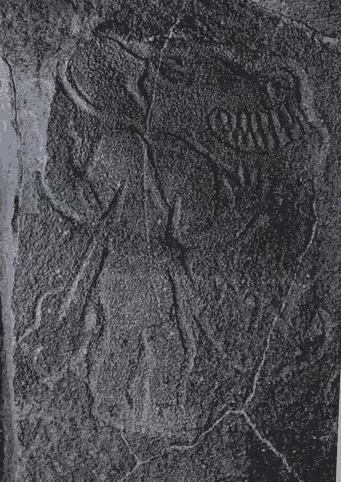
"Lycaon man (width 50, height 72), Wadi Tidoua. 11RV22 Bas-relief of a lycaon man with an oversized head. The creature has human features. It carries an emblem, probably a lion head. Only in engravings of the southern Messak Mellet do such figures convey the impression of worldly chiefs having appropriated the power of the lycaon – the mystical “Robusta” (The Secret Of The Desert, Rudinger and Gabriele Lutz, p. 158).
If you are wondering what lycaon means, Lycanthropy comes from Greek lukos (wolf) + anthropos (man): the transformation of a human being into a wolf, which, according to ancient mythology, took place as the result of magic spells. Werewolf (wer ‘man’ + wulf ‘wolf’): in folklore, a person who takes the shape of a wolf. Were they concieved in the Sahara!
Jebel Uaweinat (Awaynat), in the far south-east of Libya
Ennedi Plateau
Hoggar, Acacus
Tassili
Aouanrhet (masked shamans and religious ceremonies).
Tan-Zoumiatak( in Tin Teka massif: archers, big cats, cattle, figures painted in red ochre).
Jabbaren (giants) (gigantic human figures, one is eighteen feet high, depicting alien-like figures which Lhote called Martians. Lhote have identified at least 12 consecutive civilizations in the Jabbaren area alone. According to Lhote the Bovidians at Jabbaren apparently engraved their pictures before they painted them. All the walls of Jabbaren shelters are covered with pictures, some of which were painted over earlier pictures. The giants depicted, according to Berber Tuareg mythology, could have inhabited the earth before the human race, and feature greatly in many mythologies from across the world. As pointed out by Robert Graves, the ancient Egyptians associated Anubis with the archangel Gabrier Sabao.
Sefar (the Great Fishing God, boats, linked to rock painting from Egypt).
Messak Settafet & Mellet.
Wadi Matkhandoush: very rich in animal engravings (see our Metkhandoush Museum for more on this).
Wadi Alhayat: Garamantian territories.
Tadrart Acacus, pronounced akakous, is well known for two things: its prehistoric cave drawings and paintings, and its alien-like, jagged landscape of bizarre basalt monoliths, towering granite mountains, massive sand dunes, wadis, mushroom-shaped rock formations, and a network of caves, that would have been a better alternative location for Star Wars' Tunisia's troglodyte caves.
GPS
Locating prehistoric paintings and engravings is not easy for most Libyan guides, owing to various reasons, like lack of official documentation of all the art sites in the area and lack of experience; not to say they are as oblivious to these places as they have never visited them before. One can only wonder how many will be discovered after. Lonely Planet has included GPS points for some of the most important sites in its guide: Libya (2007).
Prehistoric Abstract Composition (not actual prehistoric but a painting using real elements).
Further Information about online Libyan prehistoric art sites
The Sahara Journal: Prehistory and History of the Sahara: Scientific, international yearly journal. Articles in English, Italian or French. ISSN
1120-5679. Link: http://www.saharajournal.com/
Italian-Libyan-Archaeological Mission in the Acacus and Messak:
The Libyan Goddess, based on Lhote's White Lady, from the Evolved Round
Heads period.
The original picture (100 X 150 cm) is in yellow ochre and white, with dots on
the body, the shoulders and the breasts. Some of the above pictures are a mixture
of hand-drawn pictures and digital art work. The art
work is based on real prehistoric paintings and all the actual elements of each
picture are real. Some pictures are made of several layers, and were produced
using collage on actual paper and then scanned for digital manipulation. The
black & white ones are drawn by hand, and some were afterwards painted with
water colour. All our images are copyrighted and copying or reproducing
of any kind without prior permission from Temehu.com is not permitted.