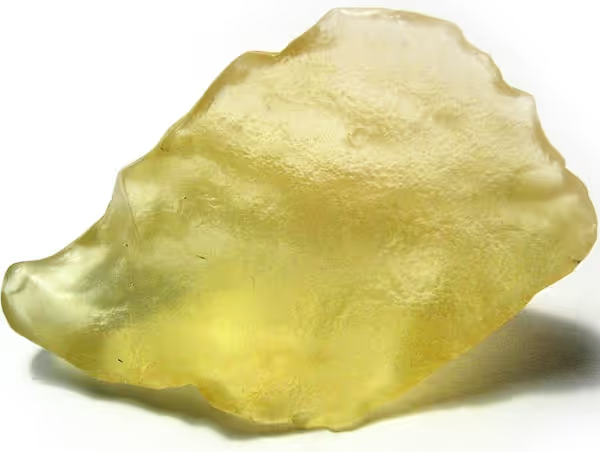
The Libyan Desert Glass (LDG) is a naturally occurring glass made
of silica (silicon dioxide). It is generally found in the Libyan Desert
– the Western Desert of Egypt, widely scattered along the Libyan-Egyptian
border (the Great Erg). Scientists say the glass is the largest known deposit
of natural silica glass on the planet Earth (about 98% SiO2). The transparent-to-translucent
pieces are clear-to-opaque white or yellow-to-green in colour, which glitter
like gems in the bright desert sun. The pieces vary in size from small
to large chunks, weighing up to 16 pounds. The glass was known to the ancient
Egyptians who used it in Tutankhamen's scarab pendant (see below) and who
called it "the
Rock of God"; while according to some sources it was
even known to prehistoric wo-man as it was used for palaeolithic tools,
such as sharp blades, dating to about 10,000 years ago.
Libyan Desert Glass: image from wikipedia commons: found in the Great Sand Sea along the Libyan-Egyptian border. This specimen weights 22 grams and is about 55 mm wide.
The Discovery of The Libyan Glass
Early confirmed reports of the glass were made by members of the survey
expedition led by P. Clayton, who were sent to explore the Sand Sea and Gilf
Kebir in 1932 and to investigate the earlier reports of 1846 as well as to
find the legendary oasis of Zerzura. In December 1932 Clayton (and
his team) was driving across the sand dunes towards the red rocks of the Saad plateau
when suddenly he felt the tyres of his car crunch. Upon stopping the car
and stepping out he came face to face with chunks of the bright glass beneath
the tyre, and therefore confirming that the glass was indeed found scattered
across the Libyan desert, between the high north-south dune ranges of the
south-west Sand Sea (25.25' N., 25 30' E.) Over the next few years he returned
on several expeditions to collect more samples and carry out further research.
The finds were also confirmed by an American-Libyan team in 1971.
Tutankhamen Wadjet pendant, Cairo Museum, Egypt.
The yellow-green scarab at the heart of Tutanhkamen (Tutankhamon) pendant is made of Libyan glass. Apparently the jewel was reported to be older than the earliest Egyptian civilisation and as such it was connected with alien theories. The truth of the matter is that the stone is naturally millions of years older than any human civilisation but the jewel in which it is found is not.
"Crackpot theories linking the pyramids to aliens abound. So I am surprised to learn that one such link has a solid basis in science. It turns out that King Tut's necklace was made with the help of a meteorite. A glass scarab beetle in the necklace appears to have been made from sand melted by a meteorite crashing in the Egyptian desert. The necklace was excavated from the pharaoh's tomb in the 1920s, but no one had any inkling of its meteoritic origins until 1999, when Italian scientists chemically tested the glass. They found it to be made of "Libyan desert glass", which comes exclusively from the Great Sand Sea at the Egyptian-Libyan border."
The Origin of The Libyan Glass
The fission track dates of the glass indicate that it is at least 29 million years old (New Scientist). The origin of the glass is not known, and various theories have been put forward to explain its abundance in the Libyan Desert, some of which are out of this world, literally, like nuclear explosions, Tunguska event, and alien activities. But scientific research, based on the traces of iridium found on the glass, seems to conclude that the glass was formed as a result of a natural meteor impact sometimes in the distant past, or as a result of a comet impact.
A massive [alien] meteor came down hurtling from the
sky like a fireball, crashing somewhere in the Libyan desert,
generating a tremendous amount of heat on impact (at least 1600 degrees Celsius),
blasting the gentle sand up into the sky before it rained liquid glass.
The glass is a form of tektite,
a word which comes from the Greek word tektos, meaning molten. However,
it is not known yet if tektites were first produced on the moon
and then ejected as meteorites which landed on earth or whether they were
produced as a result of impact on earth. Another theory has it that the
glass was not a result of a meteor impact but of a "radiative melting
from meteoric aerial bursts", making the glass analogous to trinitite.
"We made a systematic study (employing INAA, microprobe and mass spectrometry techniques) of several varieties of LDG and locally associated sand and sandstone to provide insight into the nature and formation of these enigmatic glass fragments . . . "Our studies suggest that LDG is the product of meteorite impact into quartz-rich surficial eolion and alluvial sand, and perhaps also into quartz-rich sandstone, of the western Desert of Egypt." (science-frontiers.com/sf064/sf064g09)
However, there are those who say the glass could not have been fused from
the local exposed sandstone simply because both the sand and the dunes are
not older than one million years, while the glass is reported to be around
29 million years old. Also critics say there was no crater found near the
site of the glass, around the Libyan-Egyptian border.
But, according to Mark Boslough, an expert on impact physics
based at the Sandia National Laboratories in New Mexico, using computer software,
estimated that an object about 390 feet in diameter and travelling at 12.4 miles
a second would produce enough heat to melt sand and create glass without leaving
a crater as it broke up in the atmosphere.
However, according to sciencemag.org: (Science 3 March 2006: Vol. 311. no. 5765, p. 1223):
"Now Farouk El-Baz, director of the Boston University Center for Remote Sensing, believes the mystery has been solved. This month, poring over satellite images of the Sahara Desert, he found a gigantic impact crater in the area. At a diameter of 30 kilometers, it's "the largest crater yet found in the Sahara," El-Baz says, and big enough to be the source of the glass, which covers a 60- by 100-kilometer area. He believes the crater hadn't been recognized before because it is so big; also, parts of its rims were eroded by two ancient river systems. El-Baz has named the crater, located on the Gilf Kebir plateau, the Kebira. "This is a large crater and well worth scientific investigation," says Friedrich Horz, a crater expert at the Johnson Space Center in Houston, Texas.