Food in Libya is one of the most important activities of any
Libyan family. The Libyans always say: one must eat well. Olive
oil is the main ingredient of nearly any dish or meal in Libya, and it is almost
impossible to prepare any Libyan food without it. Its use in North Africa
goes back thousands of years, and its healing goodness and life-prolonging properties
were well known to the ancient Libyans and Egyptians. Offering of the olive branch
to the Libyan oracle of Siwa's God Amon indicates its sacred nature and
antiquity.
Its use in Mediterranean diets has always been associated with good health and preventing major diseases like stroke, heart disease and lung cancer. The healing properties are found mainly in the extra virgin olive oil (and virgin olive oil), which is naturally produced, unrefined oil (also called "cold pressed"); while the active ingredients of the second type, known as "pure oil" or "olive oil", were badly destroyed by the chemical processes used to extract the oil.
According to recent research extra-virgin olive oil contains a natural painkiller
similar to ibuprofen (found in headache tablets), and its active ingredient oleocanthal inhibits
the activity of enzymes involved in inflammation just as ibuprofen does.
Olive oil is also widely used as a skin ointment for its healing properties
and in perfumes and medicines. Ancient oil lamps in Libya were also kept alight
by a regular supply of olive oil; adding a bit of salt around the wick prolongs
the life of the lamp and reduces the consumption of oil. In fact the first
commercial advert in the world was said to have been a Carthaginian oil lamp
which went for sale for one penny.
"Your balanced diet is your medicine."
Dates & Date Syrup in Libyan Food
Dates at various stages: yellow when first ripen, dark brown when mature, black-dark-red as date syrup (rreb). The image on the right shows the seed, housed inside the date, which will go on to become another Palm.
There are four main ingredients of traditional Libyan food: olives (and olive oil), palm dates, grains and milk. These are very ancient foods and their use must go back to neolithic times, when humans first began to harvest their produce and make use of the natural surrounding ingredients. Grains are roasted, ground, sieved and used for making bread, cakes, soups, bazin, and other dough-based dishes. Dates are harvested, dried and stored for the rest of the year; they can be eaten as they are, made into syrup or slightly fried and eaten with "bsisa", or eaten with milk as a delicious delicacy. This traditional breakfast was very common in Libya until recently, when many of the traditional dishes and foods began to slowly disappear into the corridors of darkness, and supplanted by modern, bland, fat-rich foods.
Palm dates, bsisa and a glass of milk: prehistoric dish.
Anthropologists tell us that early neolithic societies never
"end the life" of female cattle and that it is always the
male who is subsequently consumed; females are a regular source of both: milk
and more females, to continue the cycle of families. Thus, milk by itself becomes
a meal of its own; and from milk one obtains ghee, yogurt, butter and cheese.
Sahara's slim and dignified Tuareg can easily live on dried dates and fresh milk
provided by the palm and the goat respectively. Date syrup, olive oil, and boiled
dough make one of the most ancient and popular dishes in Libya: "a'eish", "utshu" or "bazin" --
names which also mean "food" and "life".
Libyan Traditional Sand Ovens
Baking Bread in Hot Sand, Ghadames.
The sand in Libya gets really hot in the summer that walking slowly on it with bare feet becomes unbearable; one needs to walk fast just like some walk on embers. Adding some real fire to that, one can imagine the effect on tender dough: instant
baking.
Traditional Tuareg way of cooking bread by burying it in hot sand, which is as effective as an oven. The technique can also be used to bake potatoes (jacket potato) and eggs by burying them whole beneath the hearth. A good shake and a couple of whacks renders the bread clean and ready to eat (see photo below).
Local Libyan Bread From Ghadames.
Modern bread: the one on the right is made in the bakery,
and the one on the left is home-made tajeen-bread, some of which is made of real
wholemeal flour and thus very filling and tasty.
Libyan Black & Green Tea
One of the most important social occasions in Libya is
the daily session of tea drinking.
Brings families together,
to chat, laugh, discuss and gossip about the highlights
of the day
and about life in general. Talking in Libya
is very important social activity; it firmly bonds the
family.
Libyan tea is rather very strong, thick, syrup-like black
tea. After boiling water in a traditional tea pot, one adds a handful
of red tea leaves, and leaves to boil for a long time (ten to twenty minutes).
Remove the pot from the fire, open the lid, add some sugar, and boil again
for a few more minutes. The ready tea is then removed from the fire, left
to settle for a few seconds, and served in small glasses (as shown in
the photo). Normally this is prepared during a chat session, around which
members of the family gather together to socialise for an hour or so before
they each carry on with their own separate paths, and during which one
drinks two rounds of tea (each round prepared as above and lasts about
half an hour). The third round is served with roasted peanuts or roasted
almonds (mixed with the tea in the same glass).
In special occasions and for those who still follow the
old tradition, the tea is first poured into another
mug, and then using two mugs, one continuously empties
the content of one mug into the other and then back
into the original mug for at least twenty or thirty
times, to produce what the Libyans call
reghwet
or
reghwa, which can be translated as froth or foam, which is steadily added to one
glass at a time as being made. After all the
empty glasses are half-full with froth, the hot tea
is poured over the froth and served hot. The trick to produce
the froth is to lift one mug as high as possible,
by stretching your arm over your head, while pouring
the content into the other mug, and then repeat the
process by lowering the raised hand and rising the
other one, and so on until enough froth has been
produced.
After meals, the Libyans traditionally always use green
tea to aid digestion, and also help eliminate stomach
problems after a heavy meal. It really does work.
Green tea is better for you, especially when drank
without milk. Adding milk destroys much of the powerful
effects of its antioxidants.
One of the main components of tea are antioxidants.
The process of oxidation in the human body causes
damage to our cells. A free radical is a charged
atom that steals an electron from a healthy cell
in order to re-establish its own stability, leaving
you with a bit of damaged DNA. Given time, the damage
accumulates and as a result one ages faster or even dies quicker.
Now
comes the important role of antioxidants. They talk to
free radicals and say: hi, I have some free
electrons, do you want some? The free radicals, being
lazy, care less where the electrons come
from and thus happily take up the free offer and
spare your helpless, healthy cells the loss of much-needed electrons.
The process of oxidation
is accelerated by pollution, alcohol and smoking,
and therefore regular supply of green (or red) black
tea and vitamins help keep the supply of antioxidants.
Ask your Libyan guide to prepare some Libyan tea
for you and taste the difference.
The above photo is of a tea session we prepared for an Italian
group while camping in the desert - in Adiri.
Garlic
Garlic and lemons for sale in a local market.
Garlic is also one of the most important items in Libyan food,
as it is usually added to most dishes that involve preparing tomato sauce or
stew, especially for couscous and pasta sauce. It is finely chopped over the
sauce as it boils, just before taking it off the ring (or the fire source) to
preserve its goodness and flavour; and then served immediately while its rich
aroma still in the air. Garlic can also be crushed and then either mixed with
honey and eaten with bread, or mixed with olive oil and spread over food and
salads.
Garlic in fact is the most important medicinal food on the planet. It contains
nearly 60 minerals, vitamins, antibacterial, antifungal and anti-cancer agents;
all of which are vital to human health, and many of
which are said to ward off many diseases and even cancer.
For example, old people take a regular dose of aspirin to prevent stroke,
year after year; but consuming regular quantities of raw garlic thins the blood
and thus prevents clotting - the trigger of stroke. It was said that the Ancient
Egyptian masters prescribed
daily doses of garlic to the labourers who built the pyramids.
The way nature compacted the individual cloves, into one uniform head, is
instantly comparable to a jar of multivitamin tablets - except that the manufactured
multivitamins are said to be devoid of the raw goodness lost in the process,
just as many scientists still think they are a complete waste of money.
Garlic is one of nature's seven wonders of the universe. If nature has already
made them cheaply for us, why smashup our own "expensive" mix?
Is
there anybody in my head that is not me?
Utshu, A'eish or Bazin
One of the main and most popular dishes in Libya. A traditional, and probably neolithic, dish made of dough
and sauce. The dough is kneed into a semi spherical ball and placed
in the middle of a large bowel, around which the sauce is poured,
making the dish look like a rock island surrounded by water.
The Dough: the first stage is to prepare the flour which
then can be stored for up to two years and used when needed:
roast the grains in an empty frying pan until golden brown;
grind into fine flour; sieve well and store away in a jar.
To prepare the dish, take about one kilogram of flour from the
mix, boil about third litre of water in a large deep saucepan,
and then as the water is boiling keep adding a bit of flour with
your hand while mixing with the other hand, using a large
wooden ladle. Once you start this, do not stop, just keep adding
flour with one hand while mixing in a circular fashion with the
other, until the dough becomes hard to stir and the mixture solidifies
into dough.
Remove the saucepan off the ring, take out the dough,
place in a larger bowel, and while wetting your hand
with a bit of water (because the dough retains heat) start kneading
the mixture into consistent dough, just as you kneed bread, and
shape it into a ball, and finally place in
the middle of a large bowel and pour the sauce all around.
It is eaten by hand by breaking a small bit with your fingers,
pulling a small bit down into the sauce and kneading it with
the sauce, before eating.
Doughing: making the dough.
The consistency is solid and thick, where a
bit of force is required to push your fingers through the finished dough. It
is nothing like bread. And if you want a really tough bazin you need to visit
Nafousah Mountain (say Jado) and ask for mountain
bazin - tough and hard to drive the fingers through.
This stiff consistency is achieved by boiling the final dough (after it has been
prepared as described above).
Although in the above photo the cook is using
one hand to mix the dough, usually women sit on the floor, wrap a thick cloth
around the hot pan, and hold the pan between their feet, while both hands holding
the wooden ladle (aghenjay) to mix the dough with their full strength
- something many modern women cannot do, or instead they use white flour wich
produces light and soft bazin, instead of the traditional wholemeal flour which
yields hard dough, we call "mountain bazin".
The dough then is shaped into a solid dome and placed in the middle
of the plate - looking like a mountain down the plain.
The Sauce: any kind of sauce can be used with this. Normally a simple
meat and a couple of vegetables are used as follows: fry two large onions, add
garlic, turmeric, chili powder and tomato puree, then throw in the lamb
chops (or beef or fish), a bit of salt and water, and then cook until the meat
nearly done. Add potatoes and pumpkin pieces (or other vegetable of your choice)
and return to heat until vegetables are done. Add more garlic (usually two or
three crushed cloves), heat for a further minute or two, remove from fire, then
pour around the dough and serve hot - with a squeeze of lemon on
top.
A simple version of white bazin (made of white flour) is normally cooked for
breakfast, but eaten with olive oil and date syrup: instead of mounting the dough
like a mound, spread flat across the plate, then sprinkle with a generous amount
of extra-virgin olive oil and pour some date syrup in the middle (or alternatively
use honey or sugar). Another variant of the dish replaces date syrup with fenugreek
powder - a bit bitter. It is eaten in a similar way: break a small piece of dough,
mix thoroughly with oil, dip into the syrup, and Eat.
The sauce used for this one is made of tomato puree, turmeric, chili powder, potatoes, chicken and fenugreek seeds (still visible at the top). The fenugreek seeds are really unique: strong in flavour and slightly bitter.
The sauce used for this one is made of sour milk (milk that tastes like yogurt) and topped with fenugreek powder. Delicious, to say the least. Again, this is an ancient dish, possibly neolithic.
Libyan bazin with fish & potatoes
Zummeeta
Z'ummeeta or zumita is yet another ancient Libyan dish. It is a doughy dish
made of mixing water with flour until it is firm and doughy.
It is eaten by dipping a small bit, taken by hand, in olive oil,
and with the option of dipping in chili sauce.
It is usually eaten for breakfast, but some times it is eaten
whenever one is hungry, as it takes only few minutes to mix.
The
flour mix is made of whole grain barley or wheat, a bit of coriander and
cumin seeds. These are dry roasted in an empty
frying pan until golden brown, then ground into powder, sieved
and finally placed in clay jars and put away. Normally this process
is done once a year, although the mixture can last for even two
years. Whenever you need some z'ummeeta, just take some flour, add a
pinch of salt, mix thoroughly with a bit of water, spread on a plate, and pour
the olive oil on top - normally with a bit of harisa in the middle as
a dip.
The mixture breaks in the hand nice and easy,
and smells fresh with a hint of coriander and olive oil. The modern way of making
it is to mix the oil with the mixture and serve it already mixed.
Couscous (Kesksoo)
Traditional couscous meal, covered with straw-made cover.
Couscous is one of the most widely popular dishes in Libya and,
for that matter, in the whole of North Africa.
Its recent spread in Europe is a testimony to its unique
qualities and special taste,
rarely found in other dishes.
The dish involves cooking two things: the couscous, made of wheat or barley,
ground into coarse flour just like semolina (but without the stickiness), and
the vegetable and meat sauce to go with it.
The couscous: to start with, sprinkle some salt,
pepper, olive oil and a bit of water over the couscous grains,
then mix thoroughly by hand, from right to left, slowly rolling
the couscous grains into larger balls. Keep mixing and adding
a few drops of water at a time until the balls become round and
about a third the size of a rice grain. Keep mixing in this manner until all
couscous has been used. (Nowadays you buy it mixed and ready to steam.)
Place
the mixture in a special saucepan called "keskas", which is like
a steamer, or a saucepan with lots of holes, and cover with the
lid. This steamer is then placed on top of the other saucepan
containing the vegetable and meat sauce, so that the couscous
will be cooked by the steam rising from the simmering sauce,
thus transferring the flavour to the couscous itself.
The modern,
commercial way of cooking couscous, by placing the ready-mixed couscous
in a saucepan and covering it with boiling water for a few minutes, does not
produce a proper couscous, but some tasteless stuff you buy in
London's supermarkets.
Real
couscous needs to be steamed over a good sauce for the flavour
to soak in, and then needs to be thoroughly mixed with a bit
of extra virgin olive oil to further enhance the flavour, before
covering the couscous with the lamb and vegetable sauce. It seems supermarkets
are there to make super money, and not serve top quality food at affordable prices.
Couscous with meat, vegetables, chickpeas, chips, and a fried, hot green pepper
on top.
The sauce's recipe:
olive oil, water
onion & garlic
spices: chili powder, turmeric, cumin, coriander, salt.
tomato pure
vegetable: potatoes, carrots, pumpkin, chickpeas
lamb meat (or fish, or dried octopus, or chicken): lamb meat is the traditional favourite for its rich flavour.
Heat the oil, fry the onions until golden brown, throw in the garlic, the
spices and tomato puree and mix for a few minutes, and then add the meat and
about half a litre of water and cover the saucepan with the lid and cook for
at least half an hour. Then remove the lid and add the vegetable and the chickpeas
to the sauce, make sure there is enough water but not too much,
so that the sauce comes out nice and thick, and place the steamer containing
the couscous on top and cover with the lid and leave to cook
for a further 15 or 20 minutes on a slow heat.
After that, take the couscous
out of the steamer and pour into a large bowl and leave to cool
for a few minutes, then sprinkle some olive oil and mix again,
breaking the congealed clumps into fine soft grains of couscous,
and place back in the steamer for a further few minutes.
To serve, put
the couscous in a large bowl (if the whole family eating from
one bowl) or serve small portions into plates, cover with the
vegetable sauce (using a good ladle), place a piece of tender lamb on
top of the sauce, then finally fry some finely chopped onions
until golden and mix them with a bit more of cooked chickpeas
and sprinkle the mixture on top of the sauce and the meat. Some
people further place peeled boiled eggs between the pieces of meat, or more
recently home-made chips. Finally, do not forget to eat.
Sacks of dried beans, nuts, seeds and roots in a local market.
Dried
beans and grains are also a fundamental part of food in Libya. Chickpeas are
soaked in water for a few hours, then cooked with tomato and meat sauce for couscous
or added to pasta sauce. Broad beans are cooked in tomatoes sauce and
eaten with bread.
Ikerkoushen
ikerkoushen: cubes of sun-dried meat fried in oil.
The initial preparation of this dish takes a number of days (for the meat
to dry in the sun), but after it was made in large quantity it is stored
for the whole year and used when needed.
Portions
of fresh meat are cut into long strips, spread along the washing line, sprinkled
with chili powder and salt, and left to dry in the sun for a good few days,
until the outside becomes hard. Then they are cut into
small cubes, fried in oil, and stored in clay jars, to
use throughout the year for modest use.
The oil in which they were fried is also added to the
jar, which solidifies like ghee (or butter) to seal the
fried cubes from the air and thus preserve the mixture.
The jars are often kept in a cool,
dark cupboard.
One of the traditional uses is to take a few large spoonfuls from the jar,
into a heated pan, to melt the ghee and heat the cubes, before breaking a couple
of eggs in the mixture and frying for a few more minutes; before serving hot
with crispy bread for breakfast. The dried portions can also be used to flavour
vegetable dishes when meat is scarce.
Mb'atten
Mb'atten is really a Libyan specialty dish, prepared on special occasions, celebrations and festivities, often with Kofta and
couscous. It is a unique dish never to be found anywhere else
in the world (according to our current knowledge).
It is made
of slicing potato lengthwise into thin slices (about 3mm thick)
but keeping each two slices joined together at the base, to form
a sandwich, which will be stuffed with minced meat and herbs
and then fried.
The Stuffing: a good quantity of minced meat (beef or lamb),
about half of the mixture should be meat, a bundle of fresh green
dill, a bundle of fresh parsley, two bundles of spring
onion, a bit of fresh parsley, 3 cloves of garlic (ground into
paste), teaspoon of salt, teaspoon of hot chili, 2 teaspoon of
turmeric, a touch of cinnamon, 3 tablespoons of tomato puree,
and one egg. (Modern variants of the dish do not include dill any more in the ingredients.)
Weighing fresh herbs at the local market. The most common herbs used in some dishes, like Mb'atten, include spring onions, coriander, parsley, dill, and vine leaves (used for stuffing with rice).
Cutting the fresh herbs, to be mixed with mince, egg, tomato puree, spices, salt.
Finely chopped herbs (left), then mixed with mince meat, spices and the rest of the mix (right).
Preparation:
finely chop the fresh herbs (parsley, dill and spring onion) and place in a large
bowel. Spice and season before adding tomato puree, break in the
egg and mix and squeeze (with your hands to force all the juice out of the herbs).
Pour some oil in a frying pan, chop in one onion very fine, and add the mince,
and cook until nearly done (but not cooked yet), and then put the mince in a
bowel and leave to cool down, before finally mixing it with the herb mixture.
The second stage involves preparing the potatoes: slice the potato lengthwise,
cutting one slice three-quarters down and stopping just before reaching the base,
then cutting the second all the way down, ending with two slices of potatoes
joined at the base, each about 3mm thick. Sprinkle some salt on all the slices
and dry with kitchen paper, if wet.
Stuffing the potatoes with the mixture of mince and herbs.
Hold the two slices from the joined end, stuff with the mixture, dip the
exposed stuffing in egg (to hold together while frying), then in flour (just
the edge and not the whole slice), throw in a deep fryer (or in frying pan
with lots of oil), and fry until golden brown.
These are now ready to eat, but traditionally, they can be cooked for a further
few minutes in a saucepan with a bit of tomato sauce, as follows: place all the
remaining potato pieces that were left over from the slicing in the saucepan,
place all the cooked potatoes on top, pour in a bit of tomato sauce, cover the
saucepan, and heat over a very low heat for about ten minutes. This turns the
fried potatoes into soft and sauce-covered delicious chunks, just like adding
a bit of ketchup to chips.
Serve warm with couscous or salad. If there
is a lot of mixture left over, then roll into small balls, flatten onto a plate
containing white flour, then fry in oil as koftas. The stuffed potatoes
are also great cold, after being kept in the fridge overnight.
Summer Salad
Traditional Libyan "slatha" is a main meal eaten with bread,
as a full meal, and not as a side dish. This is a traditional summer salad,
often prepared by the beach, for an easy and light lunch after swimming in the
sea.
Preparation: cut one onion very thinly into a large bowel, chop
five tomatoes into six segments each, cut half cucumber into small cubes, throw
in a handful of pitted green olives, cut one fresh green chili pepper into small
pieces, add a pinch of salt, 3 tablespoons of olive oil, and about half a cup
of water. Mix well to release some of the flavour into the water, squeeze
a bit of lemon, and serve with crispy bread.
Libyan Summer Salad
The dish is eaten by breaking a piece of bread and dipping it into the salad and lifting some of the vegetables with it by folding it over the vegetables. Many of the younger generations nowadays add a tin of tuna to the salad for richer flavour and some protein.
Pumpkins at sale in the local market.
Pumpkins are cooked in tomato and herb sauce with other vegetables like potatoes and carrots (or/and meat or chicken), and served either with couscous, rice or pasta, or even eaten as a dip with bread.
Shorba (Libyan Soup)
Fry
finely-cut large onion in ghee until golden brown; add the meat cubes (beef or
lamb), spices (turmeric, chili, salt, a bit of curry powder, and a teaspoonful of sugar), tomato puree and water, then cover and simmer for about 40 minutes
until the meat is cooked. Add in the orz, cooked chickpeas, and cook for 15
minutes until cooked. Chop a bit of fresh parsley and crush one clove
of garlic and mix with olive oil and add to the mixture just before removing
from fire. Serve with lemon wedges, raw chopped parsley (sprinkled on
top) and crispy warm bread.
T'ajeen or Tajeen
Peel and cut potatoes into thick slices, boil until cooked, crush, and spread
in a "tajeen" (a
baking tray). Fry thinly-chopped two onions until brown, and add the mince and
cook for a few minutes, then add the crushed garlic and spice up with chili,
turmeric, salt and curry powder, and stir and simmer until cooked. Remove and
spread on a large plate and leave to cool. Add to the
potatoes, mix in the beaten eggs, and bake for 20 minutes at mark 180. Finally,
take out from the oven, sprinkle some mozzarella cheese on top and bake for a
further 15 minutes until the dish is covered with a light golden crust.
Boureek: Bureek: Burik
The
Libyan basic boureek, also written as bourik, burik or bourek, is a deliciously
crispy dish, made as follows:
break an egg on a flat piece of pastry
fold the other half of the pastry over to form a triangular shape
pinch the edges together to seal firmly
brush the edges with a solution of egg and water (to prevent the egg leaking out while frying)
throw in hot oil to sizzle for a few minutes
turn over and fry the other side for a few more minutes
then take out and serve hot and crispy
Of
course, there are other flavours of the dish, made by varying the filling, including
one with minced meat. In other North African countries, like Algeria, the shape
of the boureek is like a "spring roll" or a sausage roll.
Libyan Boureek
Lebrak
Lebrak is a dish made of stuffed vine leaves (locally called esselk leaves).
In fact any kind of green thick leaves will probably do the job. The mixture
is made of rice, tomato pure, herbs, spices, garlic, a bit of salt, and either
small pieces of meat or mince. Mix all well, put a bit on a leaf, roll over and
fold the edges, then place in a saucepan, making sure you place a few leaves
in the bottom of the saucepan to take the heat. Once all in the saucepan, you
need a lid that is slightly smaller than the saucepan so that it will drop all
the way down inside the saucepan and sit directly on the stuffed pieces. Then
you need a heavy stone to put on the lid, to keep it down. All this is to prevent
the stuffed pieces from opening up while cooking. Finally put a little bit of
water in the saucepan, not much at all (maybe a small cup), and then place over
slow fire to simmer gently for about half an hour until the rice is cooked. Take
out gently, sprinkle some olive oil, and serve. Really nice cold too.
Mbekbka: Boiled-Macaroni
Mbekbka: quick macaroni:
Instead of the European way of boiling pasta or spaghetti in water and then throwing
the water away (with all the goodness it contains), the Libyans boil pasta with
the sauce, which adds a real pasta flavour to the sauce. You can make it with
any type of pasta, and the simplest dish involves frying onions in oil, throwing
in the tomato puree, chili powder, turmeric, then adding water and salt and leave
to boil, before adding the pasta. But the proper way to do it is to add some
lamb chops, chickpeas and garlic to the sauce. Serve hot with a sprinkle of extra
virgin olive oil, lemon, fresh chili and crusty bread (optional). You can also
add other vegetable like pumpkin, potato and green pepper.
Megetta' (home-made
fresh spaghetti)
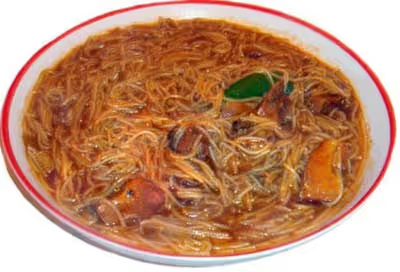
This dish is also probably very ancient. A fresh dough is knead from flour,
and then flattened like thick pastry, (mixing with flour as you go to prevent
it sticking together), cut into small strips as in photo, then cook in tomato
sauce with vegetables and/or meat. You need to cook the vegetables and meat in
the sauce first, and only once these are nearly cooked, you add the pasta and
cook for a few minutes more.
Although it looks like spaghetti, it tastes much better because you can taste
the flavour of fresh pasta and because it is very chewy and delicious.
Owing
to the time it takes to prepare, don't expect your mum to cook this yummy
dish for you as often as she would dry spaghetti. But you can give her a helping
hand, if you want to, and maybe do the washing up too afterwards, if
you are a genius!
Rice
Rice in Libya can be cooked either boiled with sauce, just like risotto, or steamed over a vegetable and meat sauce, just like couscous. The following one is steamed rice with meat, chickpeas and potato sauce.
O's'b'an or Ma'danous
Ma'danous is in a way a thicker kind of herb sausage, made of stuffing intestines
with a mixture of fresh herbs, rice and meat and liver pieces.
Preparing the
intestines: clean the intestines with hot water, turning inside out and flashing
all the way through, then marinate in a mixture of lemon juice and salt for at
least one hour. Wash again, very well. Modern
day women use bleach to clean the belly and the intestines.
The
mixture: take two bundles of spring onion, two bundles of fresh parsley, a bit
of mint, and one bundle of fresh coriander, chop finely in a large deep bowel,
add the spices (chili, turmeric, salt, curry powder, black pepper, a handful
of raw white rice, few spoonful's of olive oil, and then cut in the meat pieces
of liver, kidney, lungs, heart and belly.
Mix the mixture very well, then use to stuff the intestines, tie a couple of knots at each end, and place in a saucepan in which a sauce of tomatoes, spices and salt brought to boil. Remember one thing: before you put the stuffed intestines in the saucepan, make sure you prick them with a needle in few places, otherwise they will explode when the stuffing expands with heat. This dish may not appeal to some, but its unique flavour and rich aroma makes it more delicious than ordinary sausages.
Ghrayba With Almonds
Heat the butter, add the sugar, flour, almond, mix well, cut in diamonds, place in a baking tray, and put in a preheated oven. Once cooked (when it looks firm and slightly golden by the edges), remove from the oven and sprinkle some sugar over the ghrayba.
Leka'ek or Ka'ek
Leka'ek is a kind of shortbread, made of flour, sugar, baking powder, and
olive oil. Once the dough is knead, take a small piece, roll it into a
long round strip, then cut it into short lengths, and roll
each one into a ring. You can leave this ring as it is, or take a knife and cut
small cuts on the outer edge to give it the shape you see on the
left. There are two verities, one with sugar added to the mixture to make it
sweet, and the other is salty, which makes it more like bread sticks.
The one on the left is the sweet one, while the other is the salty.
Watermelons & Melons
Libyan vegetable & fruit market, traditionally built with
tree branches and palm fronds.
Watermelon market, with the scales just by the edge of the road. In the way
back from work, one would often pull over, select a good melon, weigh
it, pay for it, put it in the car, then continue the journey home.
But how
do you know a watermelon is ripe or not? The common practice is to flick your
finger against the watermelon, and if the bounced sound is sharp, and not
dull, then
it is ripe.
Bsisa: Ademmin
Excellent ancient breakfast.
Bsisa or Ademmin, topped with halva.
Bsisa is probably very ancient.
A sweet, rich-textured dish with strong aroma of ground chickpeas, fenugreek
and coriander seeds, mixed with olive oil, and best eaten with palm dates and
washed down with hot black tea. Well-liked by almost everyone, and there is nothing
like it.
The plate on the left contains the powdery mixture before it was mixed with
olive oil (main image, middle), with the oil collecting at the top
with time; which is the traditional way of preparing the sweet dish.
Recipe:
Dry barley
Dry chickpeas
Dry green lentils
Dry broad beans
Fenugreek seeds
Coriander seeds (and/or sweet cumin seeds)
Turmeric
Sugar
Olive oil
Mostly made of ground roasted chickpeas, and handfuls of roasted green lentils,
barely, and broad beans, a bit of turmeric (good for the stomach), a few coriander
seeds; all ground and sieved into fine powder,before finally mixing
with sugar and kept in a sealed jar. The powder can last for the whole year (or
even longer). Whenever you want some bsisa, you would take a bit of powder
into a bowel and mix with extra virgin olive oil until smooth and ready to eat.
The yellow colour comes from the colour of ground chickpeas and turmeric.
Some recipes of bsisa include sweet cumin seeds. Chickpeas are very rich
in iron and therefore important to vegetarians. The fenugreek seeds are very,
very bitter, and their taste succulently stays in the mouth as an after taste
to the sweet bsisa, similar to the zest of a sweet orange that lingers behind
on the tongue.
During the last two decades or so, the practice of mixing the whole powder
in one large jar has disappeared, and instead only a small
amount is mixed as and when needed. The consistency resulting from the mixture,
gradually condensing over time, forcing the oil to rise to the surface (as shown
in the picture), is also lost; and instead it is now mixed with too much oil
to achieve a "runny" consistency, which apparently the new generations
find easier to digest.
Fenugreek powder has also disappeared from the list of
the ingredients, possibly due to the bitter taste.
Instead, there are those who add almonds, honey or halvah - which is a similar
sweet of its own, made of crushed sesame seeds, flour, sugar and oil.
You can eat it in its own, two or three table-spoonfuls at a time, not more;
but traditionally bsisa is served with palm dates (either fresh, or slightly
dipped in fenugreek powder and fried in olive oil) and a glass of milk, or
the all-favourite: a cup of hot black tea.
Magrood
Filling: mix one pound of dates (paste) with one teaspoon of cinnamon and three tablespoons of olive oil. Take a handful
of the mixture and shape into a small ball, roll into a long
thick strip.
Dough: mix about 4 cups of semolina, one
teaspoon of baking powder, half a cup of flour and one
cup of oil. Mix into soft dough and roll into a shape of a loaf. Press a deep
line along the middle of the loaf, and stuff with the date mixture and roll again
into a closed loaf (this keeps the date mixture inside the dough), then cut into
diagonal, 2 inch pieces (like diamonds), and place in a baking tray.
Bake in a preheated oven at mark 200 for about
35 minutes, or until golden brown. Take out of the oven, and
while still hot pour the sugar syrup and/or honey over the
whole pieces, and leave to soak
for a while, before serving.
Seafood: Fish & Squid & Octopus
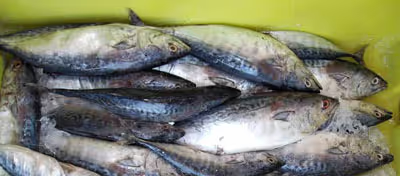
Libyan diet is also rich in sea food, like fresh fish, and sun-dried octopus
and squids. Couscous with dried octopus is an old delicacy the new generations
seem to gradually leave behind; probably due to the fact that this dish requires
a long time to prepare. First, the octopus needs to be dried in the sun for days,
then cut and preserved, then boiled in water for a couple of hours (or until
tender), before finally adding it to the tomato and herb stew. Once flavoured
with garlic and olive oil, couscous with octopus stew is really something special.
The main types of fish used include the following:
Ambuka (Lambuket)
Azdouz
Awragh
Azday
Flower and plant market. The Peugeot 404 is very characteristic of Libya.





2.avif)
