The House of Karamanly, or al-Qaramanli
House, was built in the second half of the 18th century, during the reign of
Ali Pasha Al-Qaramanli, and was used by Yousuf Pasha until his death. The house
was restored during the early 1990s and became known as Tripoli Historical
Exhibition.
The house includes a fine fountain and mosaic-covered walls, with two floors:
the ground floor comprises four rooms, including Assaddah Room, which
is a room with a built-in wooden bed usually one meter high from the floor; a
guest room; clothes room; toilet; and a kitchen. The first floor contains Dar Alqabou,
which houses the Karamanli costumes and furniture from that period; the Bedroom
(with traditional bed and embroidered cushions); Historical & Traditional
Weapons Room, containing models dressed in traditional costumes from all periods
of Libyan history; and Dar Alarasah (models of instruments used by the
Sufis).
This house is located in Tripoli's Old City (Al-Hara), and was built in the
second half of the eighteenth century, during the rule of Ali Pasha Qaramanli
(1754 - 1793). Previously the house was known as "The
Harem House"; while during the second era of the Othomans
it was occupied by the Consulate of Tuscania. In the 1994 the house was restored
by the Old City Project, and consequently was rehabilitated as a cultural sight
under the name of "Tripoli Historical Exhibition",
and officially inaugurated on the 27th of October 1994. The
house houses a good selection of the objects normally found in a Libyan house
from that period, including furniture, kitchen gear, copper and brass ornaments,
clothes, jewellery, and vintage gadgets such as a gramophone, telephone and a
radio. The name Qaramanli is written in various forms including Al-Karamanli, Caramanli or Al-Qaramanli.
The Qaramanli dynasty consisted of a number of rulers generally known as Pashas,
who ruled from 1711 to 1835 in Tripolitania and later in Cyrenaica and Fezzan.
The dynasty was founded by the Turkish Ahmed Pasha Al-Qaramanli, and ended by
Ali II Pasha Al-Qaramanli.
The above old notice showing entrance and camera fees.
Entrance Fees: 2 LYD; normal camera permission 2 LYD; digital & video
camera permission 5 LYD. Current Entrance Fees: 3 LYD; camera: 5 LYD; video camera:
10 LYD.
The main entrance to the museum house.
The entrance door to the house.
The Karamanly Dynasty (1711-1835)
Ahmad I Pasha (1711 - 1745)
Mehmed Pasha (1745 - 1754)
Ali I Pasha (1754 - 1793)
Ali II Burghul Pasha Cezayrli (1793 - 1795)
Ahmad II Pasha (1795)
Yusuf Pasha (1795 - 1832)
Mehmed (1817)
Mehmed Ibn Ali (1824)
Mehmed (1826)
Mehmed (1832)
Mehmed Ibn Ali (1835)
Ali II Pasha (1832 - 1835)
The Living Room
Man and a woman in traditional attire, sitting around a mirror.
The Bedroom
Dar An-Namousiyyah
This sign says: "The Bedroom" (Dar An-Namousiyyah).
Stylish bed with embroidered sheets and hanging curtains.
A lady sitting in her bedroom, nice and tidy.
The Clothing Room
(Dar Al-Albisah)
Traditional barnus (hooded cloak).
The Kitchen
A traditional kitchen cutlery, pots and other cooking utensils.
The kitchen was restored recently to include traditional kitchen cutlery
traditionally found in Libyan kitchens, including the stone quern (the pistle & mortar),
wooden bowls, copper and brass aparatuses and paraffin stoves, and clay pots
and jars.
Old copper paraffin stoves.
Large clay jars.
Large copper pot.
Copper & brass ornaments in glass display cabins.
Brass water heating stoves.
Vintage brass and copper heaters and lights.
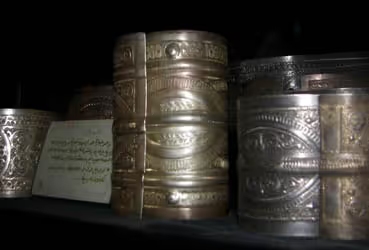
Silver & Gold Jewellery
Amber necklace.
Traditional Libyan silver jewellery, showing the hands and the stars.