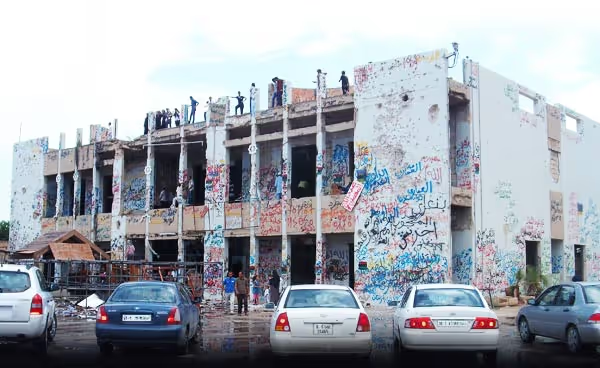
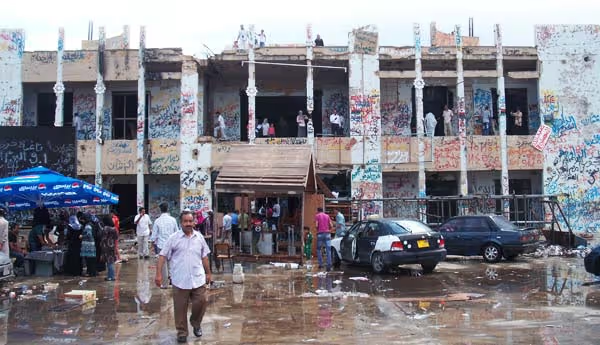
Above: Libya's Conflict Museum: photo
from the Metropolitan Workshop (metwork.co.uk) - 2009 - 2011?
The Conflict Museum: Libya
Freedom of speech cries for true revolution:
freeing the mind.
Background
The war museum was envisaged by Gaddafi's
government to house some of Libya's rich war heritage, from the
colonial periods that attended to Benghazi's utter devastation and the fake
independence of installed king Idris (and his pompous Turkish pashas in
their hopeless reign), and down to the staged September Coup, which Gaddafi
called "white
revolution" but
many Libyans came to see as yet another hapless "foreign operation".
The Saudi King pointed with his index finger:
"men jaabek lilhokom, men jaabek lilhokom" ('who brought
you to power') when Gaddafi called Arabia the agent of Satan in
the Arab League. The NTC itself was
installed by the UN-bomb to send Libya back to square one, in
a "troubled foray" the foreigners
call the "Arab Spring",
the spring that sprouted with metal stings, the sad fall that turned
Libya into a "Jihadist
Wonderland" for
world terrorists to reap, the "unintended mistake" of
the world's diplomats; whilst leaving the Berbers no more than the usual "agents
of foreign agenda" in their own home.
Installed Gaddafi was indeed shortsighted to start his museum
from the recent colonial history, since the wars in and on Libya go all the way
back to prehistory. The Ancient Egyptians, the Phoenicians, the Carthaginians,
the Sea People, the Greeks, the Romans, the Arabs, the Turks, and
the barbarians of medieval Europe and their modern colonial intruders
have all had their share of the Berber spoils. That is why the indigenous Berbers
still are to this day scattered across ten North African countries (occupying
nearly half of Africa) without an official "identity" and without
the free will to determine their own destiny – just mere hamlets waiting for
overdue justice to be served, by the masters of course and not by the slaves.
Even recent America fought its first ever foreign war in
history in Libya, namely The
Barbary Wars of Tripolitania,
where the phrase "the shores of Tripoli" still is memorialised
in the Marines' Hymn. Ladies and gentlemen, Libya is thus the Museum of War.
WWII Tobruk: vintage weapon of medium destruction (wmd*)
Design
The spectacular design of the
conflict museum, by London's Metropolitan
Workshop, employs dynamic and environmental technology,
aesthetic principles, powerful desert landscape, impressive nomad camps,
and a camouflage veil draped over the structure, eerily illustrating the
point in disguise; with some parts below the ground, incorporating unique
mixture of angled exterior skins, interlocking square floors, and shining
gallery terraced-spaces; spiraling to the top, contrastingly aspiring contradictions
of conflict: "conditioned" & "non-conditioned" spaces
existing in harmony!
The entrance
to the Conflict Museum even has a lovely remembrance poppy field
to wholeheartedly welcome Libya's peaceful visitors from far afield.
Galleries
Ground Floor: weapons of medium destruction: wmd*,
large-scale exhibits: planes,
bombs, torpedoes, cannons, tanks, field guns, guns, bullets,
etc.
First Floor: uprising against colonial imperialism,
and struggle movements and heroes of the Italian resistance!
Second Floor: the 1st of September
1969 'Operation'.
Top Floor: exhibits, photos and literature on
reconciliation, peace, remembrance, tolerance and diligent
dialogue.
The museum complex also includes a Library,
Reading Room, offices, conference hall, canteen, conservation centre, museum
shop and prayer rooms.
Odysseus'
eyes.
Cost:
$33,761,666 Area:
15,000 sqm
Location:
the museum was intended to be built on the green belt, near the General People’s
Congress hall (The GPC).
Construction Versus Destruction
The construction of the Conflict Museum
in Tripoli was envisaged to begin sometime before September
2009, and was hoped to be finished by the end of 2011.
By the time the February Operation was nearing its expected end,
as war-torn Libyans were left to pick up the pieces and heal their deepest
wounds without "any means", the scheduled
deadline for the conflict museum to open was lost in the conflict. Initially,
we have setup this page (just with the above information) in anticipation
of the opening, but due to the war
the museum project was never completed. This means that the museum does
not exist in the real world yet.
Instead of leaving our online
museum vacant, Temehu.com took a step further to occupy the museum (for the
time being) with factual conflict information, war imagery and damage inflicted
for freedom & chaos; and chose 11/11/2011 the
day to open the online war museum in remembrance of
this historic year – the 11th year of the third millennium that dearly
transformed Libya in so many ways. We have also included photos from Misrata's
War Museum – one
of the new war museums that sprung
up in the spring after the February
War. The Dictator's
Crimes Museum, in Benghazi, is housed inside the palace
from which King Idris was made to declare the fake independence of Libya
in 1951.
The 2011 February War
What started as peaceful protests by Libyan women and children
was quickly transformed into a gruesome armed rebellion against
government troops, before it broke out as an international war, Africom's
first war in Africa; authorised by the UN and involved 18 countries
(representing nearly 50 countries from three world unions: the United States
of America, the European Union, and, of course, the mostly-dictatorial Arab
League).
The coalition's air force was guided by "special" boots on the
ground (CIA,
Qataris, General-Advisors and Special
Forces), "training rebel groups" and pin-pointing target
coordinates for pilots in
the sky; when Resolution 1973 specifically excludes any "foreign
occupation force of any form on any part of Libyan territory". Apparently
using local rebels as soldiers not only saves money but also "wins
popularity at home".
Roaming Libya's sovereign sky, allegedly in hunt of "command & control
centres", UN-mandated
forces blasted 26,000 sorties, 9,600 missile
strikes, and 5,900 bombing missions; reportedly
demolishing government buildings, pulverising military convoys, and destroying
Libya's entire infrastructure including bombing Libya's TV station (where
3 journalists were killed and around 20 more were injured, despite the UN's
1738 (2006) Resolution condemning acts of violence
against peaceful journalists during conflict). It
was also reported that Apache helicopters were
used to take out targets on the ground; and that "retreating" convoys
were pulverised seemingly in conflict with resolution 1973's
Article 4, which calls for protecting civilians "under threat of
attack".
Hence, it was no secret to Lord
Dannatt that "The mission under UNHCR 1973 is . . . to protect
people but of course the implied task . . . is the removal of Colonel Gaddafi";
while Russian officials accused
the allies of overstepping their mandate by helping rebels overthrow Gaddafi
via a UN resolution which they compared to "medieval
calls for crusades".
The result however was "complete destruction of Libya's infrastructure" as
well as pulverising Gaddafi's regime and ending in his grotesque death. The stench of
his rotting body, left in a meat locker with putrefied liquid trickling beneath,
had attracted onlookers to Misrata queuing for 20 Libyan Dinars;
and in a secret grave in the desert he was buried to disintegrate, allegedly
to avoid the contrasting conflict of his enemies' desecration and his loyalists
instigating a shrine for the world to see.
It was initially reported that at least 30,000 Libyans
were slaughtered during the war, and a staggering 50,000 were
wounded, 20,000 of whom were seriously injured. Fifteen
months later, the newly-created Libyan Ministry of Martyrs & Missing
Persons had reduced the figure of dead rebels down to 4,700;
before Dr. E'sam Zerieq (a technical manager at the Martyrs Ministry) finally confirmed the
total number of martyrs to be 5,517. It seems evidence
inventing "such figures" are good for venting further conflictive
events!
Nearly 500,000 Libyans
fled their homes to Tunisia due to the effects of the war, and to the combined
events created by the harsh sanctions and the scorching heat of the Libyan
sun. More than 150,000 Libyans were displaced from
their homes including the entire population of "black" Tawergha,
due to "revenge events", and the brutal humanrights violations
endured in the name of "Free Libya" and "protection of civilians".
In addition to the physical damage, the "military
events"
had a devastating effect on the mental health of hundreds of thousands of
[protected] Libyan civilians. Researchers at Queensland University (UQ) have
predicted that 123,200 Libyans
may suffer from severe PTSD (post-traumatic stress disorder), and more than 220,000 are
predicted to have 'severe depression' as a direct result of being exposed
to a high level of political terror and traumatic events. A
few years later the UN was eager to inform the world that 2.4
million Libyan civilians are in need of further protection, and around
40% of Libyan children ARE in need of psychological assistance as a result
of the violence initially authorised by the UN.
Regarding structural destruction, the installed
NTC had estimated the extensive devastation of Libya's infrastructure will
require no less than ten years of intensive restructure to get back on its
amputated feet; while bankers and financial vultures had calculated the damage
will require no less than $400,000,000,000 to
put back the way it was before the war.
The most terrible event however is the effected social disaster: the infestation of our beloved
Libya with foreign radicals; the growth of human rights violations;
robbers and criminals left to roam across all Libya's borders with 6 African
turbulent countries; financial corruption in billions; morality down the
drain; trafficking in
"humans", arms, suicidal Tramadol, and narcotics rocketing
to the sky; crime shooting up by 500% (including
murder); violations of women and holy shrines; and, of course, the "disrespect" of
the old generation by the euphoric teenagers of the latest imposed
disaster.
The worst effected result of the UN-bombing campaign
and the ensued war is the division of Libya into mutual enemies
at the top of which sits the loyalists, followed by religious groups, then
the federalists, the Berberists, the Tebu, and the secularists among other
victims of revolt; and thus it is evident from the grotesque murder of
Gaddafi (when most Libyans preferred to see him defend himself before the
courts of law) and from the way the war was orchestrated that hatred, revenge
and the clash of militias will dictate the future of Libya for many years
to come.
Libya's Acting President,
Dr. Magarief, warned his sons to open their eyes, think first, and "not
be pawns on others' chess board" -
just before his resignation on the 28th of May 2013; albeit too late having
swallowed the bait. Dear Libyans no matter what the UN did or still does
violence is not the answer and the only way to defeat the smart, anonymous
enemy is not to fight each other no matter WHAT.
WWII Tobruk Vintage WMD*
Rewinding back to 1911 and the
Two Wars, Libya was the stage on which
a number of crucial battles were orchestrated for the control of the
Suez Canal, as it was also the home of both the longest ever
siege in Allied military history, and the bloodiest and most brutal African
confrontation in
"colonial history". During the "Libya Wars", "the
longest resistance to European colonialism", more than 100,000 Libyans
disappeared in Mussolini's fascist dungeons, while the Berenice of the
Eusperides was bombed more than 1000 times.
After
the hopeless Lausanne Agreement of the 18th
of October 1912, without consultation with the Libyan people,
of course, Turkey signed a deal with Italy, "granting" independence
to Libya; only for the Italians to return with vengeance to capture
Tripolitania, take Misrata, ransack Benghazi, and humiliatingly hang the
symbol of resistance Omar al-Mukhtar on the 16th of September 1931 -- 9 years
after Emir Idris Sanusi fled to Egypt. Prison camps were set up for those
who refused to give up the fight, where the Barayka Camp alone imprisoned 80,000 Libyan
freedom-fighters, 30,000 of whom died within two
years of capture.
The humiliating display of wrongly hanging an old man: Omar Mokhtar.
Second World War Cemetery, Tobruk, Cyrenaica.
"The Rats of Tobruk", "the Butcher
of Fezzan", "Lady
Be Good", and the "Fig Tree Hospital" are only a
few names that persist in living memory, but the worst to stay is the staggering 60,000,000 humans,
or so, slaughtered worldwide during the deadliest man-inflicted massacre in history. 40
million of these were civilians, 13,000,000 of
whom were mostly children died of effected starvation and painful war-inflicted
diseases; all too reminiscent of the 1,000,000 civilians
died in Iraq by the agonising diseases effected by the war.
Italy's representation of the takeover of Turkish Libya:
Libyans on their knees before the proud Pashas.
Chromolithograph of the Italo-Turkish War peace treaty, 1912;
source: Lombardi Historical Collection (via Wikipedia),
The Rossotti Litho & Printing Co.
Libyans ought to know better than anyone
else that only peace can defeat war.
Lady Be Good, Tobruk.
(1)
Tripoli
Gaddafi's Home in Tripoli
Some Libyans speak of creating a Human
Rights organisation on the site, to defend the Berbers' rights, presumably;
while others prefer to see a recreational park for children to play and for adults
to relax. A flea market has been set up before the house to revive the besieged
economy!
The graffiti mainly consists
of names of militias, armed groups, brigades, names of individuals, towns and
villages including but not limited to Jado, Zuwarah, Zintan, Zawiya, Misrata,
Yefren, Nalut, Gheryan and Benghazi. Plus the usual Libyan floor on top.
Writing
new kind of history for New Libya, the indigenous history all other Libyas were
made to erase. Tifinagh signatures:
Nalout (first from left), azoul ('hello', second), Tamazight (last),
with the names of Jado and Nalout (all in red).
Gaddafi: born in 42 & ruled for 42 years; installed in 69 &
removed at the age of 69.
Assuming demolishing the house is a symbolic gesture of destroying
the old, the next question the Libyans need to answer
is: who will lead the Libyans out of the quagmire,
if ever?
(2)
Zuwarah (Zwara)
Zuwarah: streets strewn with brass bullets.
Zuwarah
Zuwarah Fighters Workshop, stationed by
the sea in a building that was originally a school.
Zuwarah Fighters improvising rocket launchers; please do not try this at home!
The aluminium launcher (left) was originally attached
to a military helicopter. The fighters dismantle it, take it to the
workshop, weld a mounting base, attach an electronic control to program the
number of rockets to fire, and presto: ready to go.
Here is another "do not try this at home" device,
used by Zuwarah fighters to halt the advances of Libyan government doomed troops:
six gas cylinders, with dynamite in between, placed
on the road and ignited just before the tanks grind their way forward across
the tarmac. Since Zuwarans are fisherman by nature and use dynamite
as well as nets for fishing, it emerged later that some
of the government soldiers were more bemused than afraid, as they
sarcastically spoke of not being fish.
Zuwarah
Zuwarah: celebrating the capture of Gaddafi on the 20th of October 2011.
Tamort n At Willoul n Tilelly.
The Berber flag flies free over the Town Hall in Zuwarah; the seat of local
authority.
( 3 )
Zawiya
Andulus Celebrations Hall
Zawiya
Martyrs Square, Zawiya, where one of the fiercest battles took place.
Zawiya
Zawiya
The sign in the poster says: "Freedom
is Our Demand".
The black writing below the poster calls for: "Our Youth We
Call Upon You to Protect Libya"; in contrast to the background
men built across the generations. Naser, the man carrying the slogan in the poster,
has become a national symbol of the February Uprising, as the poster spread across
Libya.
Dressed in the manner shown in the poster, Naser joined the fighters
of Zawiya in Martyrs Square on a horse. The horse fled back to his owner's home
as soon as machine guns cut through the sky and tanks punched
holes in walls.
Retouched.
The sign says: "No to weapons; yes, yes to the law."
Held by demonstrators in Tripoli on Wednesday the 7th of December
2011.
(4)
Misrata
Misrata, made by the "Revolutionaries of The Central
Workshop".
The photo's shadow was slightly retouched!
A metal crossbow, improvised to fire arrows capable of detonating
targets in high places, such as top floors of tower blocks; made by Misrata's "Central
Workshop's Revolutionaries".
Ammunition in display at the War Museum in Misrata.
Ammunition in display at the War Museum in Misrata.
Bab Aziziya "Golden Fist" (left) in display at the war museum in Misrata.
Misrata War Museum: display of ammunition and war junk.
The Golden fist is visible at the end of the photo.
A bulldozer shielded with metal sheets to protect fighters from incoming fire.
Carries the name: "Protection
or Reinforcement Unit"
(5)
Sabratha
Sweet Shop, Sabratha.
Sabratha: this building was just completed before
the turbulent uprising. A sweet shop was operating from the ground floor. The
building was used by Libyan government snipers to take out the fighters. After
long exchanges of hide and seek, the fighters lost patience and blasted the
building with their missiles.
(6)
Arson Attacks on Banks
Jamhouriya Bank, Sabratha.
Apparently; there were quite a number of banks attacked during the uprising in
Libya, including the commerce bank in Benghazi, where one of the
largest thefts of archaeological material in history took place, in May 2011,
in NTC-controlled Benghazi, Libya.
The Commerce Bank, Zawiya.
Jamhouriya Bank, Zuwarah.
(7)
War Screen Shots From The Media
Tripoli: image source: Reuters.com
Image source: screenshots from al-Jazeera news video. Mesrata Street: Cause & Effect.
Image source: www.reuters.com
One of the first photos of the war in Libya that captured the headlines from
around the world.
The boat of freedom sails away off the shores of Zuwarah towards
its desolate destiny: Berber offshore.