The Sultan's City 50 km east of Sirt (Surt);
coordinates: 31.09306°N 20.22361°E / 31.09306; 20.22361.
The Name Sultan
The name As Sultan, Es Sultan, Al Sulţān, or Sultan, means 'king, ruler or sovereign', especially one from the Turkish Ottoman empire, when the word entered the English dictionary in the 16th century. The name sultan is a popular person name in the whole of North Africa and the Middle East, which because it implies power, status and kingship, one may also associate it with the ancient Egyptian Suten. Strangely enough, the name Sultan (in English) also means "a variety of small white domestic fowl that originated in Turkey", where the guinea fowl went on to become the Christmas turkey.
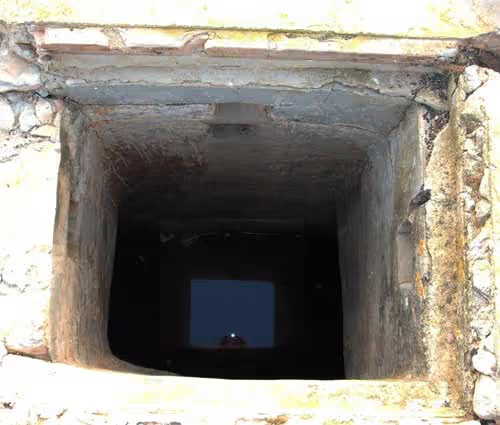
Excavation site at Sultan.
History: but why this particular place was named "Sultan"?
The area once served the Islamic Fatimid rulers
(the sultans)
with a strategic command point, ideally located between Libya's three provinces:
Cyrenaica, Tripolitania and Fezzan, and as such was also an important trade city
for the trans-Saharan caravans coming from the Sahara and sub-Saharan Africa.
It is plausible that the reason the Fatimids rulers chose the site as a command
post can be attributed to the historical records indicating that after subduing
Cyrenaica the Fatimid generals were met by heavier opposition in Tripolitania,
and as a result retreated to the border area between Cyrenaica and Tripolitania.
Indeed, as we shall see below, this area was the official border between the
Greek-run Cyrenaica and the Carthaginian-controlled Tripolitania.
Originally the town was part of Ajdabiya District between the years 2001 and 2007, and between 1987 and 1995 when it covered a much larger area, with its capital at
Ajdabiya city. It is found along the coast of the northeastern part of Libya, after Surt and before Benghazi. Since 2007 this district was renamed Alwahat District (the Oases District), bordered by the districts: Alhizam Alakhdar (the Green Belt), Alkufrah, Aljufrah and Surt (from the west). The rising town has a number of interesting landmarks, archaeological sites, remains of a large mosque (probably from the Fatimid period), Byzantine ceramics, Islamic pottery, stone reliefs, and a number of exhibits from the arch including the bronze statues.
Marble relief from the Italian Philaeni Arch.
The Triumphal Arch (Arco Philaeni)
The 5-meters-high Triumphal Arch was built by the
Italian Italo Balbo (1896-1940), in dedication to the Philaeni brothers,
some 200 miles west of the original site near Ras Lanuf, where the foundation
of the arch is still visible as flattened grounds on either side of the road.
After the 1st of September, the government declared the work a "fascist
symbol of colonialism" and was
destroyed.
A scene showing a farmer ploughing the ground.
These stone reliefs formed a collection of scenes which once decorated the arch. The above one shows Mussolini standing on the left of the panel (second from left) and saluted by one of his soldiers (second from right).
The Hollow Bronze Statues of Assultan Triumphal
Arch
The Philaeni Brothers bronze statues, once part of the Triumphal Arch.
But who are the Philaeni Brothers?
The name Philaeni means: lovers of praise.
The Sultan area is a strategic location linking all the three provinces of Libya
at the shortest distance from the heart of the Sahara. In ancient times, it was
the border area between the regions of Tripolitania and Cyrenaica. Since the
Carthaginians were mainly in the western part of Libya, and the Greeks in the
eastern part of the country (Cyrenaica), then it was only a matter of time before
border dispute erupts. The Philaeni were two Carthaginian brothers who gave their
lives to settle the border issue between the two powers.
The wars lasted for a long time, without either side silencing the other. Somehow, the two colonies decided to settle the matter and draw an official border between the two states. They agreed to send runners from their capitals (Carthage and Cyrene) at a fixed time, and take their meeting point as the official border between the two territories.
Apparently the Carthaginian runners, the two Philaeni brothers, had done better than their Greek counterparts and advanced much further into Cyrenaica (and reached somewhere near Ras Lanuf) than the Greeks did into Tripolitania. Subsequently, accusations of cheating were exchanged - a kind of milder continuation of the earlier war proper.
Rather than return home defeated, the Greeks gave
the Carthaginian a choice: either the two brothers accept being buried alive
at the spot they claim they reached as the boundary between the two countries,
or else accept the Greeks right to advance into the Carthaginian territory as
far as they desired. The Philaeni brothers honourably stood by their word and
gave up their lives for their country and accepted to be buried alive on the
sacred spot. Hence, one of the statues is facing Cyrene, while the other looking
towards Carthage; they lay dead in between.
References & Further Resources
Excavations at Surt (Medinet al-Sultan) Between l977 and l981: Geza Fehervari with contributions from 'Abbas Hamdani, Masoud Shaglouf, Hal Bishop, John Riley, Muhammed Hamid and Ted Hughes. Edited by Elizabeth Savage. 2002. 120 pp. + viii, 11 figs, 45 pls (some col), foldout plan. 200 x 253 mm. Arabic summary 7 pp. ISBN 9781900971003