Cyrene is a beautiful site situated across the hills of Libya's Green Mountain.
Cyrene: the temple of the Sun-god Zeus, 6th century BC, rebuilt during the 2nd century AD. The largest Greek temple in Libya, and the second largest temple dedicated to the god Zeus.
Key Facts About Cyrene:
Cyrene: Athens of Africa.
Local names of the city include: Qurina, Qourinah and Shahhat.
Greeks' Arrival: 631 BC.
Cyrene was a Libyan Amazon Queen.
Prospered through the silphium plant.
Cyrene was one of the largest cities in Africa in the 4th century BC.
Temple of Zeus (above picture) was larger than Athens' Parthenon.
The rulers of Cyrene include: Cleopatra, Alexander the Great, and Marc Antony.
A series of turbulent rebellions sent the city in turmoil in the 2nd
century AD.
The city recovered under the patronage of the Libyan Emperor Septimius
Severus.
Cyrene was named Unesco World Heritage Site in 1982.
One of the top archaeological destination in Libya today.
The Greek Invasion of Cyrene
The Greek invasions of Crete and Rhodes of the 9th century BC were shortly followed by their invasions of Cyrenaica in Eastern
Libya.
The city of
Cyrene
was a Greek colony, built in the seventh century BC
(631 BC) upon the oracle advice of Delphi, on one of
the best verdant regions of Eastern Libya's Green Mountain,
by
immigrants (or refugees according to some sources) from
the island of Thera (Santhorini).
However, there
was also a failed attempt to colonise Tripolitania under
the command of Dorieus, the king of Sparta, who
reached the River Cinyps (Wadi Caam), just east of
Leptis Magna, in 520 BC and founded a city by that
name. They were kicked out three years later by the
Carthaginians (Berbers
&
Phoenicians).
The prosperity of Cyrene was founded
on the silphium plant,
pictured on Cyrenaican coins, where it resembles a stylised
leek or a sunflower. The plant once grew only in Libya
and apparently its extinction was a grievous blow to
the city's economy.
Libyan Amazonian Cyrene:
The city is locally known as
Qurina: (QRN)
>
*Qyrne
>
Cyrne (CRN). But Cyrene was also one of the Libyan Amazon
queens who, according to legend, founded a city with that name (Cerne) along the coast. The Greek goddess Ceres, a Hellenic form of African Isis, the Corn-goddess, the goddess of fertility, was also known as Qer,
Ger or Cer, and therefore Qurina appears to be the Libyan
form of Qer.
The Greek Version of the Myth of Cyrene
According to the Greek version of the founding myth, the nymph-huntress
Cyrene, whom the Greeks knew as Kurana (cf. Qurina), was spotted by the
Sun-god Apollo wrestling with and subsequently strangling
a lion in the jungle, and he immediately fell in love
with the courageous princess. Typical of most Greek
gods Apollo did
what Zeus normally does, and so he abducted the beautiful
princess, threw her in his golden chariot, and flew to
a site that eventually bore her name. To make
the region safe for settlers, the followers of the god
built
the Temple of Apollo, whence probably the port of Apollonia nearby. Like Graves had brilliantly pointed
out in his Greek Myths, abductions and rapes point to physical
invasions in the real world, and as such Apollo's abduction
of Cyrene could point us to the fact that the Greeks had
invaded an already existent city with that name, which we can,
with some reserve, identify with the above Amazonian
city. The evidence for this could also come
from the myth itself: building a temple for Apollo to protect
the settlers indicate that the place originally was inhabited
by locals whom the settlers needed protection from.
Cyrene's Amazonian connection is also hinted at by the fact
that instead of the usual household tasks
of weaving and cooking, the nymph Cyrene
was strongly passionate about
"manly"
activities, such as hunting wild beasts; and
therefore the fact that
Libyan nymph was seen by Apollo wrestling a lion could
only point to her being an Amazon
princess.
One of several pieces found in Cyrenaica, which show
the Libyan Amazons.
This particular one, currently on display in
Tolmeita Museum
, was found in Wadi Khamish.
Archaeological Evidence
But given the advanced state the city had attained during its short period of Greek occupation, and given the fact that Leptis Magna, Sabratha and Tripoli were all in existence well before the arrival of the Phoenicians, and later on the Romans, one can safely assume that the city was in existence way before the Greek invasions. During the excavation of the Roman Theatre, it was found to have been built on top of an old market, which one is naturally led to think that it was a Greek market. But then archaeologists have further discovered that this market itself was also built on an earlier market or structure. In fact this practice was so rife in the ancient world that almost all the religious sites, like temples and churches, were built over the earlier pagan temples, for more than one reason: to prevent the locals from continuing the worship of their gods and goddesses is one of them. Recent researchers were also puzzled by the fact that some of temples and tombs found in Cyrenaica were far more advanced than similar ones from Greece; indicating a south-north flow of culture rather than
the presumed north-south.
The Temple of Goddess Demeter.
The Temple of Goddess Demeter
Two hundred years later, the Greeks established four
more cities: Apollonia (Sousa), Ptolemais (Tolmeita), Taucheira (Tokra)
and Berenice (Benghazi). When the Romans took over, or were handed over,
the Cyrenaican area in the first century BC, they called the region the
Pentapolis (The Five Cities). Among the best attractions are the landscape
of the area, the Eastern Basilica, some ancient Greek inscriptions and
mosaics, and the Roman rock grottos, which cut into the scarp of the rock
and separated from the Sacred Way by a retaining wall. Three of them formed
a sort of nymphaeum, made of chair-like baths cut out of the rock, in
which the bather sat in a niche, each containing a recess for a lamp.
In the Sacred Laws of the sacred stelae, discovered by the Italians, the
nymphaeum were used in connection with Artemis, where girls go down to
Cyrene's Necropolis encompasses hundreds of
tombs expertly cut into the hills.
The Venus of Cyrene:
In ancient times Cyrene acquired the status of being one of the largest cities in the Mediterranean, and reached its peak in the 4th century BC. In the 2nd century AD. a series of violent rebellions sent the city in turmoil. After the massacres of the Jewish Revolt of 115 AD, the city began to recover, especially under the patronage of the Libyan Emperor Septimius Severus. But its final blow arrived with the
great earthquake of 365 AD, where the city was reduced
to ruins; only to be rebuilt again.
The Venus of Cyrene is back home
During the recent meeting between the Italian Prime Minister Silvio Berlusconi and Col Muammar al-Qaddafi Italy
has agreed to pay Libya US$5 billion as compensation for its occupation of the country from 1911 to 1943. Apparently, as a gesture
of goodwill, Berlusconi would also hand over to Libya the statue of Venus of
Cyrene, an ancient statue taken by Italian troops from the ruins of Cyrene during
the wars.
A damaged statue of a goddess still standing in the open air.
The Three Graces.
The elegant three sister goddesses of beauty,
elegance and magic, now on display at the Assaraya Alhamra
Museum in Tripoli, were found in the city of Cyrene.
They must have been of unimaginable beauty when the statues
were in their original state.
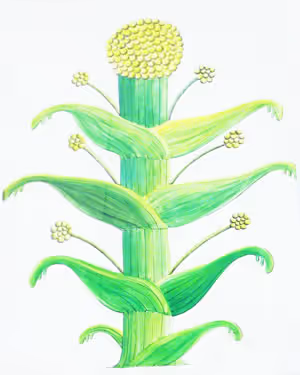
Silphium Plant
This drawing of the Silphium plant is on display in Apollonia
Museum, Cyrenaica.
The Silphium plant, or silphion, member of the giant fennel
family (Ferula), once grew only in Cyrene, in a mountainous
strip of land along the eastern coast of Libya. Classical
physicians and herbalists recommended the plant as both
contraceptive and abortive, as well as a remedy for coughs.
An image of a woman touching the plant with one hand
and pointing to her genitalia with the other, found on
a 5th century BC Cyrenian coin, was said to indicate
the contraceptive property of the plant.
In addition to its use in cooking, the plant was also used to
treat stomach aliments, sore throat and fever.
The plant was
heavily cultivated, where it became more valuable than
its weight in silver, and became an important product
of Cyrenaican economy that eventually led the plant to
go extinct by the second century AD.
The plant is similar to the modern
silphium laciniatum
(compass flower), a Silphium species native to east-central
North
America, closely resembling sunflower plant, with the distinctive large yellow
flower at the top; and hence the association in ancient times
of Silphium with the Sun-God.