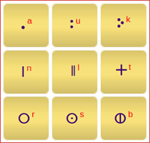
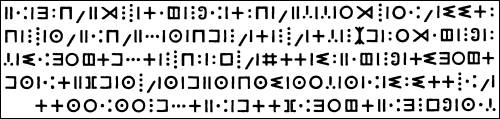
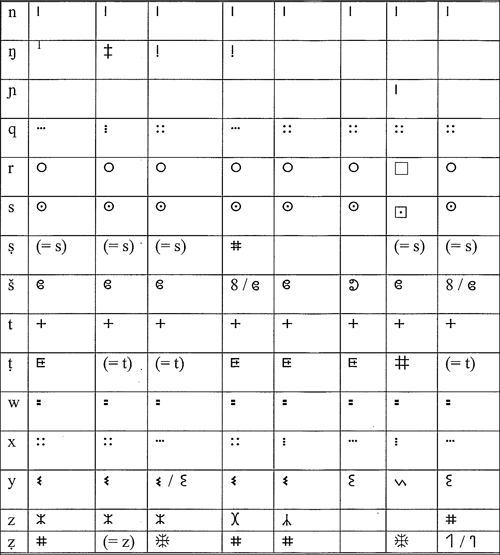
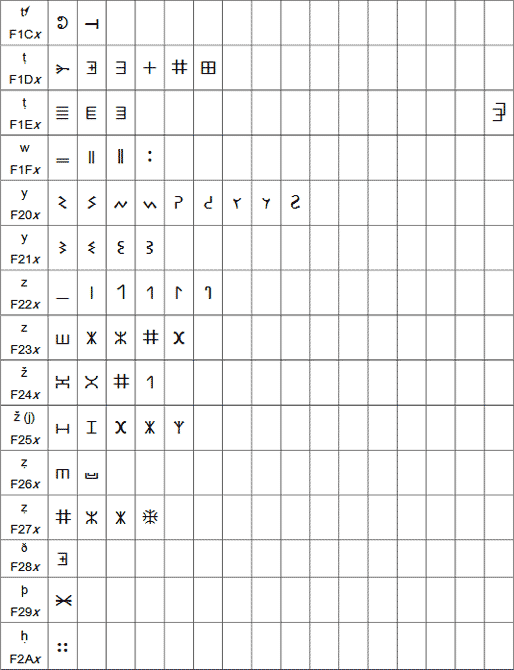
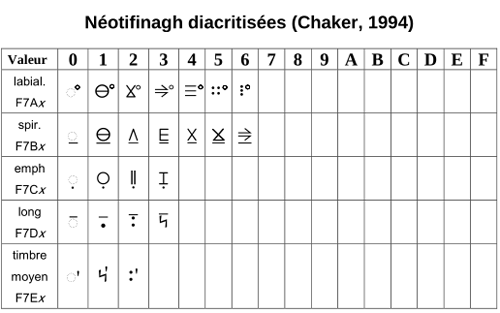
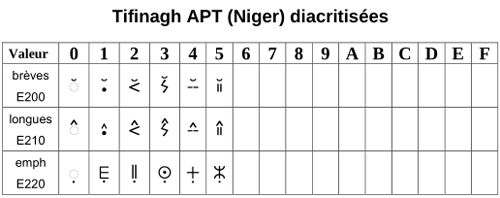
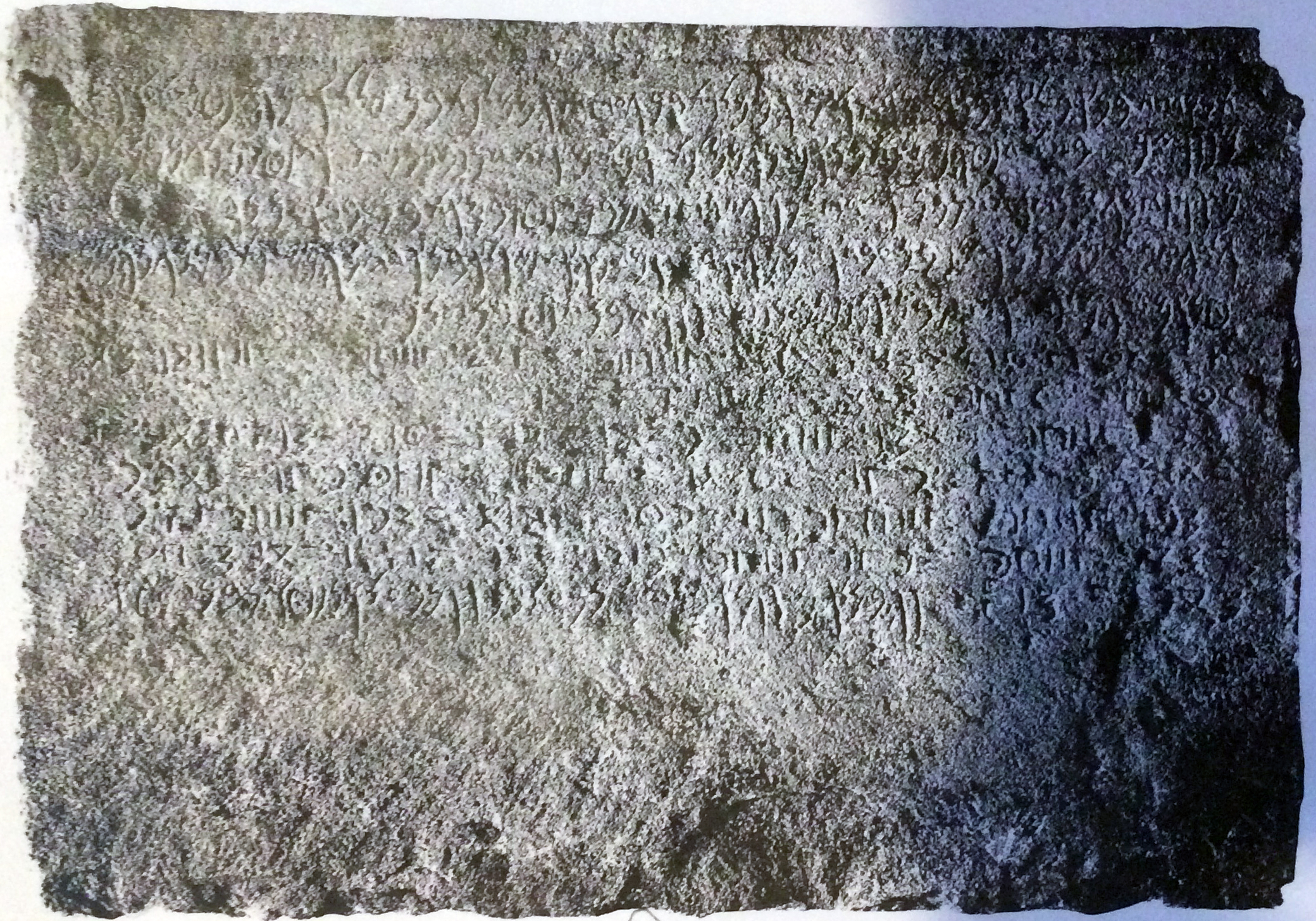
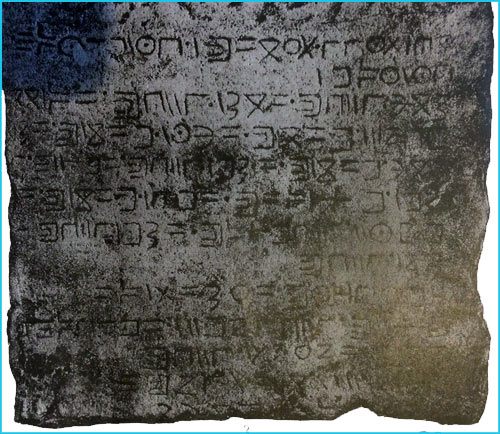
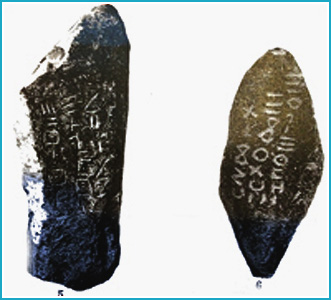
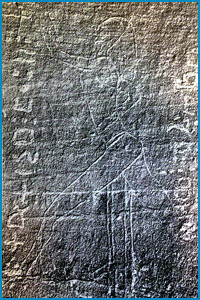
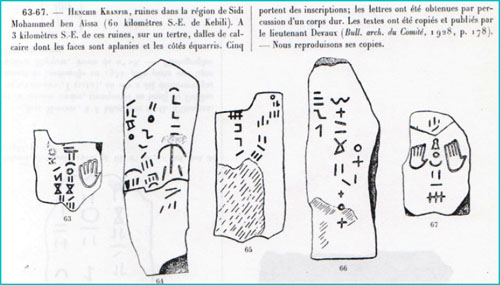
The original, ancient Temahuq Tifinagh as used by the Berbers of the Sahara for thousands of years. If you see letters as "boxes", you can correct them by installing some Tifinar fonts from the Fonts & Keyboards tab.
Source: IRCAM.
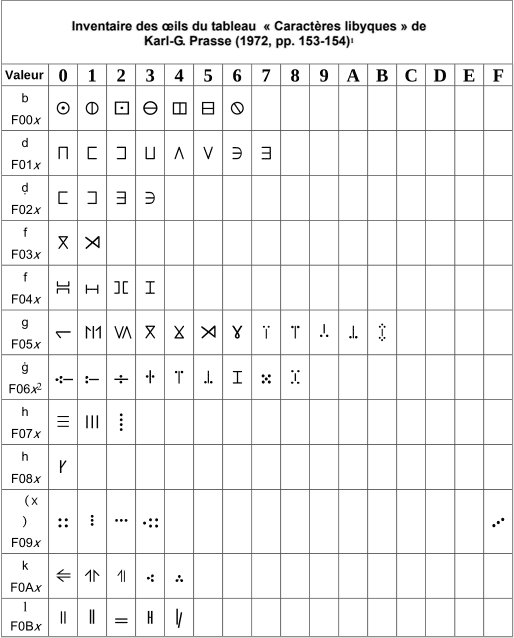
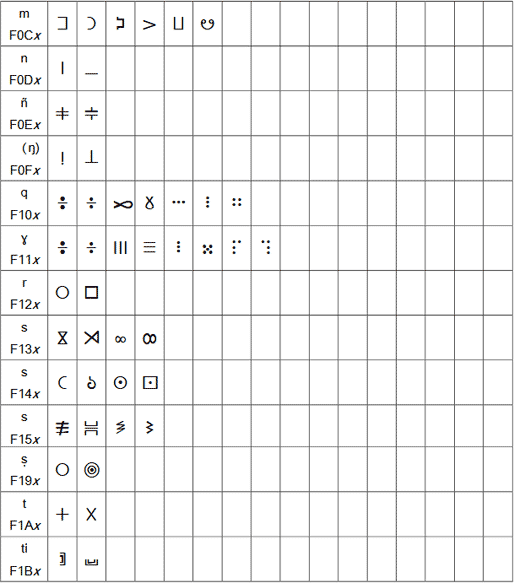
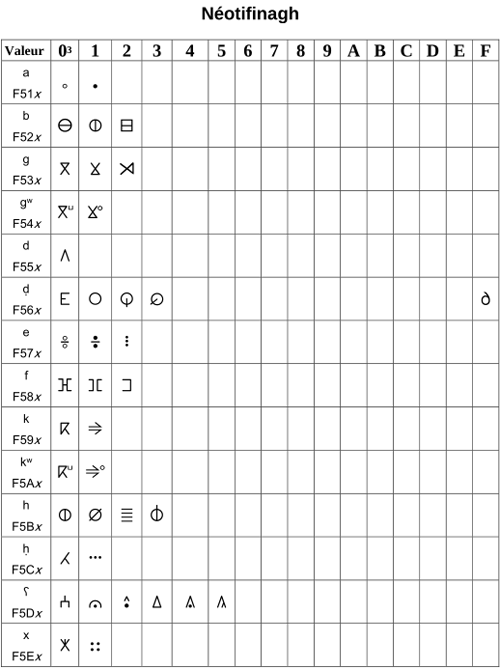
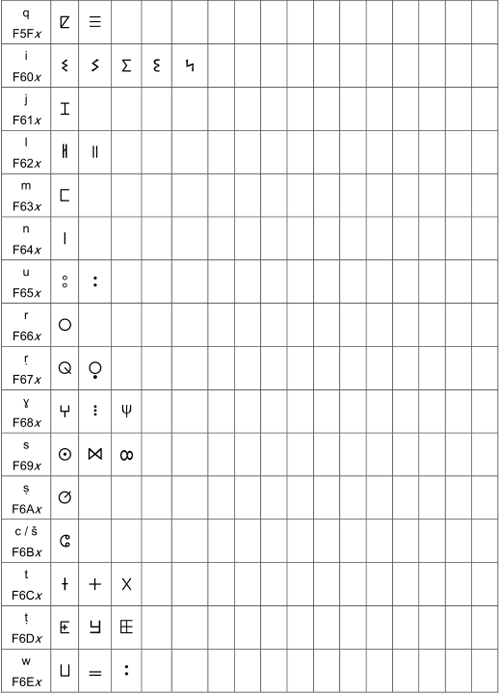
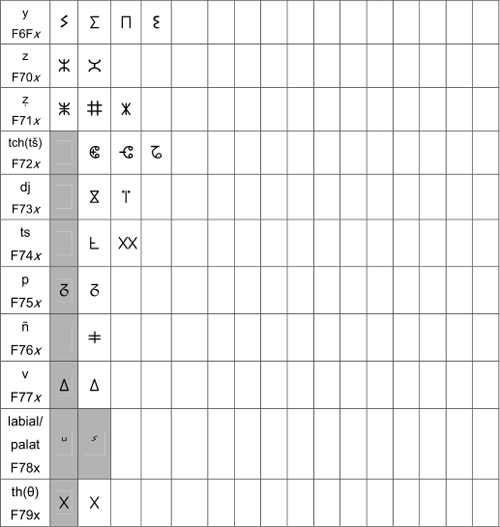
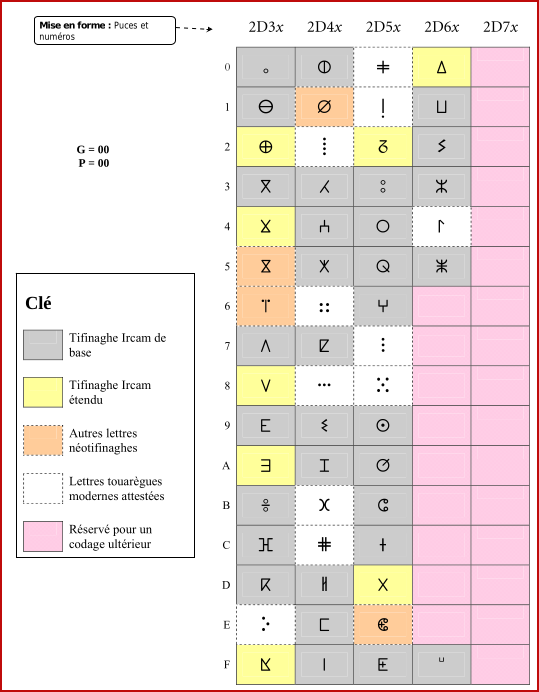
The corrupted, modern Neo-Tifinagh as invented by amateurs in the 20th century. Despite conflicting with existing systems, the fictitious alphabet was imposed by IRCAM, and unfortunately registered by the ISO in 2004.
Tamazight Tifinagh (Tifinar)
According to the Berbers of the Sahara, Tamazight is the spoken language of the proud Berber tribes of North Africa, and Tifinaɣ is the 'sacred' writing system of Tamazight.
Tifinagh is an ancient, indigenous system developed by the Berbers in prehistoric times, and preserved by Timushagh women to the present day.
The name occurs in various forms including Tefinagh, Tifinagh (Tifinaɣ), Tifinar, Tifinag and Tifinak; the last two of which appear in foreign documents; while the voiced-uvular-fricative /ʁ/ (ɣ) in the second form is widely interchangeable with /r/. [This also occurs in other languages, as in 'parrot', which the French pronounce something like /paɣout/, and the Imaziɣen as /babaɣa/.]
Contrary to common belief Tifinagh is not a single alphabet. There are at least 25 types of Tifinagh systems known to us today. The extinct systems, the Libyco-Berber scripts, were used by the ancient Berbers of Tripolitania (Libya), Numidia (Algeria, Tunisia), Morocco, Mauritania and the Garamants; while the current systems in use today are generally called Saharan Tifinagh, the Temahuq Tifinagh alphabets as preserved and taught by Tuareg women throughout the Sahara. The ancient scripts used by the exterminated Berbers of the conquered Canary Islands were a mixture of the above two systems, as well as having unique characters of their own.
Tifinagh Engravings & Inscriptions
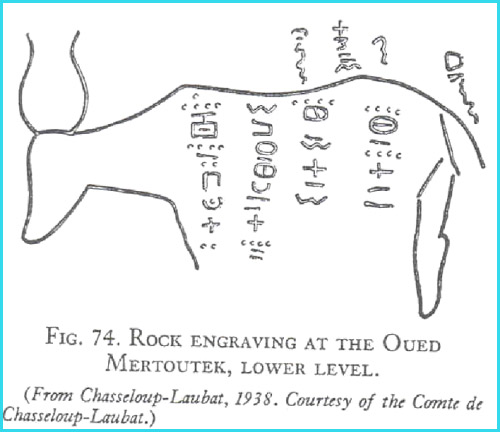
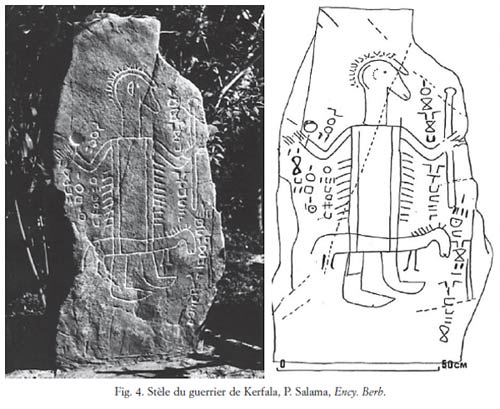
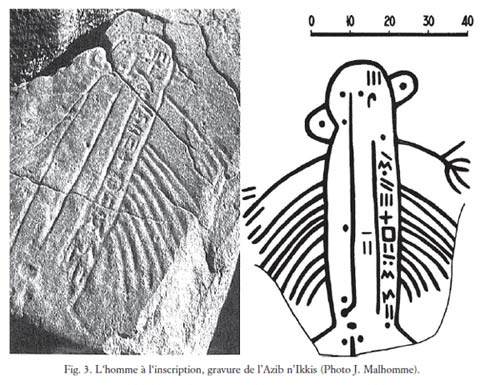
Among the earliest Tifinagh inscriptions found in North Africa are those found inscribed on rocks and painted in cave shelters across the Sahara desert (e.g., Wadi Takdhalt, Matkhandoush). Although the dating of the Libyan scripts was based on the earliest inscriptions found in some coastal areas, there is no comprehensive study to catalogue and date the massive prehistoric collection found in cave art across the Sahara. As the dating of many of these rock engravings and paintings themselves is also incomplete and questionable, the age of Tifinagh may not be known for some time. However, according to Oued Mertoutek Tifinagh engraving, Tifinagh could be up to 5000 years old.
The Italian-Libyan Archaeological Mission in the Acacus region has located more than one hundred Tifinagh and Tifinagh-related sites in Libya. A copy of the collected data, the first archive of Tifinagh rock inscriptions and engravings in Fezzan, is available for registered users in the Mission's website: http://www.acacus.org. Copies were also given to the Libyan Department of Archaeology, and to the British Library in London [EAP265: The tifinagh rock inscriptions in the Tadrart Acacus mountains (SW Libya): an unknown endangered heritage]. The massive EAP265 archival records span across 76 web-pages, each containing 15 Tifinagh engravings.
There is also The Messak Project, a collaboration between ENI SPA, the Italian Libyan Archaeological Mission, and the Libyan Department of Archaeology. Even though the project was interrupted by the devastating (and evil) UN-bombing campaign of Libya in 2011, the team managed to compile an impressive database of nearly 10,000 sites, which includes hundreds of unpublished sites from previous surveys; plus the discovery of nearly 2500 new archaeological sites. According to the project's website, the "results have highlighted an unexpected wealth and diversity of the region's cultural heritage in terms of quantity, complexity and chronology".
Most of the enigmatic inscriptions and engravings found so far are yet to be conclusively deciphered, and therefore scientific results and conclusions regarding Tifinagh may not be available for decades to come. Some experts say the task of cracking the enigma of Tifinar inscriptions is hampered by the fact that many of the existing systems differ from one other, as well as from the ancient Libyco-Berber systems, and therefore it is almost impossible to agree on the correct transliteration of the engravings and inscriptions.
The matter was made even worse by the recent euphoria of political activists, initially led by the Berber Academy, then takenover by Arab-created IRCAM, who invented a new system of fictitious Tifinagh (they) called "Neo-Tifinagh".
Initially they claimed the changes were made to facilitate writing and introduce new characters to encode the sounds not covered by the original script, and in doing so they invented a staggering 22 new letters (nearly an entire new script), taking the total of Tifinagh characters to 59.
But later it turned out that they actually had changed existing letters, and even invented new letters for the sounds that are already covered by the original script (see below for more on this violation). IRCAM was created by the Arab government of Morocco, a country in which the persecuted Berbers are yet to have the right to write their own constitution and decide their own destiny according to their own traditions, beliefs and values.
The Tada group of nearly twenty Moroccan Tamazight associations objected to IRCAM's decision in 2003; calling IRCAM "a Makhzenian [4] institution created with the sole goal of neutralizing the Amazigh movement".
Although most Berberists were in the opinion of using the Latin script in conjunction with the development of Tifinagh, the Arabs of IRCAM had the upper hand to dictate by royal decree what is best for the persecuted Berbers.
Professor of Tamazight Salem Chaker says the IRCAM's decision is like putting the carriage before the horse. In an interview with Aid Chemakh and Masin Ferkal, Chaker points out that the decision to use Tifinagh is "a hasty and badly founded decision", and that the goal of IRCAM "can only be an attempt by the dominant spheres and their auxiliaries to take over the Amazigh field by driving this transitional period of Amazigh writing and teaching into a sure dead end", and that the, "creation of the IRCAM, as well as the adoption of the Tifinagh script are part of a strategy which aims at reducing the Amazigh social and political factor to nothing or close to nothing."
Chaker argues that the political decision to impose Tifinagh was made without conducting any academic work on the subject of Tifinagh to bring it up to date, and given the fact that it has not been in effective use for nearly a millennium, Tifinagh can only
"play an identity or emblematic role and cannot be used as a basis for a functional writing system that can easily be disseminated . . . The version currently in use . . . is purely and simply aberrant since it is actually a phonetic notation of Kabyl based on Tifinagh characters. This was developed in 1970 in the Berber Academy circles by amateurs full of goodwill, but nonetheless without any linguistic training. The result is that the alphabet which is currently presented to us as the Amazigh alphabet is not an authentic one. It was strongly altered in order to transcribe the phonetic characteristics of Kabyl. It cannot thus be an Amazigh-wide alphabet."
In June 2004 the Neo-Tifinagh system was registered in the ISO's register of languages, and thus the hybrid, deformed alphabet had been officially registered as "Tifinagh". Simply put, this is wrong. The ISO ought to have registered the new system under the name "Neo-Tifinagh" and not as "Tifinagh", because the two systems are as different as Greek and Latin alphabets (as clearly shown by the above two tables).
Nonetheless, this means that the coding of Neo-Tifinagh will enable it from 2005 to be integrated into the software products of the major companies. Microsoft Windows 8 was the first version of the operating system to include Neo-Tifinagh. Tamazight was also added to the Languages Subtag Registry on the 16 of October 2005, in which the language is listed as "Berber Language", and the tag as "ber". As of 2021, the ISO [Neo-]Tifingh Unicode block covers 59 points between 2D30 and 2D7F including 22 invented letters, plus 21 reserved points for future inventions.
Many Berberists still hope that one day the Berbers would remedy such cultural vandalism once they regain their freedom to establish their own destiny on solid, scientific ground, away from foreign politics and stagnant superstition.
Types of Tifinagh Systems
Another problematic issue affecting the current revival of Tifinagh is that there are numerous versions of the alphabet in use throughout North Africa, some of which conflict with one other. For example, britishmuseum.org spoke of the Libyan alphabet in the plural sense, by noting that the "Libyco-Berber alphabets" comprise up to 25 different groups, divided into 5 major families, some of which "show strong similarities while between others up to half of the alphabetic symbols may be different".
Despite the differences between the various Saharan Tifinagh systems in use today and the ancient Libyco-Berber scripts, and despite the differences between all these and the newly invented script (Neo-Tifinagh), the names "Libyan Script", "Neo-Tifinagh", "Libyco-Berber alphabet(s)" and "Tifinagh" are used indiscriminately as if they are the same and one.
This is a preposterous problem policy makers ought to reconsider, simply because there are several, different alphabets used by the Imushagh in Libya, Algeria, Mali and Niger and therefore are we going to force all of them to abandon their ancient systems and adopt the new script imposed by IRCAM? Disaster struck, again!
There are at least 40 Tamazight languages spoken across ten North African countries, which some linguists compare to European languages, rather than to a single language. Each of these languages (some call dialects) has its own sets of sounds and rules and therefore it is reasonable to allow each language to have its own alphabet. The existing differences between these languages have led to the creation of the known 25 Tifinagh alphabets not for decoration purposes or fun; the differences were due to cultural evolution which must be respected as part of the greater Tamazight heritage. Simply put Tamazight is not a single language, and Tifinagh is not a single alphabet.
The Libyco-Berber scripts can be divided into the following types:
Eastern Libyco-Berber (Libyque oriental: L/or)
Western Libyco-Berber (Libyque occidental: L/oc)
Dougga Alphabet
Old Saharan Alphabet (Garaments and Getulian)
Bou Njem Alphabet (Libya)
Some of the Tifinagh inscriptions found in the conquered Canary Islands belong to Libyco-Berber, others to Saharan Tifinagh, while some letters exist nowhere else outside the Canary Islands. Generally speaking, the Canarian Tifinagh alphabets were divided into two types:
Western Canarian: used in El Hierro and Gran Canaria, and related to Numidian Masilius.
Eastern Canarian: used in Fuerteventura and Lanzarote.
There is no specific study that classifies all the Saharan Tifinagh systems into distinct groups, but generally speaking the following Tifinagh systems (or types) are often noted when comparing the Tuareg alphabets with the ancient Libyco-Berber scripts:
Adrar Tifinagh
Ayer Tifinagh
Azawagh Tifinagh
Ghat Tifinagh
Ghadames Tifinagh
Hoggar Tifinagh
Imi-n-Taboraq Tifinagh
Iwellemmeden Tifinagh
Kel Agef Tifinagh
Kel Ansar Tifinagh
Kel Ayorou Tifinagh
Saharien Tifinagh
Taneslemt Tifinagh
Libyco-Berber & Canarian Alphabets
The ancient Libyco-Berber script was first made known to European scholars in the 17th century, as preserved by the bilingual Dougga and other inscriptions found throughout the northern region, especially in Tunisia, Algeria, Morocco and Mauritania. However, the script remained in obscurity until mid 19th century, when some scholars began to show some interest in the mysterious inscriptions. In total there are around 1390 inscriptions, of which 1125 were published by Chabot in his Recueil des Inscriptions libyques. The majority of these are religious and funeral inscriptions, confirming the fact that Tifinagh, likewise Ancient Egyptian hieroglyphics, was essentially a sacred writing system.
Only the Eastern Libyco-Berber script was partially deciphered by F. de Saulcy in 1843, and while a number of Tifinagh characters still remain uncertain, some of the deciphered characters conflict with the existing Saharan Tifinar systems; for which many Berber scholars believe the Libyco-Berber inscriptions remain indecipherable. Berber scholars generally attribute such indecipherability to various reasons, the most obvious of which are:
most of the specialists who attempted to decipher the inscriptions did not speak Tamazight;
the lack of historical data about the ancient civilisations of North Africa;
the lack of methodological work relating to Tamazight culture in general;
Tamazight mythology and religion remain to be written (since the majority of the inscriptions are religious and funeral);
the historical distance separating ancient Tamazight from modern Tamazight;
and, of course, the fact that many roots in Tamazight are differentiated by vowels which are lacking in the inscriptions and therefore it becomes almost impossible to differentiate between, say, aman 'water', iman 'self',and mani 'where'.
In summary, to generalise a hasty conclusion based on one dated inscription while the majority of both the coastal and Saharan inscriptions remain undeciphered and undated is certainly far from science.
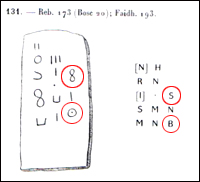
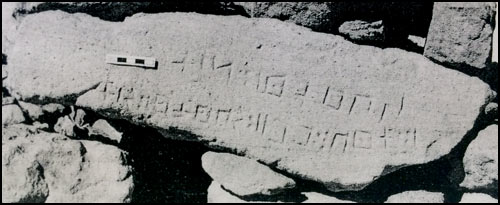
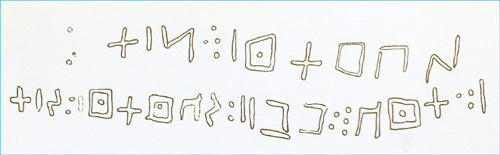
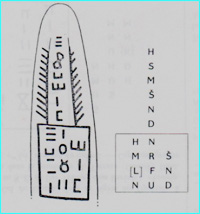
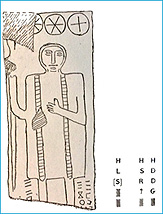
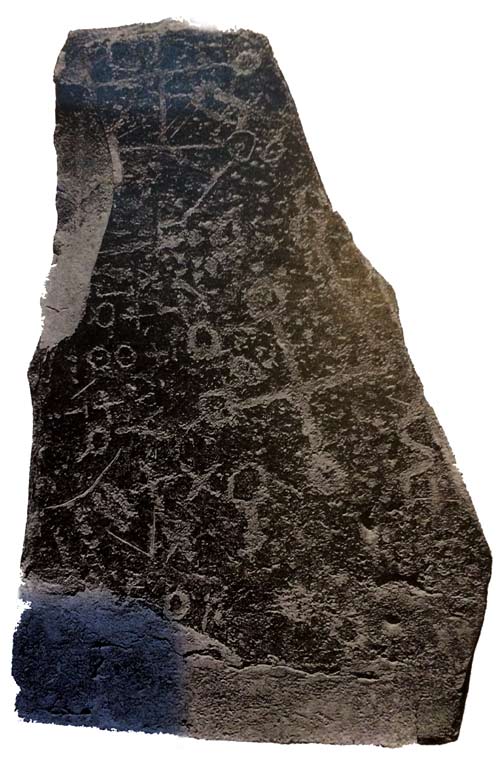
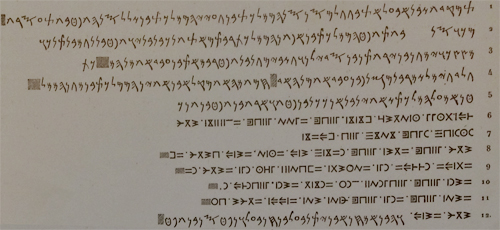
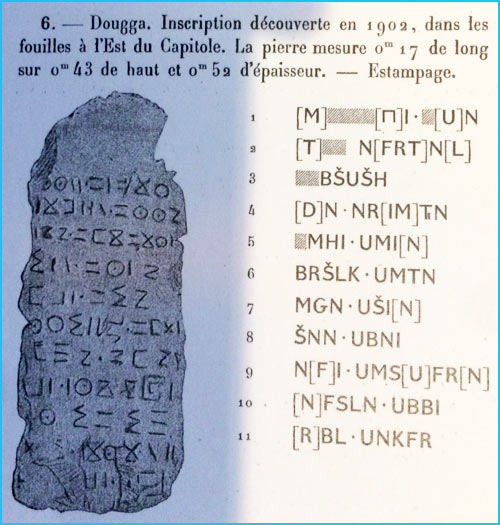
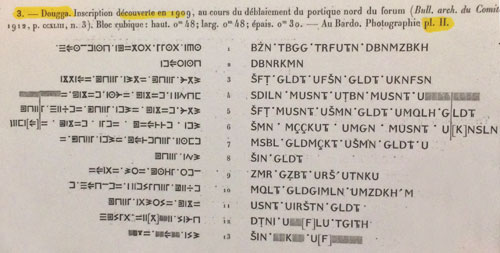
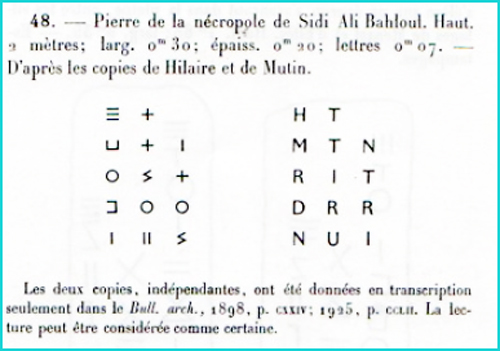
The other important problem is the supposedly deciphered characters. For example, the letter S (ⴵ) in the ancient Libyco-Berber script is used today to write the sound "dj" (ⴵ) (as invented by the Berber Academy); while today's B (ⵀ) is confusingly written like this: ⵙ, which is S in today's Tifinagh. More confusing is that today's B (ⵀ) is letter H (ⵀ) according to IRCAM, who instead used this letter ⴱ for B (which is letter B when writing Tifinagh vertically). On the other hand, ancient Libyan B (ⵙ) is the letter S (ⵙ) in today's Tifinagh; while today's B (ⵀ) does not exist in ancient Libyco-Berber, while it does exist in ancient rock engravings from the Sahara. Here is a copy of an ancient Libyan inscription showing two of the aforementioned letters:
Still worse, today's activists, led by IRCAM, violated another feature of Tifinagh, which is the direction of writing. It is a well-known fact that although anciently Tifinagh letters are inscribed vertically, Tifinagh can also be written horizontally, from left to right, from right to left, and spirally, and thus the direction of the letter would change accordingly. Therefore letter B can be written like this ⴱ or like this ⵀ. But unfortunately today's politicians at the IRCAM decided to use the horizontal B (ⵀ) for letter H (ⵀ); and in doing so they violated most of the current Temahuq alphabet systems in use in Libya, Algeria, Mali, Niger, Burkina Faso and Mauritania who use it for horizontal B (ⵀ).
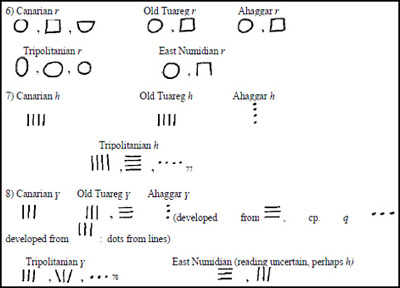
Of course, letter H in ancient Libyco-Berber is different: ⵏⵏⵏ, and interestingly all the current Tuareg systems use dots to write letter H (ⵂ), which is very similar to the ancient Libyco-Berber in that the "dots" became "lines". The extra dot (the fourth dot) is easily explained by the fact that, it is only in the horizontal form that we have three lines, while the vertical form of the Libyco-Berber letter H is written with four vertical strokes (ⵏⵏⵏⵏ) — corresponding to four vertical dots in at least six types of today's Tifinagh systems: Adrar Tifinagh, Ayer Tifinagh, Ghat Tifinagh, Hoggar Tifinagh, Iwellemmeden Tifinagh and the Taneslemt Tifinagh.
So now those who claim that, they had to invent new Tifinagh letters to represent the sounds that are not represented by the ancient Tifinagh are in fact liars, because here we have numerous occasions where they invented new letters for the sounds that are already represented by both: the ancient Libyco-Berber and the existing Saharan Tifinagh systems still in use throughout the Sahara. Therefore: why?
No reason was given for going against all the existing alphabetical systems, and thus one is forced to guess that the hidden intention seemingly is to make Tifinagh look like the Latin and Greek alphabets. For example, this is the Old Italic letter H: 𐌇, the source of the later Latin H, and which now looks like IRCAM H (). Why instigate such confusion when we already have a letter for the sound /H/?
Source: IRCAM. Modern Neo-Tifinagh as invented by IRCAM.
IRCAM has committed another major violation, namely the removal of all dot-based letters from the sacred alphabet, and in doing so they have in fact invented a new alphabetical system which they imposed as "Tifinagh". Even the vowels "a" and "u" were changed into small circles, instead of the original dots.
The dots are there for a reason, apparently unknown to them. For example, if you try and type ligature "NK" (ⵏ⵿ⴾ) via the Tagmukay keyboard using the modern, corrupted letter K (ⴽ), letter N, and the "joining character" ( ⵿ ), it will not work. But if you use the original dotted K (ⴾ) instead (which the Imushagh always use), then the result is the ligature ⵏ⵿ⴾ. Thus removing the dots breaks the system.
Why fix it when it ain't broke? And more so, why not fix the things that are broken?
There are other problems concerning other letters including the emblematic Z and D, F, G, K, U and T, to name only a few. Take the letter K (ⴽ), for a start, which they made it look like Latin K, when we already have Temahuq ⴾ (K).
Look at the ⵖ (/gh/), for example, where did it come from? Here is the original and ancient /gh/ in Tifinagh: ⵗ. The letter already exists, and so why invent a new one that looks like Greek gamma γ ?
Also, the T, which in Tamazight starts and ends feminine nouns, as In Tameɣɣart, Tamshumt and Tamettant, they turned it into something else:
Original:
New:
Is the reason to make it look like a Christian cross and therefore give the fake impression of its European origin, as they did with the H, K, gamma, etc?
The symbolism of the original Temahuq F is of peculiar interest, and yet IRCAM connects the two parts with a stroke (ⴼ), as if the Ẓ () was struck by a royal blow to the ground; just as they turned the L () into vertically-flipped Latin N (ⵍ).
Another excuse used to tamper with the sacred Tifinagh system is that some Tifinagh letters, they say, can be confused with one another when written in double, like double N (which can be confused with L), or F and M. But what about the direction of writing: F () has two parts (each of which looks like M, with one in the opposite direction), and therefore it is impossible to confuse the F with M because one half of the F will be facing in the opposite direction of all the other M's; and thus there is no need to join the two parts of the F (ⴼ) to make it look like Ẓ ()
Regarding double N and L, traditionally speaking the Imushagh incline the second letter to distinguish it from the preceding letter if they look alike, and also most Berber keyboards usually offset adjacent L and N by inclining, lowering, raising, or shortening the second occurrence of the letter. For example:
N = |
L = ||
LN = ||/
NL = |//
NN = |/
LL = ||//
NNN = |/|
LLL = ||//||
etc.
Source: Hanoteau's Essai de grammaire Tamachek, 1896, Here is a line from an old Temahuq text showing how the Imushagh handle this issue.
Instead of addressing these important violations, the Arab-run IRCAM were merely concerned with the trivial issue of whether to use Arabic, Latin or Tifinagh script in teaching Tamazight in schools. What if now they decide to use Arabic instead? Would the Berbers follow their masters to the grave?
Simply put, and regardless of outcome, it is not up to them nor to anyone else to tamper with the sacred heritage the Berbers ought to cherish. Berbers worldwide should stand up and reject such desecration of the sacred alphabet, rather than burry their faces in fakebook.
Twenty odd years before the so-called "Arab Spring" was "set in motion", the Arab regimes realised that their dreams of suppressing the Berber cultural revolution were shattered beyond repair, and therefore rather than give up the tyranny and grant the Berbers official recognition and the unconditional freedom, they decided to hijack the movement instead; and consequently sat in the driving seat to steer Tamazight towards an Arab-determined destination. The first setback they accomplished was to change the name of our language 'Tamazight' (as known in linguistics) into the patriarchal, masculine 'Amazigh'; followed by officially registering the corrupted system of Neo-Tifinagh in the ISO's register; before they declared Tifinagh Yemenite in origin. Alas!
Such orthographic vandalism is short of cultural terrorism imposed upon us in the name of 'conditional freedom'; audaciously reflecting the foreign environment in which the native Berbers still endure persecution as second-class citizens in their own Homeland. Regardless of all attempts to obfuscate, the prophesy of the Berber Goddess LIBYA is simple: "coming of the day when that which is hidden shall be revealed". Amen.
Etymology & Origin of Tifinagh
There are numerous papers put forward to solve the origin of Tifinagh, as there are etymologies proposed to crack the enigma of the name "Tifinar"; the results of which is a concussion of contradicting suggestions, none of which gained wide acceptance. Again, this is not the place to review all the suggested etymologies, but the following little story I wrote will briefly illustrate how one such etymology is as absurd as saying "Tannit" is Phoenician or "Tifinagh" from Yemen.
The Phoenician Etymology:
Once upon a time, Phoenician immigrants arrived in Carthage, around 814 BC. They made a pact with the native Berbers to settle on a piece of land as large as an ox hide can cover. Soon afterwards, the Berber queen of the Amazons instructed the High Priestess of the Goddess Tannit par excellence to investigate the rumours that the new comers brought with them a new system of writing.
Upon arrival at the immigrants' base, the High Priestess was greeted by a Phoenician official dressed in a purple cloak.
We heard you have a new system of writing, the High Priestess said.
Yes, we do, the official replied. Do you want to borrow it, he asked the High Priestess?
No; we just want a few consonants, and you can keep the rest of the alphabet, the High Priestess said with a little smile on her tifinar-tattooed face.
You cannot do that, the Phoenician replied. Why not, she asked?
Because you need to borrow the whole alphabet in order to use our system correctly, just like everyone else is doing right now around the Mediterranean.
Please do not trouble yourself with our affairs, the Berber High Priestess politely replied.
Failing to figure out the unusual Berber request, the Phoenician official reached for his leather pouch (also made of purple velvet), pulled out a few consonants (some say 5 consonants, others say 1), each engraved on a little pebble, leaving the rest of the alphabet behind in the leather pouch, and handed them over to the High Priestess to take back to legendary Lake Tritonis — the birth-place of mythology and the 'gods', Diodorus said.
Upon reaching the temple, the Berber High Priestess threw the pebbles on the altar, and as soon as the other priestesses saw the crooked squiggles they burst with laughter.
Surely, sister, you do not expect us to use these "squiggles" for our sacred ceremonies, one priestess exclaimed, with wide-open eyes!
Of course not, the High Priestess smiled; out of these crude scratches of chaos we shall create perfect geometrical beauty to reflect the cosmic order and the power of Divinity Herself: the geometrical principles of the universe that will mystify humanity for many millennia to come!
Nesmenser.
I wrote this simple story to highlight a number of problems concerning the popular Phoenician hypothesis.
If the Berbers did borrow the idea and the tools of writing from the new comers, then they would have borrowed the entire script, and not just a few letters as suggested by most sources.
How come every other nation around the whole Mediterranean borrowed the entire alphabet from the Phoenicians except the Berbers who borrowed just a few consonants?
How did the Berber priestess decide which few consonants exactly to borrow, which ones not to borrow, and for what reason did she make such bizarre decision?
To explain the perfect geometrical forms of Tifinar, a number of sources (including Wikipedia, at one stage) alleged that the Berbers "borrowed the Phoenician alphabet perfectly". Why then did all the other nations around the Mediterranean borrow the same alphabet imperfectly?
Such strange hypothesis does not, and cannot, explain how there are several Tifinar alphabetical systems in use in ancient Tripolitania, Numidia, Algeria, Morocco, Mauritania, the Canary Islands, and across the Great Sahara; all of which differ from one another! If they were all derived from the same source you would expect a greater degree of uniformity, not to say that the time span allowed probably cannot explain such divergence to occur across such a massive geographical space.
Such outlandish suggestions cannot explain the countless Tifinagh engravings strewn across the Sahara, some of which are nearly 5000 years old (as we shall see below).
The Phoenician suggestion cannot explain the similarities between Tifinagh and Ancient Egyptian hieroglyphics (see below for more on this); leading some scholars to believe that the Phoenicians and the Berbers independently borrowed their writing systems from Egyptian hieroglyphics.
One must also remember that the Phoenicians actually borrowed their "alphabet" from Ancient Egypt and specifically from an area that was heavily populated by Berbers from predynastic times; and therefore the new system was not new, after all, as it was developed and used in North Africa for at least 2500 years before the Phoenicians came to borrow it, thousands of years before Dido arrived to embrace Libyan Tannit. As noted below, it was the Libyan Berber scribes of the Delta who developed "Demotic" for administrative and commercial use.
The whole notion of Tifinagh being Phoenician was originally introduced on the basis of five similar letters, proposed by Halvey in his Essai d'Epigraphie Libyque, 1875, as well as on the similarity of the names "Tifinagh" and "Phoenician":
First of all the name Phoenician was not known to the Phoenicians because it is a Greek name derived from the Greek word "phoenix" (meaning 'red'; 'palm tree'; 'mythical bird'); and therefore according to this kind of morbid reasoning Tifinagh is Greek.
Such fake etymologies are called "phonic etymologies" by linguists because such deceptive similarities are due to languages sharing basic 20 or 30 phonemes to express hundreds of thousand of words. Even Gaddafi entertained "his people" with such etymologies when he claimed the name Shakespeare comes from Arabic Sheikh 'old man'. Is 'phoenix' or 'finger' Phoenician in origin?
What is not widely publicised, however, is the fact that Halevy's wild identification, though gaining some popularity among like-minded authors, was rejected from the start, because while three or four letters may resemble some Phoenician characters (as expectedly they do other glyphs in far distant regions) the majority of the letters are totally different.
Therefore, if the majority of Tifinagh consonants bare no Phoenician resemblance, then denying the indigenous development, at least for the majority of characters that are unique to Tifinagh, is nothing but nonsense.
The Phoenician Etymology Updated: The Berbers Borrowed Only A Few Letters From The Phoenicians
It is for this precise reason that some modern authors, later on, came up with the second bizarre hypothesis to explain how the majority of Tifinar consonantal letters look nothing like the Phoenician alphabet, namely: the Berbers borrowed only a few consonants (although the precise number varies from 1 to 5 consonants [according to author]) from the Phoenicians, and then invented the remaining letters of the alphabet by themselves based on the few borrowed letters — a kind of hybrid solution reflecting the frustration of being unable to let go the sinking ship, unable to reconcile the dilemma they created for themselves, rather than a documented scientific conclusion supported with facts. In fact every fact known to us so far (as we shall see below) proves the Phoenician hypothesis is nothing more than a rejected hypo-thesis.
Indigenous Origin of Tifinagh
Having said this, one must also briefly mention some of the numerous sources who were convinced that Tifinar was developed by the Berbers, with a few sources still insisting that Tifinagh is an "independent invention with Phoenician influence".
Some sources say the Berbers employ an alphabet of their own, of great antiquity and disputed origin; while other sources are certain that Tifinagh (or Libyco-Berber script) is an ancient indigenous system that the Berbers have developed and preserved to the present day.
However, most scholars who studied the still-undeciphered Libyco-Berber scripts, like S. Gsell, J. G. Février, G. Camps, L. Galand, S. Chaker and S. Hachi, had unequivocally disputed the Phoenician origin, some of whom excluded any Punic connection, and most of whom favoured the indigenous evolution of Tifinagh from the local, prehistoric, pictographic and ideographic systems; the symbolism of which is also present in Berber tattoos, pottery designs and marks of animals. Such ideographic data is much older than the first millennium BC.
K. G Prasse, however, favours the "Unknown Origin" hypothesis, while categorically rejecting all attempts to derive the Berber script from the alphabets of southern Arabia, Greek, Iberian, Punic or Phoenician for lack of "proof ".
On the other hand, there are a number of scholars who were convinced that both the Phoenicians and the Berbers developed their alphabets from the Ancient Egyptian hieroglyphics independently. For example, Professor Wulsin, who studied the 5000-year old Oued Mertoutek Tifinagh engraving around 80 years ago, also suggested an independent origin with an Ancient Egyptian influence.
Ideographic Tifinar
As noted earlier, most of the main characters of Tifinar are also found in Berber tattoos, pottery designs, animal marks, textile, henna designs, and especially embedded in the designs of the popular Berber carpets. Also they can be found in the design of stone circles and dolmens found across the Sahara, as well as painted or engraved on stone in countless caves in what is known as the largest collection of prehistoric art in the world — over 100,000 sites, and probably much more to be discovered in decades to come.
Some of these signs represent names of the Goddess Neith, while others signify names of tribes and ownership, and therefore such signs must have been ideographic in origin. Like many ancient ideographic scripts, most of the Tifinar inscriptions and engravings discovered so far were written vertically — a feature which according to J. G. Février excludes any Punic connection (see the Inscriptions tab for examples).
In support of the ideographic hypothesis, F. De Chasseloup Laubat points out that Tifinar uses "only the circle and the straight line", and that "ancient tifinars . . . are vertically arranged in the usual manner of hieroglyphs and ideographic characters". It is also possible that such characters, or symbols, could have both values: ideographic and phonetic.
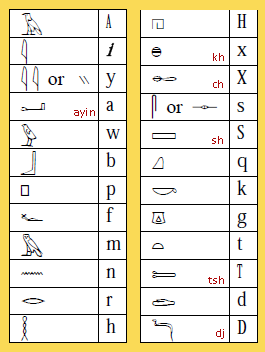
For example, Gardiner reminds us that, "it must never be forgotten that in the eyes of the old Egyptians the hieroglyphic writing always remained a system of pictorial representation as well as a script". It took dedicated Egyptologists sometime to extract the hidden phonetic alphabet, which was known to and used by the Ancient Egyptians and Libyans (west of the Nile and the Delta) for thousands of years before the Phoenicians borrowed the alphabet from Egypt. The following table shows the Ancient Egyptian hieroglyphic alphabet:
Source: Nesmenser. The Hieroglyphic Alphabet according to Gardiner.
The similarity of some Tifinar characters to their hieroglyphic counterparts led some sources to suggest that the Berbers derived their alphabet directly from Egypt. Also it is almost unanimously accepted that the Temahu tribes of Ancient Egypt are the same as the Temahuq speakers of the Sahara. See Temehu Tribes of Ancient Libya for my notes regarding this overlooked aspect of Temazight history. Professor Gautier seems even more certain that the Hoggar region was once the capital of great civilisation, and the original home of the Ancient Egyptians themselves. Recent genetic and linguistic research confirms his conclusions, even though the precise location of the original home of the Hamito-Semitic phylum remains to be determined, with some favouring the central Sahara, while others point to a location somewhere between the central Sahara and mysterious Ethiopia.
Source: Nesmenser.
I made the above table to show how Tifinar and Hieroglyphics appear to have one common ancestor. The Berber letter ⵅ (IPA χ, or /kh/) looks like the Ancient Egyptian sign for 'star', which the Egyptians call 'ax'.
Ancient Egyptian language and Tamazight ('Berber Language') are sister languages of the Hamitic branch of the Hamito-Semitic Phylum; both of which are much older than both Semitic and Indo-European languages by at least 10,000 years. Both the Ancient Egyptians and the Temahu tribes of Ancient Egypt (the natives of all of Egypt west of the Nile from predynastic times) also share the same mythology, most of which is Berber in origin. Both also were among the same group of tribes who inhabited the Sahara before it turned desert, and therefore it is not far fetched to presume they share a common ancestor for their writing systems.
Geometry of Saharan Stone Circles & Funerary Monuments
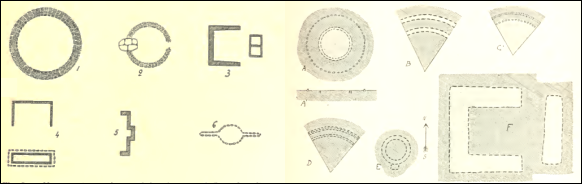
Looking at the designs of ancient stone circles and sacred monuments and dolmens abandoned across the Sahara, the first thing came to mind is the remarkable similarity between the designs of the stone structures and the geometrical shapes of the sacred Tifinagh.
Saharan stone monuments showing designs similar to the Tifinagh letters R, B, M N, D and S. From the areas of Tamanrasset, Iferouane, Tin Amnaser, Tiafedet, and Ouan Tohra.
Source: SAHARA ALGÉRIEN, by Professor E. F. Gautier, 1908.
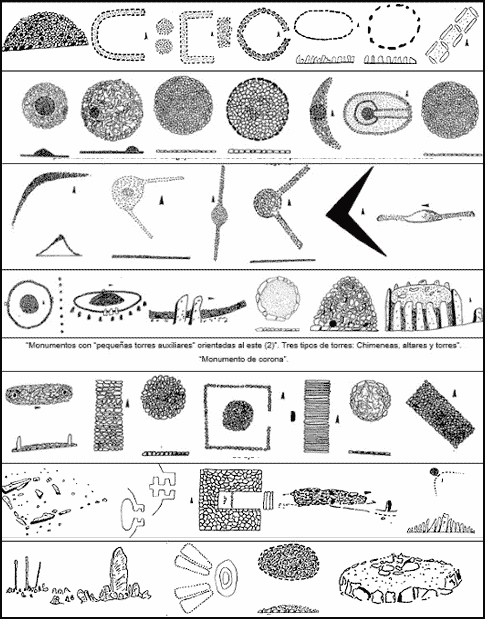
Stone circles and monuments. Selection of images I combined from the images found on pages 427 and 429 of Daniel G. Quiroga's doctoral thesis.
This suggests that the geometry of Tifinagh is remarkably similar (or related) to the geometry found in the design of stone circles and funerary monuments across the Sahara. The stone monuments and circles were the early forms of temples and therefore the geometry, without a doubt, is related to a mythological-religious subject. Hence the majority of Tifinagh inscriptions found so far were found in temples, on funerary stelae, and in Garamantian tombs (as documented by various sources). Both Tifinagh and its sister Egyptian hieroglyphics are sacred alphabets and hence the name of the latter: "Hiero-" ('sacred') + -"glyph-ics" ('letters') = 'Sacred Writing'.
Such sacred alphabets were used for religious purposes in North Africa for thousands of years before the Libyans of the Delta (the Berbers), according to various sources, developed the Demotic alphabet for administrative and commercial use.
The Libyan scribes of the north (of the Delta) apparently "employed grammatical constructions and phonetic spelling that reflected current usage rather than traditions" (Oxford's History of Ancient Egypt, 2000); while the Egyptian priests of Thebes developed the "Abnormal Hieratic" script (also based on Hieratic) which they used in monumental inscriptions instead of traditional hieroglyphics.
Without a doubt, therefore, it was the Berbers of the Delta who were first to break away from the religious use of the sacred alphabet (hieroglyphics) by developing Demotic.
Again, this is not the place to address the origin of the commercial alphabet, but a quick review of the original inscriptions of Proto-Sinaitic reveals a number of questions left unanswered by the specialist scholars who are the authority on the subject, including a number of characteristically Berber symbols and the name of The Berber Goddess par excellence Tannit which was not known to the Phoenicians at that stage at that location simply because the Phoenicians adopted Tannit only after their arrival in Carthage thousands of miles to the west.
I am not going to claim the Phoenicians borrowed their alphabet from Tifinagh, but we do have plenty of (neglected) evidence to unequivocally demonstrate that the Berbers were aware of the "concept of writing" long before the Phoenicians left North Africa to settle in the land of Canaan; as I am aware of the simple fact that the Phoenicians actually borrowed their "alphabet" from Ancient Egypt specifically from an area that was heavily populated by Berbers from predynastic times.
Geometry of Tifinagh As Indicator of Indigenous Origin
One of the unique characteristics of the Berber characters is the fact that they are perfect geometric designs, consisting of dots and straight lines; indicating an intentional design by the Berbers themselves without any external influence, be it Phoenician or otherwise Egyptian. Anyone in their right mind can see we have a complete system.
ⵈⵗⵆ ⵏ ⵜ ⵎ ⵐ
All the letters of the Berber alphabet can be written either with dots or/and lines. The lines are grouped and crossed to create other shapes like the T, M and F, for example. The lines are also grouped to form squares, and thus most of the Imushagh alphabetical systems (as shown below) use the square form for the letters R, B and S, just as found in classical Libyco-Berber. As noted by a few sources, the archaic forms of letters R, B and S are the square forms. At some point in the history of Tifinagh the square forms of R, S and B were rounded to produce the circular forms for the same letters. For example the R can be written by both a square or a circle.
Circles: ⵔ ⵙ ⵀ ⴲ
Source: Hanoteau's Essai de Grammaire.
Tifinagh text showing how the entire script is made of two elements: dots and lines.
Students of Tamazight are unable to explain this unique feature, leading some to contradict themselves. Amusingly, Wikipedia amateur editors, to resolve the problem they created for themselves, wrote that Tifinagh was borrowed from the Phoenician alphabet "perfectly" — whatever that means.
As another example, Juan Luis Blanco attempted to explain the geometry of Tifinagh by saying (in his dissertation "Tifinagh & the IRCAM") that "Although it is difficult to determine the exact rationale behind this system, a matter of economics when it comes to carving on stone with rudimentary tools might have been at play in the first stages of the script" (p. 23).
This, in my opinion, not only gives no credit to our ancestors for their unique and impressive invention, but also contradicts with what he calls the "new hypothesis that somehow combines" the "Phoenician/Punic origin hypothesis" and "the independent invention with Phoenician influence hypothesis".
If the geometry of Tifinagh was a result of such practical carving that appeared during "the first stages of the script", then the conclusion is obvious: the Berbers invented the script in this perfect geometrical form during the FIRST stages of the script, and therefore the probability of any foreign influence is zero.
More importantly, Juan Luis Blanco's classification of the shapes of Tifinagh letters into ten groups (on page 25) is misleading, because his categorisation includes all the modern letters invented by amateur activists and Arab politicians (the so-called Neo-Tifinagh system of 59 letters), and therefore it is academically incorrect to use the name "Tifinagh" for results or observations relating to "Neo-Tifinagh". Scientific measurements are precise and specific, and never generalised or mixed in the manner employed by politicians. In my opinion, Juan Luis Blanco needs to change the title of his PHD dissertation to: "Neo-Tifinagh & the IRCAM", instead of "Tifinagh & the IRCAM".
The Age of Tifinagh
Let us now examine one or two prehistoric Tifinagh inscriptions seemingly ignored by the academic world. Most conservative estimates suggest that the Tifinar inscriptions found along the coast of North Africa to be around 3000 years old.
However, most of the Saharan Tifinagh engravings and inscriptions found deeper south remain undated and undeciphered, as there is no complete survey of the hundreds of thousands of prehistoric cave drawings and engravings found across the Sahara. For these reasons cautious Berberists believe that it is not known exactly when writing first appeared in North Africa.
Also, the majority of the Libyco-Berber inscriptions found along the northern region were not dated. The dates were estimated (or guessed) based on the only dated inscription found in the temple of king Massinissa at Dougga, which was dated to 139 BC. Several Berber specialists tried to date the inscriptions including Prasse, Février and Camps, but their proposed dates (2nd or 3rd century BC.) contradicted later findings that were dated to the 7th century BC; while other researchers traced the origin of Tifinagh towards the end of the 2nd millennium BC (between 1500-1000 BC). This suggests that the coastal Tifinagh inscriptions could be up to 3500 years old.
However, if we turn our attention to the neglected Sahara and its countless treasures and archaic Tifinagh engravings, and leave the turbulent coast aside (at least for a change), the subject becomes more exciting. One of the most interesting Tifinagh engravings discovered in the Sahara, so far, the "Oued Mertoutek Rock Engraving", is said to be up to 5000 years old.
Patina
Source: The Prehistoric Archaeology of Northwest Africa, by Professor Frederick R. Wulsin (1941), Papers of the Peabody Museum of American Archaeology And Ethnology, Harvard University, Vol. XIX - No. 1
According to Professor Frederick Wulsin:
"The oxen, the man, and the inscriptions are as dark as the surrounding rock . . . These engravings accompanied by inscriptions raise difficult questions. In each instance inscription and picture are alike in patina and workmanship; they appear to be of the same age. Style, subject-matter, and patina place the pictures in the prehistoric series, and this suggest a date in the first, second, or third millennium B.C." [p. 129].
Scientists often allow "plus or minus" a few hundred years when it comes to estimating the age of archeaological artifacts and prehistoric art periods, but to allow a range of 3000 years does not sound 'logical'. It seems an attempt to gradually edge the date closer to the arrival of the Phoenicians in Carthage (thousands of miles north).
Aaccording to most experts, "variations in patina may thus be used to work out the relative age of an engraving" [p. 301]. Therefore, if the engraving of the oxen could be 5000 years old, then the engraved Tifinagh inscription could also be 5000 years old. Yet Professor Wulsin went on to say:
Tifinagh writing has no business to appear so early . . . " (p. 129).
The use of 'business' in this instance is strange. Having expressed his reluctance to accept the simple fact that Tifinagh are much older than the Phoenician alphabet, while at the same time he was convinced that the pictures are that old, Professor Wulsin went on to resolve the difficulty he created for himself by proposing three hypotheses. Here they are, together with my comments:
1 - The "inscriptions are later than the picture, although they are equally patinated" [p. 129].
My comment: how is it possible the picture and the Tifinagh inscriptions are of different age when they have the exact same patina? I believe there was no need for Professor Wulsin to suggest such hypotheses, because this is like saying: "1 is larger than 1, although they are equal".
2 - Or "by saying that a fine prehistoric style lasted until the appearance of writing at the Oued Mertoutek, and that the rock, which is fine-grained granite, patinated unusually fast" [p. 129].
My comment: one can accept the statement, "lasted until the appearance of writing at the Oued Mertoutek", only if we know for sure when writing actually began at Oued Mertoutek; but is it scientifically acceptable to "speed up" or "slow down" time in order to force patina to comply with preconceived conclusions that were never supported with facts in the first place? If that patina "patinated unusually fast", then are there other such fast-patinated rocks elsewhere or does this apply only to Berber rocks? Are there any other parts of "rock" that patinated unusally slow?
3 - Or "by saying that Tifinagh writing was invented earlier than is commonly believed, is perhaps based on Egyptian hieroglyphics . . ." [p.129].
My comment: Professor Wulsin saved his best hypothese to last. Regarding the second part of his third hypothesis (the Egyptian influence), perhaps we can ignore the common tendency to seek external sources to explain anything "Berber", and remind ourselves that the inhabitants of Ancient Egypt west of the Nile (including that of the entire Delta) were either Berbers (Libyans) or Berabera (Nubians) from predynastic times to the time of the disastrous Arab invasions of North Africa; where the Libyan natives venerated Neith, Osiris, Isis, Bast, Amen, Ament, Shu and many more Libyan gods and goddess whom the Ancient Egyptians also venerated (not because they borrowed them from Libya but because they shared a common heritage with the Berbers, Ethiopians and other Hamitic groups of the Sahara). Animal-headed, prehistoric, rock paintings and engravings are found in numerous sites in the Sahara. The common belief that the Egyptian civilisation appeared suddenly from nowhere, or worse from Mars, Orion, Sirius or Draco, are either absurd or else politically impostered to obfuscate truth; when in fact most respected Egyptologists had already stated more than a hundred years ago that the civilisation of the Libyans of the Delta (the Berbers) was far more advanced than that of the Egyptians — see Temehu Tribes of Ancient Libya for sources.
Professor Gauthier categorically stated that the Berber Hoggar area was the home of the Ancient Egyptians before they left for the Nile, as he noted the remarkable affinities between the two sister languages and the two cultures long before recent linguistic, anthropological and genetic evidence confirmed his conclusion (although the precise location is still uncertain); and therefore the direction of influence mentioned by Professor Wulsin could be reversed, in that instead of saying the Berbers invented Tifinagh based on Egyptian hieroglyphics, it would be more logical to assume that both Tifinar and Hieroglyphics share a common ancestor, going back to the time when both lived as one group somewhere in the central Sahara.
In summary, in the end Professor Wulsin had no choice but to admit:
"We cannot yet date these pictures, or relate them to their sources by plausible hypotheses" (p. 137).
The fact remains patina is widely recognised by scientists and used to date artifacts from around the world, and there is no reason to deny Berber heritage the same technique to date these pictures and stone-age engravings.
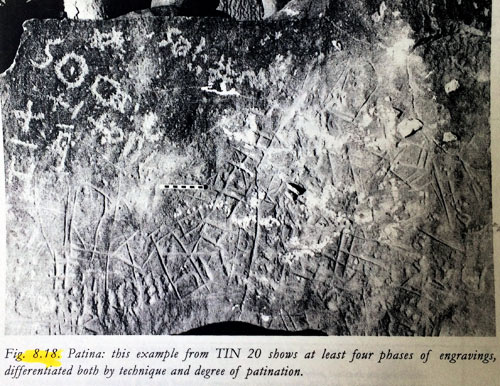
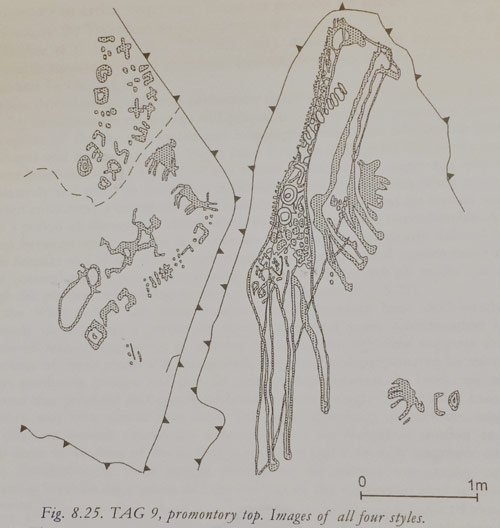
Regarding the patina issue, the common opinion among specialists is that if the patina is the same across a given surface then whatever beneath that surface is of the same age. For example, in the above engraving from Fezzan, Libya, David Mattingly shows how different sections of the same engraving (with superimposed paintings and inscriptions) each has a different patina and thus each was dated to a different period. This particular engraving shows at least four phases of engravings, differentiated by technique and "degree of patination", and therefore each section belongs to a different time period. If however they all had the exact same patina (plus the same style and technique) then all the four would be of the same age.
Ideographic Tifinar & Haut Mertoutek
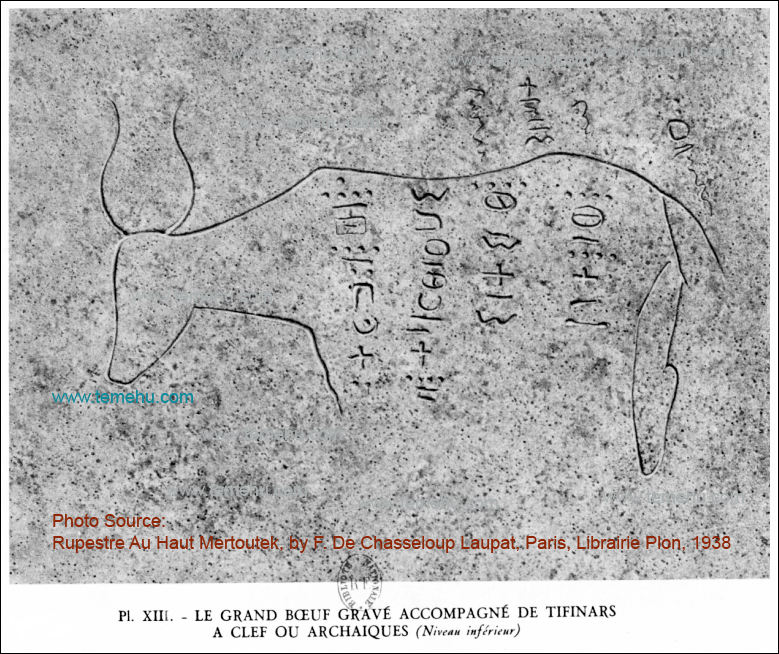
If we go to the source from which Professor Wulsin took the above Mertoutek engraving, we are rewarded with a good photo of the actual engraving. The source is: Art Rupestre Au Haut Mertoutek, by F. De Chasseloup Laupat, 1938.
The following points will summarise what Chasseloup Laubat had noted regarding the Oued Mertoutek engravings:
The engravings of the "archaic tifinars" are very interesting because of their great dimensions and the superior quality of clear, smooth, and chiseled lines.
The patina is the same as that of the rock.
In quoting Professor Gautier, the recognised authority on Saharan prehistory, he states that the deep and smooth etching can only be the work of people who knew how to work with flint thoroughly.
Hence F. De Chasseloup Laubat seems almost certain that the people who execute any engraving with this mastery could only belong to the "Stone Age", and therefore the engraving is likely to be "very old", he said.
The stone age ended around 5,300 years ago. It is not clear, however, why Professor Wulsin said the style and patina of the engraving "suggest a date in the first, second, or third millennium BC" — a massive range of 3000 years. The second millennium BC, maybe (since some sources say the Stone Age lasted until 2000 BC); but to include the first millennium in his rather long range speculation could be nothing more than an attempt to edge the date closer to the arrival of Dido in North Africa; and hence Professor Wulsin himself eventually suggested that "Tifinagh writing was invented earlier than is commonly believed", and perhaps it is "based on Egyptian hieroglyphics".
F. De Chasseloup Laubat then anticipated what other authors had said years later, when he wrote: "It is convenient to affirm that the Tifinar characters have been added later, but is it not so logical to assume that these archaic Tifinar characters are perhaps much older than we have first assumed and that Tifinar characters, before they became alphabetic, were ideographic, just like the Egyptian hieroglyphs"? [My own translation from French.]
He also noted that these "ancient tifinars, in both cases that we have observed, are vertically arranged in the usual manner of hieroglyphs and ideographic characters; which in any case makes tifinars characters quite ancient".
F. De Chasseloup Laubat was also convinced of the strong affinities between some of the art found in Oued Mertoutek and similar works from Ancient Egypt, and that these affinities become stronger the more one continued to explore the Sahara, he said.
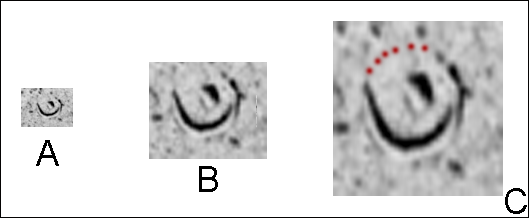
F. De Chasseloup Laubat also mentioned that some specialists said they saw some Arabic characters in the Oued Mertoutek engraving, to which he paid no attention. I believe such specialists were again mistaken, as they probably were referring to the character that looks like Arabic ن (N). When I examined this particular letter, which is the only character that looks like an Arabic character, I realised that the letter is actually incomplete, as if a small section was chipped off, probably by wind, rain or just age. If you zoom in, you will see that only half of the the top half of the circle is missing, like this:
A: original and untouched. B: original and untouched: zoomed in to show half of the top half of the circle. C: red dots added to trace the missing half of the top half, to illustrate how it could have looked originally.
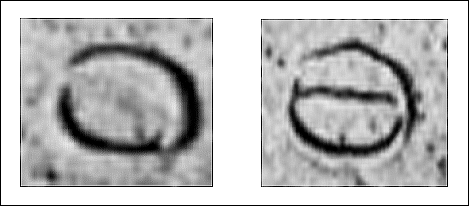
The style of engraving a circle in two halves is also shown in the same engraving by the letters B and R, as follows:
The reason for chiseling a circle in two halves is, probably,
because it is difficult to engrave a perfect circle on hard stone using only a stone flint.
Or maybe for some other 'magical' reason known only to the artist(s).
The truth is we do not know why the circle was engraved in two halves!
Therefore the above Stone Age engraving preserves both letters S and B, the latter of which is not found in the Libyco-Berber scripts. The horizontal line inside the B indicates vertical direction of writing, as is common in most ideographic engravings and inscriptions.
Precursor of Tifinar
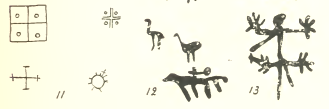
Saharan signs and symbols.
Despite the abundance of signs and symbols in prehistoric rock art across the Sahara, José Farrujia de la Rosa was more obliged to search for the probable precursor of the Libyco-Berber script in Sumer, rather than in North Africa. Such suggestion does not make sense for two reasons: first, the Phoenicians took their alphabet from Egypt (as acknowledged by almost all experts in the field) and therefore there is nothing to do in Sumer or anywhere else in Asia. Secondly, the English definition of "precursor" is: "one that precedes and indicates the approach of another", which indicates some kind of local evolutionary stages that eventually led to the final product or idea; and therefore looking for the precursor thousands of miles away would be called "borrowing" and not "precursor".
The Proto-Sinaitic script itself was originally discovered in Egypt, in Africa, in 1905 by Sir William Matthew Flinders Petrie and his wife Hilda Petrie in Serabit el-Khadim. Further inscriptions were discovered in 1999 by John and Deborah Darnell in Wadi el-Hol. Many of these remain undeciphered. However, the discovery in 1999 of Wadi el-Hol inscriptions near the Nile River, also in Africa, shows, according to the latest accepted opinion, that the script originated in Egypt, and therefore why would anyone look for the precursor of Tifinagh in Asia? Are we supposed to look for the precursor of predynastic Egyptian hieroglyphics in China?
The precursor signs found in Berber tattoos are also present in pottery designs from across North Africa, from predynastic time to the present. Pottery marks, which are extremely archaic, are another world of their own, and have been covered by numerous authors. One study ('Libyan Studies') compared pre-dynastic Egyptian pottery marks to Berber Kabyle pottery designs; suggesting a Berber origin.
Some of the Berber tattoos were documented by Ancient Egyptian inscriptions to have been worn by the Libyans on arms and legs, probably for protection (since they included the name of the Libyan Goddess Neith), which proves that the Berbers were using tattoo symbols and other signs to write the name of the Goddess par excellence, as well as to write spells of magic and protection; and therefore Berber tattoos must be considered as an early form of Berber writing — they convey information including names and mythological data. As they are, there is no doubt that these signs are the local "precursor" of Tifinagh.
As noted elsewhere in this website, there are hundreds of thousands of sites of prehistoric art in North Africa; most of which are undocumented, let alone properly studied and correctly interpreted. In fact 75% of Libya still is "undiscovered". A few outdated techniques have concluded that the enigmatic and mysterious engravings deep within the corridors of Wadi Methkhendoush and the surrounding regions are at least 12,000 years old. Such tumultuous library of data includes geometric, anthropomorphic and religious symbols yet to be analysed; primitive forms of the stylised Ancient Egyptian gods and goddesses; and a mummy that is older than any mummy ever found in Egypt.
Types of Tifinagh:
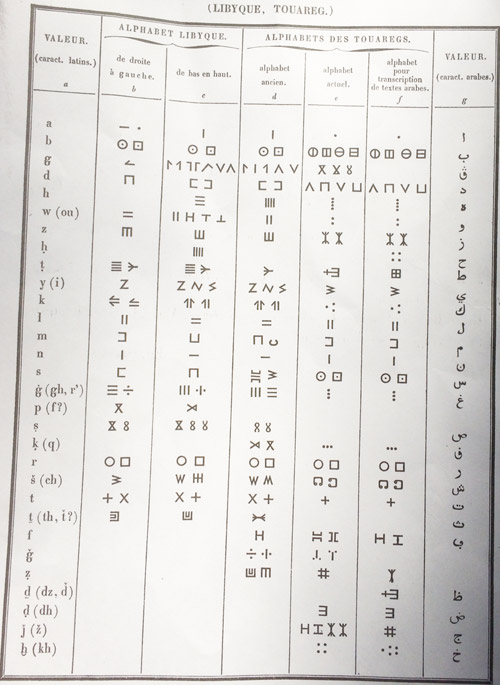
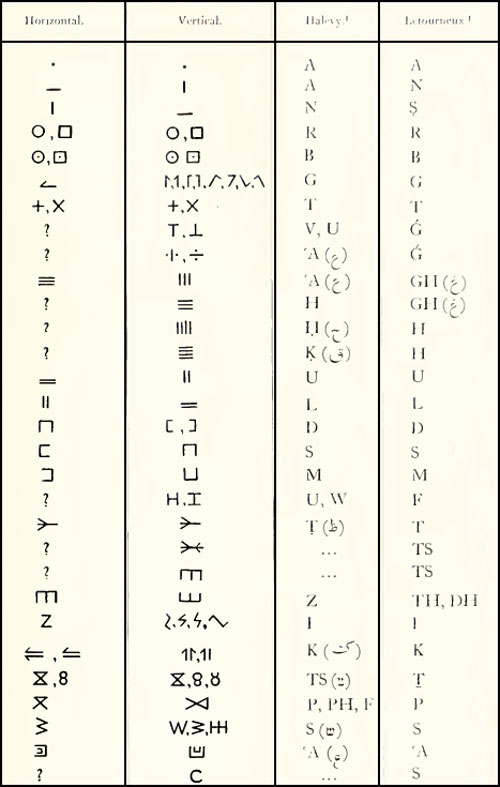
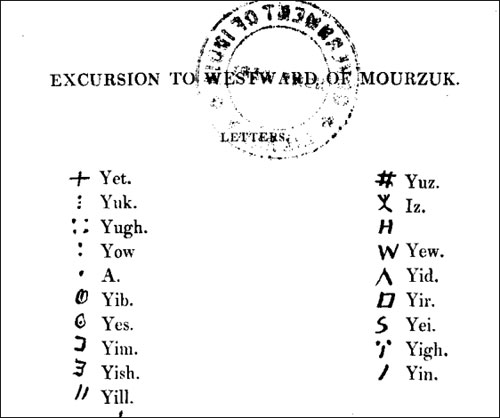
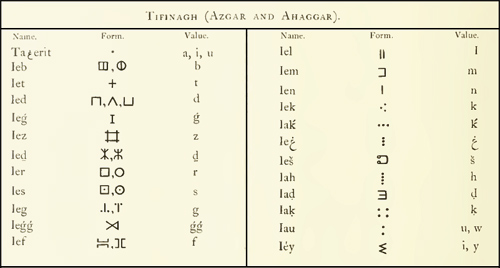
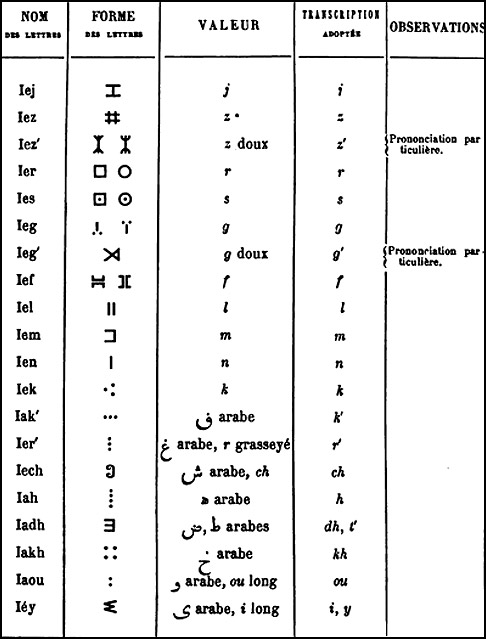
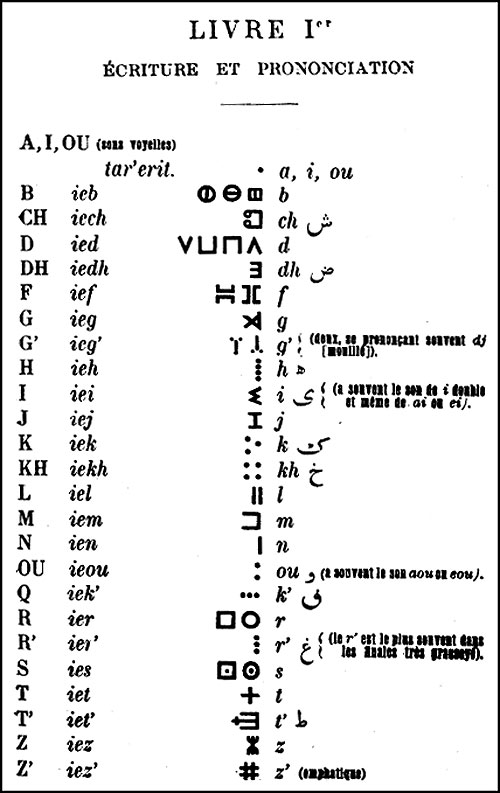
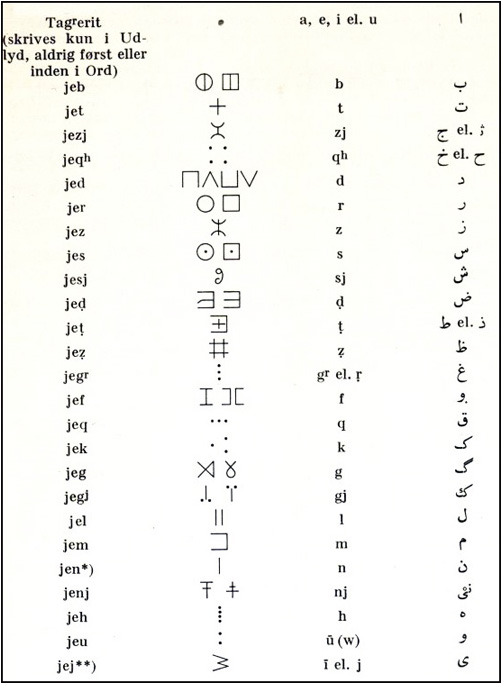
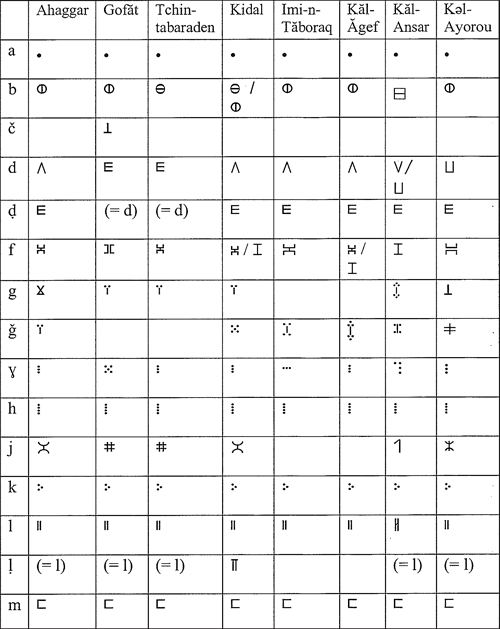
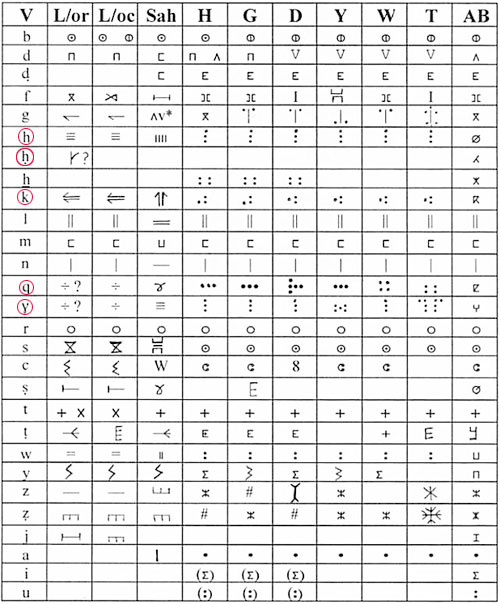
The following charts show some of the common Tifinagh systems. The first group covers the ancient Libyco-Berber script, as given by a number of sources. The second group covers the various types still in use among the Berber Imushagh of the Sahara in Libya, Algeria, Mali, Niger and Burkina Faso.
The Berber alphabet according to the ancient Libyco-Berber Script and their current Imushagh equivalents. Source: Notices Sur Les Charecteres Etrangers Anciens Et Modernes, M. Charles Fossey, 1927
Ancient Libyco-Berber Tifinagh as given by Halévy, via Oric Bates's The Eastern Libyan. (Halévy, M.J. (1874): Essai d’épigraphie libyque. Journal asiatique. 7e série, t. III, Fev.-Mars 1874, 73-203)
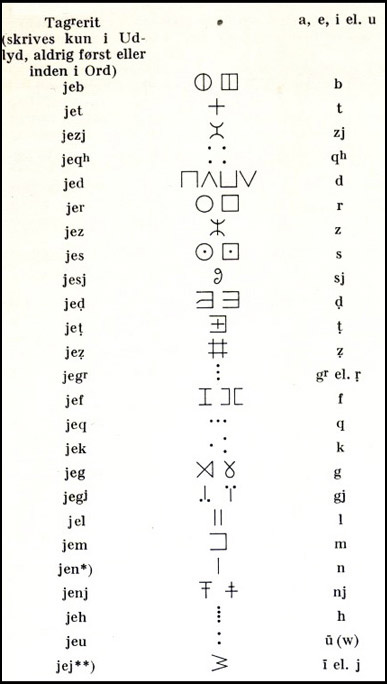
Tifinagh alphabet as given by Thott-Hansen, Kortfattet Dansk Haandbog i de vigstigste af Afrikas Sprog, Kobenhavn, 1969. Source of the image: https://www.win.tue.nl Note the names of the letters, all starting with letter j.
Very interesting paper exploring the various types of Tifinagh alphabets found in today's Niger. Font designers might find the paper very useful, as it also lists all the various forms of each Tifinagh letter as they change through space and time.
V = valeur
Sah = Saharien
A = Ayer
AB = Neo-tifinagh de l'Académie berbère
L/oc = Libyque occidental
G = Ghat
W = Iwelmedan
L/or = Libyque oriental
D = Adrar
T = Tanslemt
Tifinagh alphabet as given by the Berber Academy (l'Académie berbère). There are few errors in their document, notably the letter H was given as three vertical dots, which is letter ⵖ, which is written like this ⵗ in all theTifinagh systems of the Temahuq (Temasheght) (IPA: ɣ). The H is actually four vertical dots. The ɣ confusingly was also given as three dots, as well as four dots (in a square form, and as a vertically-flipped L-shaped four dots). Whoever was behind the Berber Academy (AB), the attempt is clear to make Tifinagh look like the Greek alphabet (see the last column: AB).
IRCAM's Tifinagh chart for the Hapax Berbère font. The first two characters (from left) are from the ancient Libyco-Berber Tifinagh ("Caractères libyques"), while the rest are Tuareg Tifinagh mixed with the newly invented Tifinagh (Neo-Tifinagh), all in one chart. Source: inventaire-des-oeils; quoting Karl-G. Prasse (1972, pp. 153-154).
The modern Neo-Tifinagh invented by IRCAM (ircam.ma/ar/index.php).
The Temahuq Berber alphabet and its Arabic translation, as displayed by the Imushagh of Ghadames, Libya, at Ghadames Museum.
The first column on the right is the Arabic translation of the second column, the third of the fourth, and so on. The English translation is as follows: starting from top right and going down (of the second column from the right): A, B, T, J, χ (KH), D, then from the top of the fourth column from the right: R, Z, ɣ (GH), N, S, ʃ (SH), then from the sixth column from the right: ðˤ, F, Q, L, M, Zˤ, then from the top of first column on the left: H, Y, O (or W), G, ʤ (as in judge), K, and tˤ.
If you like this page and would like to share it, please click on the following button to copy the URL:
https://www.temehu.com/imazighen/tifinagh.htm
Author: (Berber) Nesmenser Zuwarah, Libya.
Written: 2012. Updated: 2021. Updated: 2023.
Ligatures
ⵔ⵿ⵜ
ft
ⵟmt
ⵞt͡ʃ
ⵎ⵿ⵙms
rt
ut
ⵏ⵿ⴾnk
ⵏ⵿ⵌn⵿zˤ
ⵍ⵿ⵜlt
bt
ⵙ⵿ⵜst
rt
ⵏ⵿ⵙns
nt
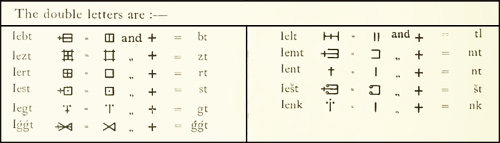
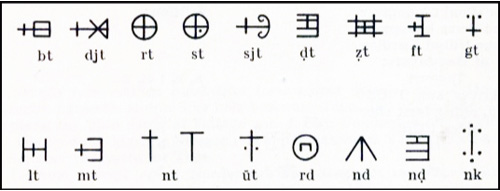
A ligature is a letter that is made of two letters joined together. It is also known as a "double letter" or a "bi-consonant cluster". For example, in English we have "æ", which is made of letters "a" and "e". Most of the ligatures found in various writing systems appear to be "stylistic" in origin to make writing more practical and quicker, especially in handwriting. For example, the "fi" ligature in European scripts joins the letters "f" and "i" through the horizontal dash of the "f" while at the same time removes the dot from letter "i". Ligatures eventually fell out of use and practically disappeared after the computer revolution.
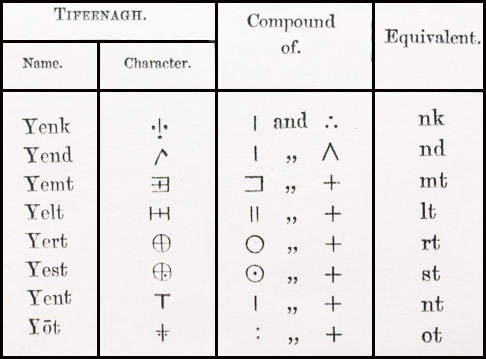
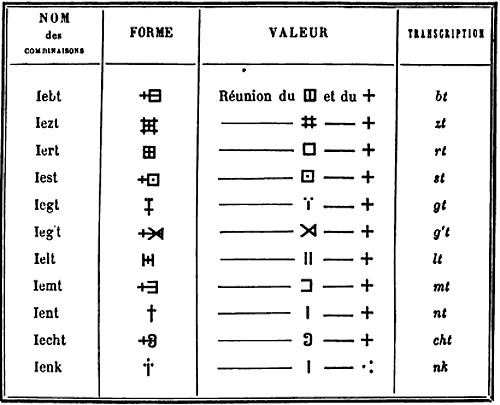
However, Tamazight Tifinagh ligatures are different, and perhaps unique, because they are not stylistic, but real double-letters that represent compound "sounds" that cannot be represented by a single letter. For example, English /ng/ in 'sing' sounds as if it is made of one sound, and yet there is no ligature for it in English. On the other hand, each of the Berber sounds /nt/, /mt/, /lt/, /rt/, /st/, /ts/ or /tsh/ is pronounced as if it is one sound, and therefore they all have unique ligatures assigned to them by our Berber ancestors. Interestingly, there are nearly as many ligatures in Tifinagh as there are letters.
Judging from some inscriptions and Berber rock art of Mother Sahara, these ligatures are probably as ancient as the Tifinagh letters themselves. Other ancient scripts that also employ ligatures include the Ancient Egyptian Hieratic and the Germanic Rune alphabet.
For this reason (ligatures represent unique sounds and not just typographical styles), in late 19th century the International Phonetic Alphabet (IPA) used ligatures (and diacritics) to represent speech sounds, like ʣ, ʤ, ʥ, ʦ, ʧ, ʨ, ɮ, ʩ, ʪ and ʫ. This makes it easy for linguists and translators to correctly read any language in the world. See the IPA & MRI tab for a full list of IPA forms of the characters of Tifinagh.
In Tifinagh Tagmukay the bi-consonant cluster is joined together using the Tifinagh Constant Joiner ( ⵿ ), code: U+2D7F. See below for instructions on how to use it to write ligatures using the Berber Tagmukay font (which you can download from the Fonts & Keyboards tab in the above yellow menu).
"Temahuq Tifeenagh" Ligatures as given by H. Stanhope Freeman, in his book Temahuq, 1862.
Tifinagh Ligatures as given by Oric Btes (The Eastern Libyan). (These are identical with the ligatures given by Hanoteau [shown above]).
Tifinagh Ligatures as given by Thott-Hansen, Kortfattet DanskHaandbog i de vigstigste af Afrikas Sprog, Kobenhavn, 1969. Source of the image: https://www.win.tue.nl
Thott-Hansen's ligatures are different from those given by Hanoteau and Oric Bates, in that they have seven more ligatures, and the styles of three of the shared ligatures are different. For example, the T of ST is given inside the S, which is interesting; the three dots of NK are repeated at the bottom of the sign as well; and the T of SJT is more prominent (note that SJT is also noted elsewhere SHT: ⵞ ( č )).
ⴼ⵿ⵜ
ⵏ⵿ⴶ
ⵎ⵿ⵙ
ⵏ⵿ⵗ
ⵏ⵿ⵙ
ⵎ⵿ⵀ
ⵏ⵿ⵌ
ft
n⵿ʤ
ms
n⵿ɣ
ns
mh
n⵿zˤ
From other sources I have found seven more ligatures which are not given by the above three sources, except the FT ligature which was given by Thott-Hansen with the two parts of the F joined together.
This means that it is possible to develop your own ligatures to suit your needs providing the double letters are pronounced with no vowels between them. See instructions (below) for how to use the Tagmukay Berber keyboard to write ligatures.
If your browser does not display the above ligatures correctly, the following table shows them as images.
ft
n⵿ʤ
ms
n⵿ɣ
ns
mh
n⵿zˤ
How To Type Tifinagh Ligatures Using Tagmukay: ⵔ⵿ⵜ
type letter 1 (say R: ⵔ)
hit the key <Right Alt>
press the key at the top with 3 dots (…), which is the "constant joiner" ( ⵿ ), or use the code: U+2D7F.
then go back to normal keyboard (by pressing the Left Alt twice) and type the second letter (say T: ⵜ)
Result: ⵔ⵿ⵜ
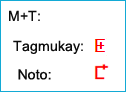
Please note that ligatures are displayed differently depending on font. The Noto Sans Tifinagh font, for example, shows the MT with the t joined to the top notch of the m (like in the above image), while Tagmukay font shows the t inside the m as it should be (like this: ⵎ⵿ⵜ). On the other hand, the new vowel ye (ⵦ) does not show in Tagmukay (as of now), but it does show in Noto Sans Tifinagh.
How To Type Tifinagh Ligatures Using Hapax-Berber:
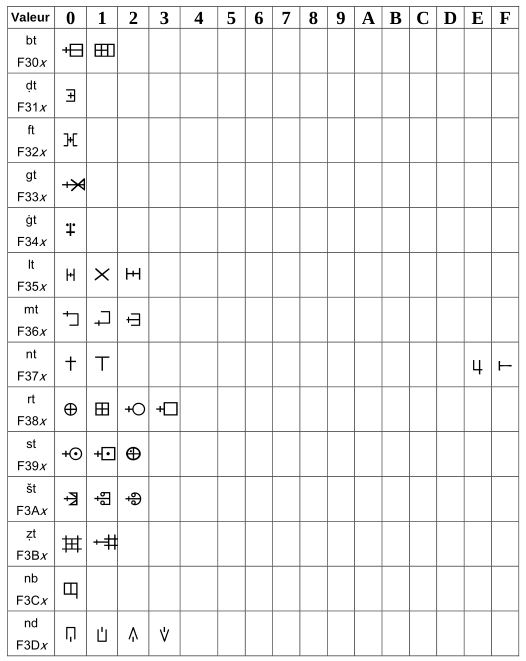
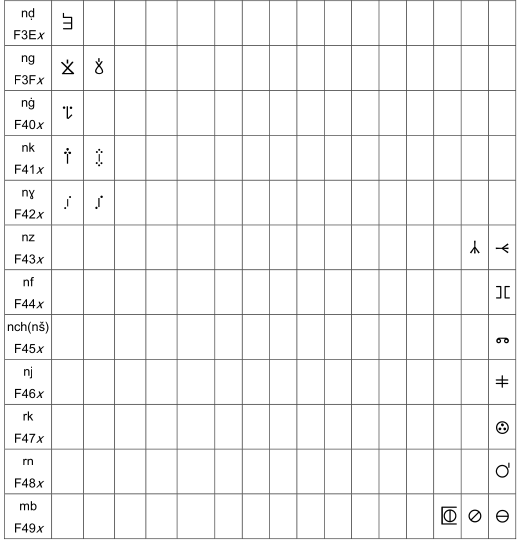
After installing the Hapax-Berber font, use the following table to identify the code for the required ligature.
Type the code using the keyboard
Press the keys: Alt + X
For example, F381 Alt+X = (= R + T)
The above table shows the Ligatures unicodes using the Hapax-Berber (hapaxber.ttf) font. Source: inventaire-des-oeils
If you like this page and would like to share it, please click on the following button to copy the URL:
https://www.temehu.com/imazighen/tifinagh.htm
Author: (Berber) Nesmenser Zuwarah, Libya.
Written: 2012. Updated: 2021. Updated: 2023.
Tamazight Vowels
MRI
Audio
IPA
Unicode (IPA)
English
Berber Latin
Tifinagh (IRCAM)
Unicode (Tifinagh)
Name
æ
U+00E6
fat
A a
(ⵎⵏ)
U+2D30
Near-open front unrounded vowel
ə
U+0259
about
ə [abərkus]
Mid central vowel
schwa float vowel
e
U+0065
e
ⴻ
U+2D3B
close-mid front unrounded vowel
i
U+0069
sheet
I i
ⵉ
U+2D49
Close front unrounded vowel
ʊ
U+028A
put
U u
U+2D53
Near-close back rounded vowel
Vowels Found In Temahuq Dictionaries:
ä
U+0061 U+0308
open_central_unrounded_vowel as in American-English father
◌̃
ã
U+0303
nasal vowel, as in French en
The audio files I used for the above table are from Wikipedia.
The animation and MRI video files I used for the table below are from the following sources.
ⴵ2: this letter appears as dj and sometimes as g in Neo-Tifinagh. It is not found in any of the Temahuq alphabets. However, it does exist in the ancient Libyco-Berber script as sˤ (ṣ); and as ts (given by Halévy); while according to Chabot's Dougga insctiption this letter is normal s (as in see).
Pharyngealisation: place as superscript after a letter: tˁ dˁ sˁ zˁ mˁ nˁ lˁ rˁ
428
◌̴
tilde is also used for: emphatic sign
◌ the dotted circle is for illustration only, and denotes any letter
̴
U+0334
Pharyngealisation: The swung dash or combining tilde diacritic (U+0334) was originally intended to combine with other letters to represent pharyngealisation. However, precomposed letters are required for proper display in most IPA fonts. They are available only for labial consonants (ᵱ ᵬ ᵮ ᵯ) and coronal consonants (ᵵ ᵭ ᵴ ᵶ ᵰ ᵲ ᵳ ɫ).
◌ʷ
or
°
Tamatart 'Labialisation sign'
ⵯ
e.g.:
kʷʃət (kʷcet)
Labialisation is a secondary articulatory feature of sounds in some languages. Labialised sounds involve the lips while the remainder of the oral cavity produces another sound. The term is normally restricted to consonants. When vowels involve the lips, they are called rounded. The most common labialized consonants are labialized velars.
A labialised velar or labiovelar is a velar consonant that is labialised, with a /w/-like secondary articulation. Common examples are [kʷ, ɡʷ, xʷ, ŋʷ], which are pronounced like a [k, ɡ, x, ŋ], with rounded lips, such as the labialised voiceless velar plosive [kʷ].
U+0361
◌͡◌
tie bar (above or below)
͡ts
͜ts
Affricates and double articulations can be represented by two symbols joined by a tie bar either above or below the letters: one for the stop element and the other for the fricative element:
a, e, i, o and u stand for the vowels of hat [a], get [ɛ], heat [i], hot [ɔ] and fool [u] in British English.
â, é, ó stand for the vowels of father [ɑ], day [e] and core [ɒ].
ā, ē, ī, ō and ū stand for the same vowels as without the accent, but pronounced longer. [aː], [ɛː], [iː], [ɔː], [uː]
b, d, f, h, k, l, m, n, p, r, s, t, v, w, y and z stand for their equivalents in English.
θ stands for the th of English thick. [θ]
ð stands for the th of English this. [ð]
j stands for the j of English job. [dʒ]
g stands for the g of English good. [ɡ]
x stands for the sound of German ch in Ach! or j in Spanish jota. [x]
ğ stands for the voiced counterpart of x, much as Spanish intervocalic g. [ɣ]
š stands for the sh of English ship. [ʃ]
ħ stands for the typical rough h sound of Semitic languages. [ħ]
ʿ stands for the voiced counterpart of ħ. [ʕ]
ʾ stands for the glottal stop of cockney English boʼle ('bottle'). [ʔ]
q stands for a k sound produced from the back of the mouth. [q]
ṭ, ṣ, ḍ and ẓ stand for the sounds derived from t, s, d and z/ð. These are called the pharyngealised, emphatic, or velarised sounds. They affect the sound of the consonants and vowels that follow or precede; they are made by constricting the pharynx during the articulation of the sound. [tˁ], [sˁ], [dˁ], [zˁ]/[ðˁ].
IPA Brackets used to enclose transcriptions
/Slashes/
indicate sounds that are distinguished as the basic units of words in a language by native speakers; these are called phonemes.
[Square brackets]
indicate the narrower or more detailed phonetic qualities of a pronunciation.
Either //double slashes// or |pipes| show that the enclosed sounds are theoretical constructs. For instance, most phonologists argue that the -s at the end of verbs, as /s/ in talks /tɔːks/ or as /z/ in lulls /lʌlz/, has a single underlying form. If they decide this form is an s, they would write it //s// (or |s|) (as in /tɔːks/); but if they decide it was //z//, they would write it as //z// (as in //lʌlz//).
〈 Angle brackets 〉(also called chevrons)
〈 : 〈 〉 : 〉
are used to set off orthography, as well as transliteration from non-Latin scripts. Angle brackets are not supported by all fonts, so a template {{angle bracket}} (shortcut {{angbr}}) is used to ensure maximal compatibility. You can use this template to generate a pair of left and right angle brackets that will display correctly. For example:
{{angbr|ŋ}} displays as 〈ŋ〉
{{angbr|foo}} displays as 〈foo〉
If you like this page and would like to share it, please click on the following button to copy the URL:
https://www.temehu.com/imazighen/tifinagh.htm
Author: (Berber) Nesmenser Zuwarah, Libya.
Written: 2012. Updated: 2021. Updated: 2023.
Tamazight Tifinagh Fonts
To be able to write with Tifinagh you need to download and install the Tifinagh keyboard and some fonts. The following two sections allow you to download the most popular fonts and some important Berber Tifinagh keyboards including Tagmukay. The software available in this page (and the whole website) is downloadable only via secure HTTPS.
Installing The Fonts
Mac OS
Unzip the downloaded file
Double click the folder to extract the files
Copy only the fonts (do not copy the .pdf guide)
Paste the fonts in Library/Fonts
Windows
Method 1
Unzip the downloaded file
Double click the folder to extract the files
double-click on each font you want to install (Windows will do the rest)
Method 2
Unzip the downloaded file
Double click the folder to extract the files
Copy only the fonts (do not copy the .pdf guide)
Paste the fonts in C:\WINDOWS\Fonts
Download Tifinagh Fonts
Tifinagh Fonts
Some of the fonts still preserve the original Tifinagh forms, as in letters L () and F () by default (like Tagmukay, for example); while other fonts by default use the corrupted forms of Neo-Tifinagh by adding a joining line between the two parts of the letter. This practice is unnecessary because most of the keyboards available already offset double and similar letters by inclining the second part (as shown above). Of course, one can manually enter the correct code for the original form of the letter, but the default option while typing normally on the keyboard should be the original form, with the extra option to enter invented forms manually if and when required.
Download Tagmukay font (for Windows, Linux and Apple Macintosh): Tagmukay/Tagmukay-2.000.zip ( ZIP | 706.8 KB | 21 July 2017 )
Download Google's Noto Sans Tifinagh font: Noto SansTifinagh-Regular.zip The NotoSansTifinagh font has some issue (see this link for details: https://github.com/googlefonts/noto-fonts/issues/1619)
Tifinagh Keyboards
Download the keyboard software
The following zipped files come from Paul Anderson's website at: akufi.org . Each download includes pdf guides and layouts. The first and the third links (below) are Latin-mapped keyboard layouts, while the second one is Arabic-mapped layout.
A high-quality Tifinagh font that supports the Tawallammat dialect of Tamajaq (Temahuq, Temasheght or Tamazight) of the Berbers of Niger. What is special about Tagmukay is that you can use it to type double letters in Tifinagh, else known as bi-consonant ligatures.
Tagmukay Tifinagh has:
24 consonants,
19 bi-consonant ligatures (includes a variant),
one vowel (found word-final),
and one punctuation character.
Download Tagmukay
Download: Tawallammat Tifinagh Package (can be installed via Keyman):
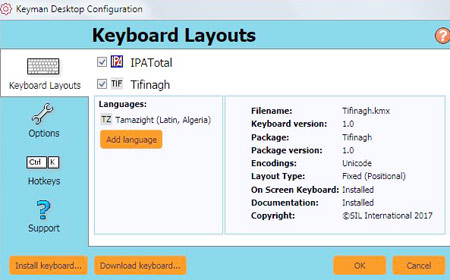
Once you install keyman Desktop, you can click "Add language", then navigate to the location of your Tagmukay Tifinagh package. You can as many languages as you need, all accessible from the task bar.
The Keyman keyboard allows you to type in over 1,000 languages on Windows and Mac OS, and also online via a web browser. The following Windows Keyman does not include any languages (or keyboards), which means you need to download additional packages for each font or language you require. For example, after installing this Keyman software, you can install the Tagmukay Tifinagh package from within the Keyman program itself (click on Add language, shown in the above image).
MSKLC Keyboard layout for “IPA Unicode 6.2 (ver. 1.4b) MSK”
The International Phonetic Alphabet Unicode 6.2 (ver. 1.4) MSK keyboard has been automatically associated with the Icelandic language. After installation you can select this keyboard from the language bar in the system tray (this will be “IS”). This keyboard is excellent for typing Berber-Latin transcription and IPA symbols.
If you like this page and would like to share it, please click on the following button to copy the URL:
https://www.temehu.com/imazighen/tifinagh.htm
Author: (Berber) Nesmenser Zuwarah, Libya.
Written: 2012. Updated: 2021. Updated: 2023.
Tifinagh Books
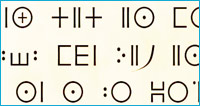
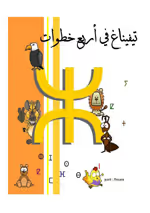
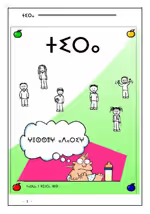
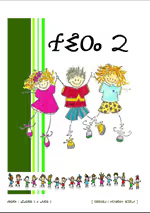
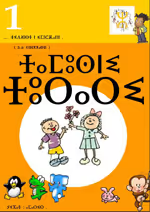
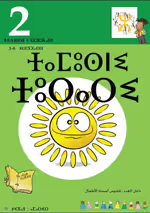
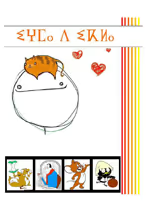
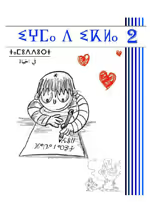
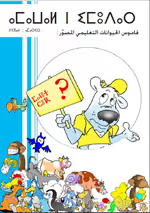
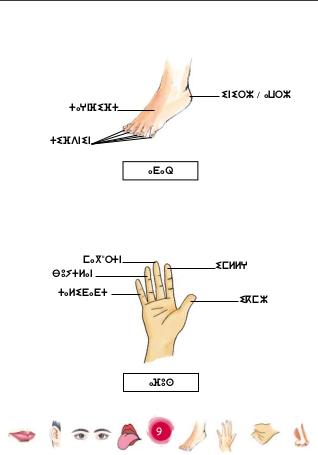
The following ten PDF books were produced by tawalt.com. The books are written in Arabic, to teach Tamazight Tifinagh. One of the books is titled "Tifinagh In Four Steps", which teaches how to read and write in Tamazight; while another includes children activities to practice and learn Tifinagh, as in the following image, in which children are encouraged to identify the Berber words in the square:
Children were encouraged to locate Tifinagh words in a number of exercises as this one.
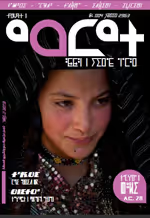
Armat is Libya's first official Berber magazine to be launched under the supervision of the Libyan National Centre for Local Cultures Studies (المركز الوطني الليبي لدراسات الثقافات المحلية) on the 29th of December 2012. The entire magazine is in Tamazight and is written in Tifinagh. Website: armat.ly .
Download Armat 1
Download Armat 2
Download Armat 3
Download Armat 4
Tamazight Curriculum
Sawlat
Picture Dictionary
Tizlatin
Tamazight 1
Tamazight 2
Tamazight 3
Tamazight 4 (?)
Tamazight 5
Tamazight 6
If you like this page and would like to share it, please click on the following button to copy the URL:
https://www.temehu.com/imazighen/tifinagh.htm
Author: (Berber) Nesmenser Zuwarah, Libya.
Written: 2012. Updated: 2021. Updated: 2023.
Prehistoric Tifinagh Inscriptions & Engravings
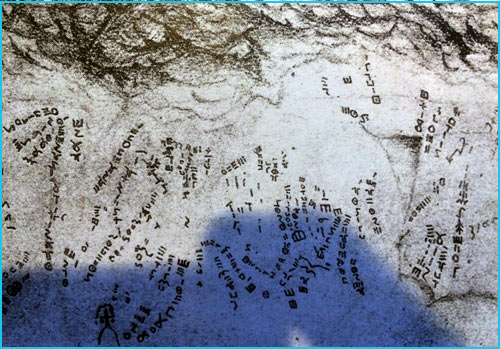
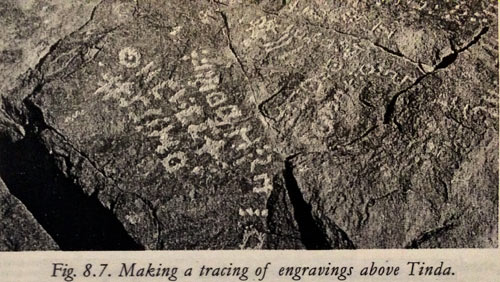
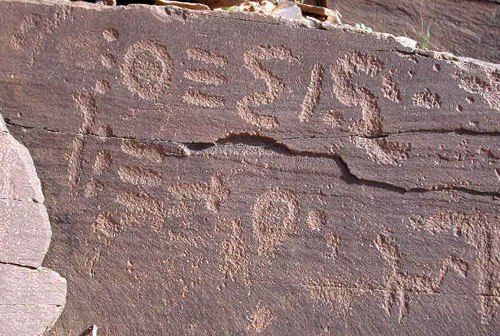
The following Tifinagh inscriptions and engravings are only a small sample of the countless prehistoric Tifinagh engravings and inscriptions scattered across hundreds of thousands of rock art sites in the Great Sahara desert, as well as along the northern regions of the continent Africa. Tassili n'Ajjer alone, in southern Algeria, is the home of more than 15,000 rock paintings and engravings, dating back as far as 12,000 years. The majority of these prehistoric treasures are yet to be documented and properly dated, and certainly many more to be discovered in decades to come, once freedom sinks in and the Berbers take matters into their hands.
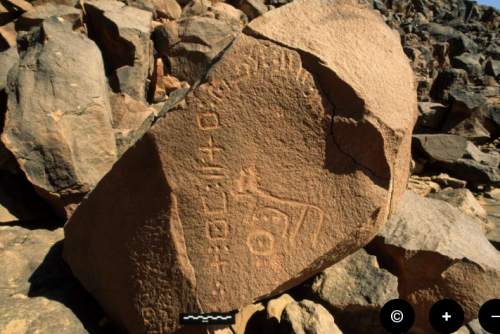
Tifinagh engraving from the Wadi Metkhendoush area. Source: britishmuseum.org The photograph was taken by the photographer and author David Coulson: the founder and Chairman of the Trust for African Rock Art (TARA).
In Barry Fell’s two books, America BC and Saga America, one learns about the Berber Tifinagh inscriptions found in America (California, New Mexico, Texas, Iowa and Nevada) and in Polynesia; but the findings were dismissed by the scientific community. A quick search for the alleged inscriptions reveals nothing at all, except those sources quoting "Fell's inscriptions"; leading some to believe they are a hoax.
If you like this page and would like to share it, please click on the following button to copy the URL:
Likewise anything else to do with Tifinagh, there are various forms, or types, for the names of letters in circulation. Depending on regional differences, some types start every letter with "j"; others start with "i"; in Ayr the names start with "e"; while in the Ahoggar they start with "y".
Tifinagh Unicode Names
Tifinagh
Unicode Character
Oct
Dec
Hex
HTML
ⴰ
ya
026460
11568
0x2D30
ⴰ
ⴱ
yab
026461
11569
0x2D31
ⴱ
ⴲ
yabh
026462
11570
0x2D32
ⴲ
ⴳ
yag
026463
11571
0x2D33
ⴳ
ⴴ
yaghh
026464
11572
0x2D34
ⴴ
ⴵ
Berber Academy yaj
026465
11573
0x2D35
ⴵ
ⴶ
yaj
026466
11574
0x2D36
ⴶ
ⴷ
yad
026467
11575
0x2D37
ⴷ
ⴸ
yadh
026470
11576
0x2D38
ⴸ
ⴹ
yadd
026471
11577
0x2D39
ⴹ
ⴺ
yaddh
026472
11578
0x2D3A
ⴺ
ⴻ
yey
026473
11579
0x2D3B
ⴻ
ⴼ
yaf
026474
11580
0x2D3C
ⴼ
ⴽ
yak
026475
11581
0x2D3D
ⴽ
ⴾ
Temahuq yak
026476
11582
0x2D3E
ⴾ
ⴿ
yakhh
026477
11583
0x2D3F
ⴿ
ⵀ
yah
026500
11584
0x2D40
ⵀ
ⵁ
Berber Academy yah
026501
11585
0x2D41
ⵁ
ⵂ
Temahuq yah
026502
11586
0x2D42
ⵂ
ⵃ
yahh
026503
11587
0x2D43
ⵃ
ⵄ
yaa
026504
11588
0x2D44
ⵄ
ⵅ
yakh
026505
11589
0x2D45
ⵅ
ⵆ
Temahuq yakh
026506
11590
0x2D46
ⵆ
ⵇ
yaq
026507
11591
0x2D47
ⵇ
ⵈ
Temahuq yaq
026510
11592
0x2D48
ⵈ
ⵉ
yi
026511
11593
0x2D49
ⵉ
ⵊ
yazh
026512
11594
0x2D4A
ⵊ
ⵋ
Ahoggar yazh
026513
11595
0x2D4B
ⵋ
ⵌ
Temahuq yazh
026514
11596
0x2D4C
ⵌ
ⵍ
yal
026515
11597
0x2D4D
ⵍ
ⵎ
yam
026516
11598
0x2D4E
ⵎ
ⵏ
yan
026517
11599
0x2D4F
ⵏ
ⵐ
Temahuq yagn
026520
11600
0x2D50
ⵐ
ⵑ
Temahuq yang
026521
11601
0x2D51
ⵑ
ⵒ
yap
026522
11602
0x2D52
ⵒ
ⵓ
yu
026523
11603
0x2D53
ⵓ
ⵔ
yar
026524
11604
0x2D54
ⵔ
ⵕ
yarr
026525
11605
0x2D55
ⵕ
ⵖ
yagh
026526
11606
0x2D56
ⵖ
ⵗ
Temahuq yagh
026527
11607
0x2D57
ⵗ
ⵘ
ayer yagh
026530
11608
0x2D58
ⵘ
ⵙ
yas
026531
11609
0x2D59
ⵙ
ⵚ
yass
026532
11610
0x2D5A
ⵚ
ⵛ
yash
026533
11611
0x2D5B
ⵛ
ⵜ
yat
026534
11612
0x2D5C
ⵜ
ⵝ
yath
026535
11613
0x2D5D
ⵝ
ⵞ
yach
026536
11614
0x2D5E
ⵞ
ⵟ
yatt
026537
11615
0x2D5F
ⵟ
ⵠ
yav
026540
11616
0x2D60
ⵠ
ⵡ
yaw
026541
11617
0x2D61
ⵡ
ⵢ
yay
026542
11618
0x2D62
ⵢ
ⵣ
yaz
026543
11619
0x2D63
ⵣ
ⵤ
Tawellemet yaz
026544
11620
0x2D64
ⵤ
ⵥ
yazz
026545
11621
0x2D65
ⵥ
ⵯ
modifier labialization marker
026557
11631
0x2D6F
ⵯ
Tifinagh letter names according to Thott-Hansen, 1969.
Inserting Unicode characters
ⵙ sˤ ṣ
To insert a Unicode character:
Type the character code
Press ALT
Then press X
Notes: ALT+X converts the wrong character code into Unicode, select the correct character code before pressing ALT+X.
Alternatively, precede the correct character code with the text "U+".
ASJP version from 2016 uses the following symbols to encode the phonemes: p, b, f, v, m, w, 8, t, d, s, z, c, n, r, l, S, Z, C, j, T, 5, y, k, g, x, N, q, X, h, 7, L, 4, G, !, i, e, E, 3, a, u and o. They represent 34 consonants and seven vowels, all found on the standard QWERTY keyboard.
ASJP
Description
IPA
i
high front vowel, rounded and unrounded
i, ɪ, y, ʏ
e
mid front vowel, rounded and unrounded
e, ø
E
low front vowel, rounded and unrounded
a, æ, ɛ, ɶ, œ
3
high and mid central vowel, rounded and unrounded
ɨ, ɘ, ə, ɜ, ʉ, ɵ, ɞ
a
low central vowel, unrounded
ɐ
u
high back vowel, rounded and unrounded
ɯ, u
o
mid and low back vowel, rounded and unrounded
ɤ, ʌ, ɑ, o, ɔ, ɒ
p
voiceless bilabial stop and fricative
p, ɸ
b
voiced bilabial stop and fricative
b, β
m
bilabial nasal
m
f
voiceless labiodental fricative
f
v
voiced labiodental fricative
v
8
voiceless and voiced dental fricative
θ, ð
4
dental nasal
n̪
t
voiceless alveolar stop
t
d
voiced alveolar stop
d
s
voiceless alveolar fricative
s
z
voiced alveolar fricative
z
c
voiceless and voiced alveolar affricate
ts, dz
n
voiceless and voiced alveolar nasal
n
S
voiceless postalveolar fricative
ʃ
Z
voiced postalveolar fricative
ʒ
C
voiceless palato-alveolar affricate
tʃ
j
voiced palato-alveolar affricate
dʒ
T
voiceless and voiced palatal stop
c, ɟ
5
palatal nasal
ɲ
k
voiceless velar stop
k
g
voiced velar stop
ɡ
x
voiceless and voiced velar fricative
x, ɣ
N
velar nasal
ŋ
q
voiceless uvular stop
q
G
voiced uvular stop
ɢ
X
voiceless and voiced uvular fricative, voiceless and voiced pharyngeal fricative
χ, ʁ, ħ, ʕ
7
voiceless glottal stop
ʔ
h
voiceless and voiced glottal fricative
h, ɦ
l
voiced alveolar lateral approximate
l
L
all other laterals
ʟ, ɭ, ʎ
w
voiced bilabial-velar approximant
w
y
palatal approximant
j
r
voiced apico-alveolar trill and all varieties of “r-sounds”
r, ʀ, etc.
!
all varieties of “click-sounds”
ǃ, ǀ, ǁ, ǂ
If you like this page and would like to share it, please click on the following button to copy the URL:
https://www.temehu.com/imazighen/tifinagh.htm
Author: (Berber) Nesmenser Zuwarah, Libya.
Written: 2012. Updated: 2021.
Resources
The British Library: EAP265: The tifinagh rock inscriptions in the Tadrart Acacus mountains (SW Libya): an unknown endangered heritage: eap.bl.uk/database/overview_project.a4d?projID=EAP265;r=9514
Trust For African Rock Art (TARA): https://www.britishmuseum.org/collection/term/BIOG221337
Le Quellec, J.L. 2012. Rock Art, Scripts and proto-scripts in Africa: the Libyco-berber example. In: Delmas, A. and Penn, P. (eds.), Written Culture in a Colonial Context: Africa and the Americas 1500 – 1900. Brill Academic Publishers, Boston.
LBI (Libyco-Berber Inscriptions Online Database): Inscriptionas Database: http://www.institutum-canarium.org/lbi-project/site_index_name.php This site is also archived under another URL by archive.org: https://web.archive.org/web/20160101181518/http://lbi-project.org/lbi-db.php
The Italian-Libyan Archaeological Mission in the Acacus: acacus.org
Halévy, M.J. (1874): Essai d’épigraphie libyque. Journal asiatique. 7e série, t. III, Fev.-Mars 1874, 73-203
Pichler, W. 2007. Origin and Development of the Libyco-Berber Script. Berber Studies 15. Rüdiger Köppe Verlag, Köln.
Chaker, S. : tamazgha.fr/Professor-Chaker-Speaks-Out-on-the-Tifinagh-Script-Issue,427.html
Chaker, S. and Hachi, S. : A PROPOS DE L’ORIGINE ET DE L’AGE DE L’ECRITURE LIBYCO-BERBERE.
Paul Anderson: download Tifinagh keyboard software and layout: akufi.org/en/tools/azerty2.html
Royal Institution for Amazigh Culture: download Tifinagh fonts and Tamazight keyboard for Windows and Mac systems; the eight fonts and the keyboard were both developed by IRCAM: ircam.ma/ar/index.php?soc=telec , ircam.ma/amzfr.htm
Deciphering Tifinagh inscriptions: the following paper attempts to decipher Canarian inscriptions by comparing them to Temahuq Tifinagh inscriptions: https://www.temehu.com/imazighen/dictionaries/Amawals-2/Berbers-Tuaregs-Canarians1.pdf
ALMOGAREN: Scientific Publication Series of the Institutum Canarium Digital Platform for the Interdisciplinary Research on the Canary Islands and Mediterranean Cultures http://www.almogaren.org/almo_contents_e.html
Camps, G. (1978): Recherches sur les plus anciennes inscriptions libyques de l’Afrique du Nord et du Sahara. B.C.T.H. fasc. B., 143-166
Blau, O. (1851): Ueber das numidische Alphabet. Zeitschrift der Deutschen morgenländischen Gesellschaft. 5. Bd. Leipzig, 330-364
Camps, G. (1978): Recherches sur les plus anciennes inscriptions libyques de l’Afrique du Nord et du Sahara. B.C.T.H. fasc. B., 143-166
Chaker, S. (1984): Textes en linguistique berbère. Paris, 247-258
Chaker, S. ; Hachi, S. (2000): À propos de l’origine et de l’âge de l’écriture libyco-berbère. Réflexions du linguiste et du préhistorien. In: Études berbère et chamito-sémitique. Paris, 95-111
Cohen, M. (1958): La grande invention de l’écriture et son évolution. Paris
Delgado, A. (1964): Inscripciones líbicas de Canarias. La Laguna
Friedrich, J. (1937): Schriftgeschichtliche Betrachtungen. Zeitschrift der Deutschen Morgenländischen Gesellschaft. Band 91, Nachdruck 1966, 319-342
Friedrich, J. (1966): Die libyschen Schriften. In: Geschichte der Schrift. Heidelberg, 94-95
Galand, L. (1972): À propos d’une comparaison entre écritures libyco-berbère et méroïtique. Meroitic Newsletter 9, 6-8
Galand, L. (1991): Entre l’oral et l’écrit: le berbère. Phoinikeia Grammata. Namur, 703-715
Galand, L. (1996): Du Berbère au Libyque: une remontée difficile. L'ALIES 16, 77-98
Galand, L. (2001): Un vieux débat: l’origine de l’écriture libyco-berbère. Lettre de l’AARS. Nr. 20. St. Lizier. 21-24
Halévy, M.J. (1874): Essai d’épigraphie libyque. Journal asiatique. 7e série, t. III, Fev.-Mars 1874, 73-203
Higounnet, Ch. (1986): L’écriture. Que sais-je? PUF, Paris, 47-60
Jensen, H. (1958): Die Schrift in Vergangenheit und Gegenwart. Berlin, 146-148
Kelley, D.H. (1994): The identification of the Proto-Tifinagh script at Peterborough, Ontario. NEARA-Journal, vol. 28, nos.3-4, 86
Knauer, D. (1990): Schalensteine als Schriftträger. Eigenverlag. Karlsruhe. 231-233
Kossmann, M. (1999): Essai sur la phonologie du proto-berbère. Köln
Lemaire, A. (2000): Inscription araméene dans l’abri du Wadi Sura et nord-arabique à l’oasis de Baharieh/Égypt. Sahara 12. Segrate. 173-174
Lidzbarski, M. (1902) : Der Ursprung der nord- und südsemitischen Schrift. Ephemeris I, 109-136
Littmann, E. (1904): L’origine de l’alphabet libyen. Journal asiatique II. Nov.-Dez. 1904, 423-440
Meinhof, C. (1931): Die libyschen Inschriften. Abhandlungen für die Kunde des Morgenlandes. Bd. XIX, Nr. 1. Leipzig, 1-46
Mukarovsky, H.G. (1981): Zur Herkunft der Tifinagh-Schrift. In: Trost: Die Felsbilder des Zentralen Ahaggar. Graz, 36-38
Muzzolini, A. (1995): Les images rupestres du Sahara. Toulouse, 177-180
Muzzolini, A. (2001): Au sujet de l’origine de l’écriture libyque. Lettre de l’AARS. Nr. 19. St. Lizier. 23-26
O’Connor, M. (1996) : The Berber scripts. In: Daniels;Bright: The World’s Writing Systems. Oxford, 112-116
Pichler, W. (2007): Origin and development of the Libyco-Berber script. Berber Studies Vol. 15. Köln
Prasse, K.-G. (1972) Manuel de grammaire Touaregue. Kopenhagen
Rössler, O. (1979): Die Numider. In: Die Numider. Reiter und Könige nördlich der Sahara. Bonn. 90-95
Saulcy, F.de (1849): Observations sur l’alphabet tifinagh. Journal asiatique, 4e série, t. XIII, Mars 1849, 247-264
Tovar, A. (1944/45): Pepeletas de epigrafía líbica. Boletín del Seminario de Estudios de Arte y Arqueología. Valladolid. 69-80
Zawadowsky, Y. (1971): Notule sur une possible contamination de l’alphabet méroïtique par le système d’écriture libyco-berbère. Meroitic Newsletter 7, 11-12
Zawadowsky, Y. (1972): À propos de l’ «à propos » de M. Galand. Et suite de ma « notule » sur l’écriture méroïtique. Meroitic Newsletter 9, 9-13
Aghali-Zakara, M. ; Drouin, J. (1997): Écritures libyco-berbères. Vingt-cinq siècles d’histoire. L’aventure des écritures. Naissances, 99-111
Aghali-Zakara, M. ; Drouin, J. (1997): Le sens différé – du lisible à l’énigmatique en tifinagh. L’aventure des écritures. Naissances, 196-199
Aghali-Zakara, M. (1997): Alphabets Libyco-berbères et informatique. Lettre du RILB, No. 3, 2-3
Aghali-Zakara, M. (1998): Du recueil empirique au traitement informatique des inscriptions libyco-berbères: La base de données. Lettre du RILB, No. 4, 2
Aghali-Zakara, M. (1999): Les marqueurs d’orientation dans la lecture des inscriptions. Lettre du RILB, No. 5, 2-3
Aghali-Zakara, M. (1999): „De la stéle à la page“. Cahiers Pédagogiques des expositions L’aventure des Ecritures 3 – La Page, 62-63
Aghali-Zakara, M. (2000): Séquences graphiques et lecture déductive. Lettre du RILB, No. 6, 2-3
Aghali-Zakara, M. (2001): À propos des signes libyco-berbères énigmatiques Sahariens, Sahéliens et Canariens. Cahiers de l’AARS. No. 6, 11-14
Aghali-Zakara, M. (2001): Unité et diversité des Libyco-Berbères. La Lettre du RILB No. 7, 4-6
Aghali-Zakara, M. (2002): Unité et diversité des Libyco-Berbères (2). La Lettre du RILB No. 8, 3-4
Aghali-Zakara, M. (2004): À propos de variantes graphiques. La Lettre du RILB No. 10, 2-3
Basset, A. (1948/1949): Écritures libyque et touarègue. Articles de dialectologie berbère. Collection linguistique publiée par la société de linguistique de Paris, 167-175
Drouin, J. (1991): Inscriptions et représentations rupestres saharo-sahéliennes: Problèmes de typologie graphique et d'interférences. Bulletin de la Société Méridionale de Spéléologie et de Préhistoire XXXI, 89-97
Drouin, J. (1996): Déchiffrer n’est pas traduire. Lettre du RILB, No. 2, 2-3
Drouin, J. (1997): Segmentation, vocalisation et polysemie. Lettre du RILB, No. 3, 2-3
Drouin, J. (1998): Espace et orientations graphiques. Lettre du RILB, No. 4, 3
Drouin, J. (1999): Réflexions autour d’une recherche épigraphique dans l’Adrar des Ifoghas. Lettre du RILB, No. 5, 3-4
Drouin, J. (2001): Les pièges de la lecture des inscriptions libyco-berbères. Cahiers de l’AARS. No. 6, 7-9
Drouin, J. (2003) : Les incipit dans les inscriptions rupestres. La Lettre du RILB, No. 9, 2-3
Drouin, J. (2006) : Apparentement possible de trois variantes graphiques du phonème gh. Lettre du RILB No. 12:4-6
Galand, L. (1975): L'epigraphie libyco-berbères. Colloque du XXIX congrès international des orientalistes, Paris
Galand, L. (1988): The problem of the Libyan alphabets in ancient North Africa. Sahara Studien, Hallein, 59 - 64
Galand, L. (1989): Les alphabets libyques.- Antiquites africaines, t. 25, 69 - 81
Galand, L. (1992): Petit lexique pour l'étude des inscriptions libyco-berbères. Almogaren XXIII, Hallein, 119-126
Galand, L. (1996): Du Berbère aus Libyque: une remontée difficile. L'ALIES 16, 77-98
Galand, L. (1996): Le piège des consonnes tendues. Lettre du RILB, No. 2, 1
Galand, L. (1997): Graphie et phonie. Les caractères à valeur biconsonantique.- Lettre du RILB, No. 3, 1-2
Galand, L. (1998): Note d’information: l’écriture libyco-berbère.- Comptes rendus de l’Académie des Inscriptions et Belles Lettres, fasc. II, 593-601
Galand, L. (1998): La "mise en page" des inscriptions libyques. Lettre du RILB, No. 4, 1
Galand, L. (1999): Nouvelles inscriptions libyques. Lettre du RILB, No. 5, 1-2
Galand, L. (1999): L’écriture libyco-berbère. SAHARA 11, Segrate, 143-145
Galand, L. (2000): L’écritures libyco-berbère et l’Égypte. Lettre du RILB, No. 6, 1
Galand, L. (2004): Les traits et les points. La Lettre du RILB, No. 10, 1-2
Garbini, G. (1966): Note libiche. Studi magrebini, t. 1, 81-90
Lafuente, G.A. (1957): Le role du signe M dans le inscriptions libyques. Revue africaine, 388-392
Marcy, G. (1936): L'épigraphie berbère. Annales de l'institut d'études orientales de l'Université d'Alger 2, 128-164
Meinhof, C. (1931): Die libyschen Inschriften. Abhandlungen für die Kunde des Morgenlandes, Bd.XIX, Nr.1, Leipzig, 1-46
Pichler, W. (2000): Essai de systématique de l’écriture libyco-berbère. Comptes rendus du Groupe linguistique d’études Chamito-sémitique. Tome XXXIII (1995-1998). Paris. 131-139
Rössler, O. (1979): Die Numider. Die Numider. Reiter und Könige nördlich der Sahara, Rheinisches Landesmuseum, Bonn
Saulcy, F.de (1849): Observations sur l'alphabet Tifinagh. Journal Asiatique 247-264
Pichler, W. (2008): Was ist die libysch-berberische Inschrift? IC-Nachrichten 90:28-31
If you like this page and would like to share it, please click on the following button to copy the URL: