The Libyan Berberist, poet, linguist, and writer
SaÏd Sifaw Maḥrouq was born on the 18th of April 1946, in the Berber
town of Jado, Nafousa Mountain, north-west Libya. His mother died when
he was seven years old. His search for his "Tamazight" identity
began when he was fifteen, but by the time he reached full maturity he
found himself face to face with the "demons of darkness", the
victim of circumstantial absurdities of Libya's darkest period in history.
His unique, powerful identity and pioneering, daring ideals attracted
the enmity of the Libyan monarchy long before the installation of Gaddafi
in 1969, when his scholarship to study medicine in Egypt was withdrawn
by king Idris' government; apparently because he was among the first
to call for "revolution" against the corrupt monarchy. The
kings's diplomatic staff granted him the choice to denounce his revolutionary
activities or else lose his scholarship, and being who he was he refused
to bargain, lost his scholarship, and returned home. After the installation
of Gaddafi, he continued to speak out the truth, in the open and without
fear, since he used his real name to publish his views that even in today's
alleged free Libya not many will dare to think, let alone voice in the open.
Without a doubt Sifaw will be for ever one of Libya's heroes the real
world has ever seen. Berbers around his charming company saw in him a
dangerous personality stemming from his alert vision and simple attitude
to life. A true legend of Berber history; a powerful and charismatic
leader; a genius ahead of his time; a treasure of tales even recorded
history miserably failed to notice; and a stern activist afraid of absolutely
nothing, not even the dark sky and its mythical Stars. Nesmenser.
The Assassination Attempt on Sifaw's Life:
Having no other way to buy his loyalty or influence
him to sell his soul, he was reportedly "hit-and-run"
by a car on the 21st of February 1979, while trying to purchase some
medicine for his child from the Najma chemist, nearby where
he lived; only to wake up and find himself paralysed from the waist down
and with broken skull, broken spine, smashed left arm, and smashed left
thigh. According to his last notes, he was followed by the Libyan intelligence
on a number of occasions leading to the assassination attempt. The original
report compiled by Hay al-Andulus police in Tripoli, which carried the
number (854/1979), listed a "chase" as the cause of the incident
and not an "accident" as others had later claimed. In
fact the same police report states that the car that hit him had followed
him from one side of the dual carriageway to the opposite side of the
road, therefore eliminating the accident claim altogether. According
to Sifaw himself, reportedly in a latter letter [see links below
for a copy] which he intended to send to Gaddafi, the same police report
even mentioned the name of the driver of the car that hit him, namely
Hasan Alkilani Ahmed Alhmami",
which he said he had no way of knowing if the name was real or "fictitious".
Bound to his wheelchair, he traveled around the world seeking medical
help, without any noticeable success. This is not surprising, since all
the Libyan departments including the embassies seemingly obstructed his
moves for recovery, forged his medical reports, harassed his two children
and wife, reduced his wages, refused to pay his insurance claim for so
many agonising years, denied him access to medical facilities in Libya,
and even was left to starve alone in his flat had it not been for a handful
of his devoted friends. He died on the 29th of July 1994 while he was
being treated in Tunisia.
His last whispered words before his death were said
to be:
"Tamazight", "Tamazgha",
"Tamazight".
The Fictitious "Berber Party":
The story goes that in 1980 forty Berber citizens
from Zuwarah, Jado and Yefren were arrested and accused of forming a
Berber political party (see Berberism for more on this and for a list
of names). There is no doubt that some Berber activists did visit Algeria,
France and many other countries to buy forbidden Berber books and music,
but there is no evidence that the party had actually existed in the real
world. The suspects were brought before a revolutionary government
court, charged with "Berber Activism", and sent to
jail in 1981: three were executed, Said Sifaw was proved innocent (of
course, after the attempt that sent him to the wheelchair instead), and
the rest were sentenced to between ten years and life imprisonment. However,
one learns later that this so called "Berber Party" was no
more than an invention by Gaddafi's government to warrant the arrest
of some activists, and according to Sifaw, listing his name among the
members of the party was no more than a ploy to "justify" the
assassination attempt made on his life on the 21st of February 1979.
Sifaw spoke of being persecuted for being a "Berber", and that
it was him who requested to be returned from Germany to Libya to face
the allegations. He said enlisting his name in a fictitious organisation
had nothing to do with the secret service, since from the outset of the "revolutionary
thought symposium" the attack on "Berberism" was
very clear under the name of "populism"
[or "tribalism"], a word which people do not understand, he
said; and openly demanded a re-trial in this case that was started in
his absence and in which a decision was made in his absence while he
was actually present in Libya.
The Berber Academy (L'Académie berbère):
Sifaw seems to know some secrets about the Berber
Academy which he explicitly declined to reveal in his letter (in Arabic)
that was intended for Gaddafi. The following is our translation of
what he said according to this letter:
"I know everything about Ait Ahmed
despite the fact that I do not know him personally at all, and I know
everything about this "Berber Academy" even though I was not
one of its members, but all that is behind us now . . . Perhaps Ait Ahmed
and Bosoud Mohamed Aarab (who is responsible for this Academy) know,
to exchange "accusations" as usual, but why now? If it was
the Libyan Intelligence that accused me of such charge then it is the
stupidest secret service in the world. Why? I will not say why, but it
is enough to say that Ait Ahmed was finished as a Berber before I was
personally born since he is only a Kabylian; and that the charge that
I belonged to Ait Ahmed's party had enabled me to know the exact identity
of this person; this person is complicated by his war with his friend
Ben Bella, and he did not include Tamazight in his program and his party's
program only after the attempt on my life [in 1979] -- he asked for Tamazight
to be listed as an official language after the attempt on my life, and
therefore the charge ought to be directed at Ait Ahmed who was influenced
by what I write in the open in your newspapers and not at myself. I heard
he visited you [Gaddafi] last year and so why didn't you ask him? Regarding
the "Berber Academy" I had no need for any academy because
I am myself a Berber academy, but on the 18th of April 1985 you spoke
about the academy and you said it was France that created the academy,
and here on behalf of the "helpless" Bosoud Mohamed Aarab I
will defend him and not defend myself. I came to know about
this academy through an article by one of Ben Bella's friends: Mohamed
Harbi, which I have read here in "Jeune Afrique",
in 1978. Mohamed Aarab wanted to secure some financial funding from one
of the wealthy Kabyles and this Kabyle was an infiltrator working for
the Algerian and the French Intelligence at the same time, and when he
intimidated him with a pistol one of the French Intelligence agents was
ready to confront him, Mohamed Aarab was arrested, and that was the end
of everything; and therefore it was surprising for you to go to Jado
[Sifaw's home town in Nafusa Mountain] and lecture the Berbers about
being agents of the French Intelligence when it was the French Intelligence
that destroyed the alleged Berber Academy that "lived" on begging
and donations from Algerian labourers." End of translation.
Nesmenser, Zuwarah, Libya.
Sifaw’s Literary Work:
During the period between 1961 and 1966 he wrote
a number of works in which he developed his Tamazight identity. His poems
and literary works had similar effects in Libya to those produced by
the Berber scholar Mouloud Mammeri in Algeria, whom he met in 1971. Sifaw's
work included a number of studies about Tamazight grammar, language,
and Berber mythology, especially his “Midnight Voices”, a collection
of fifteen Berber myths; in which he said, as I would translate: “How
can I rescue and preserve an oral tradition much hated and considered
a kind of superstition by its people?” Sifaw spoke of two kinds
of colonialism: "modern colonialism" and "ancient colonialism" -
but perhaps to this day most people still seemingly unable to grasp the
extent of violence in human patriarchal history. His work was circulated
(underground) in Libya across the Nafousa Mountain, Zuwarah and Tripoli,
while some of it was published in Libyan official newspapers and cultural
periodicals during Gaddafi's government. Fifteen years after Sifaw's
tragic death, the Libyan Government attempted to put pressure on the
Moroccan government to block a lecture about one of Sifaw's books on
the 18th of June 2009. Some of Sifaw’s work was badly represented and
distributed full of typing, spelling and grammatical mistakes by some
Berberists after his death. Some other changes could also reflect dialectical
differences, where people copy phrases and then repeat them (or publish
them) in their own Berber dialects or languages without paying attention
to details -- or maybe they had other reasons in mind; who knows? It
was also reported that one of his entire works was borrowed by one of
his supposed friends whom later turned out to be an agent of the Dictator
himself, allegedly to read and maybe report back with some feedback,
but instead published it under his name -- probably with some modifications
to suit the agenda he had in mind.
“Sligh tinigt n tagherma
Sligh anya win tagrawla
Ghrigh isefra inggura
Tanemmirt in yal amdan”
“Sligh tinigt n tagrawla
ghrigh isefra imenza
Tanemmirt in yal amdan
Inki-d idles n tamurt”
Published Works (Printed)
Midnight Voices (As’wat’ Mont’as’if Allayel), Dar Aljamahiriyyah,
1992. British Library number: ARB 1993a 1258. A collection of fifteen
Tamazight myths and tales, written in Arabic.
Souqout' Al Attaa'reef, published by Dar al-Quds, Beirut, April 1979.
Asha'ar Katimat Ass'out', published by Addar Alarabiya Lilkitab,
Tripoli, 1987.
Published Works (Newspapers, Periodicals & Online):
The Rebellion (At-Tamarrod), 1964: a play, published in Al-Youm (The
Day) Newspaper, 568, Tripoli, Saturday 19 September 1970. (See http://www.libyanet.com/sifao01.htm).
Qayh: a novel, published online by Tamenghast, Tawalt Cultural Association
(Tawalt.com).
Baqaya Annuskha Arramliyah, published online by Tamenghast, Tawalt
Cultural Association (Tawalt.com).
A collection of poems were also published online by Libya Net,
at
ww.libyanet.com/sifao001.htm.
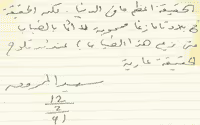
One of Sifaw's handwritten notes. Source: Najib
Boukriat.
Translation:
"Truth is the greatest (thing) in the
world. But truth
in our country Tamazgha is always obscured with fog;
when we remove this fog, truth appears naked."
Said Sifaw, 12/2/91.
Poems
Amezruy-nnegh
Tzallit
Tidet
Amarir
Fad
Timmuzgha
T’awes’
Idles Nnwen
Tayri
Hal Howa Assaho
Idnat
Qahqahet \muntasif Allayel
A'ezraeel
Qalaq
Amousnaw
Amousnaw:
Awin yellan d amusnaw
sestengh-ak rri-d awal
Af tsisut n tsisaw
d matta i midden temmal
Id'ennat' tedrez tawurt
d netsh af tizi nuddem
Origh Ofigh tira af tamort
wel ukzegh mammu tt yers'em
Ghrigh d drigh masha tawurrt
tules tekkes felli nuddem
Imeqqaren n tmura
ds’un ghfi ansi krurben
Ghiluntet d tin tad’s’a
negh d awal n iderwishen
Susmegh fellasen assa
d ayetsha mammu yessen
Taluft t t’aru yellis
d ass iduggel d aseggas
Ansi tuwi t d yadjis
d agujil gar aytmas
Tfut tbed af odemis
d nuddem yerwel fellas.
Nesmenser, Tamort ('Zuwarah'), Libya.
Downloads
The following are some of Sifaw's work, by Tamenghast
(Tawalt: www.tawalt.com).