The Berbers and the Bushmen are among the oldest people on earth.
Berber Versus Mazigh & Etymology of Imazighen
The perplexed term “Berber” is shrouded with mystery just as the Berbers
themselves. During the 19th century the Berber tribes were called Hamites, while others called them "Proto-Semites" — from the fact that all Semitic languages (including Phoenician, Hebrew and Arabic) were derived from Proto-Berbero-Libyan of the Hamito-Semitic superfamily, which linguists now renamed Afro-Asiatic. All linguists agree that Hamitic languages (Berber, Chadic, Ancient Egyptian, Omotic and Cushitic) are older than Semitic languages.
Regardless of whether some people like or dislike the use of the
term 'Berber' the name had entered the international vocabulary and therefore
it will be used here when writing in English. The matriarchal name “Tamazight”,
albeit more popular in its recent masculine and patriarchal form Amazigh,
is gradually becoming known to the outside world.
This is not to say there
is anything wrong with using the term Berber, just because it was
mistakenly associated with Greek barbarous and the negative connotation
it conveys; and even though this is not the place to dig into the enigmatic term "Berbers", it is sufficient to say, here, that the term was mentioned by the ancient Egyptians long before the arrival of the Romans, and long before the Arab invasions of North Africa, and therefore all those scholars and students who 'brag' about 'Berber' being Arab or Roman 'barbarous' are ignorant of the facts.
First, the term "Barabara", or "Barabra", appeared in an Ancient Egyptian inscription as "one of the 113 tribes recorded in the inscription on a gateway of Thutmes, by whom they were reduced about 1700 B.C." Secondly, according to various sources including Encyclopaedia Britannica (Eleventh Edition, Volume 3, Slice 6, 1910), "In a later inscription of Rameses II. at Karnak (c. 1300 B.C.) Beraberata is given as that of a southern conquered people. Thus it is suggested that Barabra is a real ethnical name, confused later with Greek and Roman barbarus, and revived in its proper meaning subsequent to the Moslem conquest. A tribe living on the banks of the Nile between Wadi Haifa and Assuan are called Barabra" [p. 379].
The Ancient Egyptian name "Beraberata" is made of two parts: Berabera- and the suffix -ta ('land'), meaning 'The Territories of the Barabera'. Even today, the Arabs of [invaded] Egypt still call the natives of Nubia by the name 'Barabera'. The Barabra were identified with the modern "Berbers", as they were identified with the Temehu Berbers of Ancient Lubia (Libya). The comprehensive list of evidence presented by Oric Bates (p. 251) shows that
the Barabra of Middle Nubians were of Libyan Berber origin. The ancient Temehu's
territories extended all
the way down to Middle Nubia and thus
the Temehu Berbers were also known to archaeologists as
"the C-Group of Nubia".
One of the three Nubian languages identified by professor Lepsius is 'Nubinga', which incidentally is also called 'Berber', spoken in three dialects along the Nile, from Aswan to Southern Dongola, and also in some parts of 'Kordofan'. More interestingly is the conclusion proposed by Alexander Militarev regarding the Berber word "aman" ('water'), which he says the Nubians borrowed from the Berbers apparently when, "the Nubian speaking population came to settle in the Nile valley, [where] they encountered . . . a Berber speaking one from whom they learned the name of the river – water par excellence". The question is, if the Nubians did not have a word for water when they arrived in Egypt, then it is doubtful if they had a language at all; in which case the only explanation is that the two populations are one and the same, just as Oric Bates had concluded more than a century ago. In short, there are numerous sources documenting the existence of the Berbers in Egypt (including the entire Delta and West of the Nile) before the invasions of the Pharaohs, and long before the forced unification of Egypt by Menes around 3300 BC. See temehu.com/Temehu.htm for more on this and on the Palermo Stone saga.
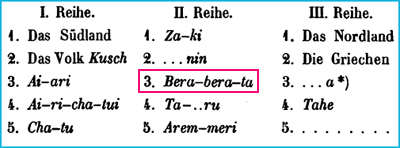
The great Egyptologist Brugsch, who identified Beraberata with today's Nubian Barabra [p. 144], was also inclined to regard the modern 'Barabra' as a true ethnical name confused in classical times with the Greek and Roman Barbarous. Interestingly, in another inscription from the temple of Rameses III, Brugsch mentions Beraberata with hyphens: "Bera-bera-ta" (Reisebericht aus Ægypten, p. 140) (see scan below). Root duplication is common in ancient African languages and thus a further indication of the *Africanity of the term.
(Reisebericht aus Ægypten, Brugsch, page 140).
However, the real challenge today's Berberists need to tackle is to decipher the etymology of the perplexed term 'Berber', which according to preliminary research has nothing to do with 'barbarous' or ‘savage’ simply because the
Romans used it to describe the Ancient Egyptians whom we all know were far
more advanced and civilised than the Romans, Greeks and Arabs put together by thousands of years; and for which the German Egyptologist Heinrich Karl Brugsch had provided a good clue. The truth of the matter is that it was Berber Isis & Osiris who weaned the ancient "savage world" of cannibalism and showed them the arts of agriculture and sublime civilisation.
This means that the terms Berberi, Barabera, Barabra and Baraberata were in literary use in North Africa for at least 3700 years: that is around 2400 years before the Arab invasions of North Africa, or around 2000 years before the Arabs first learnt to write, or around 1900 years before the Roman invasions of North Africa. It is sad indeed to see Berber activists, politicians and academicians abandon their linguistic heritage solely based on ignorance, and instead adopt a dubious patriarchal alterative when they can dive into the Pierian Spring to unlock their true identity their enemies do not want them to see. For those who want to see more about the original etymology of the Berber root "BER" could start by digesting Temehu's collection of Tamazight dictionaries.
Tamazight Versus Amazigh
Generally speaking the term “Berbers” was used internationally to describe the native inhabitants of North Africa,
while the Berbers call themselves Imazighen; the etymology of which,
likewise “Berber”,
has neither etymological basis nor historical foundation, as it was merely
a superstitious conjuncture that somehow gained widespread popularity amongst
both Berberists and European scholars, probably after it was introduced to them
by Leo Africanus, without questioning its authority or explaining
how it came to have this bizarre etymology: “Freemen”.
Which part in the term “Imazighen” that says ‘free’ and which part
that means ‘men’ remain to be explained. The only etymology that can be concluded
so far is ‘noble’,
as in Tamaheqt majegh (‘noble’). Noble they are, no doubt; but
free is far from true. Freedom starts in the mind, then magically manifests
in the real world.
Still worse is the mixed etymology propounded recently by an Arab writer who claimed "Amazigh" means "free and noble men" — a whopping three words in one; and, as a bonus gift, our Arab writer goes on to bluff that the term "Amazigh" comes from Phoenician "mazis" and that it was used to refer to all those tribes "who revolted against the Roman Empire". Of course, likewise the proponents of Berber-barbarous, the Arab writer does not seem to be aware of the ancient references in literature prior to the Roman Empire, nor of the etymological evidence from Tamazight which is older than both: IE and Semitic languages.
Imazighen is the plural form of the masculine singular Amazigh or Mazigh,
while “Timazighin” is the plural form of the feminine singular Tamazight. This
means that the recent use of the term 'Amazigh' to describe a group of people
(as in the Amazigh of Libya)
is incorrect because the term is singular;
and therefore the correct form to use is the plural form: the Imazighen
of Libya.
The popular and masculine form used almost
world-wide, namely “Amazigh Language”,
does not exist; violates the sacred Tamazight; and seemingly is heading
towards threatening the foundation on which it was based — the matriarchal
nature of the Berber society. Tamazight by
itself means exactly that: 'Berber Language'.
Researchers have no right to alter the scientific names of languages as listed in linguistic dictionaries. In Hamito-Semitic (now renamed Afro-Asiatic) Berber language is listed as "Tamazight" or "Berber"; there is no such thing as "Amazigh Language" anywhere except in those dubious sources recently imposed by Arab politicians after which the term became pandemic.
If however one is writing in Arabic, then the name الأمازيغ is used, which transliterates to "Alamazigh"; the singular of which is مازيغ or أمازيغ (Mazigh or Amazigh); hence the term "Amazigh" is actually an Arab form written in the English alphabet, in the same way the Arabs write الماني (Almani) for 'German'. No one in their right mind would dare to write "Almani" in English, because it is internationally accepted that "German" is the term used to refer to a citizen of Germany when writing in English. In the same way it is internationally agreed and linguistically enshrined in text books that "Tamazight" is the name used to refer to, and universally translated to mean, 'Berber Language', with a small number of sources using the term 'Berber' instead.
In conclusion it is not a matter of "preference" or "connotations" to use "Amazigh" when referring to "language", because there is no such thing as "Amazigh Language". Presumably the logic behind the "Arab Initiative" assumes that, given the recent international awareness of the persecution of the indigenous societies across the stricken globe by the various invaders (democrats and dictators alike), one might as well sit in the driving seat to divert the flow of research away from the sacred roots of the matriarchal Tamazight society of the Libyan Goddess Neith.
Finally, we have the term “Tamazgha”, meaning the ‘land of the Imazighen’ (or North Africa),
which was also invented by activists to describe what the Berbers
have always prescribed as Thamorth, (‘land, town, country’). Terms
like ‘Amazighity’ (mixing the English suffix -ty
with Berber a-Mazigh-), 'Amazighophones', '*Amazighophobics', and ‘Imazighenautes’
(the Berber geeks of the internet) give the amusing impression that
things are getting complicated.
Our ancestors developed our vocabulary based on established etymological principles on which the whole of Tamazight (and of any other language for that matter) is based, and which are now mostly forgotten; and therefore for activists or politicians to jump in the wagon and start spewing out new words out of the blue, and removing letters from existing ones, without understanding the underlying etymological foundation is a form of "linguistic terrorism" that should be prevented by those who claim to preserve "heritage".
Some might say this should not pose a threat, so long as
modernisation is applied to illuminate (rather than integrate then eliminate).
But nature
has already taken care of this process in a natural way. TEK (‘Traditional Environmental Knowledge’)
is continuously modernising all aspects of human existence in one complete
system we know as evolution — with the free ‘will’ to steer
one's destiny. To be the free offspring of Tamazight requires courage to abandon fear and liberate one's mind from centuries of oppression and superstition, and instead openly embrace the glorious wisdom of TAMAZIGHT.
This extensive TEK knowledge of indigenous People's heritage
and accumulative wisdom, which modern scientists now seek for new insights,
insures cultural continuation and inspires new inventions of material types,
smart tools and even new human societies altogether;
encompassing all aspects of human existence. Yet despotic democracies,
in contrast, emphasise only one single aspect on the expense of all other aspects
including the desecration of nature, policing indigenous principles, impoverishing
people, and even feeding the earth with toxic waste. This transitional expression
will not succeed in evolutionary terms because it violates long-range perspective
with which nature sees her future offspring thriving as ever!
The Berbers' mentality, their cheerful attitude to life, their customary egalitarian
justice and tribal council of the elders (of both female and male transparent
members of society who lead by example), and all the good, unique
elements that distinguish Tamazight society from the ‘warring’ ideals
thriving in neighbouring and far distant countries may all
become affected by, if not infected with, the new cultureless
direction towards which the Berber society may one day find itself led-to
–> something
the Imazighen of today ought to be concerned-with right now, rather than
shortsightedly endure in decades to come. If the Berbers lose their
unique sense of identity, as a Berber, one may no longer wish to remain a Berber,
simply because there will be none in essence.
To take away from indigenous people their pride, then deprive
them of the values at the heart of their existence, rather than
preserve their priceless world heritage, goes against all human ideals allegedly reverberating across
the moral world. The Berber Tuareg of the Sahara were also brought under
the hammer in recent decades when they were forced to perform some patriarchal
con-sessions to abandon a number of Tamazight matriarchal institutions including
the “sacred matrilineal
naming system”.
“If the only tool you have is
a hammer, I guess every problem has to look like a nail.”
Geographic Distribution of The Berbers
Estimated number of Berbers in North Africa: 38 million
The conglomerate tribes known under the generic term of Berbers or Imazighen are
the indigenous inhabitants of North Africa since time immemorial; currently distributed
across a wide extent of country including Egypt, Libya, Tunisia, Algeria, Morocco,
Mauritania, Niger, Nigeria, Mali, and Burkina Faso.
In spite of the fact that extant linguistic evidence proves the Berber's
racial unity, from the Mediterranean to the Sudan and from the Red Sea to the
Atlantic Ocean, many political and otherwise regimes still perceive Berber speech
as a threat to their (presumed) national unity — albeit in conflict with
the lost unity of the aforementioned conquered countries: The Berber
Empire Without Borders.
The majority of Berbers (in terms of percentage) are found in Morocco, followed
by Algeria, Niger, Mali then Libya. The Tuareg tribes of the Sahara are
also Berbers, whose language Tamasheght is considered the least
corrupted of all Berber languages — due to their geographical isolation
from the turbulent north: always [and always] coveted by various invaders. Northern
Mali was home to the largest concentration of Tuareg tribes in the Sahara until
recently — just before they were forced to flee their homeland by European
invaders.
The Tuareg themselves reckon the
year 1894 the year the French first seized their beloved Azawad — now in tatters.
After a long history of resistance and rebellions, totally ignored by the civilised
world, the Berbers of Mali were “lured” into
liberating their occupied homeland Azawad in 2012, only to be
later hijacked by planted infiltrators to provide the catalyst for it to be destroyed
in 2013s.
The number of Berbers still in Tunisia is small, estimated at 110,000
people (around 1%), found mainly in the south of the country and in the island
of Djerba including in Dwirat, Metmata, and Tataouine. In Mauritania only a
small group of Berbers still speak Zenaga and Tamasheq.
There is also a small population of Tuareg in Nigeria, speaking Tawallamat
Tamajaq.
The current number of Berbers in Egypt is estimated at
30,000 people, mostly in Siwa and in the region of Beni Suef. However,
in ancient times all Egypt west of the Nile was inhabited by Berbers, including
the Delta and all the oases in the Libyan Desert. In pre-Dynastic
Egypt the Berbers were the dominant population of Egypt (before its invasion
by the Pharaohs) regardless of what fabricated history still says. In today's
Arab Egypt the Siwans, like all other Berbers across the region, still are
neglected by the ruling authority, where some Siwans say they were forced to
adopt the Arab identity. Their ancient “gods” included the Berber
God Amon, adopted by the Ancient Egyptians as Amen-Ra, by the Greeks as Zeus-Amon,
and by the Phoenicians as Baal-Amon.
Berber Origins & Fake Genealogies
The Berbers' supposed Iberian, Cretan, Canaanite, or/and Yemenite origins
are wholly unfounded, if not colonially impostored to divide and ruin, as anthropologists
and historical linguists are increasingly pointing to the native nature of the
Berbers. Regarding Ibn Khaldun's widely-quoted Berber ancestors, Olwen Brogan
points out that his genealogies are “as artificial as are most similar
genealogies”.
While specific Oric Bates states that “The literary opinion generally
current among the Arab writers acknowledged several lines of descent for the
various groups of Berbers, each group being referred to an imaginary, and usually
eponymous, ancestor.”
The histories of al-Bakari and Ibn Qotaybah (who identified the Berbers with
the vanquished Philistines and the giant Goliath) Ibn Khaldun calls a ‘mistake’.
So are those genealogies tracing the Berbers to Yemen, H'imir or Ber-Bin-Qis,
which according to the anonymous author of Mafakher Al-Barbar (‘The
Boasts of the Berbers’) are false and exist only in the minds
of ‘jahilite’ (1312 AD, p. 78).
In relation to the Berbers' Canaanite origin, who adopted the language of
the conquered Hamites, myth has it both Phoenix and Cadmus were the sons of Agenor,
the son of goddess ‘Libya’ by Poseidon, who left Egypt
to settle in the land of Canaan; and thus one reads in Genesis (09: 22):
“Ham [is] the
father of Canaan” (not vice versa). Unfortunately, both sources are
now deemed by science unfit to recorded history; while the science of linguistics
does confirm Hamitic languages are much older than both Semitic and Indo-European
languages.
It is probably because of these and similar other influences, like Oric
Bates had said, “The Byzantine historian Procopius has, like Sallust,
preserved a story of African origins which reflect this tendency on the part
of the Libyans to relate their remote ancestry to Asia Minor.”
In fact Ibn Khaldun himself, nearly 700 years ago, made it clear that
people “chose” to
relate their origin to Semitic ancestors because Sam had five prophets when Ham
had none. One can only wish prosperity for the “chosen ones”,
and equally hope mercy and forgiveness for the “cursed”
son of Ham: the “servant of servants”, Genesis says (09:25) — the proper translation of which should be, according G. R. Gliddon, 'the slave of the slaves', because in almost all the translations of the Old and New Testaments where the vulgar English version has the word "servant", the original Hebrew has 'Abed', slave.
In addition to the above genealogies, relating our
biological origin to eponymous male-ancestors, “mitochondrial
DNA” genes trace all modern humans to one female
ancestor scientists called “African Eve”, or Mitochondrial Eve (mt-MRCA),
who lived between 150,000 and 200,000 years ago, in, Africa
.
Speaking of male ancestors, geneticists have also traced Y-chromosomal
Adam (Y-MRCA) back to Africa — specifically to West, Northwest
and Central Africa. The Y-MRCA is the patrilineal Most Recent
Common Ancestor (MRCA) from whom all living humans have descended. The identified
chromosomes belonged to either haplogroup
A1a (identified in two Moroccan Berbers,
one Fulbe, and one Tuareg Berber from Niger) or A1b (identified
in three Bakola pygmies from Cameroon and one Algerian Berber); and
hence the Berbers and the Pygmies are among the oldest people on earth.
The Guanches Massacre
The indigenous Guanche inhabitants of the Canary Islands (west of
Morocco, in the Atlantic Ocean) were also Berbers right down to the 16th century,
just before they were condemned to oblivion by barbarians
from medieval Europe.
Probably the most disastrous event in Berber history in
relation to European conquests is the terrible
massacre of
the Guanche tribes of the Canaries. Unimaginable catastrophe; effected in the
name of piracy.
They were completely isolated from the outside world, living in peace and
tranquillity, and reportedly had no contact with
the outside world until Spanish conquerors broke-in to embark on their systematic
genocide — a brutal job that took nearly 90 years of savage slaughter
to complete.
Still worse, those ‘Berbers’ who hid in the sacred caves of the
mountains were slowly hunted to extinction like poor animals;
while the captured survivors were sold as “first-class
slaves” in
Europe's aristocratic markets.
Without learning much about them, or about their painful tragedy, the
Guanches were forced not-only to give up their beloved pride, and see their
women & children slaughtered before their eyes, but also were
forced to vanish off the surface of the ‘earth’.
Imagine. Imagine what it would be like had they survived to-day!
Imagine what it would be like today if the Berber Guanche civilisation remained
so onto the present day; a rare treasure from our prehistoric past, where anthropologists
say they did not even know about the “wheel” — the wooden wheel first
invented by the Berber Garaments; the brakeless wheel that goes round an empty
circle; the ouroboros wheel
that eats itself to infinity;
and yet more wheels to spin from the merciless “wheel of
misfortune”,
else known as the wheel of fortune to the chosen ones.
“Unfortunately,
in the case of the Spanish conquests of the sixteenth century”, notes
Elsdon Best, “that
nation appears never to have considered it a duty to hand down to posterity any
detailed description of the singularly interesting races they had vanquished.
As it was with the Guanches of the Canaries, the Aztecs of Mexico, and the Quichuas
of Peru, so was it with the Chamorro of the Ladrones, and the Tagalo-Bisaya tribes
of the Philippines”
(Pre-Historic Civilization In The Philippines, Journal of The Polynesian
Society, vol. 1,1892, p. 118).
Perplexed as it might seem, tragedy after another,
the Berbers' destiny is fraught with pain and perpetual struggle
against the destruction of their peaceful legacy — the untold saga of human's
longest misery in history: the
massacre of identity.
Like
the Arab war generals themselves had later said (in their wars against Queen
Kahina) :– whenever a Berber tribe is slaughtered, another emerged
from the mirage like the jinn of the desert.
When Berber Hannibal crossed the Alps and besieged Rome, the Roman emperor
fled to hide behind his city walls for 12 years — apparently afraid to
give the Berber general a fair fight. When Hannibal was advised by his war generals
to end the 12-year siege and burst through the city gates (as
the Romans later did Carthage), he wisely reprimanded them that ‘women & children’
shall never be ‘collateral damage’. Commanding Hannibal declined to
murder women and children because he was a man.
Hannibal even refused to be made ‘dead’,
when he voluntarily declared the return of his soul to the lone stars;
not because he was scared of death but because
he was afraid to live a matricidal master.
No wonder a single glimpse of the Berber Gorgon's eyes instantly turns ‘man‘
to stone. The blood droplets that fell off her severed head were said
to have infested the Sahara with ‘serpents’.
The authors of “The Berbers”(1996)
came under sharp criticism by a number of scholars and activists for the poor
picture they claim to be the first comprehensive guide to the Berbers in the
English language. In their Introduction, M. Brett and E. Fentress state that,
“No general book on the Berbers is available in English.
One of the most unfortunate consequences of this is the total ignorance in both
Great Britain and the United States of the existence of the Berbers. . . This
book is intended as a step towards answering the question, and perhaps toward
a modification of the idea that Mediterranean history can be divided between
black Africans and white Europeans.”
This sounds a good book, especially when its back cover carries
the approval of the Journal of North African Studies (JNAS), and
perhaps when the cover is black — with
the title (‘The
Berbers’) written in ‘white’. However, starting Berber history
from 7000 BC is either a mistake or ‘somethingelse’. No
doubt, ignorance could have played its role, as the authors say, but London
is a great city for books about the Berbers and conceivably about any other culture
in the world. So, what does that say?
Colour
too still plays its usual part, where some Afrocentricists,
Eurocentricists, Arayanists, and other exotic specialists are getting lost
in the web, applying colour to the pagan gods
of the ancient world. But the most devastating factor is nothing but ‘
persecution’ itself — going back not 42 years (as some now say)
but centuries upon centuries, legally depriving the Berbers from
expressing “themselves”.
Hence, it is about time the Berbers
start writing their own history. It is about time the Berbers break
away from this long period of darkness in which supremacists wrote like tyrants,
and in which brutal dictators and democratic conquerors ruled like “brats”,
barring free speech and the flow of information and hunting down what Gaddafi
called “rats”.
Simply put, the amount of
material available in libraries, especially the wonderful British
Library in London (in English and conceivably in any other language), would
easily allow any ‘independent’
student to write a comprehensive Berber history going
back not to 7000 BC but to the beginning of Afroasiatic language itself, and
perhaps all the way back to the lost civilisations of the Sahara and beyond.
There are several studies and fossil remains from Casablanca, Cyrenaica,
Ternifine and Rabat, documenting the existence of the indigenous Berbers (or/and
their extinct ancestors) in North Africa for at least one million years (1,000,000),
when the first wave of early humans began to leave Africa — presumably
to explore the “prim-eval world”, then still infested with cannibals.
The Lower Pleistocene sites of Algerian Ain Hanech
and Moroccan Casablanca have, long time ago, provided some of the earliest evidence
for “human behaviour”, which arriving at a time when most
archaeologists believed no human artifacts older than the Pleistocene can be
found can only confirm tool-making humans had lived in North Africa in the Pliocene.
Among the sprung, flourished, and vanished cultures of North
Africa are the Libyan Pre-Aurignacian culture (85,000 BC); the Libyan Dabba
culture (40,000 BC); Aterian culture (40,000-20,000 BC); Ibero-maurusian culture
(22,000 BC); the Eastern Oranian culture (15,000-9,000 BC); and the Mesolithic
culture of Murzuk in southern Libya (10.000-6.000 BC).
The Garamantian
civilisation was also one of the cultures involved in the Sahara's cultural
proliferation. Rüdiger and Gabriele Lutz (1955) recall the cultures of Fezzan
to have evolved over the past hundreds of thousands of years and vanished under
adverse conditions. “Stone tools of bygone eras are lying about
in millions, from the relics of early and late Acheulian (up to 500.000 years),
Levalloisian (100.000 years) and Mousterian (50.000 years).”
The unique Haua
Fteah Cave in Cyrenaica was previously documented by McBurney and others
to preserve a continuous archaeological history in Libya from about 100,000
BC to the present — one continuous line of living entities in one single
cave, the largest cave in the Mediterranean basin, and one of the largest caves
in the (visible) world. This means that the cave was occupied by Libyans
at about the same time African Eve left Africa to
colonise the savage world.
Finally, in 2017 researchers at Jebel Irhoud (or Ighoud) in Morocco have discovered
a third Homo sapiens skull which they dated to 315,000 years ago;
pushing back our species' origin by 115,000 years — that is 115,000
years older than other Homo sapiens remains discovered in east Africa. This,
according to one view, may explain the Dali skull (found in China), which is
very similar to the Irhoud skull. The Dali skull's owner lived around 260,000
years ago; suggesting that
Homo sapiens may have left Africa far earlier than previously
thought.
Berber Languages
Scientists estimate that 50% of the 7,000 languages still spoken today will
disappear by the year 2100. The main reasons for such ‘massacre’ are ‘oppression’ and ‘injustice’ (endangeredlanguages.com).
If unprotected constitutionally a language may eventually die. On average, one language goes extinct every week in this modern age (of technology
and enlightenment), often due to democratic and dictatorial conquerors' open
neglect. Berber language however is one of the oldest languages on the surface
of the earth.
Berber, Arabic, Italian, French, and English are all widely used in North
Africa, where most if not all educated Berbers are either bilingual or trilingual
speakers. Berber languages of North Africa are classified as close relatives
of Chadic and Ancient Egyptian in the Afroasiatic Phylum. The hopeless term
Afro-Asiatic designates nothing to us, other than translate the ousted Hamito-Semitic
label, where Hamitic was somehow replaced with “Afro”, and Semitic
tweaked as “Asiatic” — even though both terms give the illusive
impression that this family encompasses all African and Asian languages in
one single family, when they do not.
And so it follows that studying Berber in isolation of Egyptian, Chadian,
Omotic, and Cushitic languages is not necessary since one needs to approach
the whole Family of Afroasiatic as one entity, not to prove whatever was meant
to be proved, or whatever brothers are fighting for, but simply to venture
deeper in time to understand its source. That source will tell us what we do
not know, dear friends, or at least guide us in the right way. And even then,
regardless of any amusing skin-colour theories or genetic interpretations,
which ultimately regress us to our primal past — inescapably, it is the
culture question that requires correct understanding and unperplexed interpretation.
Berber languages were also linked to Euskara, Asian Dravidian, Polynesian
Maori, Japanese Ainu, American Zuni, Greek, Latin, and Germanic languages;
while some linguists suggested placing Celtic, Welsh, and other Western European
languages with Afroasiatic, rather than with IE. Thus, many linguists increasingly
believe the ancient Mediterranean peoples were more closely-related than
has been previously documented. Long before the Romans appeared across the pages of history (to eventually
expel most native European languages to extinction and impose Latin instead),
ancient Cretan, Sumerian, and other extinct Mediterranean languages and cultures
were also linked to Berber. Surviving Basque's Euskara is clearly related
to Berber language and yet it was abruptly placed with the Na-Dene group. The
geographic proximity of the two however stays stuck between the Pyrenees Alps
and the Atlas like a mountain in the sky. The geographic route from the Atlas
Mountain to Iberia, via the straits of Gibraltar, and on to Britain and Ireland
speaks volumes by itself — without a single word.
No doubt, being the bridge between Africa, Europe, and Asia implies long,
continual contact with various migrants, refugees and invaders — of all
sorts and colours; but then these often take place both ways, and not only
one way. Long time ago, Diakonoff wrote: “It is reasonable to suppose
that the speakers of Proto-Semitic had separated from Proto-Berbero-Libyan some
time during the Neolithicum (6th-5th millennium B.C.). . . The tribes speaking
the Proto-Semitic language went north-eastward crossing the Nile valley (still
unfit for settlement), and, passing onward over the Suez isthmus, spread throughout
the Middle East . . . The Libyan-Guanche tribes went in the opposite
direction up to the Atlantic coast and the Canaries; and possibly, over into
the Pyrenaean Peninsula [24] . . . The Iberians, the ancient population of
the Pyrenaean Peninsula . . . are sometimes believed to be linguistically related
to the Berbero-Libyans, but the surviving Iberian texts make this
hypothesis very plausible” (Afrasian Languages, Moscow 1988, pp.
32, 33).
The direction of influence in which some supremacists entertain the foreign
origin of the Berbers can be dislodged, and replaced by a dual highway through
which traffic still flows around the Mediterranean world to nurture culture — and
genes too, Ridley adds. At times, it seems more like a roundabout, and at other
times the traffic collides head on disaster. In the long run Europe's Ice Ages
and the Sahara's droughts alternate back and forth, receding and proceeding
according to Gaia's clock, reshuffling population flow, and slowly rocking
the cradle of civilisation to sleep.
Applying the throttle to venture deeper into the “long
range” linguists came to connect all these languages with other
language families from around the world, like Nostratic and other global superfamilies,
comprising yet-much-bigger boundaries. Sending the throttle to maximum linguists have come full circle, reversing
the trend by uniting the chaotic classification of languages into one Mother
Language — just as geneticists came to trace all modern humans to
one African Mother they named African Eve. Pessimists say this will
never be possible; while optimists as ever see only promising light. (For more
on protolanguage, Google global etymology and Ruhlen.)
To make premature conclusions about a civilisation that is hardly documented,
let alone understood, where hundreds of thousands of prehistoric art sites
in the Sahara still are awaiting discovery and analysis, and where countless
ancient cities still buried beneath the sand (seen recently only by satellites)
can only fuel further confusion — at times justifiably leading to unjust
wars.
The number of unbiased studies about Berber language(s) and civilisation(s)
is hardly any, compared to the popularised Greek's and Ancient Egyptian's edited
histories; and until then one can only wait for the facts to emerge from the
deserted desert, before one is empowered by its hidden secrets.
Libya's previous rulers and their friends showed no serious interest in Libya's
deepest history; and let us hope the new leaders can see the light that made
them who they are — the light that made them see in pitch-black darkness.
Libya's archaeological and prehistoric heritage, oral literature and other
obscure-d venues shall provide rich environment for determined Berberists to
research and ultimately enjoy — once freedom sinks in; the spring
blossoms with real flowers (instead of metal stings);
and the “chariots of fire” fall back to Hell.
Thus, to this day Berber language remains persecuted, unofficial, and extensively
neglected, as much as “recorded history” itself still
refuses to update its pages with the most recent results.
Berber Friends, Personalities, And North African Explorers
Septimius Severus: Libyan-Roman Emperor (193-211
AD); Africa's first Roman Emperor.
Born in Berber Leptis Magna.
Died in York, UK; upon taking part (indirectly) in the brutal massacre of Boudica's indigenous tribes of Britain.
Boudica, dear father, was our friend who defended her nation to death — the bravest of the British.
The five Berber Libyan Nasamonians of ancient Eastern Libya were
perhaps the first ever to venture into the Sahara — at least the first
to leave a record of their heroic efforts for us to hear. During the conversation
between some Libyans (from Cyrene) and the Ammonian king Etearchus (regarding
the riddle of the source of the river Nile), the latter, according to Herodotus,
“had once had a visit from certain Nasamonians, a people who live
in Syrtis and the country a little to the eastward. Being asked if there was
anything more they could tell him about the uninhabited parts of Libya, these
men declared that a group of wild young fellows, sons of chieftains in their
country, had on coming to manhood planned amongst themselves all sorts of extravagant
adventures, one of which was to draw lots for five of their number to explore
the Libyan desert and try to penetrate further than had ever been done before”.
Eratosthenes of Cyrene ( c. 276 BC – c. 195/194 BC): a mathematician,
geographer, poet, astronomer, and music theorist who entered history for being
the first man to measure the diameter of planet Earth; the first person to calculate
the circumference of the Earth; and the first to calculate the tilt of the
Earth's axis. Being a man of learning he became the chief librarian at the Library
of Alexandria. He is also known for inventing the discipline of geography,
inventing the leap day, calculating the distance between the Earth
to the Sun, and creating the first
map of the world. For more information please see (https://en.wikipedia.org/wiki/Eratosthenes),
or download Eratosthenes'
Geography.
Al-Idrisi (12th century): at one stage in history, the Nile
was thought to bend westward and over to the Niger River in the west, and perhaps
the reason the Nasamonians' failure to trace its eastern source. But nearly 1700
years after Herodotus' death, the North African al-Idrisi was
said to have had discovered the river Nile flowed from Africa's equatorial lakes
long before European explorers eventually claimed the discovery and named it
Lake Victoria.
Hanno (ca 500–450 BC): the North African navigator
Hano was among the first to explore the west African coast. About 2000 years
ago Berber Mauritania's king Juba's expedition went as far west
as the Canaries —
long before their inhabitants were slaughtered by European
pirates. [It might be of interest to note here that Pausanias (Description of
Greece, v. 1, xvii, 2) informs us that there were statues of the Libyan Juba
in the gymnasium of Ptolemy, near the market-place of beloved Athena.] Whether
Hanno was a Berber or a Phoenician it is not easy to say, not for lack of destroyed
records and burnt Berber libraries, as much as references were made to “Hanno
the Libyan, starting out from Carthage” and travelling beyond the “Columns
of Heracles out into the ocean, keeping Africa on his left”.
Ibn Batuta: Between 1325 and 1354
the Berber Moroccan Ibn Batuta explored the western portions
of the Sahara, and along the northern coast of the continent he reached east
Africa, before continuing his quest into Arabia. His claim of reaching as far
as the “Far East” were said far-fetched, just as those of other
ancient and medieval travellers.
Not to mention that the proper geography of Africa itself became known to Europeans
only after Leo Africanus published his Description de l'Afrique in
1550 — on which Marmol himself based his book Afrique (1573
AD).
Leo Africanus (1485–1554): a North African
Berber geographer, explorer, and traveller who wrote a Geographical History
of Africa, including a description of the Berber kingdoms and Timbuktu. Even
three centuries later, European geographers continued to draw fancy pictures
of wild beasts in unknown places and brown Africans and dwarfs in
uninhabited zones in their maps of Africa. Leo Africanus wrote his book in
Arabic, before it was translated into Italian. The book was written in 1526,
but it was not published until 1550, when the book came into the hands of Jean-Baptiste
Ramusio — who was said to may have rewrote the entire book.
Unfortunately we will never know how much has been added or removed because Leo's
original work did not survive. The Italian edition was later translated into
English in 1600 by John Pory.
To speak of geographers without mentioning astrolabes would be unfair, and
so the Berber story goes by saying the Moorish (Berber) astrolabe (1067)
was used for geographical orientation before the Chinese invented the magnetic
needle in 1119, and long before the invention of the octant and then the sextant
in the 18th century.
A'ebdla'ziz Ben A'ebdella's book ‘Alu'loum Alkawniyyah Wattajribiyyah
Fi Almaghrib’ (p. 125) lists a number of astrolabes invented by North
African scientists including Abu ar-Rabia' al-Laji al-Fasi (from Fas, Morocco)
and Ya'qoub Ben Mousa al-Fasi. The same author, in citing the French historian
Ronan, informs us (p. 34) that Columbus himself confessed that he did not feel
that there was a dry continent beyond the Atlantic Ocean until he read the Kulliyyat book,
written by the North African scientist Ibn Rushd.
In fact, America itself may have been discovered several times, and not once,
before Columbus, by Celtic navigators; and as Anthony Burgess
puts it: “Any
boy named Maurice . . . ought to be proud at apparently having named a continent.
Dr Basil Cottle, the onomastic expert, considers that 'America' derives from
the Welsh 'Ap Meuric', son of Maurice. A certain Richard Amerik, senior collector
of customs for Bristol, was probably the 'heaviest investor' in John Cabot's
second westward voyage in 1498. The nominative claim of Amerigo Vespucci as regards
America Dr Cottle considers 'frivolous'” (A Mouthful of Air, p. 328,
329).
According to a recent discovery by Kirsten Seaver (endorsed
by Peter Barber of the British Library, London, UK) the Vinland map, which rewrote
the history of America and was thought to have been drawn in 1440 (long
before Columbus' trip to America), is a 1930 forgery by the Austrian Father Joseph
Fischer. The map appears to confirm the
arrival of Norsemen in America five centuries before Columbus paved the way for
the destruction of Aztec and other native American cultures. “Bjarni
Herjolfsson is believed,” reports Nicholas Hellen, “to have
sailed there in 985 and Leif Eriksson in 1002. Historians now accept that the
Norse explorers were indeed first — but the map which appeared to prove
it was an inspired fraud . . . ”
(Sunday Times, London, 04/08/2002). Moreover, there are various reports of a number of Berber, Druids and Berber-related-Iberian inscriptions
found in American sites including Iowa, Texas, Nevada, New Mexico, Oak Island, California, and St. John's; but as yet there is no academic study to validate these claims. The matter is further complicated by the alleged connection between some of these inscriptions and the Knights Templar who fled presecution in Europe to start America.
Estevan De Dorantes: the Berber explorer Estevan De Dorantes was born in the Berber village of Azemmour,
in Morocco. He was a member of the Narvaez expedition that sailed from Spain in 1527. They
were stranded on the coast of the Gulf of Mexico and consequently were captured
by the native Americans. He was reported to have died when he was attacked by
the Berber-like Zuni tribes between 1539 and 1540. Apparently he continued practicing
his native Berber religious duties to eventually become highly respected by
the Zuni people, some of whom even worshipped him as a demi-god.
Abbas Bin Firnas (810–887 AD): the Berber, Andalusian
inventor-engineer Abbas Bin Firnas was born in Izn-Rand Onda (Ronda, Spain)
in 810 AD. At the age 70 he
has entered the pages of history as the first man to fly. Inspired by birds,
he invented artificial wings, covered them and himself with feathers, took to
a hill in Cordoba, and launched himself into the air. He was said to have
flown for a considerable time before he crash-landed, badly hurting his back,
apparently because he failed to include a ‘tail’ in his prototype.
His story was told by the Moroccan historian Ahmed Mohammed Maqqari (d.1632),
based on a 9th century account of the poet Mu'min Ibn Said, who said that Ibn
Firnas flew faster than the phoenix and that he dressed his body in the feathers
of a vulture [Lynn Townsend White, Jr., Eilmer of Malmesbury,
an Eleventh Century Aviator: A Case Study of Technological Innovation, Its Context
and Tradition, Technology and Culture 2 (2), 1961, p. 97–111].
Callimachus (310/305–240
BC): a Berber poet from Cyrene, Eastern Libya. He was a critic and
scholar at the Library of Alexandria in Egypt, famous for being the first librarian
in the world who produced the world's first library catalogue in 245 BC
– a stupendous 120 volumes long bibliographic survey of the contents of the Alexandria
Library, organized by authors and subjects, and collectively known as the
“Pinakes” (‘tables’).
Saint Augustine (13 November 354–28 August 430):
one of the most known of Africa's 100 bishops is the Berber bishop of Algerian
Hippo St. Augustine, one of the first Christian philosophers whose contribution
to Christian thought is detailed in his book: “The City of God”.
Saint Mark (1st century AD): the first Christian
Bible was written by Saint
Mark — a Berber native of Cyrene, in Libya's Green Mountain, else
known as the author of the
“Gospel of Mark” and the founder of
Christianity in Africa.
Upon his arrival in Egypt he founded the Church of Alexandria and
began spreading the new religion — the religion which Berber Arius Ammonius deplored
for being freely mixed with pagan philosophy. Both the Coptic
Orthodox Church and the Greek Orthodox Church of Alexandria are considered the
successors of Saint Mark's Church of Alexandria.
Arius Ammonius (AD 250/256–336 AD): the Berber
leader of the movement of reform and modernization in Christianity in North
Africa, who emphasized the Father's divinity over the Son. He was an ascetic
Christian presbyter and a priest of the church of Baucalis in Alexandria, Egypt.
He was described as being a tall man of pure morals and distinguished appearance,
with charming personality and an aura
of intellectual superiority.
Sextus Julius Africanus (c. 160–c. 240) : the Berber
scholar and historian Sextus is known for choosing the date on which to celebrate
the birth of Jesus Christ. The Christian Bible does not provide any information
about the date on which Jesus was born, but after a few hundred years Christian
theologians agreed on the date chosen by the Berber scholar, namely the 25th
of December (Christmas Day). The BBC has
a short video about this little fact in its website. His surname, Africanus,
clearly preserves his African origin. The 25th of December apparently is the
date on which the three stars of Orion's belt (the so-called
“three kings”) align with both the Sirius star and the rising sun,
and hence the Son is the Sun.
List of Berber Personalities In History
Ancient Berber Kings, Queens & Personalities
Shoshenq I: (Shishenq I): Berber Pharaoh, founder of the Egyptian 22nd dynasty
(945-924 BC); (946-925); (943-922)? Shoshenk's daughter was married to king Solomon,
who built a special palace for her.
Wayheset: Libyan king.
Osorkon I: Berber King, probably son of Shoshenq from Karima (Egyptian 22nd
dynasty: 924-889 BC).
Queen Makere: wife of King Osorkon I.
Shoshenq II: Berber King (Egyptian 22nd dynasty: 890-889 BC).
Takeloth I: Berber King (Egyptian 22nd dynasty: 889-874 BC).
Osorkon II: Berber King (Egyptian 22nd dynasty: 874-850 BC).
Horseise: Hight Preist of Amon: son of Sheshonk II.
Takeloth II: Berber King (Egyptian 22nd dynasty: 850-825 BC).
Amazigh chief Larbas: negotiated a deal to marry Princess Dido in 814 BC
(Tarshish: Carthage)?
Pediese: Great Chief of the Meshwesh.
Hetihenker: Great Chief of the Meshwesh.
Shoshenq Ill: Berber King (Egyptian 22nd dynasty 825-773 BC).
Pimay (‘The Cat’): son of Shoshenq III: (Egyptian 22nd dynasty 773-767 BC).
Bakennefi: brother of Pimay: Prince of Heliopolis.
Shoshenq IV: Berber King (Egyptian 22nd dynasty 767-730 BC).
Osorkon IV: Berber King (Egyptian 22nd dynasty: 730-715).
Pedubast: Berber King (Egyptian 23rd dynasty).
Input II: Berber King (Egyptian 23rd dynasty).
Sheshong VI: Berber King (Egyptian 23rd dynasty).
Osorkon III: Berber King (Egyptian 23rd dynasty).
Takeloth III: Berber King (Egyptian 23rd dynasty).
Rudamon: Berber King: (Egyptian 23rd dynasty).
Tefnakht: Berber King, founder of the Egyptian 24th dynasty (unified the
Delta).
Bocchoris: Berber King (Egyptian 23rd dynasty).
Masinissa: King of Numidia.
Jugurtha: King of Numidia.
Juba II: King of Numidia.
Macrinus: Roman emperor.
Clodius Albinus: ruler of Britannia.
Lusius Quietus: ruler of Judaea.
Quintus Lollius Urbicus: ruler of Britannia (138–144 AD).
Septimius Severus: Libyan Roman emperor (193–211 AD).
Tacfarinas: (Leader of the wars against the Romans in the Aures Mountains).
Firmus: (fought the Romans: 372–375).
Gildo: (fought the Romans in 398).
Publius Terentius Afer (Terence: writer, Latin).
Lucius Apuleius: author of “The Transformations of Lucius Apuleius
of Madaura”, otherwise known as “The Golden Ass”.
Wonderful work of written-art. A maze of clues. A treasure for the future to
indulge. Humour at its best. Queen Isis.
Priscian: (Latin grammarian).
Marcus Cornelius Fronto: (Roman grammarian).
Saint Augustine of Hippo: Christian philosopher; the founder of Christian
Philosophy).
Saint Monica of Hippo: (Saint Augustine's mother).
Arius: (proposed the doctrine of Arianism).
Donatus Magnus: (head of Donatist School).
Gelasius I: (Pope: 492-496).
Victor I: (Pope: 186-201).
Miltiades: (Pope: 311-314).
Abd ar-Rahman I: (731-788).
Al-Mansur: (712-775).
Tariq ibn Ziyad (Zeyyad): (leader of the army that invaded Spain in 711 AD).
Adrian of Canterbury: Abbot of St Augustine's Abbey in Canterbury.
Dihya: Kahina:
Berber Queen, Priestess and War General; the fiercest Berber leader who defended
her nation to death. According to the Arab
generals themselves, she defeated them like no other general had done before
her, and that whenever a Berber tribe is slaughtered, another emerged
from the mirage like the jinn of the desert.
Aksil: Kusayla: King or tribal leader.
Salih ibn Tarif of Berghouata: translated the Koran to Berber.
Abbas Ibn Firnas: first man to fly.
Ibn Tumart: founder of the Almohad dynasty.
Yusuf ibn Tashfin: Almoravid dynasty.
Al Idrisi: scientist and geographer.
Ibn Battuta: traveller.
Ibn Khaldoun: histography.
Leo Africanus: geographer and historian.
Abu Yaqub Yusuf I.
Abu Yaqub Yusuf II.
Ziri ibn Manad: founder of Zirid dynasty.
Muhammad Awzal.
Muhammad al-Jazuli: Sufi.
Imam al-Busiri: poet.
Abu Ali al-Hassan al-Yusi.
Modern Berber Personalities
Solaiman al-Barouni: Berber from Jado, Nafousa Mountain, Libya: creator
of the first republic in the North Africa and the Middle East: the Tripolitanian
Republic.
Jean Amrouche, (1906–1962) writer and Taos Amrouche's brother.
Taos Amrouche: powerful Algerian writer and singer (1913-1976).
Said Sifaw al-Mah'rouq: Libyan scholar, poet, writer, activist, and linguist,
from Jado, Nafousa Mountain.
Mohammed Bessaoud: Algerian spiritual father of Berberism.
Hocine Aït Ahmed: Algerian revolutionary fighter and secularist politician.
Saïd Sadi: Algerian politician.
Ali Yahya Mua'amar: Libyan Abadi Scholar.
Mouloud Feraoun: Algerian writer assassinated by the OAS.
Mouloud Mammeri: Algerian writer, anthropologist and linguist.
Salem Chaker: Algerian Berberist, writer, linguist, cultural and political
activist.
Sidi Said: leader of the Algerian syndicate of workers: UGTA.
Khalida Toumi: Algerian feminist and secularist.
Ahmed Ouyahia: Prime Minister of Algeria.
Belaïd Abrika: one of the spokesmen of the Arouch.
Nordine Ait Hamouda: secularist politician and son of Colonel Amirouche.
Driss Jettou: Prime Minister of Morocco.
Lalla Fatma n Soumer: female warrior (Amazon) who led western Kabylie in
battle against the French.
Kateb Yacine: writer founder of the “berberiste mouvement”.
Mohamed Chafik: Moroccan writer; IRCAM.
Tahar Djaout: writer and journalist assassinated by the GIA in 1993.
Si Mohand: Kabyle poet.
Fidel Castro: (Cuba: his mother was said a Berber from the Canary Islands).
Morocco's King Mohammed VI (the monarchy's mother was a Berber).
The Berber Flag
The above flag was adopted by Berber activists and was initially used
by the Kabyles of Algeria, where it appeared in political demonstrations
and banners, before it spread to websites and eventually across North Africa. It was said that the flag was designed
by Mohammed Bessaoud, the spiritual father of Berberism in Algeria, who fought
during the independence wars between 1954 and 1962.
The above flag is one of the other variants
that was proposed by Canarian Berberists during the 1997 World Amazigh Congress.
It must be noted, however, that both flags are ugly, shallow and do not symbolise neither the historic nor the current state of Tamazight; not to say the colours themselves lack the stamina and the power to propel the cause forward. The blue needs to be richer and darker to express the strength of both the sky and sea; the yellow must reflect the warmth of the Sahara; and the green has to be verdant and vibrant to represent the power of Mother Earth.
The Provisional Government of Kabylia
On the other hand, compare the above flag adopted by the Provisional Government of Kabylia, after abandoning the earlier design. The flag is used to symbolise Kabylia (in Algeria). The Kabyles seek autonomy from the Arab government of Algeria. The idea that all the Berbers of North Africa are united and that one flag will be used to represent Tamazgha is far fetched; as it is more likely to see a number of Berber flags in the future, each representing a particular area (or a particular confederacy).
The Berber Calendar
Some Berber activists even made a Berber calendar dating back to 950 BC, when
Libyan Shoshenq I became the King-Pharaoh of the Egyptian XXII dynasty, without
actually telling us what had happened between 750 BC (when the Libyan kings lost
control of Egypt) and now (the present time) as to constitute a continuous calendar
(presumably of events); and without conducting professional research into this
astronomical subject.
Pursuing the same line of thinking, one finds it hard to understand why one
cannot start from before 3100 BC and see what the “Palermo Stone”
has to say about the line of Libyan Berber kings and queens whom history had
practically forgotten? Ladies and gentlemen it is now 5113 AD!
The
12th of January has now been presumed the day in which the Berbers should celebrate
the festival of Yennayer 2962 — the New Year; while the year 2963 was celebrated
on the 13th of January 2013. It is understood that the 13th of January is the
day chosen by activists to be the start of the Berber new year.
The original Berber Calendar, for the record, is an agricultural
calendar; in which the course of the stars and the constellations was
pinned in the heavens to reflect and regulate seasonal changes and activities
on earth, such as ploughing, sowing, and harvest; to ensure maximum benefit
and prosperity for the whole community — and not just for the 1%.
Hence, the Berbers still
celebrate the festival with feasting on traditional foods, to thank Mother for
her gifts. The calendar requires proper research to bring to light, but one is
certain that it has nothing to do with political propaganda of kings, warmongering
dictators or matricidal masters. In other words, it is not a political
calendar; never was a political calendar; and Berberists have no right to make
it so.
Cultural Euphoria
During the early 1970s a kind of cultural euphoria proliferated amongst
Berberists to revive their persecuted, undocumented culture, and in doing so
they mistook and stumbled along the barricaded way. This kind of confusion is
very symptomatic and characteristic of the early Berber cultural revival; ultimately
leading to quality and accuracy being the first casualties of freedom.
But the point forward is to look back, reflect, and focus on the long road ahead.
One of the first errors made is to invent
new words to replace what they thought were foreign words in Berber. These were
published in a small dictionary called “Amawal”
(Berber-French, French Berber Dictionary, Imedyazen, Paris, 1980). These
invented words have now entered literary works and song, as they are widely used
by Berber writers, poets, activists, and artists. Initially this material was
barred by Arab despots, but with the progressive advent of internet technologies
tyrants had finally gave up the job; only to be re-placed by sponsored terror.
This may not be bad news, after all, if you knew which is which — if
you knew the original from the invented; but scientific enquiry may become
affected at some point, where one fails to distinguish between the ‘original’
and the ‘hypothetical’. The custom amongst linguists is to place an asterisk
(*) before invented words, but some excited Berberists declared themselves
stars of their own.
Brothers
and sisters, there is always the exciting possibility that those discarded
Berber words may well turn out to be original Berber words,
simply because Hamitic languages are much older than Semitic languages, and
thus most of the Afrasiatic vocabulary is African Hamitic in origin.
This is a linguistic fact, and so why go against it, dear friends? Alternative words do exist in many Berber languages still spoken today in North Africa, particularly Tuareg languages, and therefore instead of inventing "nonsense" words, what is wrong with borrowing from other Berber languages to fill the gaps, if any? If they are "activists", as they say they are, then they can go the extra step and create a thesaurus from existing, ancient words.
Worse still, the activists had even tampered with the ancient
Tifinagh alphabet.
The improvised Tifinagh script contains 55 letters, 22 of which were
new inventions — presumably out of the blue. Adding new ones to cover
those sounds that are not covered by the original alphabet is something only
some might say is ‘okay’ so long it is done by specialists.
But to alter existing ones for whatever reason including convenience
is a flagrant disrespect of the script Berberists ought to respect.
For a particular,
foreign-funded group to impose their invented proposals on the Berbers as a
whole is something some Libyans and the Kabyles refused to buy. How much the
living martyrs had to endure is perhaps the price many cannot pay. There is
no doubt these pioneers were alone, exploring the mysterious Sahara in darkness,
guided only by its dazzling stars, while having to evade prison, exile and
certain death on the ground, and for that we must remember them for all their
brilliant mistakes.
Clarifying the issue hopefully will aid future Berberists to correct
the path, steer away from stubborn trouble, build
the momentum needed, and gather the rare funds required to build a
unified Berber curriculum, democratically built by the Imazighen themselves
— not by others who claim to be their friends only to obfuscate their
identity, effect awful conflicts upon pain, and impose clear government
strategies which, like Salem Chaker had said, seem to lead to “sure
dead end”. Does one need to buy blinding sunlight as well?
Perhaps patience and pursuit of knowledge are the keys others will not
let you have to unlock your door.
We need strength and loving peace for the long road ahead.
We need to document our entire oral literature first; collect and decipher all
the inscriptions and engravings scattered across North Africa; archive our prehistoric
heritage; rewrite our hijacked history with our own fingers; then study the material
with our own heads, before we can rebuild our ‘Homeland’ with our hands
– the Berber Empire Without Borders.
Let us hope Berber academic institutions and scholars can keep their heads
high, and on their shoulders too, and lead the way forward on firm and common
ground, to eradicate irrationals inherited from persistent persecution and paranormal
apparitions, and preserve their unique ‘soul’.
One also hopes governments
show some mercy, constitutionalise our language, grant us our due share of
our countries' squandered wealth, and, alas, remember Berbers are
‘human beings’.
What is it that makes us humans if it is not human language?
Take that away from any mortal community and you will end-up with nothing but “mere
animals”.
Without
a strong political and administrative body overseeing the transition to
freedom and democracy, based on peaceful and scientific principles, the
Berber revolution could well descend into (perceived) cultural anarchy, and (orchestrated)
political chaos.
Updated: 12 February 2012.
Updated: 06 May 2012.
Updated: 25 August 2012.
Updated: 27 August 2012.
Updated: 07 September 2012.
Updated: 27 January 2013.
Updated: 17 June 2013
Updated: 25 June 2013
Updated: 07 February 2014
Updated: 17 August 2014
Updated: 21 December 2014
Updated: 29 April 2015
Updated: 25 January 2016
Updated: 8 February 2016
Updated: 29 December 2016
Updated: 21 October 2017
Updated: 05 December 2018
Updated: 16 January 2019
Updated: 28 March 2023
* * *
“What good is it to have
Freemen who sleep in this world of suffering
Wake up, my people
Straighten up, my people
Confront the difficulties of your current situation
A long road awaits you
What good is it to have
Freemen who sleep in this world of suffering
I remember this girl
Whom I left under the stars
Amongst those who invaded me
When I returned, she was alone
Abandoned on this barren and deserted earth
Her memory haunts me day and night
My friends, my friends
Never forget what
We learned from our parents
My friends, my friends
Let us not forget this heritage
That our parents have left us
Let us keep it fondly
This heritage is our identity . . .”