The Libyans are mostly friendly people, regardless of
their ethnic background, colour or social status. They respect privacy
wholeheartedly and generally will not hassle foreign visitors and guests as is
the custom nearby. The Libyan population is estimated at over
5 million people, plus under 1.5 million migrants, giving
a total of 6.5 million people approximately. The Arabs, who now form the majority of the inhabitants of Libya, invaded North Africa during the 7th century AD.
After Libya fell to the Fatimid invaders in 920 AD, the Berber Zirid dynasty
broke away from the Shiite Fatimid, leading the Fatimid rulers to bring
the tribes of Bani Hilal and Banu Salim from Arabia to strengthen their positions.
It is these two Arab tribes that began the process
of Arabisation in North Africa. Recent genetic
studies however say more than 90% of Arabs in Libya (and in North Africa
overall) are Arabised Berbers.
For example, many of the inhabitants of Benghazi, Misrata and Zintan are Arabised
Berbers – that is Berbers who adopted the Arab tongue. The name Misrata ought
to be written as Meṣraṭa, in the same way the Arabic form used by Libyans,
namely مصراتة, would be more accurate if written as is مصراطة because the 't'
is emphatic ( ṭ ). The Berber tribe "Meṣraṭa" was part of the Berber
Hawwara confederacy before the town was Arabised around 200 years ago.
Contrary to popular belief the Berbers' resistance to the Arab invasions was
long and fierce. Like the Arab war generals themselves had said (in their wars
against the Berber priestess-queen Kahina): whenever a Berber tribe is slaughtered,
another emerged from the mirage like the jinn of the desert.
In short,
after nearly three centuries (on and off) of wars with the invading
Arabs the Berbers succeeded in maintaining some form of independence from the
sultans of the Middle East; leading to the Berber dynasties to remain very
powerful down to the 16th century; after which they began to decline. Combined
with the invasions of the Turkish pashas, and subsequently the
disastrous European invasions, the official Arabisation of the various
Berber confederacies began to take visible shape. [See
History of Libya for more on this.]
It was reported that Europeans
first arrived as explorers, mapping the tribes and the rich-resources of the
continent, then as colonisers, dividing Africa by imposing the political
borders now we know as 'Arab countries', in total disregard for the ethnic
integrity of the native Berber tribes they came to subjugate.
This was followed by
the creation of the
so-called 'Arab World', characterised by installing dictators
for later to remove during the so-called 'Arab
Spring' –
yet again in total violation of the existence of the various indigenous peoples
of the region, while at the same time neglecting and even destroying the
Kurdish and Berber attempts to form native republics, such as the
brutally-crushed Rif
Berber Republic of Morocco (1923); the destroyed Tripolitanian
Republic (1918); and most recently the Berber Azawad which the
UN once again failed to recognise and instead bombed in 2012. [In relation
to the Kurds the colonial powers when dividing Iraq and Syria gave strict
instructions not to allow the Kurds to form an independent state.]
This means that the official Arabisation of North Africa and the Middle East
would not have been possible without the brutal European invasions. The big question is Why?
The major Arab centres of today's Libya include Tripoli,
Benghazi, Misrata, Zawiya, Sabratha, Khoms, Albayda, Darna, Tobruk
and other smaller villages and settlements along the coast and in the interior.
After the installation of Gaddafi in 1969 the arabisation of the Sahara was
intensified by turning Sabha the new capital of Fezzan. Nafousa Mountain in the
west is the stronghold of the various Berber tribes, to the extent it was also
known as the Berber Mountain, before it was lately renamed
"The Western Mountain" by the ousted Colonel.
The oasis of
Zuwarah in the western coast, the oases
of Jalu and Awjla in eastern Libya, and the oasis of Ghadames at the edge of
the Sahara are also Berber settlements; while the Sahara herself
is still the homeland of the various Berber Tuareg confederacies, as they were
for thousands of years the dignified keepers of the largest desert in the world
– the empire
without borders; before they were dispersed and split by colonial intruders
into so many "countries", without
regard for their ethnic integrity or nobel dignity. The Berber
Tuareg confederacies have always resisted the imposed borders to desecrate and
divide their sacred homeland, just as they still do today.
The
Tebo, whom were said to be Berbers from the Lemta tribe (by al-Yaqubi), or part
of the Berber Sanhaja group (by Agostini), are without
a doubt native to the region, especially to the Tibesti Mountain,
whence the name Tibesti itself. Likewise the Berbers, they have been persecuted
by the previous regimes of Libya,
just as today their homes were shelled by
outlaws and sponsored rebels, with various reports of rockets punching
through the roofs of their homes while women & children
still asleep.
Tribal Differences Versus War
There are at least 140 known tribal networks in
Libya, many of which subdivide into several branches and clans. Most
Libyan surnames carry the name of the tribe which they represent, and
therefore one can easily identify a person's tribe simply by knowing his surname.
For example, colonel Gaddafi comes from the Gaddadfa tribe – an Arabised Berber
tribe of the ancient Greater Syrtis region, now known as Sirte or Sert.
In Zuwarah the tribal name is also assigned to the street in which the tribe
exclusively lives. Such names were officially replaced by the ousted colonel
with Arab names, including the name of Zuwarah itself, but Zuwarans still to
this day use the ancient names they learnt by heart. Seemingly the time has finally come for the Arabs to contemplate protecting their own identity rather than in-vain insist on persecuting others'.
The complex tribal system in Libya is still a fundamental
part of the Libyan society, more than anywhere else. But
the native philosophy behind this structure (resulting from the
ancient egalitarian system) has been most often misunderstood by outsiders,
misrepresented in a way to illustrate a conflicting
nature of the Libyan society, and even employed to achieve 'political objectives'.
For example, Enrico De Agostini's work, The Inhabitants
of Libya – more or less the bible of Libyan tribes, was said to have been
motivated by "colonial" need to study the tribal components of the country the
Italians initially failed to subjugate, after their disastrous defeats to contain
the Libyan resistance, led by Barouni, Swayhli and Mokhtar among other martyrs;
in the same way many of the early Arab sources of Berber history were mainly
written from nationalist perspective; and in the same way many early European
explorers and scholars wrote others' history to serve supremacy.
Nearly one hundred
years later, almost an identical need arose from the dead after the February
2011 wars, when media outlets and political experts Suddenly developed the urge
to chat about the complex tribal system of Libya, only to fall
silent afterwards, once again. See you next generation.
Egalitarianism
The Berbers' traditional, governmental system follows
egalitarian principles. The
egalitarian system, recently noted by New Scientist
(28 July 2012), is based on tribes consulting and cooperating with each other
in a tribal council, to achieve best survival for the whole group; as they have
been for tens of thousand of years without any major problems but "foreign
invasions"
and nature's famines.
One of the most fascinating aspects of
egalitarianism is that the system eliminates poverty, and prevents the emergence
of the super rich and the super powerful in society, simply because the egalitarian
constitution (the 'customary laws' of the tribal society) ensures sharing the
harvest of nature amongst all the members of the
society – not just the elite 1%.
Each tribe has
a representative tribal leader at the Tribal Council – today's divided con-gress.
The egalitarian tribal council of the elders is made of both female
and male transparent members of the society who could lead by example. They have
no complicated electoral policies nor poverty. They effect peaceful solutions
via 'diligent dialogue' and 'logos', at the tribal council,
primarily to avoid conflict. They have learnt the hard way how to live with
nature and the harsh conditions of the environment. It is often
argued that hunger and wars create the right environment for corruption and crime
to thrive, and hence The ultimate tools the elite employ to subjugate the poor in modern society.
In traditional society sharing between the 100 per cent is what keeps the
society strong and peaceful. For example, the
Berbers provide grain and fruits during harvest for the poor families of the
tribe and of the society overall. The
persecuted Berbers of Libya to-this-day still perform what they call "Taqessamit" –
a festive occasion in which members
of the tribe "get together" in the spring to provide equal
portions of meat for the poor families of the society – to feed their hungry
children. [These portions of meat were cut into long strips,
sprinkled with pepper and salt, and dried in the sun, before they were cut into
small cubes, fried in oil, and stored in clay jars, to use throughout the year
for modest use.] This is what tribes used to do, before they
found themselves in conflict with each other and awesome invaders.
Due to the historical onslaught of foreign
invasions on indigenous territories from around the world, the egalitarian system
is now on the brink of extinction. Scientists say one language goes
extinct every single week, of the year, in this modern age of technology;
often due to governments' open
neglect.
Preserving World Heritage sites by protecting the stone idols of the archaeological
wonder is not what indigenous peoples want.
It is their culture and identity that are in great danger, they say, from the
civilised world of modernity, painful poverty, and dangerously never-ending wars.
According to one
(improvised) egalitarian tale, a dying father gathers his sons and daughters
around his death-bed, and whispers:- take one stick and snap it, you will see
the result; do the same to a "bundle of sticks",
and you will realise nothing but pure strength.
The Components of The Tribal World
Family: the smallest unit in the tribe is the family, comprising
the mother (the head of the family in matriarchal societies); the father; and
their children.
Clan: a group of families relating to one ancestor, identified
by the common 'surname', and usually living together in one location or one street.
Different clans can also form larger unions of clans linked by relation,
benefit, marriage or proximity.
Tribe: is the name given to the various clans and
the clan groups forming one large tribe. Getting
together in larger groups strengthens the sociopolitical ties between
the members of the group and the member-groups to form a stronger alliance –
the egalitarian 'stick-bundle'
principle (as defined above).
Society: an exotic collection of tribes living together
in one settlement, and now composed of tribes
from across the country. Ice ages,
famines, commerce, migrations, invasions, corrupt governments,
wars, poverty, refugee crises, curiosity to explore, and "chasing the
get-rich dream" have
all contributed to the emergence of the 'global
society' in the modern world.
Human Family: a name given by scientists to all the tribes
of the world, descending from one single tribal ancestor, they called 'African
Eve', who lived in Africa between 150,000 and 200,000 years ago. We are all 'one
family', destined to build a happy world if we stay united, help each other,
and share the bur-den.
Sources
The following
lists of Libyan Tribes were compiled from a number of sources including "Sukkan
Kibya" (سكان ليبيا : Libya's Inhabitants),
translated by Khalifa Mohammed Tillisi, خليفة محمد التليسي, 1975, and based
on the two works written by the Italian colonel
Enrico De Agostini: Popolazione
della Tripolitania (1917), and Popolazione
della Cirenaica (1923). Agostini's work was carried out by Libyans,
with Agostini sponsoring, managing and editing the project as per "house
rules". Agostini made a number of claims and errors
that are not easy to explain, and some of his tribes are not in agreement with
those listed by his source: Ibn Khaldun. The second source is "Sukkan T'arabulus
Algharb" by Ismaeil
Kamali (translated by Hasan Alhadi Ben Younis), 1997. The third source is Oric
Bates' Eastern Libyans (1919), considered by many to be the bible of ancient
Berber tribes of Libya. The fourth source is "Kitābu
l-ʻibār", by Ibn
Khaldun (1332-1406 AD), the ultimate source
of almost all other works exploring the structure of North African tribes. However,
Ibn Khaldun's widely-quoted Berber ancestors and similar other genealogies
are imaginary and usually eponymous
ancestors.
Berber Tribes
The Berber Tribal Groups of Libya
The Berbers are the indigenous inhabitants of Libya and the Sahara. There are numerous Berber tribes
found in East Libya, West Libya, and across the entire Sahara desert, where they
have been since the beginning of civilisation. Their number is difficult to
ascertain, since by their nomadic nature the Tuareg of the Sahara were not fully
included in any census. However it was widely estimated that the Berbers constitute
between 10% and 23% of the population of Libya, and therefore assuming an average
of 17% would give just under one million Berbers. Some Berberists noted that
the population of the Berbers in 1950s was just under 50%, and that the current
drop in percentage is due to government policies, like the sudden increase of
Arab nationalities granted by both King Idris and Gaddafi to large numbers
of Tunisians, Egyptians and other (so-called) "returned Libyans" -
just as today's transitional rulers reportedly are doing.
Historical records state that the Libyan population had decreased
to 523,176 people around 1911, down from 757,000 people in 1840s. Nearly 100,000
people died in Cyrenaica alone during the colonial wars. In 1968 the Libyan
population reached 2 millions. But then after Gaddafi's 1969 the Libyan population
rose sharply to 5 millions! The new transitional leaders now say the population
of Libya is 6 millions. There is no doubt that a proper and transparent census
is required.
In 2013, the transitional Civil Status Authority
was reported by [Libya Herald, article: /2013/06/06/new-family-allowance-announced/]
to have estimated the number of Libyans under the age of 18 at around 4.35 million
teenagers, out of whom 2.85 million are males, and 1.5 million are females. Such
figures do not tally with reality - inconceivably making more than 80% of Libyans
teenagers, let alone mostly males.
The reported number of females in Libya was more than males by around
1% (when Gaddafi arrived).
Closing down hospitals in Berber areas, to force Berber women give
birth in nearby Arab areas, had also decreased the official (or registered) number
of Berbers in Libya, while at the same time increased the Arabs' number with
Berber "identities".
[Similarly, the Berbers of Morocco were until recently around 80%,
before they began their gradual descent (in records) to 70%, 60%, 50%, and
now down to 40% — officially making the majority a minority in their own home?]
تلاعب بمنظومة السجل المدني والرقم
الوطني
On the 6th of July 2018 former rebel prime minister
Mr. Mahmoud Jibril warned the Libyans of the failure of the forthcoming elections
(of 2018) due to "fake IDs" being issued by Libyan officials to gather voters
for their election campaigns. He says that there is widespread fraud
concerning the so-called
"National Number" (الرقم الوطني), pointing out that this may endanger
the outcome of the forthcoming elections where the loosing political parties
may doubt the results on the basis of fake voters.
It is reported
previously that the authorities in Tripoli are implicated in the illegal trade
in human beings and that many immigrants were given fake Libyan IDs. The same
practice was observed in the military where many militias (from both the Muslim
Brotherhood-controled Tripoli) and from the Hor-controlled Benghazi)
are enlisting immigrants and mercenaries in their fight against each other
and against the so-called foreign terrorists. As we have reported
in this website, previous elections, the elections hailed success by the
colonial masters, have barred the Berbers from taking part in party elections
and therefore were never fair or transparent.
Two days after Jibril's warning the number of Libyans was reported
by Libya's Channel to have reached 7.7 million people
(or Libyans and non-Libyans). According to Mr. Bouker, the former head of the
Civil Registry Authority (مصلحة الأحوال المدنية), tampering with the civil
register and the national number had resulted in increasing the number of Libyans
to nearly 7.7 million people, thereby endangering the national security of
the country. That
is a jump of one million people in just over two years. Early reactions to
this violations are reported here (or
watch the video below).
بوكر : حوالي مليون نسمة هو حجم اختراق منظومة السجل المدني الليبي
Mr. Bouker said he has a copy of the original database that can reveal the
fake one million identities that were added in the past two years, and that
restoring the original database would not take more than 24 hours. It is not
known who could restore the database to its state before the 1969 foreign
operation, and/or restore the Sahara
motherland to its rightful owners (the Tuareg Berbers) before its desecration
by the colonial French, Italian and the British. One thing is clear; there
is a program to Arabise the Berbers of North Africa. Most of the reported violations
in national identity reported in the past two years occurred in neglected Fezzan
- the homeland of the Tuareg Berbers.
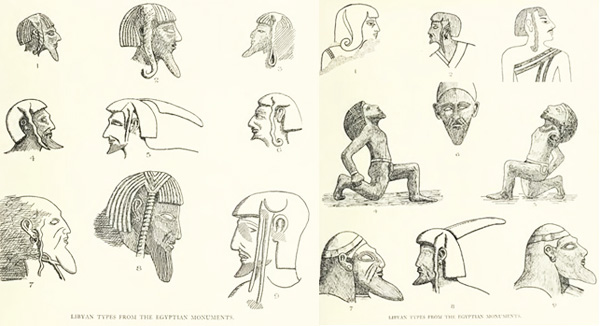
Ancient Libyans From The Egyptian Period
Ancient Libyan Berbers types from Ancient Egyptian monuments.
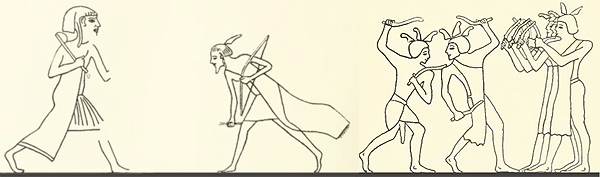
Ancient Libyan archers (left) and keska dancers (right) from the Egyptian monuments.
Berber archers were the best archers in the entire ancient world,
and were regularly employed by the Egyptian Pharaohs, Roman generals and Hannibal in their formidable armies.
The Berber Tribes According to The Genealogies of Ibn Khaldun
Ibn Khaldun divides the Berber tribes into
two major groups, each of which subdivided into further "branches":
the 'Beranes' and 'Madghis' (or Botr), both of whom were
descended from 'Berr' or 'Berber' (vol. 7, p.3), who descended
from the ancestor 'Mazigh'
(vol. 6, p. 97) and/or ancestress Tamazigh(t). This ancestress was not
mentioned by most
of the sources that claimed to study Berber ancestry, and Ibn Khaldun himself
does not appear to provide much information about this important ancestress.
The following list cannot be considered complete because Ibn Khaldun most often
gives only a few examples for each group or branch, as he often used
the word
"including" rather than "they are". Thus the list is not free from errors. The other issue
with Ibn Khaldun's work is that some of the names of the tribes appear differently
from one copy to another, including Arabic, French and English copies,
and therefore the
confusion is well entrenched. On the tendency to
relate remote ancestry to Asia Minor, Ibn Khaldun himself makes
it clear that people "chose" to
relate their origin to Semitic ancestors because Sam had five prophets
when Ham had none. In conclusion, Berber genealogy remains to be written.
Tamazight-Mazigh:
Beranes:
Aurigha: son of ancestress Tes'kee & Bernes:
Hawwar,
son of Aurigh Ben Bernes; whence Hawwara. Today the
Hawwara are found in Morocco, Algeria [Eshawiyya], and in Tripolitania's Zawiya,
Janzour, Tripoli, Tajoura, Jfara, Msellata, Misrata, [Mesrata and Zmoura], Tawergha,
Sirte, Yefren, Mizda, Ghadames, Fezzan [including the Hoggar].
Hoggar: the Hawwara of the Sahara: the Azger of Tassili
n Ajer and the Hoggar.
Hawwara (who were from Adas [of Madghis]):
Heragha
Tarhouna
Shtata
Endawa
Henzouna
Awt'it'a
S'enbra
Melila:
Gheryan
Wergha
Zgara or Zgawa [Azger ?]
Mselata
Majris
Megher:
Mawes
Zemmour
Kiyad (Keba)
Seray (Mes'ray)
Werjin
Mendasa
Kerkoura (or Kerkouda)
Kehlan:
Bani Kesi
Wertaket'
Lshewa
Hiwara
Qelden (Felden):
Khemas'a (Qems'ana)
Wers't'if
Byana
Bel (?)
Meld (or Mender or Lhana)):
Melila (?)
Wes't'et' (S't'et')
Werfel (Werfella)
Asil
Mesrata
A'jisa:
Aurba: sons of Awrb Ben Bernes: the tribe of
Kusila
Bjaya
Nfasa
Na'ja
Zagkouja
Mezyata
Rghiwa
Diqousa
Ezdaja: Ibn Khaldoun says many Berber genealogists
say Ezdaja tribe is from Zenata, and that Wezdaja is from Hawwara:
Banu Mesqen
Tes'kee: one of the rare matrilineal ancestors
given by Ibn Khaldun and others; daughter of Zh'ik n Madghis.
She was mentioned as the mother of Sanhaj, Heskour, Llemt' and Jazoul. The
Tuareg of the Sahara still to this day trace their ancestry via a matrilineal
naming system, and the Berber nations overall are matriarchal:
Sanhaja:
one of the
largest Berber tribal groups, comprising 70 tribes, and found almost all over
North Africa, and according to Ibn Khaldun some say a third of all the Berber
nations are Sanhaja. The Sahara is their home; extending six-months walking:
Telkana (Telkata)
Injfa:
Mazourat
Slaib
Feshtala
Melwana
Shert'a
Lemtouna, in Kakdem:
Wertent'eq
Zmal
S'oulan
Nasja
Msoufa
Kadala
Wetrika or Wetriga
Nawka or Nawga
Zghawa
Lemt'a
Mendla
Warith
Yitisen
Zenaga:
(S'enaka or Zenaka): the 'h' in the name of this Sanhaja group was omitted by
Arab writers, who used the form: S'enaka:
Heskoura:
Mes't'awa
Ghejrama
Fet'waka
Zemrawa
Antifet
Nefal
Reskount
Kezoula: Ibn Khaldun states that the Kezula,
Heskoura and Lemta are the brothers of Sanhaja from their mother: Tes'kee
Bint Zh'ik Ben Madghis. The Kezoula live in the Sous region.
Lemta: (Lemt'a): according to one
source the Garaments were later subdued by the matrilineal Lemta Berbers before
they eventually fused with the aboriginals of the south bank of the Upper Niger;
and according to another the Tebu were of Lemta origin:
Lemtuna
Tuareg
Tebu
Sdoykesh:
Sileen (Silin)
Noura
Zeken
Lekhsa
Ketama: Ketam Ben Bernes:
Ghersen:
Ms'ala
Qelan
Mawt'en
Ma'ad Bani Ghersen
Lahis'a
Jimla
Msalta
Ejana
Ghesman
Aufas
Melousa:
Banu Zeldwi
Yasouda:
Flasa
Denhaja
Mtousa
Werisen
Sdoukesh:
Silin
T'ersoun
T'erghyan
Moleet
Bani Fitna
Bani Lmaei
Kayara
Bani Zeghlan
Boe'ra
Bani Merwan
Warksen
Sekral
Bani A'yyad
Mas'mouda: sons of Mas'moud n Yunes n Berber:
Ghemara (Ghumara):
H'emid
Matyout
Nal
Eghs'awa
Zerwal
Mejksa: (tribe of H'a-Meem, prophesied in 313 H near H'ameem Mountain
Dern: (the inhabitants of Dern Mountain: أهل جبل درن)
Berghwat'a (tribe of T'arif Met'gheri [القائم بدعوة الصفرية]
and his son S'aleh' [صالح المؤمنين], who claimed prophesy around 313 H, and
fought with his father in the wars. He also claimed
to be the Messiah and Jesus' friend.
Metwal
Hergha
Hentata
Tinmal (Tinemlel)
Kedmuiya
Hezerejsa (H'ah'a)
Kenfisa:
Seksiwa
Wazkeet
Werika
Rekraka
Mezmeera
Dkala
S'eh'sa:
Zeken
Welkhes'
Amadeen:
Mesfawa:
Deghagha
Yut'nan
Maghous
Maker
Ilana (Hilana)
Madghis: (nicknamed Boter):
the following tribes were descended from Zh'ik,
son of Madghis:
Nafousa: one large group of Berber tribes
found across Nafousa Mountain, including Ind Zemmour, Ind Meksour and Mat'ous'a;
once inhabited the whole region between the sea and the mountain, with ancient
Sabratha being one of their important centres -- the coastal capital. After the
Arab conflict and the destruction of Sabratha, they retreated to the Nafusa mountain,
with some sources say some of them fled to Europe via the seaport to save their
lives.
Ind Zemmour
Ind Meksour (Heksour)
Mathousa
Adasa: sons of Adas n Zh'ik n Madghis,
whose various tribes, Ibn Khaldun says, were included with the Hawwara (Adas'
brother):
Esfara
Endara (Endawa)
Hezouna
D'erya
Herdagha (Heragha)
Washtata
Terhta (Terhouna)
D'ra (D'risa): sons of D'ri n Zh'ik n Madghis;
divided into: sons of Tmis'et' and sons of Yah'ya:
Tmis'et':
Fatin:
Medyouna
Mghila
Met'mat'a
Melzouza (Ma'zouza)
Meknasa
Douna
Met'ghra ( أخذ مطغرة هؤلاء برأي الصفرية)
Lmaya:
Zkoufa
Meziza
Meliza
Medineen
S'adina
Komiyah:
Nedrouma:
Nghout'a
H'ersa
Ferda
Hefana
Frata
S'ghara:
Matila
Hyasa
Ind Yeloul (Banu Yaloul):
Hiwara
Walgha
Wetyout
Habiya
Yah'ya: Zenata, Semkan and Werst'ef:
Zenata: (Jana or Zana Ben Yah'ya): (Ait Zana): one of the
biggest groups of D'risa, the tribe of the Berber General Tariq Bin Zeyyad, who
invaded Spain, and whence the name Gibraltar (Jabel Tareq). The Zenata include
the following tribes:
Wersik:
Mesaret
Reghay (or Tajert)
Washroujen (or Resin):
Warifen
Ferni:
Yezmerten
Merenjis'a
Werkla
Nemala (Nemalta)
Sbertra
Ddiret
Jrawa (Graw): the tribe of the Berber General, Priestess
and Queen Kahina "Dihya n Tabna n Nighan n Bawra n Mes'eksri n Afred
n Aus'ila n Jraw"
(Aures Mountain, Algeria). She ruled for 35 years, and lived for 127 years. When
the Arabs attempted to attack her kingdom in the mountain, she defeated them
and chased them out of Afriqya, and H'essan fled to Barqa (Cyrenaica).
Wersik: (Werdiren Ben Wersik):
Ansha Banu Ansh:
Berzal
S'eghman
Yes'dourin
Yet'oufet
Zakya Ben Wersik: (Ben Yes'liten Ben Mesra Ben Zakya):
Meghraw (Meghrawa):
Yelit
Zendak
Weraq
Wertezmir
Abi Said
Wersifan (Wershfana)
Leghwat'
Reigha
Senjas
Wera
Yefren:
Werkwa
Mernjis'a
Wasin:
Tojeen (Wertajen)
Wet'as
Yernyan:
Wet'at'
Demer (Idmer or Ghana):
Gherzoul
Tghouret
Wertatin
Semkan:
both Zwawa & Zwagha,
according to Ibn Khaldun, are the sons of Semkan n Yeh'ya n D'ri n Zh'ik n Madghis;
close relatives of Zenata (sons of Jawwa [the brother of Semkan]):
Zwawa: (Zwaza): Agostini listed this tribe
as "Zuwara" and
gave the city Zuwarah as one of their regions (p. 27). Agostini made a number
of other claims that are not easy to explain (?). But according
to his source, which is Ibn Khaldun (vol. 6, p. 128), the Zwawa inhabit the area
around Bjaya, between the territories of Katama and Sanhaja. The Zwawa are made
of the following tribes:
Ind Yejro
Ind Manklat
Ind Metroun (Yetroun)
Ind Mani
Ind Bougherdan
Ind Touregh
Ind Yousef
Ind A'isa
Ind Sha'ib
Ind S'edqa
Ind Ghebreen
Ind Kesht'oula
Zwagha: inhabit the regions around Tripoli, Demer Mountain,
near Qest'entinah, and also near Fes. If we consider the
change of /gh/ to /ra/, and vice versa, then it is more probable that the name
Zwara (Zuwarah) is more related to Zwagha than to Zwawa. One of the old
names of nearby Sabratha is Zwagha, which also appeared as Sabra in other sources:
Demer Ben Zwagh
Ind Wat'il Ben Zh'ik Ben Zwagh
Ind Majer (or Makher) Ben Tifoun Ben Zwagha
Werst'ef:
the brother of Semkan n Yeh'ya;
found along Wadi Malwiya from Sejelmasa to the sea, including Taza and Tasoul:
Meknasa:
Wous'olat (S'oulat)
Bouh'ab (Banu H'awwat)
Werflas
Werdnous (Waridous)
Qis'ara (Qens'ara)
Neba'a
Werqt'na (Werniqa)
Wertnaja:
Sederja
Meksa
Mt'asa (Bt'alsa)
Kerst'a (Kernit'a)
Henat'a
Foulala
Awkta (or Mekna):
D'ert'in (Yes'elten)
Foulalin (Toulalin)
Yizeen (Tereen)
Jereen (Jerten)
Boughal (Foughal)
Lewwa (Banu Lewwa > Lewwa-ta): 'Banu' is the
Arabic equivalent of Tamazight 'Ait': Ait-Lewwa, Lewwata. Some
sources derive the names "Libya" and "Lubda" (Leptis Magna)
from this tribe's name.
Elder Lewwa:
Nefzawa: sons of Tet'oufet (Yet'oufet)
son of Nefzaw son of Lewwa the Elder:
one of the oldest Lewwa branches, once inhabited Shat Aljarid in Tunisia:
Ghessasa
Mernisa
Zehila (Zejala)
Sumata
Zatima
Mjerra
Wersif
Meklata:
Ind Weryaghel
Keznaya
Ind Yes'ltin
Ind Dimar
Rihoun
Ind Srayen
Welhas'a:
Weretdin
Werfjouma
Young Lewwa:
Lewwata: sons of Young Lewwa son of Elder Lewwa son of Zh'ik.
Ibn Khaldun says Young Lewwa is Nefzawa, and that the Berbers add the 'a' and
't' to form the plural, and when the name was Arabised the Arabs used the plural
for singular and then added the 'h' of Arabic plural. Thus, Lewwata is
Ait-Lewwa (or Atlewwa) in Tamazight; similarly Atlellou, Atwilloul, Tellil:
Serdata n Nit'et'
A'rouza (or A'zouza) n Mas'let
Mezata: Weddan, Soukna, the Gulf of Syrtis (Sirte):
The Berbers of Today's Libya can be subdivided
into three tribal groups
(1) - The Western Berbers
Zuwarah: (Ait
Willoul):
(Zuwarah): a general name for
a group of tribes inhabiting the coastal city of Zuwarah. According
to a study published in 1946, Zuwarah was the largest region in the whole of
Tripolitania: an estimated one thousand and three hundred and thirteen square
miles (1,313). Zwara is both: a name of a 'place' and the name of
the 'tribe' inhabiting the place. In addition to 'surnames', each tribal name
in Zuwarah is given to the area or the street in which the tribe lives. For
example, asqaq
n ind gezzoul ('Leqsar
Street') is exclusively dominated by Legsar tribe. After the arrival of Gaddafi
and his Arabisation program, many of these streets
were assigned Arabic names, like Jamal Abdul Naser St., for example. According
to Agostini, Around 1909 the tribes of Zuwara were comprised of ten tribes, divided
into two groups: ibeh'reyyen and iqebliyyen:
Ibeh'reyyen:
Ind A'ettoush:
Ind Zayed
Ind Jerrafa
Ind Ben A'ribi
Ind Elh'aj
Ind A'ebdeslam
Ind A'isa: (related to Ind
A'ettoush):
Ind Bekka
Ind Bodeeb
Ind Telloua'
Ind Qerri
Ind Msheyyea'
Ind Beqqoush
Ind Fd'is'
Atlellou:
Ind Bousahmeen
Ind A'eshshini
Ind Lqeffaz
Ind Beshwashi
Ind Yedris:
Ind Elh'aj
Ind Remdan
Ind A'ebdla'zeez
Ind Debbab:
Ind Mehdi
Ind A'ashour
Ind Zayed
Ind Elh'aj
Iqebleyyen:
Ind Zeffour:
Ind Gendouz
Ind H'elleb
Ind Zriba
Ind Berk'a
Ind Salem Ben A'li
Ind Gezzoul:
Ind Ma'emmer
Ind Ghriba
Ind Saa'eed
Ind Khlifa
Ind Yah'ya
Ind Nannees
Ind Zayed:
Ind A'emrani
Ind Boukria'at
Ind Mald'i
Ind Bousa'oud
Ind H'sayri
Ind Mensour:
Ind Sea'id
Ind Elh'aj Mousa
Ind A'ebdella
Ind Yeh'ya
Ind Elh'aj Brahim
Ind A'ezzab:
Ind Elh'aj Sliman
Ind Yekhlef
Ind Jbara
A list of the main surnames found in Zuwarah today. Please
note that some of the following names are originally "nicknames", probably based
on 'profession' and 'habit', and therefore may not be desired by their owners.
A'ebza
A'eka'ak
A'ekkasha
A'ekkari
A'emrani
A'eshshini
A'es's'ara
A'ezzabi
Amensori
Bekka
Belum
Bellouz
Bena'ribi
Bendeq
Bennana
Beqqoush
Berk'a
Berriku
Beskal
Boua'jaja
Boudeeb
Boukhnana
Boukria'at
Bousahmeen
Bousa'oud
Bousennouga
Boushwashi
Bouzriba
Debbab
Dehhan
Dehmani
Denbawi
D'erd'er
Ela'efrit
Fd'is'
Fent'az'i
Founas
Gaa'bour
Gendouz
Gereb
Get't'ousa
Ghaba
Gherdeg
Ghriba
Hamisi
H'eleb
H'elmi
H'enish
Housh
H'naya
H'udjaj
H'sayri
Idrisi
Jerrafa
Jbara
Khertoul
Mald'i
Ma'rouq
Maskhout'
Ma'emmer
Merkous
Nannis (Jeyyash)
Nnayel
Naa'al
Nnejjar
Qeffaz
Qerri
Qerwi
S'aki
S'ebkha
Shelghem
S'mama
T'abouni
T'bia'a
Ttelloua'
T'termal
T'twini
Yea'la
Z'elmat'
Nafousa:
Nafusa or Nafousah is a massive group of tribes still inhabiting Nafousa Mountain
including Yefren, Kabaw, Jado and Nalut,
as well as other small villages and settlements found across the mountain.
Al-Yaqubi (9th century) informs us that the territory of the Nafousa
extended from southern Tripolitania to the neighbourhood of Kairouan (in Tunisia).
Their coastal capital during that period was Sabratha, also known as Zwagha.
After the various 'arrivals' during the course of the centuries, and after the
orders were given to "leave nothing standing" in Sabratha, the Nafousa tribes
were forced back towards their stronghold, the mountain.
Yefren Tribes:
(The following list was compiled from the Arabic article published
at www.tamatart.com/?cat=27):
Ind Salem:
Taqerbust:
Ind Bu Qs'ia'a
Ind It'aleb
Ind Mensour
Lea'nanib
Ind A'ashour
Lqes'bat:
Qradyoun
Ind Bu Srafa
Mashoshyoun
Lema'aniyoun
Bkhabkha:
Ind Said
Ind Belgasem
Lea'babda
Ind
Younes
Wer S't'ef:
Legs'ir:
Ind H'wires
Ind H'riz
Lekhsharba
Ind Belgasem
Ind A'isa
Tazemrayt:
Ind Dawed
Ind Shoushan
Shqarnah:
Ind Mens'our:
Ind Miloud
Ind eblawi
Ind Bu Wezra:
Ind H'reib
Ind Fares
Ind Madi
Taghma:
Ind Dawed:
Qdamir
Lemzazfa
Ind Buras
Ind Yah'ya
Mqalish
Ind Braheem
Zt'at'fa
Ellhawna:
Ind Mana
Leghwal
Qela'et:
Lea'lawna
Khazamiyoun:
Lbedden
Zmazma
Ind Bu H't'enna
Llkeshat
Qasbet A'ka:
Ind A'emer n Muh'emmed
Ind Ghida
Zrarfa
S'lalia'
Ind A'ebd Nbee:
Ind Shouma
Ind Sliman
Bah'ouh'
Ind A'isa n H'emmed
Ind Mesa'oud n Said
Gd'ad'fa
At Meldyan:
Ind A'isa
Kridiyoun
Ind Bu Lhoushat
Ind A'ebdella n Mousa
A'ezzabet Lbwarin
Mjersan:
Byaten
Ind Younes
Jwamea'
Qrashda
Khzazliyyah
Shmamkha
Mourabitoun:
A'ekkara
Shiyab
Fessat'u (Jado) Tribes:
Ind Ma'emmer:
Ind A'amer
Ind Sma'en
Inmutar (Ind-Mutar)
At Bukhtala
At Elh'aret:
Ind Dawed:
Ind Sma'en
T't'eba
Bghanah
Ind Khebt'a
Ssekba
Khersh
Ind Brahim
Ind A'ethman:
Hdaret
Ind A'ebdeslam
Mawaqeer
Ind Ma'youf:
Ind Ma'youf
Jwahla
Ind A'li
Ind Nouh':
Drabza
Ind Salem
Ind Lekhres
Ind Yekhlef
Ind Sould'an:
Ind Zekri
Ind Khlifa
Ind H'emed:
Ind H'emed
Ind A'ali n S'aleh'
T't'arfa
T'ermisa:
Lemqa'i
Ind Mesa'oud
Ind Mensour
Ind Yekhlef
Ind Yeh'ya
Jennawen:
Qlalla
Ind A'ali
Ind Bu H'neik
Ind Sahel
Ind Bu Ras
Drawja
Nedbas:
Ind Bu H'neik
Ind H'muda
Ind Bu Mt'ireq
Weefat:
Ind A'emer
Ind A'isa
Ind Midel
Imezghorten
Reqreq:
Ind Feth'ella
Ind Bu A'ziz
Shfousha
Rrezq
Tmezda:
Ind A'idan
Lebkaksha
Tnazfa
Ia'ezzaben: originally a name given to religious devotees and scholars among
the Abadites. This tribe is found in Jado, Yefren, Nalut and Zwara.
The Eastern Berbers: those tribes inhabiting the oases of Jalo and Aujila (Jalu, Awjla or Awjilah) in Cyrenaica, Eastern Libya. These tribes were part of a larger group of Berber tribes inhabiting the various oases in the Libyan desert in both countries Libya and Egypt, of which only Siwa in Egypt survives to this day. In ancient times all the oases west of the Nile were inhabited by Berbers (Imazighen), and it is these oases that gave us the name "oasis", from Latin oasis, from Greek, from Coptic ouahe, in turn from Berber-Egyptian wh''t.
(3) - The Southern Berbers:
Tuareg: Tuareq (الطوارق),
Twareq, Twareg, Imushagh, Imuhaq: the Tuareg tribes comprise a large and complex
group of nomadic Berber tribes and clans, native to the Sahara desert and its
various oases like Ghadames and
Ghat. The Tuareg people speak a Berber language, which they
call Tamasheght or Tamaheqt, and hence their name Kel Tamaheqt means
"the Speakers of Tamazight",
meaning: "the Speakers of
Berber Language". There are an estimated
40 major languages comprising Berber language; rightly compared by one British
linguist to Indo-European languages, which all share one common ancestor.
The
name Tuareg, according to the historian Ibn Khaldun and other sources, comes
from Berber Targa,
the ancient name of Fezzan and a subdivision of the Sanhaja Berber group,
who were still inhabiting Fezzan during the time of Ibn Khaldun.
The ancient Berber Garamantes are considered the ancestors of the
current Tuareg tribes of Fezzan (Fazzan) in southern Libya.
19th Century Tuareg Group.
The
Tuareg tribes are nomadic by nature and as such their traditional
home is the great Sahara herself. The Tuareg are
also called the "Blue People
of the Sahara", simply because of
the indigo fabric which stained their skin blue. The most distinguishable feature
of the Tuareg people is the veil, or tagelmoust, and hence
they are also known as "Kel
Tagelmoust" ('the People of the Veil'). The origin
of the veil is not understood, but it is possible that
its original use was to protect against desert sand and wind during travel
from one caravan station to another, and that after few
generations it became part of the culture where Tuareg men wear it even while
eating inside their tents - they pass food and drinks
under the veil. This hypothesis may explain why Tuareg women do not wear
the veil, as they do not take part in these caravans and
hence they are not exposed to desert sand and wind as their men are.
The Tuareg
are highly spirited nomadic Berber people, who originally
controlled the whole of the Sahara, including parts of Libya, Algeria, Morocco,
Mauritania, Niger, Mali and Burkina Faso. Only a handful of families still live
a nomadic life in the Acacus region in Libya.
The typical
tall Tuareg nomad is highly
dignified, brave, walks with long, slow steps, in unison
with his camel, and like all spearmen carries himself erect. Their
eyes are generally dark and piercing. Captain Denham describes
Tuareg women having copper complexion, large black
eyes, finely shaped noses, and long plaited hair.
Like
his forefathers in the old days of Herodotus, Oric Bates says, the modern nomad
is conspicuously robust and healthful, eats and drinks sparely
by necessity, and can walk 60 miles in two days on a handful
of dried dates and a few cupfuls of water. The loneliness
of the Sahara tends to intensify the sense of liberty to
which the nomad is born heir. This sense of freedom is
now in serious danger of extinction, if the current persecution persists; simply
because they were robbed of their homeland: the Sahara herself.
The Twareg Dance
An old Targi passing by a team of young
dancers; at first he fails to imitate them, but
then he succeeds in out-performing their best; and so, out of shame,
forcing the youngsters to leave the place, one by
one. Experience and subtlety is the theme of the 'dance'.
Berber Tuareg Confederacies
The Tuareg territories are divided into various federations
in Libya, Algeria, Niger, Mali and Burkina Faso; each of
which originally had its own traditions and tribal laws. The following map lists
the Tuareg confederacies as Sultanate or Sulthanate.
The Tebo (also Tibu, Tibo, Tibbo, Tibboo, Tubu, Tebbos or Toubou)
are a group of tribes found
to the east of Fezzan, as well as in and around Tibesti Mountain,
whence the name Tibesti itself - the region from which a number of Chadian presidents
were said to have come including Goukouni Oueddei and Hissene Habre. Their
principal region was said to be Bilma, north of Lake Chad, and their ancient
capital in Libya was Tazerbu. Today, they are mainly mentioned in association
with the violent events in Kufra and most recently by the Chadian border. Their
main towns include Tazerbu, Kufra, Bezzima, Qatroun and Tajerhi. Generally,
the western side of the Libyan Sahara is inhabited by the Tuareg, while the eastern
side is the home of the Tebo.
According to
The Living Races of Mankind (Hutchinson & CO., London), Ethnographically
the Tebo is the less important of the two groups inhabiting the Sahara (the
Tebo and the Tuareg); and that although their flat nose and high forehead
suggest "that the race is mixed", most of it "is
probably Hamitic". The source also says the Tebo dwell mainly
in rock-shelters, caves or rough huts; and that although the Tibbus headquarters
is Tibesti Mountain, they "have settlements in Fezzan" (vol.
II, p. 386). However, according to Captain Lyon (page 228), the Fezzanners of
Gatroun live inside the village, while the Tebo live outside in the low palm
huts built on the surrounding hills.
The number of the Tebo in Libya was estimated to be around 5,000 people, divided
into two main groups: the Teda and the Daza, with the main tribes include the
Kechad (of the towns of Abo and Tibesti); the Febabos (south west of Aujilah);
the Borgou (further south); Arno (recalling Arkno Mountain nearby the Egyptrian
and Sudanese borders); and the Gunda Tibbus (further southward).
The Tebo are without a doubt native to the region. The Tebu were said to be
of Berber origin from the Lemta tribe (by al-Yaqubi) or part of the Berber
Sanhaja tribe (by Agostini), in which case they would be Tuareg-related. The
Berbers are Hamitic group of tribes. One source listed by Wikipedia (J.K. Zerbo, L’histoire
de l’Afrique noire) says the Berber tribe Zghawa was the founder
of the Kanem-Bornu Empire, and that this tribe together with Teda and Guran
are the three main branches of the Tebu. Other sources however relate them
to the Ethiopians. Berber, Chadic and Ethiopian languages are all Hamitic languages
belonging to the Afroasiatic phylum (the old Hamito-Semitic family).
Early explorers remarked that the Tibbos are not like other central African
tribes, and that they appear to have been infused with other northern tribes.
The Tebu or Tbawi language belongs to the Nilo-Saharan language family,
and not to the Hamito-Semitic family to which Berber belongs. The name Tebo
was said to mean "Rock People" and hence Tibesti Mountain ('Rocky
Mountain').
Their bodies are slim and their walk is light and swift. Their
facial features include sharp eyes and thick lips, and their hair is not as
curly as that of other African tribes. Tebo females are light and graceful,
whose striking features include aquiline noses and fine lips. Their hair is
plaited on each side of the face. Like the nomadic Tuareg nearby, the Tebo
men rarely take any decisions without consultation with their women, and when
the men are away the females take full control of the family. Tebo individuals
identify with their clan, each of which has its own associated taboos. [Out
of curiosity, the etymology of "taboo" traces
its origin to Polynesian and other South Pacific languages, and the word had
entered the English language in 1777 AD from Tongan "tapu" ('forbidden'')
via Captain James Cook who visited the Friendly Islands (now Tonga).]
The Persecution of the Tebo People
The Tebo
of the Kufra in Libya were invaded by the Sanusi (Senussi) clan in 1840s, and
subsequently the Arabs took control of the oasis, while some of the inhabitants
fled to the southern regions where they joined other Tebo tribes. Like the native
Berbers, the Tebo were also persecuted by the Gaddafi regime. According to the
Office of the High Commissioner for Human Rights:
"STP recalled that massive discrimination of the
Toubou minority had been reported from the south eastern part of the country
. . . In the Libyan Arab Jamahiriya, they were treated as foreigners by the authorities.
In December 2007, the Libyan Government withdrew citizenship from members of
the Toubou group, stating that they were not Libyans but Chadians. Furthermore
the local authorities issued decrees barring Toubou from access to education
and health care services. The armed movement “Front for the Salvation of the
Toubou Libyans” has opposed these measures and up to 33 people died in Kufra,
during five days of fighting between the official security forces and the Toubou
in November 2008 . . . Since November 2009 dozens of families lost their
homes due to forced destruction by bulldozers supervised by state security forces
. . . People who refused to move from their houses were beaten by security officials.
Some were notified by the authorities to leave the houses only minutes before
bulldozers destroyed their homes. No alternative housing was proposed to the
victims of the forced evictions. Furthermore, Libyan authorities refused to renew
or extend passports to members of this minority. Several times parents were prevented
from registering births of their children and denied birth certificates."
Source: United Nations [lib.ohchr.org/HRBodies/UPR/Documents/Session9/LY/A_HRC_WG.6_9_LBY_3_Libya.pdf]
First persecuted by the Sanusi clan, then by Gaddafi, now
the Tebo say the new government (the NTC) is not doing enough to protect
them, as they once more came under attack
during the transitional period, despite them fighting alongside the fighters
in Fazzan and even capturing Murzuk from Gaddafi's forces. On the
12th of February 2012 clashes erupted again in Kufra, where intermittent
fighting was reported by the media. The fighting took place between
the Arab Zwai (or Azwaya) tribe and the Tebu. At least 17 people were killed
(9 Zwai and 8 Tebu) and 20 injured on Sunday and Monday. Five more people died
on Tuesday during the third day of clashes.
On the 23rd of February 2012, Jamestown Foundation published
its report: "The Battle for Kufra Oasis and the Ongoing War in Libya",
available at the United Nations Refugee Agency's website:
(unhcr.org/refworld/docid/4f4b5a502.html). The report said:
"An escalating tribal conflict in the strategic Kufra
Oasis has revealed once more that Libya’s Transitional National Council (TNC)
is incapable of restoring . . . Though this is hardly the first clash between
the African Tubu and the Arab Zuwaya tribe that took control of the oasis from
the Tubu in 1840, it
is certainly the first to be fought with heavy weapons such as RPGs and anti-aircraft
guns, an innovation that is reflected in the various estimates of heavy casualties
in the fighting . . .
Well over 100 people have been killed in less than two weeks; with many hundreds
more wounded (Tripoli Post, February 22)."
The Arab Tribes of Libya
The true
Arab tribes of Libya are those who descended from Bani Hilal and Bani Salim tribes,
who were brought from Arabia (via Egypt) by the Fatimid rulers in the 10th century
to assist in containing the Berber resistance. Unlike the earlier arrivals, these
arrived with their families.
Banu Hilal: this group of Arab tribes was divided
into three original branches and two mixed branches:
Alathbej: (original branch: the
first group to arrive in 1051 AD; mostly found in middle Algeria and to a lesser
extent in the Far Maghreb, with some remaining in Tripolitania, near Msellata
and Zliten).
Bani Darid:
Awlad A'at'iyya:
Awlad Mbarek
Awlad Wishah'
Awlad Srour
Awlad Jaralla:
Awlad A'enan
Awlad Touba
Bani Kerfa:
Banu Mh'ammed
Awlad Shbib
Awlad S'bih'
Bani A'yad':
Almhaya:
Awlad Difel
Alzber
Almortafia':
Awlad Dinar
Awlad H'nash
Awlad A'ebdous
Alkhraj:
Awlad Zayed
Awlad S'akher
Awlad Rah'ma
Banu Lat'if:
Awlad Keslan
Dawi Met'ref
Dawi Abi Aljalil
Dawi Jalal
Alleqmana:
Awlad Jarir
Banu Nazar
Ad'ah'h'ak:
Banu Kalb Ben Mneea'
Banu Abi A't'iyya
Ala'mour:
Banu A'ebdalla:
Awlad Fares
Awlad A'aziz
Awlad Mad'i
Awlad Shuker
Awlad Yah'ya
Awlad Zekri
Banu Riyah (original branch: the first group to arrive 1051
AD; a small percentage of these are found along the Tunisian coast, and the larger
group [Addawwadah] are found in eastern Algeria; with some Berberised in the
Far Maghreb; while others settled in Libya, mainly in Soukna, Zliten, Msellata,
Misrata, Zawiya, Tarhouna and Gheryan):
Banu Merdas:
Banu dawed (Edewwada):
Banu Masoud:
Awald Sba':
Awald Mh'emmed
Awlad Shabel
Awlad Yah'ya
Banu A'saker
Banu Rezq
Banu ghrara
Banu D'enber
Banu Msellem:
Awlad J'ma'a
Banu A'amer:
Banu Mousa
Banu Jaber
Banu Soudan
Banu Mashhour
Banu Mh'emmed
Banu A'li:
Banu Fadegh
Banu Dehman
Banu Sa'id:
Awlad Yousef
Awlad A'isa
Almkhadma
Alghyouth
Alfujour
Banu Alakhd'ar:
Awlad Tamer
Banu Zyada
Bani Zoghba (original branch: the second group to arrive
a few years later; after settling in Tripolitania and Gabes, they were expelled
by Banu Salim to the eastern parts of Algeria, and currently they are found between
Bjaya and Telmsan):
Banu Yazid:
Banu H'emyan
Banu Jwab
Banu Kerz
Banu Mousa
Banu Merba'
Banu Khshin
Awlad Lah'eq
Awlad Ma'afi
Banu Sea'd:
Banu Mad'i
Banu Mans'or
Bani Za'li:
Banu Rayan
Banu H's'in:
Banu Jendel:
Awlad S'a'ed
Awlad Khlifa
Awlad Khesha'a
Banu Khrash:
Awlad Masoud:
Awlad Reh'ab
Awlad Faraj:
Banu Khlifa
Awlad T'arif:
Alma'abda
Awlad A'rif
Banu Malek:
Banu Sweed:
Banu Flita
Banu Shbaba
Banu Mqarrer:
Banu Slima
Banu Abi Rah'ma
Banu Abi Kamel
Banu H'emdan:
Awlad A'isa
Banu Almahdi
Banu A't'iya
Banu T'arad
Banu Ghafeer
Banu Shafea'
Banu Malef
Banu Hebra
Banu Alh'arth:
Ala'et't'af:
Banu Ya'qoub
Adyalem:
Banu Zyada
Adhabka
Banu Nawal
Banu A'ekerma
Banu Ghrib:
Awlad Bani Mneea'
Awlad Yousef
Banu A'amer:
Banu Ya'qoub
Banu H'meed:
Banu A'beedalla:
Banu H'ijaz:
Banu Wellad
Banu Rebab
Awlad Ma'ref
Banu A'qil
Banu Meh'rez
Banu Shafea':
Banu Shqara
Banu met'ref
Banu A'erwa:
Alnad'er:
Awlad Khlifa
Alkhmamna
Banu Sharia
Alsh'awi
Dawi Ziyan
Awlad Sliman
Banu Khmis:
Banu A'beedalla
Banu Fadegh:
Banu Nael
Banu Jaber
Banu Yaqd'an:
Awlad A'bad
Banu Jashem (mixed branch: the second group to arrive a
few years after the first group; found in the Far Maghreb):
Bani Almashfeq
Bani Sefyan:
Banu Jermoun
Bani Kanoun
Bani Alh'erth
Alklaba
Alma'qel (mixed branch: arrived in a later period, with
other small tribes, including Ou'dwan, Throud, Banu Ghethfan, and Fzarah; mainly
found by the western borders of Algeria and southern Morocco):
Banu Sajeer:
Dawi A'beedalla:
Alhaddaj:
Awlad Ya'qoub
Awlad Menad
Awlad Fakroun
Alkharaj:
Awlad A'ebalmalik
Awlad A'isa
Aja'awna
Banu Ghasil
Banu Tha'lab:
Awlad Seba':
Almat'arfa
Almahaya
Awlad H'anish
Banu Mh'emmed:
Banu Mokhtar:
Dawi H'esan:
Awlad Abi Alkhalil
Alshabanat
Alrqit'at'
Ajyahna
Awlad Aboriyya
Dawi Mans'or:
Awlad H'sin
Awlad Abi Alh'osayn
Awlad O'emran
Awlad menba
Bani Salim: the second group began to arrive around 1066 AD. The group
was divided into five branches:
Bani Ou'f (after their arrival in Cyrenaica, they moved
to eastern Tripolitania):
Banu A'ellaq:
Banu Yah'ya:
Alka'oub:
Banu Shih'a
Banu T'aher
Banu Kathir
Awlad Abi Allayel
Awlad Mhalhel
Awlad S'oula
Awlad H'emza
Awlad T'aleb
Awlad Alh'aj
Awlad Ah'med
Banu H'as'en:
Banu A'li:
Alh'ad'ra
Almaqa'ed
Alrejlan
Aljmia'at
Alh'emer
Almsabha
Aal H'sin
Banu H'ejri
Awlad Mara'a
Banu H'kim
Banu Wael
Banu T'roud
Banu T'arif:
Awlad Jaber
Alshara'ba
Awlad Na'eer
Awlad Jrin
Awlad Zayed
Banu Nameer:
Banu Haykel:
Awlad Qaed
Awlad Zemam
Alfezyat
Awlad Myas
Banu Ah'med:
Banu Mh'emmed
Albt'in
Banu Debbab (they moved to eastern Tripolitania):
Eastern Arabs (east of Tripoli, to Sirte):
Awlad Sulayman:
Ashridat
Almayaysa
Azkari
Alhaiwat
Ajbayer
Awlad Salem (Assawalim):
Ala'lawna
Ala'maem
Alah'amid
Alma'dan
Alh'asoun
Ala'badlah
Almaraziq
Western Arabs (west of Tripoli, to the Tunisian border):
Annwayel
Almahamid:
Eastern Mah'amid
Western Mah'amid
Aljawari:
Albla'zah
Arqia'at
Aljawari
Banu Zogheb (they moved to eastern Tripolitania, Aljufra
and then Fezzan):
Almgarh'a
Alh'asawna
Azwayed
Alh'ethman
Alqwayed
Banu Lebid (stayed in Cyrenaica):
Awlad Salem:
Albahja
Alafrad
Alhnadi
Awlad Mqeddem:
Awlad Alturkiyya
Awlad Qaed
Banu Hayb (stayed in Cyrenaica):
Assa'di: (sons of the Arab Deab Abi Allayel Asselmi from his Berber
Zenati wife Sa'da Bent Khlifha):
Slam:
Alhanadi
Bou-A'ouna
Albahja
A'qar:
Ali (Awlad Ali)
Mh'areb (H'arb):
Alh'arabi:
A'bid:
Ala'bidat (al-Obeidi, the tribe of Abdul Fattah Younis)
H'was:
Alh'asa
Fayed:
Awlad Fayed
H'emed:
Awlad H'emed
Albara'isah
Idris:
Addersah
Barghouth:
Shiboun:
A'arif Ala'urfah
A'bid Ala'bid
Fayed:
Alfawayed
Arrimah'
Jibrin:
Ajbarnah:
H'emed:
H'emzah > Aljawari
Jaber > Almajaberah
O'ulia Ala'mamyah:
Mousa Alabah' > Ala'waqir
A'bd Addayem > Almagharba
A'arib > Ala'aribat
Current Arab Tribes of Libya
This list includes only the main Arab tribes of today's
Libya, and in no way is complete.
The Jewish community of North Africa must
not be confused with the later Jews who arrived after their expulsion from Spain.
Under the Roman rule the Jews were living in harmony with the native Berbers,
until the first century when the Israeli Jonathan reportedly incited the poor
to revolt in Cyrene (in 73 BC), only to be crushed by the Romans.
A second revolt followed in 115 in Cyrene, in Egypt and in Cyprus.
When the Germans occupied Benghazi the Jews were subjected to an ordeal that
saw them persecuted and even deported; resulting in many Jews
fleeing to other North African countries for refuge.
The number of Jews in Libya during the Italian occupation was estimated by Agostini
to have been around 25,000 Jews, mainly living in the
old city of Tripoli (al-H'ara),
which was characterised by its narrow and roofed lanes - still to this day a
great tourist attraction.
Berber Jews: the Berbers who adopted
the Jewish faith, long before the arrival of Islam, like the "Nafusa" in
Tripoli, the "Nefzawa" in
Tunisia, and other tribes from Algeria, Morocco and some desert oases.
Semitic Jews: foreign Jews arrived from other countries.
Their numbers began to increase as more Jews began to arrive from Spain, first
in 1391, and then after the 30th of July 1492 when the entire Jewish community,
said to be around 200,000 people, was expelled from Spain.
The Hebrews and Arabs are closely related peoples, sharing a common cultural
ancestor, in which Arabic and Hebrew languages are considered by
linguists to be "sister languages". For example, Arabic salam and
Hebrew shalom mean the same: ('peace').
Karaghila (القولوغلية , الكورغلية)
Alkaraghila is a name given to a mixed group of people
of foreign janissaries (الإنكشارية) from the Ottoman empire and local Arab and
Berber women as well as Christian maids who, Agostini says, were kidnapped by
Tripolitanian pirates.
The majority of this group, the same source adds, are
found in Tripoli, Zliten and Misrata. However, according to Wikipedia (ar.wikipedia.org/wiki/الكراغلة),
Ismail Kamali says this group included many Libyans including Arabs and Berbers
regardless of their ethnic background.
They
were an influential group during the Ottoman occupation, providing manpower
to all government services, including defence, security, the army and
tax collection; for which the Turkish Pashas rewarded them with special rights
and privileges. This remained so until Hafed Pasha issued a new administrative
structure in 1902.
Ancient Berber Tribes
Ancient Tamazight (Berber) Tribes of Libya
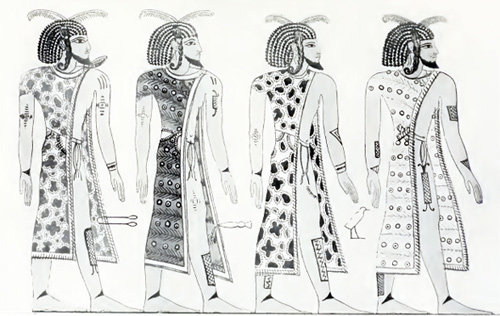
Ancient Libyans as pictured by the ancient
Egyptians.
The Ancient Berber Tribes of Eastern Libya:
The lists will deal only with the ancient Berber tribes
of Libya, and will not cover the modern Berber tribes of the country.
All the following tribes existed in classical times, during
the times of Herodotus and Ptolemy, and some of which were earlier mentioned
by the Ancient Egyptians.
Many of these ancient tribes were still present in the area when the Arabs
arrived in North Africa in the 7th century, as they were mentioned by various
Arab writers, especially the Austuriani, Mazices, Marmaridae, Nasamons, Leuathae, Psylli, Macetae
or Macae, Mamucii, Ifuraces, Mecales, Cinithii, Garamantes,
Gaetuli, Natabres, Libyoegyptiae and Magempuri.
Temeh’u, Tmh': from the
extent of their territories appear to have been comprised of various
communities or tribes. The cemeteries of a distinctive non-Egyptian people,
discovered between the First and Second Cataracts and dated to the Sixth
Dynasty, were identified with the Libyan Temehu. In late dynastic times the Egyptians divided the
human race into four classes, namely the Egyptians, the A’mu (Semitic),
the Neh’esu (black Africans) and the Temeh’u (the Berbers);
and thus Temeh’u designates the whole of the Temazight-speaking communities west of
the Nile.
Teh’nu: in the
country Th’nw of ancient Egypt: designate the Berber people inhabiting the countries west of the Nile Valley (Fayum, the northern oases, and
between the Egyptians and the Rebu). They are normally mentioned in the plural
form such as "the countries of the Teh’nu" and "the chiefs
of Teh’nu", and were identified with the ancient inhabitants of the Egyptian Delta.
Rebu: this tribe was located farther west of Temeh’u and Teh’nu, in the
region of Cyrenaica. The name Libya comes from this eastern tribe, known
to the ancient Egyptians as Rebu. According to Bates (p. 80), Lbki,
the earlier name of Leptis, is the same as Libu, in which the
U being marked by an equivalent K. The reading LBKI derived from the legends of the Punic coins of the city, and found in at least
one Roman inscription: “CIRRA VERNA LEPCITANA”. The name still
survives today in “Hatt’ah el-Lebuk”, a village few hours south of Siwa,
in Egypt. The Rebu group comprised a number
of tribes along the north of Libya, like Es’bet, Kehek,
and probably
the Libyarchae, placed by Ptolemy in the Gebel el-A’qabah,
near today’s Libyan-Egyptian border.
Kehek: the Kehek appear to have been a fairly numerous tribe, since
they supplied the Egyptians with mercenaries. They were a close ally of the
more powerful Rebu. From their number and association with the Rebu, they
have been placed by Bates (with reserve) in the interior of the territories of the Rebu.
KeyKesh: according to Bates, this name either is
of a small tribe or a misspelling of Kehek. It is found in the list of Rebu and
Meshwesh forces defeated by Rameses Ill.
Imukehek: the Imukehek appeared once in the Egyptian
annals (XVII1th Dynasty), but as they were a northern people, they may be
related to the Kehek (part of the Rebu group).
Meshwesh: a powerful group of allied
Berber tribes of eastern Libya, who were able to regain the lost Egyptian
throne (Shoshenq, Sheshenq). The name
Meshwesh is but one form of the generic Berber appellative
MZGH, as seen in such classical forms as MaXY-es and MaZY-es.
In ca. 945 BC the the Libyan Berber king Shishenq, from
the Meshwash tribe, succeeded in establishing the 22nd Dynasty in Egypt;
momentarily fulfilling the prophesy of the ancestors.
Macetae: were mentioned by Synesius as an ally of
the Ausuriani, and have been confused with Mazices by some modern writers. Oric
Bates suggests that the Cyrenaican Macetae may have been related to the Macae.
Macatutae: Ptolemy places these “caves of the Lasanici” in
the vicinity of the Psylli, the latter being on the same
parallel, farther to the east. According to Oric Bates, “In the Antonine
Itinerary a point Lasamices is found between Semerus and Cyrene, and it
has been conjectured that this was the site of the Lasinici, and that
they were to be found in Wadi K’erayb.”
Nasamones: the
territories of the Nasamones extended from the
coast, bordering the eastern part of the Greater Syrtis, into the interior
of Augila, and even roamed far to the south and west towards the borders of the
Garamantes. According to Herodotus:
“A numerous tribe, who in the summer leave their cattle on the coast
and go up country to a place called Augila for the date harvest. The
date-palms here grow in large numbers and to a great size, and are all of
the fruit-bearing kind. These people also catch locusts, which they dry
in the sun and grind up fine; then they sprinkle the powder on milk and drink
it” (iv. [167-174]). Recorded history informs us that the Forgotten
begotten five Nasamonian brothers
were the first geographers to explore the Sahara desert and as such we must
remember them as such.
Adyrmachidae: from the Egyptian Delta westwards
to the harbour called Port Plynus (Port Bardia) [Herodotus,
iiii. 328]. This old ethnic group is one of the ancient Libyan tribes of the
Delta of Egypt, long before Shishenq of the Meshwesh tribe recovered the throne
during the 22 dynasty, and so it was said the Adyrmachidae way of life is more
or less Egyptian in character - that is the Egyptian way of life was more or
less Berber. They
dress like the rest of the Libyans, and their women wear a bronze ring on each
leg, and grow their hair long; when they catch a bug on their persons, they give
it bite for bite before throwing it away. They are the only Libyan tribe to follow
this practice.
Barcaei (Barqa): mentioned by Ptolemy
and Herodotus to inhabit the areas around
Barca. In Byzantine times the Barceans were regularly
spoken of as a distinct ethnic group.
Tautamaei, Tautamona: Oric Bates
mentions them as a Syrtic people who appeared in several related Latin
chronicles (Excerpta Barbari; Liber generationis; Chronic. an. p. Chr. 334;
Origo human. gener., loc. cit.-Tautamona).
Libyarchae: west of Aniritae, in Gebel el-A’kabah, and
along the coast.
Libyaegyptii: or Libues Aegyptii is a mixed
tribe, who were located by Ptolemy west of the Nile in Middle Egypt, and
therefore may have been the dwellers of the oases H’argah, Dah’lah, etc.
Leucaethiopes: Leucoe Aethiopes ('the
White Aethiopians'), placed by Pliny south of Liby-Egyptian tribe. Oric Bates says the location is too vague to be of value geographically,
and these Leucaethiopes of Pliny may be the Libyans of the Nubian
Nile.
Libyaethiopes: a mix of Ethiopians and Libyans,
which my indicate a Nubian tribe, or another tribe farther south (Orosius i. 2
§ 88).
Auschitae: placed by Ptolemy south of the Nasamon.
Es'bet: the name of this small tribe, part of the
Rebu group, recalls the Asbystae (or Pliny’s Hasbitae).
Asbytae: Es’bet, in the east of Cyrenaica.
Asbystae: west of Giligamae, in the vicinity of
Cyrene, but not reaching the coast. They are conspicuous amongst the Libyans
for their use of four-horse chariots.
Augilae: Pliny places the Augilae half-way between
Aethiopia and the Syrtis, and thus they may had penetrated as far south
as the oasis of Kufra. The name survives today in the name of the oasis
Aujila or Awjla(h), south of Cyrenaica.
Auschisae: this Berber tribe, whose way of life was compared
by Herodotus to that of the people south of Cyrene, was placed south
of Barca, all the way to Euesperis (Benghazi) in the north and east to the
Asbystae. They are thought to be the same people as the Ausigdi of the city of Ausigda, mentioned by Callimachus and
Hecataeus. Within their territory is the small tribe of the Bacales, who reach
the coast near Tauchira, a town belonging to Barca.
Marmaridae: the Marmaric Nome is extended
inland to a considerable distance from the sea, southerly from the Gebel el-A’kabah.
They were in the same position when the Arabs arrived in North Africa.
Nitriotae: in west Egypt: this locative name
indicated an ethnic fusion of Berbers and Egyptians, the inhabitants of the
modern Wady Natrun, west of the Delta and in the northern Fayum.
Ararauceles: this tribe was placed by Ptolemy in southeast
Cyrenaica.
Aezari: in the far south, below Sentites.
Anagombri: placed south of the Adyrmachidae by Ptolemy.
Aniritae: west of the Zygritae, and on the shore of the
Catabathmus Major, by the present Libyan-Egyptian border.
Apotomitae: southwest of Bassachilae.
Bassachilae: south of the Aniritae, probably related to or
the same as he Bassachitae, who were grouped about the town Masuchis (cf.
Meshwesh).
Bacaiae: south of Augilae, and almost west of Nasamones.
Bacales: a little tribe enclaved by the Auschitae,
touching the coast at Taucheira (Tokra).
Mezatah: mixed Luatah Berbers about Ptolemais in
Cyrenaica (El-Edrisi, loc. cit.) and in Ugilah.
Fezarah: located by El-Idrisi in Cyrenaica.
Buzeans: placed by Ptolemy northwest of the
Adyrmachidae.
Chattani: were
associated with the town Chettaea; placed by Ptolemy west of Zygeans on the
coast, near modern Alexandria, in the vicinity of a small town:
Chettaea.
Zygritae: next to the Chattani, near modern
Alexandria, in the vicinity of the sea-town of Zygris.
Cinyphii: from their name, they belonged
to the fertile area about the Cinyps River near Leptis Magna.
Giligamae: from Plynus as far westward as the island
of Aphrodisias (Sharkiah or Hammam Islands).
Goniatae: located by Ptolemy in west Egypt, northwest of
the Mareotae.
Mareotae: in west Egypt: this locative name denotes the tribe
who inhabit the modern Mariut, who were much fused with the inhabitants of the
Nile Valley.
Shai: the Shai appear but once
in conjunction with the Es’bet, Keykesh, Hes’, and the Beken, in the
wars of the Meshwesh and Rebu.
Hes’: mentioned once with the Shai, the
Hassah, a modern Arabo-Berber tribe of Cyrenaica.
Ogdaemi: located in west Egypt, South of Mastiatae, in
the vicinity of Mt. Ogdaemum. Oric Bates suggests that this tribe, mentioned by
Ptolemy with Mastiatae, Goniatae, Anagombri and Zygeans, probably belonged to
the Adyrmachidae.
Mastiatae: located in west Egypt, west of the Mareotae,
and south of the Goniatae.
Ruaditae: in south Egypt, west of the Libyaegyptii.
Iobacchi: south of Anagombri, and west of Ruaditae.
Oebillae: south of Iobacchi.
Sentites: adjoining Oebillae on the west.
Tapanitae: adjoining Auschitae on the east, south of
Nasamones.
Zygeans: this locative name refers to the
people of the coastal area, near modern Alexandria.
The Ancient Berber Tribes of Western Libya
MZR, MZK, MSK, MZG:
the name MZGH appeared in the writings of classical
writers in various forms, like Mazis or Mazyes (Hecateus); Masuchi and Maxyes
(Herodotus);
Maschouacha (Chabas); Meshwash (Ancient Egyptians);
Maksiz (Ptolemy);
Mazikes or Mazages (Claudian); Maxitani (Justin); Mazic
(Latin inscriptions); forms of MSK (Libyan inscriptions: Chabot 1940, nos. 191,
192, 353, 793); Mazigan (Canary Islands), etc. The same generic
appears in classical times as MaZiC-es, MaZaC-es
or MaZaG-es, MaZY-es, or MaXY-es,
and is also seen in the Libyan inscriptions forming personal
names. Biblical
Lubim appeared in the Old Testament as Lebahim, the son of Mizraim,
the son of H’AM (Gen. x.
6-13). The name MZGH was undoubtedly employed
as a generic term by the ancestors of the modern Imushagh (Imuzagh,
Imazighen, Tuareg) and their various branches.
Ifuraces: from their location in the interior of
Tripolitana, this tribe can be identified with the Beni Ifuren of Ibn
Khaldun, most of whom were to be found in the west in the vicinity of
Tlemsan, as well as in Libya’s Nafousa Mountain (today's Yefren). The
ancient Ifuraces were the neighbours of Mazices or Mazigh.
Nafusah:
the Nafusah, Nefusa or Nafaousah and the Hawara tribes may be related to that
of the more prominent tribe of Africa Minor called Nefzawah. The
Nafousa group of tribes, living in Nafusa Mountain; in the region between
the sea and the mountain, with Sabrata being their coastal capital, before its
destruction; and according to al-Ia’qubi
(9th century) to the neighbourhood of Kairouan, includes the Beni Ifuren of
Ibn Khaldun, still living in Yefren in Nafousa Mountain and in the vicinity
of Tlemsan; who were identified with the ancient Ifuraces of
the classical sources.
Laguanten: the Leuathae of
Procopius, the Laguanten of Corippus, or Laguantes, Laguantan, Ilasguas, or Leucada,
grouped by Corippus with the Austuriani, the warlike Austur of the invincible
Ilasguas, were mentioned in relation to their revolt in Tripolitania during the
time of Emperor Maximian. Ibn Khaldun's legendary ancestor Lua or
Lewwa was regarded as the father of Zayr and of numerous Berber tribes
known under the general designation of Bani Lewwa (or Lewwata).The
Lewwata were spread across Tripolitania,
including Tripoli, Barqa or Cyrenaica and Marmarica, and according to Leo Africanus
as far east as Egypt, and so the designation came to be used for all the Berbers
of Eastern Libya.The Zenarah, a tribe of the
Lewwata established in Egypt along the western edge of the Delta, and continued
there until dislodged by the Mameluks, who drove them into Barqa, where
another group of Zenarah already
existed (al-Yaqubi). According
to Oric Bates the Lewwata had caused the medieval name of the classical Ammonium to
change from Santariyah
to Siwah before the fifteenth century A.D,
and were the predominant branch of the Berber stock in Eastern Libya during the
seventh century AD. The genealogies given by Ibn-Khaldun in his History
of the Berbers relate the Lawata and Nefusa to the tribes of Botr, another
legendary ancestor, while place the Hawaraamong
the Beranes,
the other great Berber family. Both Botr and Beranes descended
from Berr, who descended from the ancestor Mazigh and/or
ancestress Tamazigh(t).
The other Luathae who continued to inhabit Egypt after
the Arab invasions include: Benu Barkin; Benu Magdul (Majdul), in the province
of Gizah, including B. Thahlan, the Sak’k’arah, B. Abu-Kethir
and B. el-Gelas; Benu H’adi’di (who recall Morocco’s Berber
Ait H’diddu), the most powerful element
in the Egyptian Saa’eed; Benu K’at’ufah,
comprising the Maghaghah (who Ibn Khaldun traces to Luah the elder)
and the Wakhilah; Benu Malu, comprising B. Gheras, B. Gemmaz, B. el-H’akem,
B. Warkan, B. Walid, B.
el-Hajjaj and B. Mah’resah; Benu Ballar, or the B.
Balain of Ibn Khaldun,
who were divided into the sub-tribes: B. Mohammad, B. A’li,
B. Nizar and B. Thahlan; Benu Yah’yah, a mixed tribe of Zenatah and Huarah
(and probably others), in the province of Manufiah; Benu A’bdah;
Benu Mokhtar; and Benu el-Wa-Suah, the Siwa of El-Ya’qubi and Tisuah of
Ibn Khaldun.
Austuriani: the Austuriani tribe were placed in
Syrtica, between Tripolitania and Cyrenaica, in the fourth century. Their
territories stretched as far as the oases of the Giofra or Jofra (Waddan,
Socna, Houn).
Macae: the Macae, located by Herodotus (iv. [175-181]) west of the
Nasamones, wear their hair in the form of a crest, shaving it close on either
side of the head and letting it grow long in the middle; during war, they carry
ostrich skins for shields. The Macae joined forces with the Carthaginians to
drive out the Greek Doreius, in his failed attempt to establish a colony at the mouth
of the river Cinyps (Wadi Caam), which rises from the Hill of the
Graces, some twenty-five miles inland. They survived far into the Roman
period around the western and southern part of the Syrtis Major, while
the Macae Syrtitae occupied the southeast corner of Syrtis
Major.
Psylli[Seli]: Pliny
(Hist. Nat., vii 14) places the Psylli on the Syrtic coast
above the Garamantes, and gives Psyllikos Kolpos as an early name
of the Syrtic Gulf. They received their name Psylli from Psyllus, one of their
kings whose tomb is in existence in the district of the Greater Syrtis.
According to Oric Bates, the story told by Herodotus of the battle of the Psylli
against the south wind appears to have been a native version of Pliny’s
account to the effect that the Psylli were nearly exterminated by the Nasamones,
who then took possession of their territories. While Olwen Brogan (Hamito-Semitica,
1975, p. 279) further adds that they did not completely disappear: “In
the third century A.D. there was a tribe of some importance, the Seli, along
the south of the Greater Syrtis, with towns at Macomades Selorum (Zaafran, Sirte)
and Digdica or Vigdida Municipium Selorum.” The Psylli were
famous for their powers of charming serpents and curing
their bites and scorpion-stings,
and it was believed that they were in some mysterious way
antipathetic to poisonous animals; of which Oric Bates further adds that,
“ In
classical times, the Psylli were employed as doctors to “charm”
snake-bites and scorpion-stings, perhaps the most famous occasion on which
their services were requisitioned being one where their powers proved of no
avail – for Octavius endeavoured vainly to restore Cleopatra to life by the
arts of these serpent-masters” (O. Bates, p. 179, 180).
Phazanii, Gamphazantes: ancient
historians and geographers place the Garamantian region Phazania and
the ethnic group Phazanii south of the Syrtis Minor and south of
Nefusa Mountain, right through the Black Mountain and into the Sahara desert. The
name Phazania disappears from later Roman sources, and reappears as Fezzan in
the writings of the early Arab historians. The provinces of Fazzan, Tripolitania
and Cyrenaica were grouped together as Libya by the Italians in 1930s. It
is evident that the generic term Phazanii was used for a number of tribes,
including the Natabres, in the vicinity of the river Nathabur, Niteris, Enipi,
Discera and Nannagi. Some of the ancient towns mentioned include Alele, Cillaba,
Talgae, Tabudium, Nigligemela, Bubeium, Thuben, Nitibrum, Rapsa, Debris, Thapsagum, Boin, Pege, Baracum, Buluba,
Alasit, Galia, Balla, Maxalla, Zigama, Mount Gyri, Cydamus, the modern
Ghadames, and Garama, the most famous capital of the Garamantes. According to Pliny,
Mount Gyri was preceded by an inscription stating that this was the place where
precious stones were produced. According to Olwen Brogan: (Hamito-Semitic,
1975, p. 280), “It is usually accepted that the inhabitants of Phazania
were the Gamphazantes, a tribe mentioned by Mela (I, 8) and Pliny (V,
8). Procopius places a tribe called the Gadabitani near Lepcis
Magna (e Aedif., VI, 4) with a town called Gadabis which Desanges (1962, 16,
22, 91-92, 138 n. 6), thinks could be a version of Cydamis.”
Garamantes: or Garamants, placed by
Pliny twelve days journey from the Augilae, and ten days by Herodotus, in
the interior of Libya. Herodotus informs us that the Garamantes were a very
numerous tribe of people, who spread soil over the salt
to sow their seed in, and hunt in four-horse chariots. They occupied the most
habitable region of the Sahara, the Wadis el-Agial and Sciati and the oases from
Murzuk to Zuila. They had control over a wide area,
spanning the entire region from Tibesti to Acacus including the enigmatic Messaks and Wadi
Metkhandoush. They initially run their kingdom from the nearby capital Zinchecra, then
from Germa or Garama
(today's ) in the first century AD, so named after their
eponymous ancestor Garamas. Garama is thought
to be the same as as Jerma or Germah of today’s Fazzan. Please
click on the following link for the full article about Germa and the Garamantian
civilisation of ancient Libya (https://www.temehu.com/Cities_sites/germa.htm).
To this day there is no complete nor comprehensive work to document what many
came to know as one of the earliest civilisations of the Sahara, and all that
is known about them is as obscure as they were made to be.
Cinithii,Cinti: this
ancient tribe, located south of the eastern shore of the Syrtis Minor,
figure in later times as one of the main divisions of the Libyan group.
Gindanes: adjoining the Macae on the west, they appear
to have been an important division of the Lotophagi (of Zarzis or Zuchis near
the Syrtis Minor).
Arzuges: the regions of Tripolitania and Regio
Arzugum met near Leptis Magna, where the mountain reaches the sea, but were
separated by the plain of the Gefra elsewhere. According to Olwen Brogan
(Hamito-Semitica, 1975, p. 281), “Their regio extended to the
neighbourhood of the Shott el-Jerid, for we hear of a bishop of Tusuros
(Tozeur) travelling to Carthage in 411 and passing through the land of the
Arzuges (presumably to take ship from Tacape) . . . The churches of the
Sofeggin basin very likely came under the jurisdiction of the Arzugitan
bishops, and since St. Augustine, in one of his letters mentions barbarians
being admitted into the country of the Arzuges along the frontier to carry out
tasks such as crop-watching, it looks as though the regio extended right across
our pre-desert area (Epist., 93 and 46-7) . . . If the Arzuges ranged over so
great an area they must have been a large confederation of tribes, and the few
names of sub-tribes we have, such as M.s.li and T.gl.bi (or N.gl.bi) in the
Wadi el-Amud (Sofeggin, first century) (Levi Della Vida 1964a, 58-60) or
Motebi (El-Amrouni near Foum Tatahouine, Tunisia, third century) could belong
to them (Neo-Punic inscription; see Berger 1895, 73-75).”
Auseans: like the Machlyes, from whom they were
separated by the Triton river, the Auseans lived in the vicinity of Lake
Tritonis. According to Herodotus [book iv. 175-181], “Both these tribes .
. . hold an annual festival in honour of Athene, at which the girls
divide themselves into two groups and fight each other with stones and
sticks . . .
Before the fight is suffered to begin, they have another ceremony. One of
the virgins, the loveliest of the number, is selected from the rest; a
Corinthian helmet and a complete suit of Greek armour are publicly put upon
her, and, thus adorned, she is made to mount into chariot, and is led around
the whole lake in a procession.”
Numidian
Numidae: according to Herodotus there are two groups of
Libyans: the agricultural population and the shepherds or the nomads, of
which Numidae is the Latin form. However, according to Oric Bates, this
popular derivation of Numidae from the Greek “to graze” or “a
pastoral wanderer”, is questionable. The land of Numidia, as a kingdom of
Masinissa extended east all the way to
the eastern borders of Tripolitania, in Libya. The Numidian Massyli tribe
were the subjects of king Masinissa, while the Masaesyli were the
subjects of Syphax.
Gaetuli: placed by Pliny in the interior, north of theLiby-Egyptians, and south of the Gararmantes.
While Oric Bates asserts their true position to have been along the
north-western confines of the Sahara, and not farther eastwards than the
Garamantes. It appears that the Gaetuli comprised many desert tribes,
such as Ptolemy’s Baniurae-Gaetuli (v. 2) and Darae-Gaetuli (v. 1).
Atarantes & Atalantes: the
mysterious Atarantes tribe was located by Herodotus (Hist. iv. [184]) about ten
days’ journey from the Garamantes, about whom he says, “The only people in
the world, so far as our knowledge goes, to do without names. Atarantes is the collective name.” He also reports that they curse the sun as
it rises and call it by all sorts of opprobrious names, eat no living
creature, and never to dream. Ten more days’ journey from this, crossing yet
another hill and a spring, Herodotus came to a slender-cone-shaped mountain
(Mount Atlas), which he says the natives, who call themselves Atlantes, after
the mountains, call it the Pillar of the Sky.
Machryes: or Machlyes: Pliny
relates them to the Lotophagi tribe (the lotus eaters), while Herodotus and
Ptolemy locate them about Lake Tritonis, or today’s Shat’t’ al-Jareed in Tunisia. Herodotus states that the Machlyes also make use of
the lotus, but to a lesser extent than the Lotophagi. “Their
territory reaches to a large river called Triton, which flows into the great
lagoon of Tritonis. In the lagoon there is an island named Phla, and
there is said to have been an oracle to the effect that the Lacedaemonians
should send settlers there.” (Herodotus, iv. [175 -181].
Libyphoenices: mixed Berbers and Semites, who were
probably numerous wherever the latter had colonies in North Africa, Ptolemy
confines them to north of Byzacitis, near Carthage.
Magempuri: according to Bates this tribe must have had
some importance in the eyes of Vibius Sequester, since they are among the six
African peoples he lists. They are otherwise quite unknown.
Other tribes mentioned by
classical sources include:
Achaemeneans (south of Ogiplonsii)
Astrices, Astacures (south of Nigitimi, west of Samamycii)
Bubeium
Capsitani (around Capsa)
Cerophaei
Darae-Gaetuli
Discera
Dolopes
(south of Tidamensii or Cydamus)
Enipi
Erebidae (part of the
Lotophagi)
Eropaei (west of Samamycii)
Gepheans (south of Machryes)
Haliardi, Iontii, Lotophagi (on the Syrtic coast)
Mideni
Mididii
Musuni
Mampsari
Motuturii
Muturgures (south of Achaemeneans)
Muchthusii (south of
Muturgures)
Machryes or Machroas (in the elbow of the Syrtis Minor)
Machyni ( northern Byzacitis sahel)
Muctuniani
Musuni
Marchubi
Mimaces (south of Gepheans)
Musulani: or Musulini (Tacitus )
Nigitimi (south
of Lotophagi)
Nygbeni (north of Nycpii)
Nycpii
Nicives
Niteris
Nannagi
Nattabutes (or Natabudes or Nathabutes)
Ogiplonsii (south of
Cinithii)
Ozutae
Samamycii (along the west Syrtis Major)
Mamucii (probably
the Samamycii of Ptolemy)
Sabarbares or Saburbures
Uzalae (south of Mimaces).
Please let us know if you need to report any errors or add to the above lists.