The title "refuse refuse", one verb and one
noun, meaning "reject rubbish",
is the slogan we have chosen to represent Temehu.com's online campaign to Keep
Libya Clean.
Reduce Reuse Recycle Refuse
Traditionally, most Libyan women keep their houses spotlessly
clean and tidy as a matter of daily routine of hard, and mostly unrecognised,
work. But some Libyan men (if not many) seem to
care less and less about their country, regardless of what they say. Libya until
recently was clean and as isolated from the outside world as Acacus still is
shrouded with mystery today. But today, the side effects of any influx of wealth
and progressive economical growth, combined with aggressive change, would naturally
include litter, neglect, plastic and fatigue.
Those consumers
who are eager to digest and hurriedly disregard neat order for litter & clutter,
beware: rubbish,
refuse, garbage, litter and waste are piling up everywhere in Libya, even in
the most sacred archaeological sites.
We
kindly urge both Libyans and visitors to reconsider and help keep Libya clean.
Far from being limited to Libya, litter appears to be globally
symptomatic of modern industrial life as a whole. Waste is the product of creation;
a carpenter's workshop would fill up with wood cuttings and sawdust if no system
of keeping the workshop tidy was in place. Similarly our homes will fill up with
rubbish if no cleaning takes place. So what is different about the
"Big Home"? Our DNA too lacks this system as it mutates and thus our
genome is more than 90% junk DNA. Good excuse for some who
always prefer to blame others for their reckless actions! (Ref.: "Message
in a genome?", New Scientist, 12 August 1995, p 30; http://www.newscientist.com) .
Temehu.com will attempt to graphically project the scale of
this catastrophe to the attention of all: some Libyans,
some authorities, and some foreign visitors alike;
hoping to engage them to reflect and positively react to the actions some of
them occasionally enact.
A human being enters an archaeological site to marvel at its
wonderful beauty and immensely enjoy the magical satisfaction gained from being
so close to such a distant past, is fine, and wonderful experience Libya is more
than proud to provide. But why, dear friends, curse
the sacred ground with plastic and glass?
I am an important human being who hasn't
got a clue as to what to do with the plastic that was sold to me using my
plastic card!
Please, what should I do with my plastic bottle(s)?
They are "rubbish", not worth a penny, so why should
one bother? One is often was brought-up to care only about "valuable possessions",
and even secure and ensure them, in a society where so many care less and less
about rubbish tossed away against the wind?
Let us face it, there is no excuse,
no matter what; but some places do have little litter bins for some
people to toss their "trivial" rubbish in, not to say anything
of those who miss the bin and never bother to stop, go back, and try again -
that would be embarrassing; wouldn't it?
But those (lovely or ugly) plastic rubbish bins installed
by councils are not found everywhere, nor where the Libyans and some visitors
most likely would need them most. And if you do find one rubbish bin, it is more
likely to be full, to the brim, and overflowing to the ground, rather than spotlessly
empty.
And if you do do find one that is overflowing, and covering
its surroundings with rubbish and bottles to the ground, then what? Maybe
we can entice, or chase, the local council to purchase more
cheap plastic bins from Hong Kong and have them blanket-cover the pavement in
juxtaposition, waiting for junk to arrive only to be picked up and disposed of,
somewhere else, of course - in somebody else's land.
It is rubbish after all we are talking about, isn't it?
Yes. It is. Pure rubbish.
Plastic Bottles.
Why do water bottles have those lines and grooves running
across their bellies? (Have a look at the photo.) Well, these are designed for
squashing the bottle, all the way down, just like this: remove the top, place
your hand under the bottle, then squash the bottle all the way down and immediately
secure the top back in position. Much less litter to carry, until a
disposal "unit" was located.
The Problem is Some
People Not Management!
This is a real photo of a PARTICULAR group
of European tourists in the Libyan Sahara, leaving their rubbish behind after
camping overnight. We have covered the plate numbers and other identifiers bright
green in order to keep the identity of the "perpetrators" private and
safe with us.
This particular Western European
group of tourists (not to be confused with all European tourists) were habitually
leaving their rubbish behind, wherever they camp. Not a bottle or two, but bags
of it too.
When one of our Libyan tour guides kindly pointed out to
them that they needed to carry the bags with them to the nearest rubbish dump,
say the nearest village or town where one can find a rubbish bin, they took no
notice of him. Why should they!
Of course, most tourists would not dare do that. The above
evidence refers to this particular group. We have
evidence for other tourists (Europeans, Asians, etc.) for taking part in
similar practices. And we have more evidence for many more Libyans doing the
same, as we have illustrated in this article. And we have evidence for so many
people doing this all over the world (please watch the BBC video at the end of
this page).
When the guide noticed this Particular
European group do this on a regular basis and
blatantly refused to dispose of their refuse each time he asked them to, he waited
one day until they all got in their cars and drove away and took his camera to
produce the above live shot; capturing the perpetrators in action running
away from the crime-scene, leaving the evidence behind: (two green bags, one
blue bag, one white bag, one black bag, yellow plastic, and a solitary can).
This is a fantastic photo because it captures the moment we decided to share
with you!
We are not running a name and shame campaign. We hope those particular tourists find this page as it
might be of comfort to them to know that their guide had secretly took all that rubbish and disposed
of it at the nearest allocated spot.
If the above story rings the bell, then I wouldn't mind
pulling another one from the bag. I am rich in rubbish tales!
To reflect, you (regardless of your colour or nationality)
would need to imagine yourself sitting on one of those lovely white plastic chairs
and contemplating on the black graphic on the green plastic bin and ask yourself
if the council needs to install a line of these bins instead of one or whether
it needs to collect a few times a day instead of once!
Who do you think ought to answer this question?
Can we all
Libyans, including the council, sit around the empty table and discuss this "disgusting"
scene!
Many people (regardless of colour or nationality)
were accustomed to having things done for them. When they were toddlers their
mothers run behind them picking up all the loose pieces and putting all the toys
back where they should be. When they grow up, they continue to depend on "road
sweepers" and "dustmen" to pick up all the junk left behind.
Councils pay companies, and companies pay road sweepers (most often immigrants)
to do the job. When the population frighteningly grew in size, they invented
machines to sweep the roads, but they still had the sweating sweepers erratically
running behind the machine, zigzagging their brooms ahead of them (in attempt
not to miss any loose dog-ends and to avoid tripping any passers by),
sweeping rubbish towards the gutter for the noisy machine to suck. The first
walker behind the cleaning team immediately initiates the same daily cycle all
over again.
There are even companies
that break the rules and dump their waste, including toxic chemicals and hazardous
waste, wherever they like, at night of course. Some
global corporations used Africa as a dumping ground, and when they were caught
they just paid their way out -- fines are fine.
Is this a rubbish tip or the tip of the iceberg?
This story is different because at least in this one, one can contentedly argue
that the cans have decided to disappear by themselves, without any human
help, as they slowly vanish according to the cosmic law: from dust to dust.
The ground itself is heavily stained with rust.
Mother nature always takes care of
her foolish offspring
(regardless of nationality or colour) tampering with her most sacred secrets.
Nature's wind as always will be there to bury it away. But although nature can
handle most types of waste, like paper, tins, cans, wood, biological matter and
metal, other types are not biodegradable, and even harmful to the eco system
of the planet as a whole.
Plastic, for a start, would prove more tricky
than tins to resist all attempts of voluntary disappearance, at least for a very
long time to come. In fact plastic is now an important element of our beloved,
expensive diet, as it had shredded itself into our water system, and even fish
take it. Big fish eat little fish, and many of us, but not all, eat fish rich
in plastic and mercury - without knowing, of course. Scientists recommend we
eat very little fish, no more than twice a week, if we to keep a safe level of
toxins in our system.
So, there we have plenty of food for thought.
Many museums in Libya still lack surveillance cameras, and
most archaeological sites still unfenced, unguarded, and grazed by sheep.
Libyan Albayan
A scan of the front cover of Albayan magazine.
The Libyan magazine Albayan (issue: Hannibal
1376 [2008]) is a seasonal, cultural and analytical periodical published by the
peoples committee of the Five Points Municipality (Sha'biyyet Anniqat Alkhams)
in Zuwarah. In an article titled "In Plastic Farms" the
author warns the Libyan people (not tourists) of
the dangers of plastic and urges them to pay
attention to their actions and help towards keeping Libya clean and safe
for our children.
The article particularly focuses on the dangers of plastic
as a substance that does not go away even when is shredded into dust and dissolved
into the soil. Its microscopic particles remain in the soil and water for up
to a century. When taken by plants from the soil and water, and then animals
feed on these plants, the cancerous particles are transferred
to humans via animal produce like milk and cheese.
In Plastic Farms
The article goes on to warn the Libyan
people about the excess use of plastic and asks them to use less of it
whenever they can. For example, bakers use plastic carrier bags to sell hot bread
to the public, when most people know that heat and plastic do not mix. [Take
your traditional basket to the baker with you - be a traditional Libyan and forget
about this modern stuff.]
To reduce the consumption of unnecessary plastic, the article
recommends:
Take immediate action right now.
Recycle plastic whenever you can.
Do not use plastic bags to package meat and other animal produce.
Use paper whenever you can.
Avoid buying plastic toys for your children.
Do not buy plastic plates, cups and forks to use for food.
Do not use disposable plastic plates and cups.
Use straw baskets to buy and store food, as your ancestors did.
Boycott plastic products whenever you can.
Let others know about this problem and help spread the word.
Medical Waste
The following image shows the home page of www.libyanmedicalwaste.com.
Please visit the site for info on how to dispose your medical waste appropriately.
Take a closer look and you will see a Libyan driving his tractor
to empty his load of Libyan rubbish in broad day light.
The rubbish on the slope by the side of the road presumably dumped by "lazy"
drivers who cannot be bothered to follow the tractor.
I suppose most people (regardless
of nationality or colour), as ever so busy chasing the precious 'loaf of life',
are becoming lazier by the day and care less and less about anything else but
being a useful 'bread winner' for the family. Populations
around the globe are fast multiplying, while the existing constant space
increases in price by the day. Like a helpless sheep stuck between the jaws
of a lion, a general feeling of despair blankets the ground like a succubus. These
and other factors should not be ignored when attempting to understand the phenomenon
of why many people tend to care less and less about their health
and environment? Equilibrium in a society requires "economic" equality at all
levels, less political "brutality", and ample sharing of the only resources we
have to tackle resulting social, health and environmental problems.
The effects of the wind, plenty of it in Libya, can spread
plastic bags across massive areas, and in many places one is accustomed to seeing
plastic bags stuck in tree branches and power lines.
Libya needs a massive campaign to effectively remove plastic bottles from its
vast landscape.
The above
sign is saying to other Libyans who do not care:
"the road is a public right for
all and so make sure you keep it clean."
While this one says:
"random rubbish dumping shows
lack of awareness of its bad effects."
That is the person who is throwing rubbish at random (regardless
of his or her colour or nationality) does not know about the damage caused to
human health and to the planet as a result. He is probably not aware that s/he
drinks plastic everyday as a consequence. Look at the sign itself; it
rises a number of questions.
Cheers
Why Wait To Take Responsible Action?
Divine help is looming in the horizon; and the angry Sun is
about to leash.
If you are a Libyan reading this page now, as most likely
there are not many Libyan who devote some of their
precious time to reading or
thinking about "rubbish", can you care to help?
Are you not bothered?
Can you mention it to your local council for discussion or even consideration?
Or do you have influence to speed up change?
If yes, then your country needs you, right now.
She needs the attention of everyone to change their relaxed
attitude towards health and hazard matters, and their intentions too. It matters
more if people are mature enough to take responsible action by themselves and
make things happen, and make less of it happen too, and widely embrace the importance
of this embarrassing change. All of us need to work together to keep Libya clean
and tidy.
Are Some People Right To Blame Bad Management?
We have received a number of feedbacks stating that the issue
is an issue of "bad management" and that the government needs to do
something about this. We think people are mistaken to think that way.
Some people (regardless of colour
or nationality) naturally would tend to blame others for their faults!
How can you blame the management for the actions of individuals. Someone throws
an empty plastic bottle in an archaeological site, on the pavement, on the beach,
or even in the desert. And then someone else does the same. As more people (regardless
of nationality or colour) throw rubbish randomly, you will begin to notice rubbish
piling up everywhere, as it is doing now - all over the world. Then all you have
to do is put your hands in your pockets and say: bad management?
The management is doing all it can to keep the country
clean of the rubbish produced by people (see photo below).
But it cannot eradicate
the problem if these people do not stop throwing their rubbish everywhere.
In fact, one can ask: why should the
government create a waste management department in the first place?
The answer is that because people throw rubbish everywhere they go!
Rubbish does not fall from the sky by itself; does it?
Imagine what the government would spend that money on if people
do not throw their rubbish everywhere? Build new homes, new schools and new hospitals,
increase the ridiculous minimum wage, improve services, donate cash to poor countries,
and so on (to infinity). No, instead they are forced to spend billions of pounds
just to collect, recycle and incinerate human-produced rubbish. Worse still,
many of these rubbish producers blame bad management for their fantastic
actions. This is rubbish.
Reduce-Reuse-Recycle
The Good News
The Government's Campaign to Keep Libya Clean is Active and Well. Give them your support and helping hand!
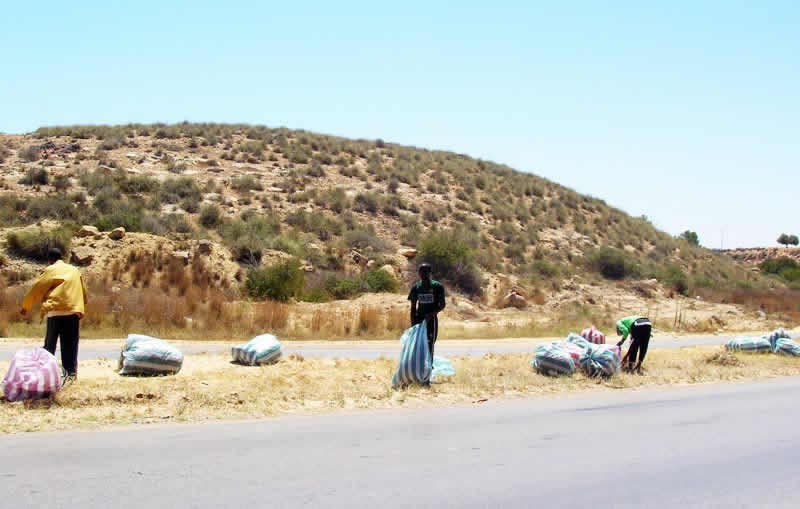
This photo shows that the campaign to clean Libyan roads and
streets is still active. Workers continue to work along all the major roads,
collecting rubbish in bags and leaving them behind for the rubbish lorry to pick.
Of course, people and visitors still need to help by changing their habits in
order to keep Libya clean and stop their unacceptable behaviours. Simply, you
cannot have people collecting your rubbish forever. It has to stop.
You can spread the word by word of mouth, or you can
use your mouse.
Tell your friends, and help towards making people more aware
of the disaster. Some people would stop throwing rubbish at random as soon
as they realise it is a problem.
Many people still think it is normal and
expected from them.
Let them know its cleaning time.
Do you want to say something?
End of 2011.
Happy New Year: 2012.
Image from: www.facebook.com/CleaningUpTripoli
The bin is saying:
"don't be afraid; I do not bite!"
2012
Cleaning up Tripoli
Cleaning Up Tripoli is a non-governmental "movement"
founded to campaign for cleaning Tripoli; the sister of "Cleaning
Revolution", which campaigns for the cleaning of Libya. In association
with the "Libyan Society for Tourism Activation" (الجمعية
الليبية للتنشيط السياحي) and other organisations and volunteers, a number of
cleaning projects were undertaken in the capital, including the cleaning of Martyrs
Square garden and painting Assaraya Alhamra Museum. Their Facebook page shows
hundreds had already volunteered for the campaign to paint the walls and clean
the garden of Libya Museum, due to take place on Saturday the 28th of January
2012. Please give Cleaning Revolution a helping hand; like their page (www.facebook.com/CleaningUpTripoli);
tell your friends; and please do take part yourself in preventing rather than
dealing with pollution.
Why litter is accumulating in the streets of Misrata?
Readers Comments:
17 July 2009:
"I am deeply shocked to hear that civilised tourists do such an awful
thing. Thank you for the lovely photos. Amina."
Temehu's reply: "us too!"
17 July 2009:
"Thank you for a very insightful post. This is an extremely important
issue in Libya. However there is a lack of waste 'management' by the state. Even
when people are careful about their rubbish and put it in the right places, it
doesn't get collected. Umm Salwan."
Temehu's reply: agree with
and can see your point regarding "full and over-flowing bins" (like
the green one above); but what about those who throw rubbish practically everywhere,
even in the heart of the desert? The only waste management there is one's sense! Everyone
needs to do their share.
5 August 2009:
"This is a problem of management and administration. Basheer."
Temehu's reply: disagree with
you. Totally disagree. We think the problem is "bad people"; people,
including some tourists, seem to care less about the landscape they desecrate
every day. Ask yourself the simple question: what would happen if people STOP
throwing rubbish at random? The answer is: clean streets. What would happen if
smokers STOP throwing their cigarette-ends everywhere?
24 August 2009:
"Thank you for this page Temehu. Rubbish is a huge
problem in Libya, and making this website is a step forward. I have a few points
to make:1) People's Responsibility: I live in Benghazi and my father and I clean
our street every Thursday, sometimes more. We also warn the neighbours to throw
their rubbish in the large bins across the street, and not on the street corner!
. . . Our street is now one of the cleanest in the area, because of an effort
we made. This shows that people can keep the place clean with a bit of effort,
but . . . 2) The Authorities' Responsibility: I was very happy to see the second
last photo of the men cleaning up the rubbish. I wonder who took this decision,
because I know another place where it is needed: I was driving from Tripoli to
Misurata (July 2009), and the road side is FILLED with plastic bags. This is
a very common tourist route which takes visitors from Tripoli to Leptis Magna.
I tried to take nice photos of the landscape but each picture was filled with
plastic bags. I felt embarassed to show it to friends back here in Ireland where
I live. I know an Irish group who visited Libya, and they were horrified at the
state of this road . . . . . . . . . . . . . . . At the moment nobody cares about
throwing rubbish in the street. Why? because they don't have to care, who's going
to stop them, who's going to punish them? . . . . . . . . . . . . . . . . . Here
in Ireland, I remember an incident where one Friday night, students threw rubbish
everywhere in our estate, everywhere. The next day the police were here asking
us, "what did you see?", "who's responsible?". The next week the local university
published a report in the newspaper scolding the students responsible. They were
found, and FINED. . . . . . . . . . There are fines of up to 1000 Euros in some
places in Ireland for dumping culprits . . . Look at this British Website: http://www.keepbritaintidy.org/Default.aspx .
. . . . . . . . . To summarise:1) People of Libya, stop being cynical and lazy
and waiting for the government to fix everything . . . 2) Authorities of Libya
. . . Start a real, strong and committed nationwide campaign such as Britain's
'Keep Britain Tidy'. You did a great job with the seatbelt campaign, and it worked
very well! Now move on to rubbish. . . . "
Temehu's reply: Thank you for
your feedback; please accept our apology for editing your comment (it is too
long). You are right in that both the people and the council need to take action
and help each other to keep their country tidy & clean. In relation to the
fines you mentioned you have in Ireland, one can note that even though there
is a £1000 fine in London for not picking up dog litter, dog owners still walk
away from their crime scenes, and you cannot have a policeman chasing every dog
owner in the capital waiting to issue the fine. However, there is a fine
of one hundred Libyan dinars already in place in Libya, for throwing rubbish
randomly, but many Libyans still do what they normally do. If people do what
you did in Benghazi, then the council will have no one to fine!
13 Junes 2010
"Check this link of a hotel made of rubbish: bbc.co.uk/worldservice/news/2010/06/100604_rubbish_hotel_et_sl.shtml
Liz."
Temehu's reply: Thank you for
the link (which no longer works - see the following link). Very interesting project: a hotel made of rubbish collected from beaches
has opened in Rome, Italy. The hotel, safely disinfected and supplied with new
sheets, is named "Save The Beach", in an effort to bring our
attention to the problem of rubbish, daily accumulating around the world's beaches,
in a sense that once you sleep in the hotel you will wake up to the sad reality.
This image is a screen shot of the article at the above link,
linked to a BBC video about the hotel.
Hello. again. I think it is wrong to write that it is tourists
that make Libya dirty. I had the most respect for the country when I lived there.
But the thing is that there is no any facilities for most of the garbage. Those
facilities that are there are not enough. even on you photos there is a rubbish
bin but it is more then ful and noone cleans it or emties it.
PS can you pls make an article about national crafmanship like national cloth,
jewlery, carpets and so on with pictures. Anonymous wrote.
Temehu's reply:
Yes, it is wrong to write that. But we did not write that.
We were specific about: "This Western European group".
The above photographic evidence implicates that group (the identity of which
we have protected), and does not refer to anyone else but them. There is
no doubt that the people who make this planet dirty come from all over the world
including from Europe, Africa, Asia and America. We have published some of the
evidence in this page. Just watch the above (European) BBC video and you will
know.