Ancient Libya was the home of Mediterranean mythology, the earliest
religion known to womankind. The ancient religion of the native Berbers was
their mythology. Most of the
Egyptian and Greek gods and goddesses are Libyan in origin. For example, Amon,
Ament, Antaeus, Bast, Osiris, Isis, Shu and Nit, are
all Berber in origin. Egyptian Nit, Phoenician Tanit and Greek Athena were
all adopted from Berber Tannit, else known as the Libyan Triple Goddess Neith par
excellence.
Many of the ancient practices of the native inhabitants of
Libya were based on the veneration of the ancestors and the dead. Most of the Berbers' ancestral doctrines also form an integral part of the jinn lore. According
to Westermarck a number of the Berbers' religious principles
are still practiced by Berber women under the disguise of Tomb Worship, where
women regularly visit the tombs and perform various rituals in association
with the ancestors and the dead; such as receiving sacred prophecies
through dreams obtained by sleeping in tombs of holy ancestors. Some prophecies
speak of reincarnations that will return to complete the work of the ancestors.
This tomb worship,
according to Herodotus, goes back to the ancient Libyan Nasamon Berbers, and
it may even go back farther in time since sacred traditions are indeed carried
forward from previous generations. The ancient Libyan Nasamons took oath at
the graves of persons who were reputed for justice and transparency. In addition
to tomb-worship, complete traditions from the Berbers' previous mythology remain
alive in various traditions and festivals. Saharan prehistoric art, Berber
jewellery, Berber
folklore and music have also preserved some fragmented elements of Berber
belief.
Shortly after
the installation of Gaddafi many of the Berber tombs were bulldozed on the
orders from the dictator because he viewed them as Berber pagan symbols; in the same
way after the installation of the NTC in 2011 many of the installed
radical and moderate militia groups began demolishing sacred tombs across Libya.
List of Berber Goddesses & Gods
The Berber Pantheon:
Afri (Afrika): a Berber goddess of fortune and fertility
Ammon (Amen): Life-God
Ament: Life-Goddess
Ancestors: a relationship similar to that existing between the totem and the worshipper
Antaeus
Anzar: Rain-God
Ash
Ashaman: God: among the ancient Berber Canary Islanders
Atlas: Libyan Mountain-God
Auliswa: worshipped at Pomaria (Tlemcen)
Awessu: Sea-God (?)
Bacax: (Bacchus): Grape-God: dedications found in a grotto of Taia near Calama (Guelma)
Bast
Draco
Froarangan: Canarian God of men
Genius of Africa (genius Africae): a female spirit
Guraya: name of a saint in Kabylie
Gurzil: Libyan Sun-God, also god of war, in Syrtes (Sirte)
Idir: name of a divinity; also found in Baliddir
Ifru
Iguc: god of the rain, among the Berghwata of Morocco (cf. Yakush)
Illu: Tuareg god
Isis
Jnoun: the Jinn
Libya: Goddess of Libya
Lilleus
Lilu: synonymous with rain water
Makurgun
Maqurtam
Masiden
Mastinam: Libyan god associated with Jupiter
Masiddica
Mathamos
[Medusa]: Gorgon Sisters: Serpent-goddess
Mona
Moreyba: Canary Berber goddess of Women
Nabel
Osiris
[Poseidon]: Libyan Sea-god
Sekhmet
Shaheded: a Libyan goddess
Shshid'an: Satan
Sinifere: a war god among the Luguata, identified with Mars
Tannit: the Libyan Goddess of Weaving (adopted by the Phoenicians as as Tanit, by the Greeks as Athena, and by the Ancient Egyptians as Nit.
Tiliwa (Tiliva)
Warsutima
Wihinam
Yakush: God
Yush: God
Yam
Yunan
Yur
Tannit
The Libyan Goddess Tannit (Neith)
at Assaraya Alhamra
Museum, Tripoli, Libya. The Arabic text, displayed under the stone, describes
the above symbol of Tannit:
Temehu.com's translation of the Arabic text at the Museum:
"The Goddess Tannit. Tannit is regarded as one of
the most famous and important Punic goddesses in Tripolitania. She is the wife
of the Punic god Bal Hamon. She was the goddess of sowing, harvest and fertility,
and a sky goddess essentially associated with the moon. Her symbol, known as
the symbol of Tannit, is a triangle representing the human body, surmounted by
a circle representing the head, and separated by a horizontal line which represents
the hands. The worship of the goddess Tannit emerged after the 5th century BC.
She appears to be of Libyan origin. This piece is from the 2nd century BC.
"
[End of translation.]
The text is clearly written by an "Arab" archaeologist or official who does not appear to be aware of the antiquity of the Libyan Goddess Neith. Neith was the main Goddess of the native Berbers across North Africa. Historical and archaeological records from the Egyptian Delta show Neith to have been the main Goddess of the Libyan (Berber) natives of the Egyptian Delta from long before the forced unification of Egypt by Menes around 3300 BC. This means that the Berbers' veneration of the Goddess Neith in North Africa goes back to Pre-Dynastic times - thousands of years before the Phoenicians arrived to adopt both: Tannit as Tanit, and Amon as Bal-Amon, and long before the Pharaohs of Egypt came to worship her under various names including Net, Nit and Nut.
There is no doubt that the Athena of Herodotus, whom the Amazon worshipped
around Lake Tritonis, was none other than the Libyan Goddess Tannit, as shown by the two spears she carries in various depictions, and sometimes by the weaving shuttle.
A commanding statue of the Libyan Goddess
Neith, adopted by the Greeks as Athena, and by the Ancient Egyptian as Nit.
The Libyan Amazons
According to several historical records, the Libyan birthplace of the Goddess
Neith was also the traditional homeland of the warrior women known as the Libyan
Amazons, in the western parts of Libya, particularly around the legendary Lake
Tritonis (southern Tunisia today). The etymology of the name "Amazon" is
still undecided, with European enthusiasts deriving the name from Greek Muse,
and Berberists linking it with Amazigh and Tamezyant.
The purely matriarchal world of the Amazons was ruled by women warrior-priestesses,
in which they followed a manner of life unlike those that which prevailed among
other races at the time or those that followed. There were a number of fake
tales about removing one of their breasts in order to be able to shoot better
(using the arrow & bow) and about abandoning their sons, without presenting
any evidence; leading to careful mythographers to suggest that these were no
more than mere patriarchal allegations to discredit matriarchy; and hence the
whole existence of the Amazons itself was dismissed as "myth".
The Libyan Gorgon Medusa, who often led the Libyans of Lake Tritonis
in battle, against her enemies, was said to have once been a beautiful maiden
until Poseidon lay with her and incurred the enmity of the goddess Athena, who
turned Medusa's lovely hair into serpents and made her face so hideous that a
glimpse of it would instantly turn man into stone. Jealous Athena helped brave
Perseus, who was coming from Argos with an army, to behead Medusa; and the drops
of blood that fell from Medusa's severed head onto the Libyan sand were transformed
into snakes.
A sarcophagus fragment showing the Libyan Amazons in action.
It was found in Wadi (Valley) Khamish, west of Tolmeita, Cyrenaica, Libya. From
the 2nd century AD.
Libyan Antaeus
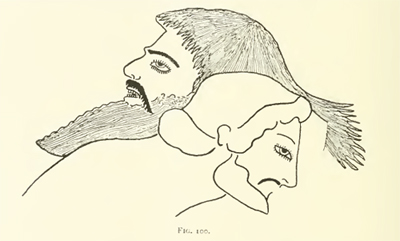
Fig. 100.
Libyan Antaeus wrestling with Greek Heracles
In Greek mythology, Antaeus was said to be a Libyan giant, son of Poseidon
and mother-earth Gaia, and the husband of Tinga, a name often linked with Tangier
in Morocco. According to Oric Bates, the above painting was not then recognised
as a representation of Libyan Antaeus, who was depicted with typical Berber characters,
such as the aquiline nose, dark long hair (projecting over the brow), strongly
marked supra-orbital ridges, and the pointed beard. The savage-like teeth were
meant to stress the nature of Antaeus, in contrast to the usual soft profile
given to Greek characters.
The story goes that during the fight between Antaeus and Heracles, Antaeus
draws his energy from the earth on which he stands, and so to defeat him Heracles
lifted Antaeus from the ground and held him high above it as to deprive him of
recharging his strength, until Antaeus lost all his energy and thus the flame
of his life was starved of its motherly source.
By invading Libya repeatedly (the Greeks, Romans, Arabs, etc.) the native Berbers lost their sacred contact with their land and therefore their grip on reality which led them to end up as second class slaves, submitting to their foreign masters in the name of who knows what. Antaeus can regain his strength only if he reclaims what is rightfully his.
"This well-known masterpiece of fifth-century vase-painting, now in the Louvre, affords an interesting representation of a Libyan, which has not, so far as I am aware, yet been recognized as such. In the scene where Heracles is portrayed as his African adversary, the combatants are strongly differentiated. The faces of both (Fig. l00) are shown as orthognathous, but, whereas Heracles is given the usual straight profile common to Greek graphic art in general, and to other Euphronian Greek faces in particular, Antaeus is represented as having a nose well-shaped but slightly aquiline, and strongly marked supra-orbital ridges. The treatment of the hair also differs in the two. That of the Greek hero is short, and ends in a roll of curls at the nape of the neck, and from the ear up and across the forehead. The beard is short and the moustache slight. In the case of the Libyan giant the hair is long and matted, and it projects over the brow in a manner which at once recalls the Egyptian representations. The beard is long and pointed ; the moustaches longer and fuller than those of Heracles. As may be seen in Poittier's excellent reproduction (from which I have drawn Fig. l00), the hair of the Libyan is shown as lighter in hue than that of the Greek (which I have left without detail). The lips of Antaeus are realistically parted in the stress of conflict, and the whole is rendered with the care characteristic of a master. In the field is the explanatory name [ANTAEUS]. There can be no question that in this picture Euphronius, without doing violence to current traditions as to what was seemly in his art, has intentionally portrayed Antaeus as rude, grim, and savage . . . This admitted, what is more natural than to suppose that in conceiving the Libyan giant in this scene he should recall to mind the Berber faces he had encountered in Athens or at the port. Four features seem to bear this out: the projection of the hair over the brow, the marked supra-orbital ridges, the slightly aquiline nose of the Antaeus, and the form of the beard . . . The face as a whole impresses me, after long familiarity with the Egyptian representations, as Berber in character" [pp.260-261].
Gurzil
Libyan god of the Laguatans on the Syrtes (Sirte), one of the nomadic tribes
of Tripolitania. He was said to be the son of the Berber Siwan God Ammon. The
Laguatans personified Gurzil in a magical bull (taurus), which they let loose
in battle, and thus he was associated with "War". This same god is
taken by Dihya (the Berber Kahina of the Auras Mountains) in her battles against
the Arabs of the 7th Century.
Goddess Libya
Libyan stamp showing the Goddess Libya.
Libya was also the name of the Goddess known to the Greeks as the Goddess Libya, and also of the whole continent before the Romans named it Africa. Her name also appeared as Libica in Michelangelo's Sistine Chapel (see next).
The Libyan Sibyl; The Ancestors of Christ (1510-12); Vault of the Sistine Chapel; by Michelangelo.
Source: Wikipedia
Commons.
The Great Berber Goddess Libya has so many names including Sibyl, Isis and Libica ('Libya'). She gracefully lifts Her "massive" book as about to rise. The book represents the scale of Berber civilisation created by Berber women in prehistoric times. This matriarchal Tamazight civilisation had inspired Libya's neighbours (like Ancient Egypt and Greece) to incorporate the obscure mysteries of Berber lore into their mythologies long before they ended up as corrupt "political cartoons" in classical mythology.
Experts say Michelangelo used "foreshortening techniques" in the Sibyl's arms to create the impression that the arms move farther away from us as She reaches forward. One of the cherubs mirrors Her position as a stark reminder that he is one part of a dual reflection of the Sibyl's nature.
The powerful, muscular body of the Great Goddess reflects both: the power the Goddess had (and still has, and will always have), and the power Berber women had in prehistoric times before the onslaught of patriarchy sent them to misery and slavery where they remained so to this day.
Berber women were the goddesses of the Goddess (regulating religion); the priestesses of the temple (venerating Mother); the oracles (foretelling the future); the queens (governing the egalitarian confederacies); and the Amazon warriors (defending the nation likewise Kahina). Men then suckled like babies in the cradle of civilisation: LIBYA.
The prophesy of Libyan Sibyl was simple: "coming of the day when that which is hidden shall be revealed."
In Greek mythology the Goddess "Libya" had three sons by the Libyan Sea-God Poseidon:
Belus, Agenor and Lelex. King Belus ruled at Chemmis or Chamesis of
Leo Africanus, Agenor migrated to Cana'an (the Middle East), and Lelex
became king of Megara. King Belus's wife, Anchinoe, daughter
of the Nile-god Nilus, bore him the twins Aegyptus and Danaus and a third son
Cepheus, and one daughter: Lamia, the Libyan Snake-goddess. The myth relates an interesting "deception
tale" in which Danaus was sent to rule Libya where he had fifty daughters,
and Aegyptus, who had fifty sons, ruled over Egypt.
Poseidon
According to the Greek historian Herodotus, the Greeks obtained their knowledge
of the Sea-God Poseidon from the Libyans (meaning the Berbers), whose cult
was in high repute among the coastwise Libyans, and was especially worshipped
about Lake Tritonis; while Plato says Poseidon was the chief God of Atlantis;
arguably located near the Atlas Mountain in North Africa. Poseidon's son Triton
was also worshipped around the Lake, and, according to Ibid, his
female counterpart "Tritonis" bore the Goddess "Athena". Poseidon's
wife, Libya, was made the daughter of Zeus's son Epaphus, the divine bull, the
Libyan Gurzil.
Awessu
Awessu was originally a sea ceremony held in the town of Zuwarah, in west
Libya, during the period between the end of July and the beginning of August
- a name which some linguists mistakenly see as the source of the name Awessu
itself.
The name could have been a name of a sea deity of some sort, since the
associated rite is clearly a religious ceremony to attract the good and banish
the bad. The Berbers of Zuwarah take
into the sea before sunrise, during the hot summer mornings, purify themselves
and their animals too, their wool garments and blankets, obtain the blessing
of the sea, and release some of the accumulated sins into the salt.
Then they
leave the sea and feast by the beach for the remaining of the day. The rite was
practiced until the 1980s, after which it began to slowly disappear after the
Libyan government and government scholars declared it a pagan festival during
which people take to the sea beneath the full moon (of Berber St. Augustine -
one of the founding theologians of Christian thought). The festival nowadays
is no more than a commercial festivity and musical propaganda, as was the fate
of so many feats the Berbers created at the dawn of time.
By all means the festival
of Awessu is still alive today, not in Libya, but in nearby Tunisia where the
inhabitants of Sousa (cf. Awessu) take to the sacred sea only once a year: in
the Awessu day, the only magical day of the whole year where the sea takes the
shape of a black mirror reflecting the dazzling stars of the Sky.
Libyan Mythology Books & Resources
Herodotus,Histories.
Il Berbero Nefusi di Fassato, by Francesco Beguinot, Roma: a collection of
Libyan Berber myths and tales in Berber, with Italian translation.
Kitab as-Siar, by ash-Shamakhi, Cairo.
Essai sur la religion des Libyens, by L. Bertholon (in Revue Tunisienne),
1909.
Triton und Euphemos, by Vater, St. Petersburg, 1849.
L’Afrique Chretienne, by H. Leclercq, 1904: vol. I (paganism).
Poesies Populaires de la Kabylie du Jurjura: Texte Kabyle et Traduction,
by Louis Adolphe Hanoteau, 1867.
Les Religions de l’Afrique Antique, by Gilbert Charles-Picard, 1954.
Spirit Possession And Personhood Among The Kel Ewey Tuareg, by Susan J. Rasmussen.
Folklore Twareg, by F. Nicolas, (Bull. Inst. Fr. d'Afrique Noire, t. 6,
p. 463, 1944).
Poesies Touaregues, by Charles Eugene de Foucauld, ed. Andre basset, 1925.
Hoggar: Chants, Fables, Legends, by Angele Maraval Berthoin, 1954.
Ritual And Belief In Morocco, by Westermarck.
Moorish Literature, the Colonial Press, introduction by Rene Basset: Berber
ballads, Poems and Popular Tales.
The Folklore of Morocco, by Francoise Legey, translated from French by Lucy
Hotz.
An Anthology of Tashelhiyt Berber Folktales, by Harry Stroomer, 2001.
Amthal wa-Hikayat Amazighiyah Muarrabah, by Muhammad Mistawi, 1985.
Chants Berberes de Kabylie, by Jean Amrouche, 1947.
The Unwritten Song, by Willard R. Trask, vol. 1:
Merrakech, by Edmond Doutte, 1905.
Magie et religion dans l’Afrique du Nord, by E. Doutte, 1909.
Antiguedades de las Islas Afortunadas, by Viana, 1883.
The History of the Canary Islands, by Glas, 1764.
The Guanches of Tenerife, by Alonso de Espinosa.
L’Ennair chez les Beni Snous, by Destaing, Algiers, 1905.
Les fetes saisonnieres chez les Beni Snous, Algiers, 1907.
Encyclopaedia of Religion and Ethics, vol. ii, 1909: a study of Berber religion
and mythology, by R. Basset.
Loqman Berbere, by R. Basset, Paris, 1890.
Les Sanctuaires du Djebel Nefousa, by R. Basset, Paris, 1897.
Recherches sur la religion des Berbers, by R. Basset,1910.
The Eastern Libyans, by Oric Bates, 1914.
A Desert God, by Oric Bates, (in CSJ, vol. iv. No. 51).
Siwan Superstitions, by Oric Bates, (in CSJ, vol. v. No. 55). [CSJ: Cairo
Scientific Journal.
The Golden Bough, by J.G. Frazer: an enjoyable 12 volumes to read.
Folk and fairy-tales, by P.C. Asbjornsen, trans. By H. L. Braekstad, New
York, 1883.
Die Religion der afrikanischen Naturvolker, by W. Schneider,1891.