The site of Umm Assultan is often referred to as "the ancient city of Sirte" (or
Surt). Locally the place is still known as "Almadinah" or "Madina" (Town
or City). The site was associated with the classical Iscinia and Macomades. Modern
Sirte was then established around 1835 AD when the Turks built the Fort
of Sirte near the area.
The welcome sign to the museum and the city of Sirte (left).
Libya map showing the main archaeological sites of Libya, starting from 100,000
years ago to 1800 AD. This map does not cover all the archaeological sites of
Libya, but it includes only the archaeological cities and villages.
The main features of this museum are exhibits from the stone-age,
namely stone tools and flints, stone and pottery pieces from the ancient site
of Sirte, Roman artifacts and coins from the 1st and 2nd centuries AD, photos
of excavated archaeological sites, Islamic exhibits from the old mosque discovered
in the site, oil lamps, some information about the history of the Arabic Kufi
style of writing, and a Libya map showing the main archaeological cities in Libya.
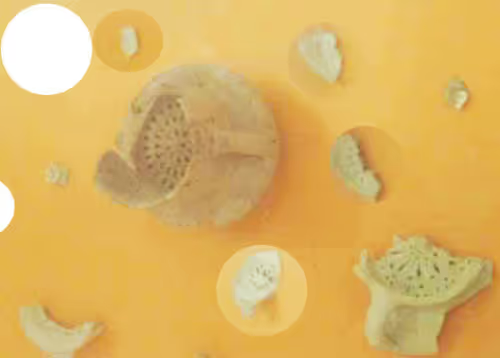
A stone with Islamic architectural motifs.
Stones with geometrical and Islamic designs inside a display
cabinet.
Stone implements and flints from the Stone Age.
Glass shreds from the 10th century AD (left). Green glass jars
from the 5th century AD (right).
Old wooden tools from the 5th (fifth) century AD, including a hair brush.
Unclassified Bones.
A large clay jar from Assultan Mosque.
Local or Libyan pottery, used for cooling drinking water.
Roman coins from the first and second centuries AD.
Photographs of the archaeological site of Umm Albarakeem, located about 9 KM
north-east of Ben Jawwad.
This board from As-Sultan Museum gives some information about
Arabic calligraphy, its types and development, particularly the Kufi style of
Arabic writing. According to this board Arabic calligraphy was derived from the
Nabataeans ( الأنباط ), also a Semitic
people whose capital city was then Petra, in Jordan. The board shows some historical
information about the origin of the Arabic Kufi (or Koufi) style of handwriting,
which dates to the 3rd century AD - around the same time when the Arabic script
made its first appearance as a derivative of Semitic script. It also classifies
the types of Kufi as follows:
Simple Kufi
Leafy Kufi (from the shape of tree leaves)
Plant-based Kufi (written on branches similar to tree branches)
Plated Kufi
Geometrical Kufi
Sirte
(Umm Assultan)
The following publication, titled "Sirte, Its History & Archaeology",
was published by the Archaeology Department of the Libyan Ministry of Education.
The booklet gives some information about the history of the ancient site of Sirte
and its archaeology.
The Mosque
This mosque, discovered in the area of Sirte, was built around
the 10th century AD.
The dimensions of the mosque are 41 meters long by 31 meters
wide (41m x 31m).
The north entrance to the city (right); the west entrance to
the city (left).
These are the remain of the ancient city of Sirte, which was
fortified and had three towers. The area of the city was said to have been 184003
square meters.